When Winston Churchill stood before the House of Commons on April 28, 1925, to deliver his budget speech, he announced that Great Britain would return to the gold standard at the pre-war parity of $4. 86 to the pound. The chamber erupted in cheers. The Times called it a masterpiece of statesmanship.
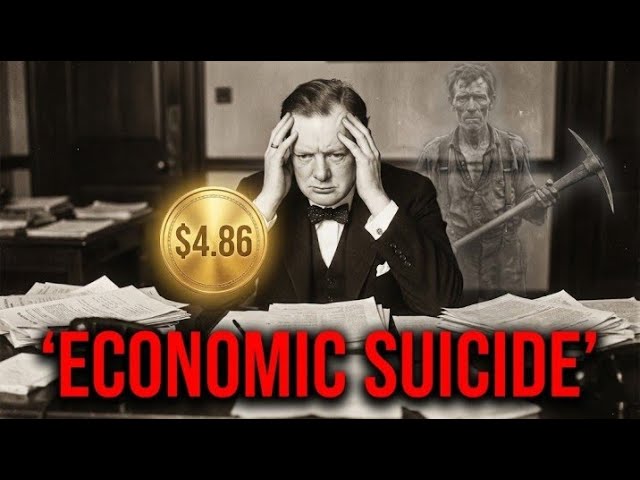
The City of London rejoiced as the pound soared in currency markets. But the decision, made after months of intense debate, would trigger a chain of events no one in Westminster fully anticipated. Within two years, it pushed the nation into the largest industrial dispute in its history. Within six years, it had provoked a mutiny in the Royal Navy, shattered the governing party, and forced Britain off gold in humiliating circumstances.
Britain entered the First World War in 1914 as the world’s leading creditor nation. By 1918, it was a debtor. To finance the war effort, the government had liquidated foreign investments, selling off railways in Argentina and mines in Africa to pay for American steel and Canadian wheat. When those reserves ran dry, it borrowed.
The national debt swelled from roughly 600 million pounds in 1914 to 7 billion pounds by 1918. Much of that debt was owed to the United States, and it had to be repaid in dollars. The war also transformed the structure of global industry. While British factories turned out shells, American, Japanese, and other competitors captured British export markets for textiles and machinery.
The core industries of coal, shipbuilding, and steel grew bloated and outdated compared to new rivals. But the British elite refused to accept that this was a permanent shift. They viewed the economic damage as a temporary aberration and believed the natural order could be restored with London at the center of the financial universe. For that order, the gold standard was the anchor.
Since before the war, major currencies were pegged to gold, and sterling, backed by the metal, served as the world’s reserve currency. Global trade was priced in pounds. Loans from Tokyo to Rio were arranged in sterling. This dominance was the bedrock of British imperial power.
When war broke out, Britain suspended the gold standard to print money for soldiers and munitions, severing the link between the paper pound and the metal. Inflation followed, with prices more than doubling during the war. The pound, worth $4. 86 before the war, sank to as low as $3.
40 by 1919. The elite viewed this decline not as economic adjustment but as national humiliation and moral failure. The consensus among politicians, Treasury officials, and the Bank of England took shape quickly. Britain’s overriding priority was to return to the gold standard, and not merely to gold, but to the exact pre-war rate of $4.
86. That required deliberate deflation on a brutal scale. The Bank of England, led by the imperious Governor Montagu Norman, raised interest rates and restricted credit. The Treasury slashed government spending.
The goal was to squeeze the economy until prices and wages fell, forcing the pound back up to its pre-war glory. By the early 1920s, the policy was inflicting deep wounds in the industrial heartlands. Businesses found that as the pound strengthened, their goods became more expensive for foreign buyers. A ton of British steel that cost a French buyer a certain number of francs grew more expensive purely because of the currency shift.
Export markets dried up, order books emptied, and unemployment climbed. One million men were out of work, then one and a half million. The choice of Chancellor fell to Churchill in 1924. A romantic with a love of history and empire, he knew little about economics.
He famously admitted the figures swam before his eyes. He was surrounded by advisers, led by Norman and senior Treasury officials, who told him that putting Britain back on gold was his destiny and the only way to restore national honor and make London the center of the world again. But Churchill had doubts. He worried about the effect on working people and manufacturers.
In private memos, he asked why the interests of finance should override the interests of industry. He wrote that he would prefer to see finance less proud and industry more content. To settle the matter, he hosted a dinner party with the leading advocates of gold and their most vocal critic, John Maynard Keynes. At that dinner, Keynes laid out his argument.
He told Churchill that the pre-war exchange rate of $4. 86 was a fantasy. Based on relative costs of production between Britain and America, the pound was really worth about ten percent less, perhaps $4. 40.
Forcing the pound back to $4. 86 would artificially overvalue it and act as a tax on every British exporter, while subsidizing every foreign importer selling goods into Britain. Keynes warned that to make British goods competitive again, companies would have to cut costs by ten percent. Since labor was the biggest cost for a coal mine or a steel mill, that meant cutting wages.
He looked at Churchill and told him the policy would be a declaration of war on the working class, leading to strikes, social chaos, and the destruction of British industry. Churchill was troubled. But the weight of the establishment was overwhelming. His advisers dismissed Keynes as an eccentric radical who did not understand the moral necessity of sound money.
They appealed to Churchill’s vanity and patriotism, insisting that without a return to gold, the United States would permanently eclipse the British Empire. Churchill chose the advice of the bankers. He chose the past over the future. The consequences came almost immediately.
British coal prices jumped in international markets. Foreign buyers in Italy, South America, and Scandinavia switched to cheaper German and Polish coal. British mine owners faced the loss of their entire profit margin. On June 30, 1925, just two months after the budget speech, they terminated the national wage agreement.
Miners were told their wages would be cut by 13 to 25 percent and their working day extended from seven to eight hours. The miners were outraged. Their union leader, A. J.
Cook, coined a slogan that became the battle cry of the British working class: not a penny off the pay, not a minute on the day. Keynes’s prediction had come true faster than he had imagined. The government, realizing a massive strike was imminent and that it was unprepared, bought time by offering a temporary nine-month subsidy to the mining industry to keep wages up. It was a band-aid on a bullet wound.
During those months, both sides prepared for a confrontation. Churchill reportedly began to regret his decision. He realized he had been misled by financial experts. He had thought gold would bring stability.
Instead, it was bringing class warfare. But he could not back down. The prestige of the empire was now staked on the value of the pound, and to devalue would be a total admission of failure. The subsidy ran out in May 1926.
The mine owners refused to back down on wage cuts. The miners refused to accept them. On May 3, 1926, the unions responded. Buses stopped running.
Trains stopped moving. Docks fell silent. Printing presses halted. The general strike had begun, the largest industrial dispute in British history, with over 1.
7 million workers walking off the job. The government had prepared. It had stockpiled coal and it had another weapon the unions had not anticipated: the middle class. Thousands of university students, stockbrokers, and retired army officers volunteered to drive buses, unload ships, and run trains.
Churchill, who had inadvertently triggered the crisis, took charge of the government’s propaganda newspaper, the British Gazette. He framed the strike not as a dispute over wages but as an insurrection, writing that it could only end in the overthrow of parliamentary government or its decisive victory. The rhetoric worked. After nine days, the leadership of the Trade Union Congress, terrified of losing control and drifting into revolutionary territory, called off the strike without securing any guarantees for the miners.
The miners, abandoned and alone, stayed out for another six grueling months. They watched their children grow thin. They sold furniture for food. By November 1926, starvation forced them back down the pits, accepting longer hours and lower wages.
The government and the City of London believed they had won. Order had been restored. The pound was safe at $4. 86.
But the boom they expected never arrived. From 1926 to 1929, while America enjoyed the Roaring Twenties, Britain sat stuck. The pound remained overvalued, British goods remained too expensive, and the Bank of England had to keep interest rates high to defend the gold peg. British industry was choked off from the cheap money it needed to modernize.
Unemployment never dropped below one million. In some northern industrial towns, seventy percent of men were out of work. In October 1929, the Wall Street crash shattered the global economy. American loans to Europe dried up.
Global trade collapsed. British export industries were decimated, and unemployment surged to two and a half million by 1930. Then came a banking crisis. In the summer of 1931, financial contagion spread across Europe.
London banks had lent heavily to Germany, and when German assets were frozen, the banks were caught in a liquidity trap. Foreign investors realized the Bank of England did not have enough gold to cover its liabilities. In July 1931, the run on the pound began. Every day, millions of pounds in gold were withdrawn from the Bank of England’s vaults and shipped to Paris and New York.
Governor Norman suffered a nervous breakdown and went to Canada to recover. The Labour government, led by Ramsay MacDonald, was trapped. To save the pound, it had to balance the budget, but tax revenue had collapsed. Bankers in New York and Paris made their demand explicit: they would lend money to defend the pound only if the government cut unemployment benefits.
The cabinet split and the government collapsed. A national coalition was formed, still led by MacDonald, with a single mandate: save the gold standard. The national government passed an emergency budget that raised taxes, slashed unemployment benefits by ten percent, and cut the wages of all public sector employees, from teachers and police officers to sailors. The reaction was immediate.
On September 15, 1931, sailors of the Atlantic Fleet at Invergordon in Scotland mutinied when they learned their pay was being cut, refusing to work and gathering on the decks to sing. It was a polite mutiny, but the news that the Royal Navy, the ultimate symbol of British power, was in revolt sent shock waves through global markets. The run on the pound turned into a stampede. In three days, the Bank of England lost nearly all its remaining gold and foreign reserves.
On September 19, 1931, the directors met in emergency session. The vaults were empty. The loans from New York had dried up. The game was up.
On Sunday, September 20, the government announced it was suspending the gold standard. The pound would float. The elite braced for apocalypse. They expected hyperinflation and riots.
But the expected catastrophe never came. The pound fell from $4. 86 to about $3. 40, ironically the exact level it had sat at in 1919 before the experiment began.
There was no hyperinflation, no collapse. The milk was delivered, and the buses still ran. Almost immediately the economy began to breathe. With a cheaper pound, British goods became competitive again on world markets.
Exports increased. With no gold peg to defend, the Bank of England slashed interest rates. Cheap money flooded into the economy, sparking a housing boom in the suburbs of London and fueling the growth of new industries in aviation, automobiles, and electronics. Britain recovered from the Great Depression faster than the United States, largely because it abandoned the gold standard two years before Roosevelt did.
The tragedy of the 1920s was complete. The unemployment, the strikes, and the hunger had been for nothing. The suffering was self-inflicted, caused by men in London who cared more about the prestige of the past than the reality of the present. But the damage could not be fully undone.
The 1930s became known as the devil’s decade, a time of bitter division and two Britains. In the south, cheap money fueled a boom for the middle classes, with new cars, houses, and cinemas. In the north and in Wales and Scotland, the old industries of coal, steel, and shipbuilding had been starved of investment for a decade. Even with a cheaper pound, these industries could not recover.
The damage was terminal. In places like Jarrow, a shipbuilding town in the northeast, unemployment hit seventy percent. In October 1936, 200 men from Jarrow marched 300 miles to London, dressed in their Sunday best, carrying a petition asking the government to build a steelworks. They were not marching to riot.
They were marching for the right to work. When they arrived, the Prime Minister, Stanley Baldwin, refused to see them, giving them one pound each for their train fare home. The Jarrow Crusade failed to get jobs but succeeded in searing the image of the abandoned into the national consciousness. The bitterness fueled the rise of political extremism.
Sir Oswald Mosley, a former Labour minister, founded the British Union of Fascists, holding rallies at Earl’s Court and telling unemployed men that democracy had failed them. Thousands marched in black shirts. Mosley never gained the power that Hitler did, largely because the British middle class remained comfortable thanks to the housing boom, but the movement owed its existence to the economic instability of the era. Britain also retreated from the free trade principles that had guided it for a century.
In 1932, at the Ottawa Conference, it established imperial preference, imposing tariffs against American and German goods while trading freely with its own colonies. It was a defensive crouch, an admission that Britain could no longer compete in the open market. Intellectually, the disaster vindicated Keynes. He had warned Churchill in 1925.
He had warned the government in 1931. Every prediction he made had come true. His book, The General Theory of Employment, Interest, and Money, published in 1936, was essentially an autopsy of British policy failures in the 1920s. It argued that when an economy is stuck in depression, the government must spend, borrow, and prioritize employment over the value of the currency.
It killed the idea of the gold standard for good. Lessons often come too late. When Britain faced Nazi Germany in 1939, it did so as a weakened power with a smaller, less efficient industrial base and a treasury that was no longer the bottomless pit of gold it had been in 1914. Britain had to borrow from the United States again.
In exchange for destroyers and oil, Britain handed over its gold reserves, sold off its remaining American investments, and leased naval bases to the US Navy. By the time World War II ended in 1945, the transfer was complete. The gold that Norman and Churchill had tried so desperately to protect in the 1920s had been shipped to Fort Knox to pay for the guns to liberate Europe. The men who made the decisions in the 1920s were not evil.
They were patriots who believed they were restoring the nation’s glory. But they committed the cardinal sin of economics. They fell in love with a symbol. They confused the map with the territory.
They believed the strength of a nation is found in the value of its coins rather than the productivity of its people. They sacrificed the real economy to save the financial economy, and in doing so, they lost both.