The four largest American tobacco companies agreed to pay over $200 billion in 1998, not out of goodwill, but because they had been exposed after decades of misleading the public about what their products did to the human body. Yet the most striking part of this story is not the settlement itself, nor even the lies. It is the fact that tobacco shaped human civilization for more than 12,000 years before anyone seriously questioned its dangers — and by then, it was too late. Archaeologists working at the so-called Wishbone site in the high desert of present-day Utah discovered seeds of wild desert tobacco inside an ancient fireplace, dating back approximately 12,300 years.
That finding makes tobacco one of the oldest plants deliberately used by humans, long before the rise of farming, cities, or written language. Indigenous peoples of the Americas did not view the plant as a casual pleasure. For them, it was sacred — a bridge between the physical and spiritual worlds. Shamans in the Peruvian and Ecuadorian Andes used tobacco in rituals at least 5,000 years ago, believing the smoke carried prayers upward, healed sickness, and connected the living with their ancestors.
Around 8,000 years ago, people shifted from simply gathering wild tobacco to actively cultivating it, selecting for favorable traits and breeding new varieties. Archaeologists observe this through changes in seed size, leaf structure, and nicotine content. This represents one of the earliest examples of deliberate agriculture in the Americas — and the chosen crop was not corn or squash, but tobacco. By the year 470, the Maya had elevated tobacco use further, developing elaborate smoking ceremonies and depicting at least two of their gods as smokers.
They also believed the plant had medicinal properties, claiming it could cure toothaches and snake bites, and even clear the lungs — a claim that would not age well. As the Maya migrated northward, they carried their tobacco practices into the Mississippi Valley, and within a few centuries smoking had spread to tribes as far north as Hudson Bay. The Algonquian peoples regarded tobacco as a gift from the Great Spirit, while the Iroquois told their own origin story in which the plant first grew from the head of a woman who died giving birth. Everything changed in 1492.
When Christopher Columbus and his crew landed in the Caribbean, the Taino people greeted them with gifts that included bundles of dried brown leaves. Columbus reportedly threw the leaves overboard, but other members of his expedition watched the Taino roll them into tubes and inhale the smoke. Two of Columbus’s men tried the habit themselves while exploring Cuba. Rodrigo de Jerez became so fond of smoking that when he returned to Spain and walked the streets blowing smoke from his mouth and nose, horrified locals suspected demonic possession, and the Spanish Inquisition imprisoned him for years.
By the time he was released seven years later, smoking had grown popular across Spain. Spanish colonial operations soon recognized tobacco’s commercial potential, but the plant received its enduring identity through a French diplomat. In 1560, Jean Nicot, the French ambassador to Portugal, sent tobacco seeds to the French court and promoted the plant as a miracle cure. His enthusiasm proved so contagious that the scientific name Nicotiana — and the chemical nicotine — were derived from his name.
Within decades, tobacco had spread across the globe at a speed perhaps unmatched by any other agricultural product in history. Portuguese sailors planted it at trading posts worldwide, French merchants carried it to West Africa, and it reached the Ottoman Empire, China, Japan, India, and Southeast Asia within roughly a single human lifetime. The plant crossed every border, culture, and religion. Not everyone welcomed it.
King James I of England published a famous 1604 polemic, A Counterblaste to Tobacco, calling the custom barbarous and describing smoking as hateful to the nose, harmful to the brain, and dangerous to the lungs. Just three years later, English settlers landed in Virginia, demonstrating that royal opinion mattered little when money was involved. The Jamestown colony, founded in 1607, was a disaster. Disease, starvation, and conflict with the Powhatan Confederacy killed more than 80% of the settlers between 1607 and 1610.
Surviving colonists tried to profit from glass blowing, silk, and wine, but nothing worked — until a newcomer named John Rolfe arrived. Rolfe, a devoted smoker, understood the European market. The native Virginia tobacco, Nicotiana rustica, tasted bitter and harsh to English smokers, who preferred the smooth Spanish varieties from the Caribbean — seeds of which Spain guarded jealously. Nevertheless, Rolfe obtained seeds of Nicotiana tabacum, likely from Trinidad or Venezuela, and planted them in Virginia soil in 1612.
The resulting crop was smooth, sweet, and enormously popular in England. By 1617, Jamestown was exporting 20,000 pounds of tobacco annually; by 1627, that figure had exploded to 500,000 pounds per year. Tobacco became so valuable that colonists planted it in streets and cemeteries, used it as currency, and paid taxes with it. Tobacco farming, however, carried a dark underside.
The crop demanded constant, backbreaking labor throughout the year and stripped the soil of nutrients within just a few growing seasons. Planters therefore needed two things without end: new land, which they took from indigenous peoples as they pushed inland, and new workers. Initially Virginia relied on indentured servants from England, but the supply was unreliable, and the workers eventually earned their freedom. Beginning in 1619, when a ship carrying roughly twenty enslaved Africans arrived at Point Comfort, Virginia, planters turned to enslaved labor.
Tobacco thus did more than build the colonial economy — it created the economic demand for the chattel slavery system that would define and scar America for centuries. By the American Revolution, Virginia was the wealthiest and most populous of the thirteen colonies, and its wealth was built on land worked by enslaved people. The pattern of ignoring warnings about tobacco was already well established. A Chinese philosopher named Fang Yizhi warned about the dangers of smoking in the early 1600s; nobody listened.
For the next two hundred years, tobacco remained a luxury product. People smoked pipes, chewed tobacco, and took snuff. Cigars were popular among the wealthy, while cigarettes existed but were hand-rolled, expensive, and relatively rare. Soldiers in the Ottoman Empire had begun rolling tobacco in strips of newspaper during the Crimean War in the 1850s, and British soldiers brought the habit home to England.
Still, a skilled worker could roll only about 3,000 cigarettes in a ten-hour day, and high prices kept cigarettes a niche product. That was about to change. In 1875, the Richmond, Virginia company Allen & Ginter offered $75,000 to anyone who could invent a cigarette-rolling machine. James Albert Bonsack, the sixteen-year-old son of a Virginia textile mill owner, took up the challenge.
After early setbacks, including a fire that destroyed his first prototype, Bonsack patented a machine that could produce 120,000 cigarettes in ten hours — roughly the equivalent of forty hand-rollers working a full shift. Allen & Ginter ordered the machine, then rejected it, worried that customers would look down on machine-made products and reluctant to pay the prize money. A young entrepreneur from Durham, North Carolina saw the opportunity everyone else missed. James Buchanan Duke understood that he could not compete in the established pipe tobacco market, but cigarettes were different: faster to smoke, easier to carry, and potentially cheap enough to sell to everyone.
In 1884, Duke reached an exclusive deal with Bonsack that gave him a 25% discount below any competitor. He installed four machines in a New York City factory surrounded by immigrant laborers whose ten-minute breaks suited the quick hit of a cheap cigarette. His labor costs collapsed — by 1895, making a thousand cigarettes cost about eight cents in labor, down from 96 cents in 1876. Duke poured his savings into aggressive advertising, and by 1889 he was the largest cigarette manufacturer in the United States.
In 1890, he merged with four other major companies to form the American Tobacco Company, which controlled 90% of the cigarette market — one of the first great monopolies of the industrial age. The Supreme Court broke the monopoly in 1911, splitting it into R. J. Reynolds, Liggett Myers, Lorillard, Philip Morris, and Brown and Williamson, the companies that would dominate the twentieth century and eventually face the largest civil litigation in American history.
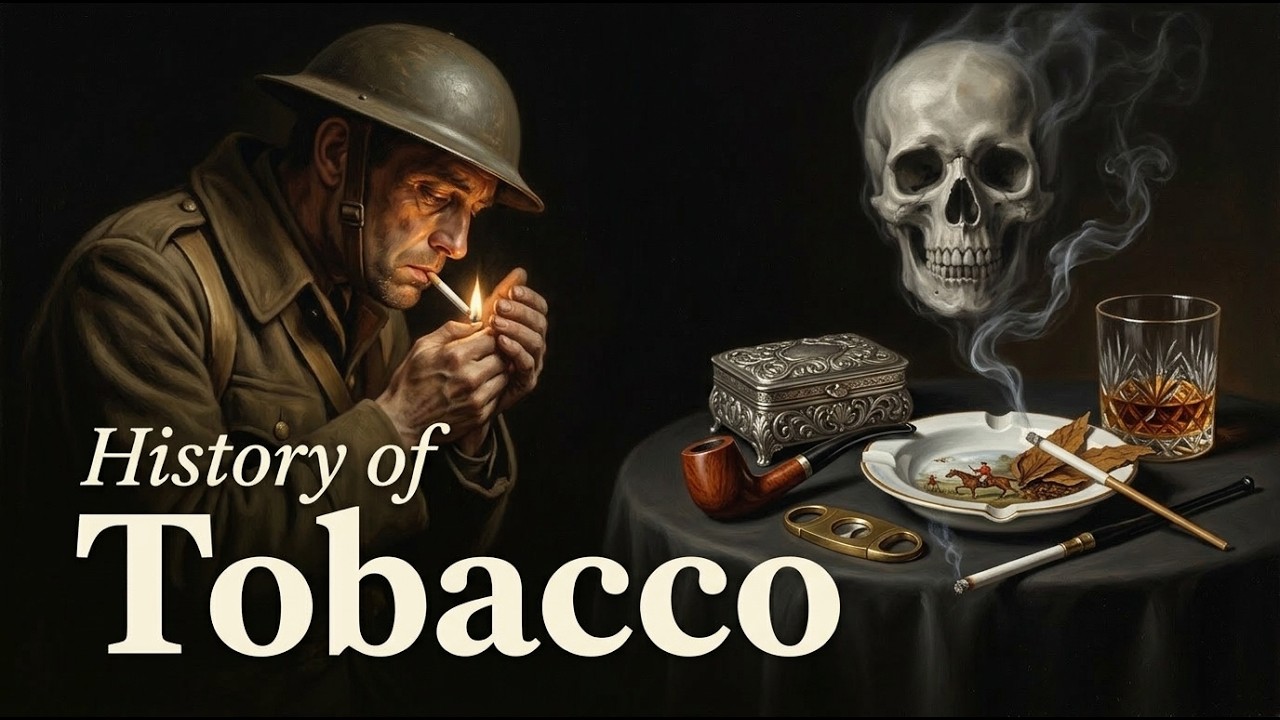
Cigarettes exploded in popularity during the World Wars. During World War I, cigarettes were included in soldiers’ rations, and General John Pershing reportedly called tobacco as important as food and ammunition. Cigarettes fit trench warfare far better than pipes or cigars, requiring no extra equipment and offering a quick smoke between shellings. The YMCA and Red Cross shipped millions of cigarettes to the front, and cigarettes became symbols of patriotic masculinity.
Millions of young men returned home addicted. World War II repeated the pattern on a larger scale, with President Roosevelt declaring tobacco an essential wartime crop and cigarette companies including free packs in military rations. By the end of the wars, smoking was embedded in American culture at every level. The post-war period became the golden age of tobacco.
Movie stars smoked glamorously on screen, and doctors appeared in advertisements endorsing specific brands, sometimes in medical journals. The industry spent millions associating smoking with sophistication, independence, rebellion, and sex appeal, while sponsoring popular television shows and cultural events. In 1900, the average American smoked about 54 cigarettes per year. By 1963, that number had risen to 4,345 per person — nearly half of all American adults smoked.
Then came the science. The first formal statistical evidence linking cigarettes to lung cancer appeared in 1929 from Fritz Lickint, a German physician in Dresden. That research contributed to an anti-smoking movement in Nazi Germany, but the association with the Nazi regime tainted it in the eyes of much of the world. In the early 1950s, two landmark studies changed everything.
Ernst Wynder and Evarts Graham published research showing a direct connection between smoking and lung cancer, and in England, Richard Doll and Austin Bradford Hill launched the British Doctors Study, tracking the health outcomes of over 40,000 physicians. The results were devastating. The tobacco industry, however, was not about to let science destroy its business without a fight. In 1953, the chief executives of major tobacco companies met at the Plaza Hotel in New York and hired the public relations firm Hill and Knowlton.
Together they crafted one of the most effective disinformation campaigns in corporate history. They would not assert that smoking was safe; instead, they would argue that the science was uncertain — manufacturing doubt. They created the Tobacco Industry Research Committee, later renamed the Council for Tobacco Research, a supposedly legitimate scientific organization that mainly funded studies to muddy the water. For decades they told the American public that the link between smoking and cancer remained an open question, even as internal research confirmed what independent scientists were saying.
Internal memos that surfaced years later exposed the depth of the deception: the companies knew nicotine was addictive and cigarettes caused cancer, and they suppressed that knowledge while spending billions to convince new customers, including teenagers, to start smoking. On January 11, 1964, U. S. Surgeon General Luther Terry held a press conference on a Saturday morning, deliberately choosing a date when the stock market would be closed when the news broke.
His report, Smoking and Health, ran 150,000 words and concluded that cigarette smoking was a direct cause of lung cancer in men and a major contributor to heart disease, chronic bronchitis, and emphysema. Smokers, the committee found, were 70% more likely to die of a heart attack than non-smokers. Some 42% of American adults smoked at the time. The report shocked the country, but it did not stop the industry.
Congress passed the Federal Cigarette Labeling and Advertising Act of 1965, eventually requiring warning labels, and a ban on television and radio cigarette ads took effect in 1970. The industry adapted, pouring more money into lobbying and expanding aggressively into international markets where regulations were weaker. For decades, tobacco companies successfully defended themselves against lawsuits from dying smokers and their families, arguing that warning labels were sufficient and that individuals chose to smoke freely. In the 1990s, that began to change.
In 1994, internal industry documents began leaking to the public. These were not rumors — they were the companies’ own memos, research papers, and strategic plans showing that they had known for decades about nicotine’s addictiveness and tobacco’s link to cancer, and that they had deliberately targeted children. State attorneys general, led by Mississippi’s Mike Moore, filed lawsuits to recover billions their states had spent treating smoking-related illnesses through Medicaid. In November 1998, Philip Morris, R.
J. Reynolds, Brown and Williamson, and Lorillard signed the Master Settlement Agreement, the largest civil litigation settlement in American history. The companies agreed to pay at least $206 billion to the states over 25 years, disband the Tobacco Institute and the Council for Tobacco Research, end billboard and transit advertising, ban cartoon characters like Joe Camel, and stop targeting minors. They also agreed to release millions of internal documents, now archived at the University of California, San Francisco — fourteen million pages considered one of the most damning records of corporate deception ever assembled.
Cigarette consumption in the United States fell by more than half between 1998 and 2019, and smoking among high schoolers dropped from about 36% in 1997 to around 6% in 2019. The tobacco story, however, is not over. Major companies diversified, buying food and pharmaceutical firms. Philip Morris renamed its parent company Altria Group in 2003 to distance itself from its most famous product.
Then came vaping — an electronic cigarette concept patented as early as 1930, but not developed into a commercially viable product until 2003, when Chinese pharmacist Hon Lik, whose father had died of lung cancer, created the first successful e-cigarette. Devices reached the American market in 2006, and by 2015 Juul dominated with sleek, USB-shaped devices and flavors like mango and crème brûlée, which critics said clearly targeted teenagers. By 2024, about 1. 63 million American middle and high school students were using e-cigarettes, and nearly 88% of them used flavored products.
The cycle — targeting young people, slick marketing, downplaying health risks — was repeating in real time, with a different delivery mechanism but the same addictive chemical: nicotine. Looking across the full arc, from ancient fireplace seeds in the Utah desert to vape pens in high school bathrooms, one fact stands out: tobacco has been one of the most consequential plants in human history. It funded colonies, built empires, enslaved millions, created fortunes, corrupted science, and killed hundreds of millions. The World Health Organization estimates that tobacco still kills more than 8 million people every year globally — more than HIV, malaria, and tuberculosis combined — and it remains the leading cause of preventable death in the United States and most of the developed world.
A sacred plant once used to connect with gods became an engine of colonial exploitation, industrial wealth, and mass addiction. The industry lied about the science for decades, paid hundreds of billions in settlements, and then reinvented itself to sell nicotine to a new generation. The names changed, but the chemistry did not — and after more than sixty years of known dangers, the cycle has started again.