In the summer and fall of 1858, two of Illinois’s most ambitious politicians met face to face seven times across the state, trading arguments over slavery, the Constitution, and the future of the nation. The Lincoln-Douglas debates were not for the presidency, but for a U. S. Senate seat.
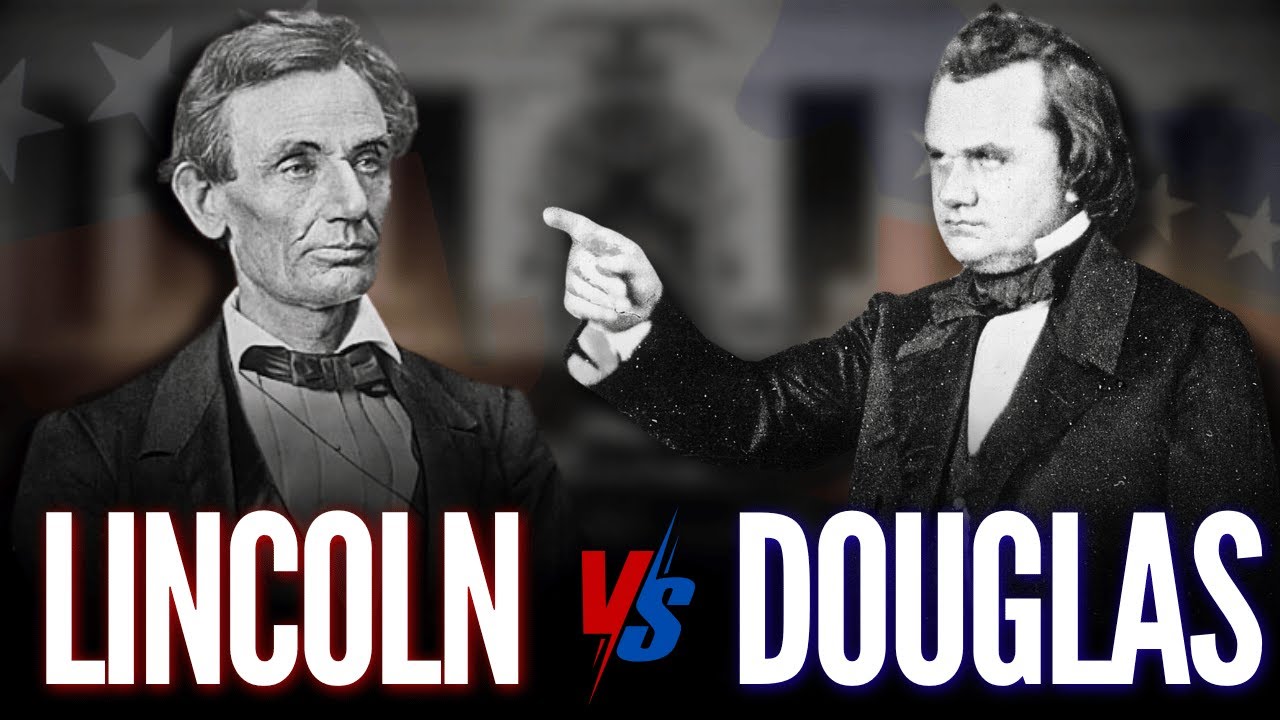
Their impact, however, reached far beyond Illinois and helped shape the 1860 election, which took place on the eve of civil war. The incumbent was Democrat Stephen A. Douglas. Known as the “Little Giant,” the five-foot-four senator was fighting for his political life.
As chairman of the Senate Committee on Territories, Douglas had pushed through the Kansas-Nebraska Act of 1854, which opened the possibility of slavery in territories where it had long been restricted. His principle, popular sovereignty, argued that white settlers in the territories should decide the issue themselves. Instead of solving the national conflict, the law inflamed it, producing the violent confrontation known as Bleeding Kansas and giving birth to the Republican Party. Abraham Lincoln, a 49-year-old former one-term congressman, emerged as the leading voice of Illinois Republicans who opposed the extension of slavery.
By 1858, he was the party’s choice to challenge Douglas for his Senate seat. Accepting the nomination, Lincoln delivered what became one of the most famous speeches in American political history: “A house divided against itself cannot stand. I believe this government cannot endure permanently half slave and half free. ”
Douglas was not a defender of slavery personally, and he believed climate and soil would naturally restrict its spread.
But he fought fiercely for allowing territories to regulate their own domestic institutions. That stance placed him at odds with both southern slaveholders, who wanted federal protection for their property, and with President James Buchanan, who supported a pro-slavery constitution for Kansas. Douglas’s repudiation of that Lecompton Constitution infuriated Buchanan, split the Democratic Party, and ensured the president would work against his reelection. The two men were opposite in nearly every way.
Douglas was short, broad, and polished, an engaging speaker with a deep voice and theatrical delivery. Lincoln was lanky, awkward, and often ill at ease on the stump, his high tenor voice and homespun wit appealing strongly to the common man. Though their attacks were sharp, they never descended into personal insults, and the two men respected one another despite their political chasm. Illinois in 1858 was sharply divided, much as the nation was.
The northern part of the state leaned antislavery, the southern part was sympathetic to the South, and central Illinois was moderate. At stake in November was not the Senate seat directly, but control of the state legislature, which would choose the next U. S. senator in January 1859.
Douglas set the tone with a major address in Chicago on July 9. Lincoln answered the next night from the same balcony. Their campaign schedules were punishing. Douglas gave dozens of speeches across the state, traveled more than 15,000 miles, and often spoke in heavy rain.
Lincoln delivered over 130 addresses. By late July, supporters pushed for the two to meet on the same platform. They settled on a series of seven debates, one in each of seven congressional districts, with specific rules for opening statements, rebuttals, and rejoinders. The first debate took place on August 21 in Ottawa.
Although the town had only about 6,000 residents, an estimated 10,000 to 12,000 people poured in for the occasion. Douglas opened by linking Lincoln to radical abolitionist positions. He played on racial fears, declaring he did not believe the Almighty ever intended the Negro to be equal to the white man. Lincoln denied the charge, insisted he favored moderation, and argued that a black man was his equal in the right to eat the bread his own hand earned.
The second debate, held in Freeport on August 27, produced a key moment. Lincoln asked Douglas whether the people of a territory could exclude slavery before forming a state constitution. Douglas answered yes, a position that angered southern Democrats and would damage his presidential hopes in 1860. Newspapers on both sides claimed victory for their candidate, and the “spin doctors,” as the narrator of this account notes, were already at work.
The third debate took place in Jonesboro on September 15, in deep southern Illinois, a region called Little Egypt. Only about 1,500 people attended, and the crowd was strongly pro-South. Douglas largely repeated his earlier themes, while Lincoln pressed him on whether he would vote for federal protection of slave property. Douglas insisted local laws would settle the matter, a position that made slaveholders deeply wary.
The fourth debate was the most colorful. It took place in Charleston on September 18, where crowds arrived from towns with names like Greasy Creek and Bloody Hutton. The fairgrounds drew about 12,000 people. Lincoln, trying to blunt Douglas’s accusations, stated plainly that he was not, and never had been, in favor of social or political equality between the races.
Douglas mockingly said Lincoln’s principles were “jet black” in northern Illinois, a decent mulatto in the center, and almost white in the south. Lincoln’s anger briefly boiled over when Douglas repeated a false newspaper claim that Lincoln had refused to vote for aid to U. S. soldiers during the Mexican War.
Lincoln grabbed a former colleague to refute the charge, and a friend had to break his grip. The fifth debate, in Galesburg on October 7, was held on the campus of Knox College before perhaps the largest crowd of the series, between 15,000 and 20,000 people, despite a cutting autumn wind. Lincoln accused Douglas of indifference to the morality of slavery, while Douglas again charged Lincoln with shifting his views to suit his audience. The sixth debate, in Quincy on October 13, attracted about 12,000 people in good weather.
Just before the proceedings, the seats in front of the platform collapsed, sending spectators sprawling, though injuries were minor. The two candidates repeated familiar positions, and after the debate, both campaign bands played at once, creating a cacophony of noise. The seventh and final debate was held in Alton on October 15, just 25 miles north of St. Louis.
The crowd was smaller than in earlier encounters, and Douglas was hoarse and showing signs of exhaustion. No new ground was broken. After the seven debates were complete, each party claimed its man had won. In truth, their differences were not as large as the rhetoric suggested.
Both men supported the Fugitive Slave Law, both favored expansion, both pledged not to interfere with slavery where it already existed, and both were committed to the Union. Their main disagreement was over how to keep slavery out of the territories: Douglas believed local legislation could do it, Lincoln believed only congressional action could. The state elections were held on November 2. When the legislature voted on January 5, 1859, Douglas won reelection by a vote of 54 to 46.
Douglas declared, “Let the voice of the people rule. ” Lincoln took the loss quietly. Years later, he recalled walking home on a dark, wet, and muddy night, slipping and catching himself at the last second. He compared it to his political career: “It’s a slip, but not a fall.
”
Though Lincoln lost the Senate race, he won something more valuable: national recognition. The printed copies of the debates became bestsellers and were studied across the country. In the 1860 presidential election, Douglas ran as the northern Democratic candidate, but he was abandoned by the South, which rejected his embrace of popular sovereignty. He carried only one state, the slaveholding state of Missouri.
Lincoln, the man who had lost to him two years earlier, won the presidency. Both men lived to see the Union break apart, but neither saw the end of the war. An exhausted and broken Stephen A. Douglas died in Chicago on June 3, 1861, at age 48.
Abraham Lincoln was assassinated on April 15, 1865. The debates that defined their rivalry helped launch one man to the White House and ultimately ended the other’s political career. In a final irony, Lincoln lost his own home county in Illinois to Douglas in the 1860 presidential election.