On the morning of January 20, 1942, fifteen senior Nazi officials gathered at a villa beside a frozen lake in the Berlin suburb of Wannsee. They were not there to discuss military strategy. The purpose of the meeting was to coordinate the systematic extermination of the Jewish population of Europe.
The meeting was called by Reinhard Heydrich, chief of the Reich Security Main Office. Heydrich had been tasked with organizing what the Nazis called the "Final Solution to the Jewish Question." By that time, mass shootings of Jewish civilians were already taking place across Eastern Europe.
Mobile killing units known as Einsatzgruppen followed the German army and carried out massacres in cities such as Kamianets-Podilskyi, where 23,600 Jews were murdered in August 1941. In late September 1941, more than 33,000 Jews were killed in the Babi Yar ravine near Kyiv. Similar horrors unfolded in Odessa, Riga, Minsk, and countless other towns.
Despite the scale of the killing, Nazi leaders considered the shootings inefficient. The method was slow, used too much ammunition, and placed a psychological burden on the soldiers who carried it out. The regime wanted a cleaner, quieter, and more industrial system of death.
By the end of 1941, extermination camps were being planned or built in occupied Poland. At Chełmno, victims were already being killed in sealed trucks with exhaust fumes redirected into the cargo area. Camps such as Belzec, Sobibor, and Treblinka were under construction or in the planning stages.
Heydrich sent invitations to the Wannsee Conference in late 1941. He also secured a letter from Hermann Göring that granted him full authority to coordinate the Final Solution. The men who attended were not fanatical street fighters. They were lawyers, state secretaries, SS officers, and bureaucrats whose job was to make the machinery of genocide run smoothly.
Heydrich opened the meeting with a report. He explained that forced emigration had been replaced by a new policy of "evacuation to the east." That phrase was a coded reference to extermination. Deportations from cities such as Vienna, Prague, and Berlin were already underway, and Jews were being sent to ghettos in occupied Poland, where many were dying from starvation and disease.
The men around the table understood the reality of the situation. Yet the word "kill" was never spoken. The language of the meeting was deliberately vague. Heydrich spoke of Jews being sent to labor camps, where a large proportion would die of natural causes. He added that those who survived would be the most resilient and would have to be "treated accordingly," as they could become the nucleus of a new Jewish community.
Adolf Eichmann, who sat quietly nearby, had prepared detailed charts listing the Jewish populations of every European country. Heydrich’s plan covered some 11 million Jews, including those living in neutral and enemy nations such as Britain, Spain, and Sweden.
The discussion soon turned to legal definitions. Wilhelm Stuckart, co-author of the Nuremberg race laws, spoke about how to classify people with Jewish ancestry. He suggested that mixed marriages could be dissolved by decree and that children of mixed unions should be sterilized. Heydrich held a different view, and the participants agreed to postpone these detailed questions to future meetings.

Josef Bühler, a state secretary from the General Government in occupied Poland, urged that the Final Solution begin immediately in his territory. He pointed out that there were no transport problems there, so the process could be carried out more quickly.
When the discussion ended, the tone remained calm. Servants brought food and wine. The men chatted and smoked, satisfied that the matter had been settled. Eichmann’s minutes recorded the decisions in clinical bureaucratic language. There was no mention of mass death, only of evacuation, resettlement, and natural reduction.
Of the thirty copies of the minutes that were distributed, only one survived. It was found in 1947 among files seized from the German Foreign Office. That single document remains one of the most chilling records in modern history, proof that the murder of millions was planned not in a moment of rage but calmly, at a conference table.
Less than two months after the meeting, killing operations began at Belzec in March 1942. Sobibor began operating in May 1942. Treblinka opened in July 1942. All three camps were located in occupied Poland and operated with industrial precision. Victims were told they were being resettled for labor. Within minutes of arrival, they were stripped, herded into chambers disguised as showers, and gassed.
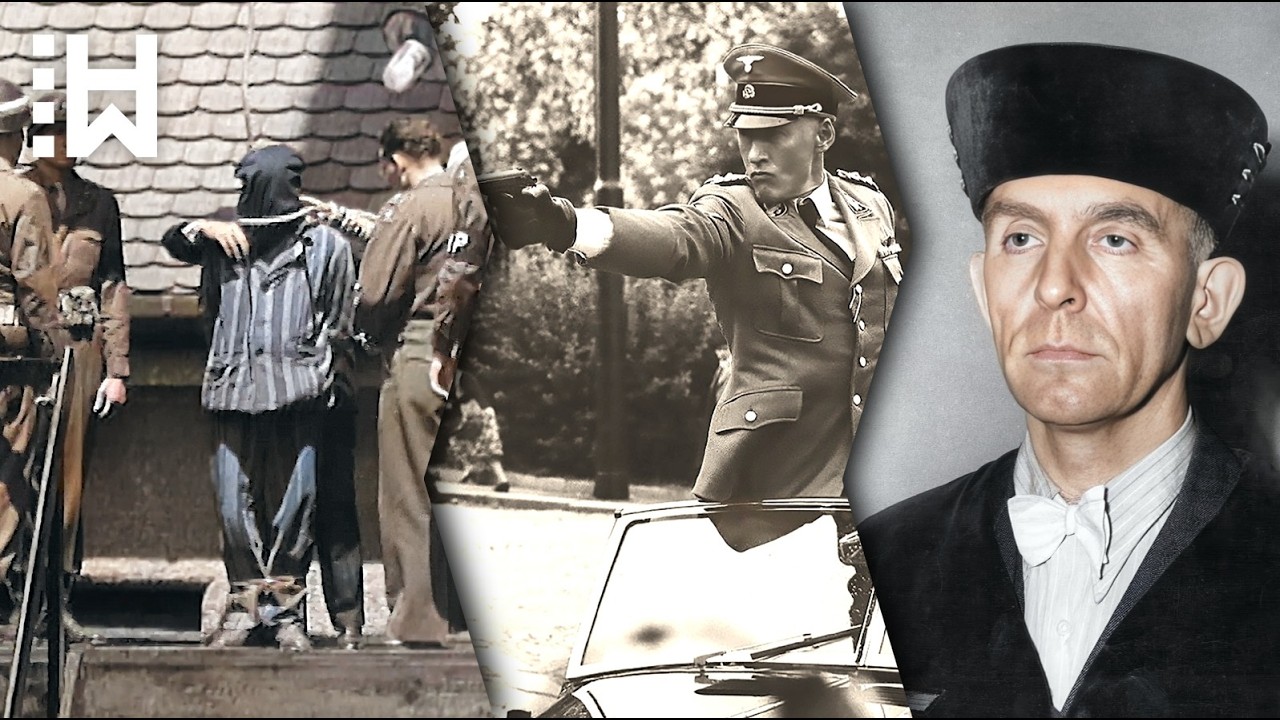
As the war turned against Germany, the men who attended the Wannsee Conference met very different ends. Reinhard Heydrich did not live to see the system he designed reach its peak. On May 27, 1942, Czechoslovak resistance fighters attacked his car in Prague. He died a few days later. In reprisal, German forces murdered hundreds of civilians in Bohemia and Moravia.

Roland Freisler, the notorious Nazi judge, was killed in February 1945 during an air raid on Berlin. A falling column struck him inside the People’s Court building, killing him instantly.
Rudolf Lange, who had overseen mass shootings in Latvia before the conference, took his own life in 1945 as the Red Army advanced. Alfred Meyer, a state secretary for the occupied Eastern territories, also committed suicide in the final days of the war.
Heinrich Müller, chief of the Gestapo, vanished in the ruins of Berlin. His body was never identified. It is believed he was killed or took his own life during the fall of the city.
Eberhard Schöngarth was captured by British forces after the war. He was tried and hanged in May 1946. His conviction was for the execution of a captured Allied airman, not for his role in the mass murder of thousands.
Josef Bühler, who had urged that extermination begin in Poland, was captured after the war, tried in Kraków, and executed in 1948. Despite his earlier enthusiasm for the killing, he begged for mercy after the verdict. His requests were denied.
Adolf Eichmann continued Heydrich’s work with tireless precision, organizing deportations across occupied Europe. After the war, he fled to Argentina under a false name. In 1960, Israeli agents captured him. Two years later, he was hanged in Jerusalem.
Today, the villa at Wannsee stands as a memorial. It was there, on that winter morning in 1942, that genocide was organized not with shouts or bloodshed, but with calm voices, deliberate words, and the turning of pages.