Lillie Langtry died at dawn on February 12, 1929, in a cliff-top villa in Monaco. Only a paid nurse and two poodles were with her. Her daughter refused to visit. Her husband was in another city.
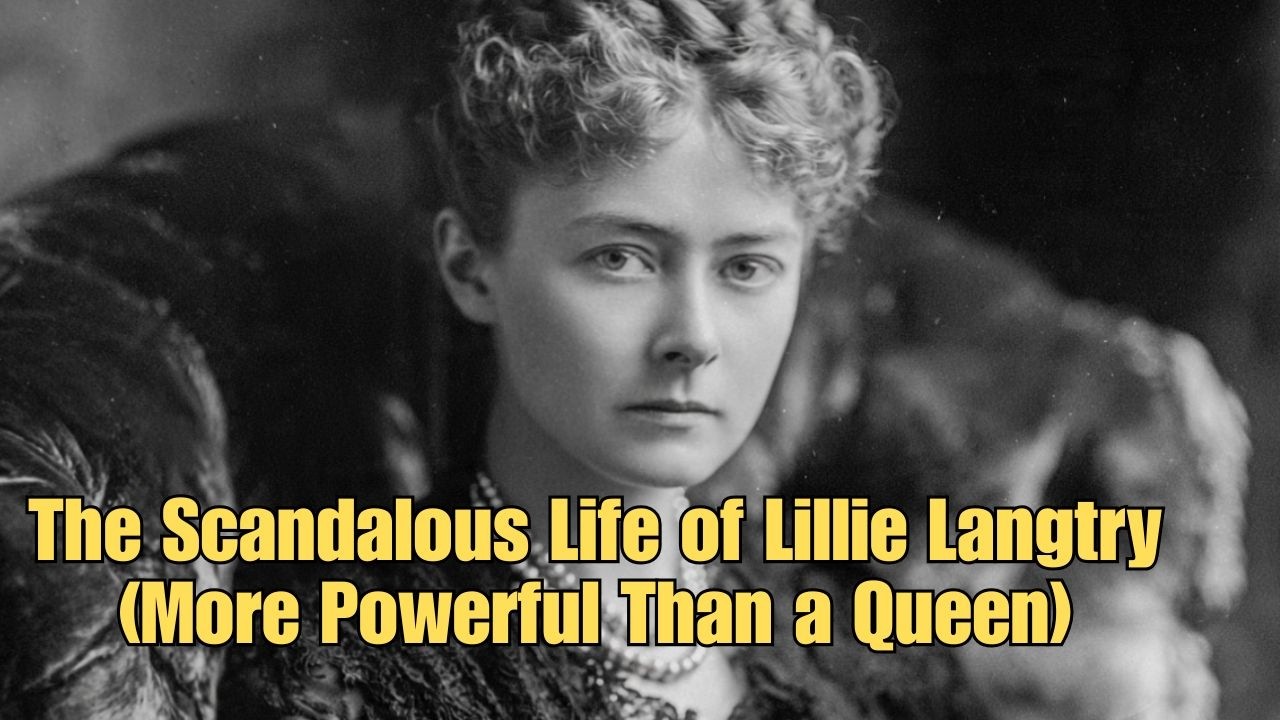
Yet when the news reached London, newspapers devoted to her the same space usually reserved for royalty. She had once brought traffic on Piccadilly to a standstill simply by walking down the street. She had been the lover of a future king of England. She was the first celebrity to endorse a commercial product, and she amassed a fortune worth an estimated $70 to $80 million in today’s money.
Her name was Lillie Langtry, and nearly every penny of it was earned by her own hand. Born Emily Charlotte Le Breton on October 13, 1853, in the rectory of Saint Saviour’s parish on the island of Jersey, she was the only girl among six brothers. Her father, the Reverend William Corbet Le Breton, was the Dean of Jersey. Her mother, the former Emily Davis, was a woman of modest roots and firm beliefs.
She grew up among boys who climbed trees, jumped fences, and swam in cold water. Their tutor taught Latin, Greek, and mathematics, and he taught Lillie too. No one thought to stop him. She grew tall with pale, clear skin and blue eyes that people struggled to describe, comparing them to violets, the sea, and things not blue at all but simply beautiful.
By age 14, the men on the island had begun to notice her. By 16, she had learned something most women of her era were never allowed to discover: that the way people looked at her was a form of power. Jersey, an island just 11 miles long and 5 miles wide, offered her nothing else. Marriage was the only door, and the men who came through the rectory were either too old, too poor, or too dull.
In 1874, a way out sailed into the harbor. Edward Langtry was an Irish widower with a private income and an 80-foot yacht called the Red Gauntlet. He was not handsome, clever, or ambitious, but the yacht could take a woman anywhere in the world. Lillie saw the yacht before she saw the man.
When Edward proposed, she accepted with the enthusiasm of a prisoner offered a key. They married on March 9, 1874. She was 20 years old. They moved to London in 1876.
Their first year was invisible. They rented rooms in Eaton Place and attended a few dinners, but London society did not open its gates to unknown couples from Jersey. Then came the evening that changed everything. In the spring of 1877, Lillie attended a reception at the home of Lady Sebright.
Every other woman wore silk, satin, and diamonds. Lillie arrived in a plain black dress with no jewelry and no embroidery. The effect was instantaneous. Conversation stopped.
Heads turned. Society artist Frank Miles crossed the room to ask if he could sketch her. Within days, his drawings of Lillie were reproduced on postcards and sold in every stationer’s shop in London. John Everett Millais, the most celebrated painter of the age, asked her to sit for him.
His portrait, titled “A Jersey Lily,” was exhibited at the Royal Academy and drew such thick crowds that a policeman had to be stationed beside it. She had become what Victorians called a professional beauty, a term made possible by advances in photographic reproduction and mass printing. Lillie’s face appeared on more postcards than any other woman in England. Shops displayed her image in their windows.
Crowds gathered outside theaters and restaurants where she was expected to appear. Edward Langtry watched his wife’s rise with the bewildered passivity of a man who had brought home a tiger cub and was surprised when it grew teeth. He was not equipped for fame, and he began to drink. Lillie barely noticed.
She was too busy becoming the most famous woman in England. Among the many powerful men now desperate for her attention, one stood above all others: Albert Edward, the Prince of Wales, the future King Edward VII. When he wanted Lillie Langtry beside him, he simply moved her husband to the other end of the table. The dinner took place on May 24, 1877, at the home of Sir Allen Young.
The prince was 45 years old, bearded, stout, and possessed of an appetite for beautiful women that was the worst-kept secret in the British Empire. Within weeks, they were inseparable. The affair was conducted with the precision of a Swiss clock. Society was informed through gestures rather than announcements.
The prince appeared with Lillie at dinners, the theater, and country house weekends. Princess Alexandra, who had long since made peace with her husband’s infidelities, did more than tolerate Lillie. She received her, invited her to events, and treated her with warmth that was either genuine grace or the most disciplined performance in royal marriage history. In 1878, Lillie was presented at court wearing the Prince of Wales’s own emblem, three ostrich feathers arranged in her hair.
The audacity was breathtaking. In the visual language the court understood perfectly, it announced that she belonged to the Prince and that he did not mind the world knowing it. Queen Victoria, who publicly deplored her son’s morals and privately could do nothing about them, received Lillie without comment. Edward Langtry became a ghost in his own marriage.
At dinners, he was seated far from his wife. He was expected to be present enough to maintain the fiction that Lillie was a respectable married woman, and absent enough to allow the Prince his pleasures. The affair lasted roughly three years. During that time, Lillie occupied a position no woman outside the aristocracy had ever held.
She was not a wife. She was not a courtesan in the traditional sense. She was elevated to the inner circle of British power through the force of her beauty and the desire of a prince. She watched and learned how power worked, who controlled the money, who controlled the invitations, and who controlled the information.
By 1880, the signs were unmistakable. The invitations grew less frequent. The dinners grew shorter. The prince’s attention had begun to drift.
At 26, Lillie was about to discover what happens when the most powerful man in England stops returning your letters, and the answer would force her to become something far more dangerous than a mistress: a businesswoman. When the Prince of Wales withdrew his favor, the consequences arrived with the speed of a foreclosure. The gifts stopped. The invitations dried up.
Creditors who had extended generous terms to a woman under royal protection suddenly remembered that generosity has limits. Lillie had been living on credit, and now she was just another debtor with excellent cheekbones. She sold her possessions. The furniture went first, then the horses, then the jewelry that was hers to sell.
She kept the pieces given by the prince. Then, in the middle of this unraveling, she discovered she was pregnant. The father was almost certainly not Edward Langtry. The most likely candidate was Arthur Jones, a friend of the prince with whom Lillie had begun a discreet relationship.
A child born in London, in full view of society that had watched her share a bed with the future king, would be a scandal of unmanageable proportions. Lillie disappeared to Paris, where she gave birth to a daughter on March 8, 1881. The baby was named Jeanne Marie. Within weeks, she was given away.
Jeanne Marie was sent to Lillie’s mother in Jersey, where she was raised as the daughter of one of Lillie’s brothers, a brother who had conveniently died young. Lillie would visit as an aunt. The child would never know. In the spring of 1881, Lillie had a more immediate problem: she needed money.
The solution she chose scandalized London more thoroughly than any affair. On December 15, 1881, she walked onto the stage of the Haymarket Theatre as Kate Hardcastle in “She Stoops to Conquer. ” She was the first society woman in living memory to become a professional actress. The reaction was volcanic.
Society women did not work, and they certainly did not display themselves on a public stage for money. The reviews were mixed. Her acting was competent but not inspired. Her stage presence, however, was extraordinary.
Oscar Wilde, who had been among her earliest admirers, encouraged her theatrical ambitions. He saw what the critics could not, that Lillie’s talent was not acting. Her talent was being Lillie Langtry in public, and a theater was simply the most efficient venue for converting that talent into cash. Then Lillie made the decision that would transform her from a disgraced society beauty into one of the wealthiest women of her generation.
She booked a passage to New York. She arrived in America in October 1882 and discovered that the country had been waiting for her. The newspapers had been running stories about the Jersey Lily for months. Her opening at Wallack’s Theater on October 30 was a phenomenon.
She played the lead in “Unequal Match” to an audience that included the Vanderbilts, the Astors, and every significant social figure in Manhattan. The house sold out. The receipts totaled $6,800. Sarah Bernhardt, the greatest actress of the century, had earned $5,800 on her own New York opening.
Lillie had beaten her by $1,000. The point was never the acting. The point was the spectacle. Lillie had grasped something about the American appetite for celebrity that most European performers never understood.
Americans did not want perfection. They wanted proximity to fame. She launched her first coast-to-coast tour, playing San Francisco, Chicago, St. Louis, and dozens of smaller cities.
She traveled with a full company, a personal staff, and an expanding wardrobe. She invested $10,000 in Fifth Avenue real estate during her first American visit. She bought property with an instinct for value. Then came the endorsement that changed advertising forever.
In 1882, Thomas J. Barrett, the managing director of Pears’ Soap, approached Lillie with an offer. He wanted her to lend her face and name to his product. She would be photographed holding a bar of Pears’ Soap, and the image would appear in newspapers and magazines across Britain and America.
No woman of social standing had ever endorsed a commercial product. Lillie said yes. The advertisement ran, was reproduced millions of times, and became the foundational moment of modern celebrity endorsement. Her financial empire drew from seven distinct streams: theatrical performances on tour, theatrical performances in London, real estate investments in New York, endorsement fees, gifts from wealthy admirers, prize money from horse racing, and rental income.
An estimated £10 million passed through her hands over the course of her career. By 1898, her personal fortune was approximately £2 million. She commissioned the Das Lillie, a private Pullman railroad car for her American tours. It was 60 feet long, upholstered in velvet, and decorated with polished brass lilies.
It contained a drawing room, a bedroom, a kitchen, and quarters for her staff. She traveled across America in this rolling palace, arriving at each city like a head of state. One of the wealthy men who moved through her orbit was Robert Peel, known as Squire Abington. He was possessive, violent, and rich.
He beat her in hotel rooms and threw objects. On at least one occasion, he struck her in the face with enough force to blacken her eye, a catastrophe for a woman whose face was her fortune. She spent 10 days recovering from one attack, hidden from public view. And she kept going back.
Her explanation remains one of the coldest calculations in Victorian social history. “I detest him,” she said, “but every time he does it, he gives me a check for £5,000. ” In the 1880s, £5,000 was roughly £600,000 today. A black eye healed in two weeks.
The money lasted considerably longer. Frederick Gebhard, a young heir to a fortune estimated at $5 million, also showered Lillie with money and devotion. He wanted to own her. He wanted exclusivity.
In the summer of 1888, Gebhard’s private train, carrying his racing stable, derailed near Shohola, Pennsylvania. Fourteen horses were killed, including Aeolus, his champion runner valued at tens of thousands of dollars. Gebhard was physically unharmed but devastated. “You have already cost me a fortune,” he told Lillie.
The relationship survived the crash but not the resentment. In 1892, Lillie found a new arena where her hunger for competition and her gift for calculation would combine into something extraordinary: horse racing. The Jockey Club’s regulations did not explicitly prohibit female ownership. They simply assumed it was unthinkable.
Lillie registered her horses under the name “Mr. Jersey,” with racing colors of turquoise and fawn hoops. The alias was transparent. Everyone in the racing world knew that Mr.
Jersey was Lillie Langtry. Nobody objected. By adopting a male pseudonym, she had given the Jockey Club what it needed most: deniability. She bought her first serious racehorse, Durado, in the early 1890s.
But it was Merman, purchased for 600 guineas, who made her fortune on the turf. Merman won the Cesarewitch of 1897 at odds of 100 to 7. Lillie had backed her horse heavily. Contemporary accounts place her winnings at approximately £120,000, a figure that exceeds £15 million in today’s money.
She went on winning the Lewes Autumn Handicap, the Goodwood Cup, the Jockey Club Cup, and then, in 1900, the prize that crowned her racing career: the Ascot Gold Cup, won by her horse at odds of 20 to 1. Lillie was 46 years old. She stood in the owner’s enclosure accepting congratulations from the same aristocrats who had cut her from their guest lists when the prince grew tired of her. On July 27, 1899, the same day Merman won the Goodwood Cup, Lillie married Hugo Gerald de Bathe.
He was 19 years her junior, with the distinction of being heir to a baronetcy. The marriage was a transaction. Hugo got a famous wife. Lillie got the eventual promise of a title.
Hugo’s father, Sir Henry de Bath, received the news with fury, reportedly declaring he wished he could die immediately so that his will, which would cut Hugo off from the family fortune, could go into effect at once. Sir Henry lived until 1907. Lillie became Lady de Bath. She and Hugo settled into an arrangement of mutual convenience, occupying separate residences for most of their marriage.
Meanwhile, a reckoning was approaching. Jeanne Marie, Lillie’s daughter, had been raised in Jersey as Lillie’s niece, believing her parents were dead. The fiction was maintained with the cooperation of a family that understood the social necessity of the lie and the financial consequences of the truth. The moment of discovery came at a social gathering, when someone who assumed Jeanne Marie already knew mentioned the truth that everyone else in the room had always known.
Jeanne Marie did not make a scene. She politely left the party. Then she began the process of withdrawal that would last for the rest of her mother’s life. Jeanne Marie married Ian Malcolm, a Scottish politician who would later become a member of Parliament.
They had four children and lived in Scotland. The door between mother and daughter closed with the soft, irreversible click of a woman who had decided that some wounds do not heal. Lillie never acknowledged her daughter in any public statement. She never corrected the official version of events, which continued to maintain the fiction that Jeanne Marie was her niece.
In the 1890s and early 1900s, Lillie’s theatrical career reached its artistic peak. She played Rosalind in “As You Like It” at the St. James’s Theatre and sold out every performance for four months. She played Cleopatra and received 14 curtain calls on opening night.
In 1891, she returned to Jersey. Crowds lined the streets. The governor received her. The churches rang their bells.
The rector’s daughter who had fled on a yacht had come back as the most famous woman in the British Empire. But the world that had made Lillie Langtry possible was disappearing. By 1900, motion pictures were arriving. By 1910, picture palaces were opening across Britain.
The gramophone was already here. A beautiful woman in a theater cost a ticket. A beautiful woman on a screen cost a penny. In 1913, Lillie made a single motion picture, a short silent film that has been largely lost.
It was a gesture toward the future, but her heart was not in it. The men who had shaped her life were reaching their ends. Edward Langtry was found demented at Crewe railway station in October 1897. He was committed to Chester County Asylum, where he died on October 15, 1897.
The cause of death was recorded as general paralysis of the insane, a term that almost certainly indicated the final stage of syphilis. He was 51 years old. The Prince of Wales ascended the throne as King Edward VII in 1901. He reigned for nine years and died in 1910 at the age of 68.
Lillie continued to perform, touring America again in the 1900s, playing smaller theaters and shorter seasons, then appearing in vaudeville. The venues grew less grand. The audiences grew smaller. The Manchester Guardian published a verdict that captured the shift: “A world with the movies and the wireless has more to do than mob a handsome woman.
”
By 1920, Lillie was 66 and had retired from the stage. She lived in Monaco. The Villa Lellis sat on the cliffs above Monte Carlo, its windows facing the Mediterranean. Hugo de Bathe lived in Nice, 15 miles away.
They saw each other occasionally. She rose late, read widely, walked in the gardens, and attended the Casino de Monte Carlo in the evenings. She dyed her hair the shade of auburn it had been in her youth. She danced at social events, sometimes with professional partners, the young men the French called gigolos.
Her poodles occupied a room adjacent to her bedroom. She spoiled them extravagantly. In her final years, they were her most reliable companions. Alfred Lunt, the American actor, met her when she was 63 and later recalled that she had the bluest eyes he had ever seen.
She was not sentimental about her past. She published a memoir in 1925, “The Days I Knew,” notable more for what it omitted than what it included. She never confirmed her affair with the prince. She never acknowledged her daughter.
She never discussed the men who had beaten her or the money they had paid in compensation. She made her will. £10,000 went to Matilda Peat, her paid companion. Nothing went to Jeanne Marie.
Whether this was punishment, pride, or a final acknowledgement that the relationship had been severed beyond repair, Lillie never explained. The winter of 1928 brought illness. She weakened through January. By February, it was clear she was dying.
She died at dawn on February 12, 1929, at age 75. She had requested burial in Jersey. February was cruel. Blizzards swept across the channel.
The seas were violent. Her coffin was placed aboard the steamer Sambrieux, which fought through heavy weather to reach the island. Saint Saviour’s Church, where her father had preached and where she had been christened, was prepared for the funeral. The flowers arrived in quantities that threatened to overwhelm the small building.
They came from London, Paris, and New York. Hugo de Bathe was present, performing his final duty as a husband. Jeanne Marie was not there. She had not come.
Among the mourners was an aged man who attracted little attention. He was the former captain of the yacht Red Gauntlet, the yacht that had brought Edward Langtry to Jersey more than 50 years before. He carried a bouquet of red Jersey lilies, the flower that shared her name, and he placed the flowers on her grave. He was the only person there who remembered the girl, the rector’s daughter who had climbed trees and jumped fences and stared at the sea with a hunger no island could satisfy.
She was buried in her parents’ tomb in the churchyard of St. Saviour’s, on the island that measured 11 miles by 5. What survives of Lillie Langtry is scattered across an unlikely geography. The grave in St.
Saviour’s churchyard draws visitors. The Jersey Museum holds photographs, playbills, and artifacts from a career that spanned four decades and two continents. In Langtry, Texas, Judge Roy Bean’s saloon still stands as a tourist attraction. Bean, a self-appointed justice of the Pecos River country, was so infatuated with Lillie that he named his bar the Jersey Lily, misspelling the name on the sign.
He wrote her letters she never answered. He named his town for her. He died in 1903 without ever having seen her in person. Today, the saloon draws 100,000 visitors a year.
In California, a vine Lillie planted in 1888 still grows. At Goodwood Racecourse, the Lillie Langtry Stakes is run each year. Lillie Langtry took the most ephemeral thing a woman of her era could possess, her physical beauty, and converted it into the most durable thing: money. She took the most dangerous position a woman could occupy, a royal mistress, and converted it into the most liberating one: independence.
She reversed the current of a system designed to consume women. She was the one who used. She was the one who discarded. Edward Langtry died insane in a county asylum.
Frederick Gebhard spent millions and received nothing but heartache and dead horses. Squire Abington paid £5,000 per bruise and gained only contempt. Hugo de Bathe outlived her and inherited a title that came with the memory of a wife who had never needed him. Lillie died titled, comfortable, and alone.
Her daughter never forgave her. Her audiences eventually forgot her. The world she had conquered moved on to moving pictures and radio waves and forms of celebrity that did not require the physical presence of a beautiful woman in a room. But every celebrity endorsement, every personal brand, every beautiful woman who looks in the mirror and sees not just a face but a business plan owes a debt to Lillie Langtry.
A contemporary once said it would be hell to be married to her because she was too damn bright. He was right about the brightness. The hell was not being married to Lillie Langtry.
The hell was being Lillie Langtry, and knowing that the very qualities that made you extraordinary were the same qualities that guaranteed you would end up, at last, alone.