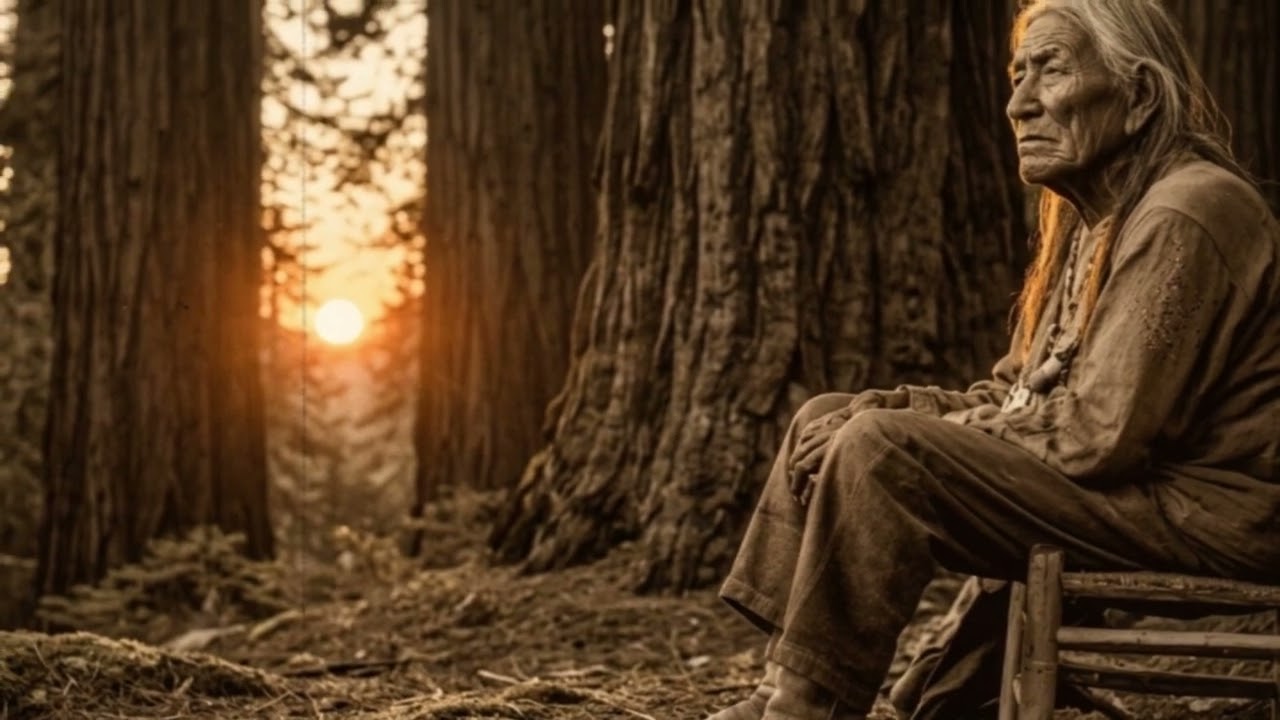
An old Navajo elder named Hashk Naba sat outside a trading post south of Shiprock, New Mexico, in 1947 and told a visiting writer a story that had been passed down through generations of his family. He spoke about the land where Arizona, New Mexico, Utah, and Colorado meet at a single point, a place his people had walked carefully for a thousand years before any state line was drawn. He said the desert there was not empty. There were places a wise person went around, not through.
There were canyons where a person did not speak above a whisper. And there was something, he said, that had walked that country for a very long time. He would not give it a name, explaining that some names, when spoken aloud in the wrong place, are heard. Hashk Naba connected the story to a period his people call the Long Walk.
In 1865, the Navajo were forced from their land and marched to Bosque Redondo. For four years, no one sang the proper songs or walked the proper paths. When they returned by treaty in 1868, he said, they came home to a desert that had grown hungry while they were away. His grandfather, a boy on the walk back, remembered that hundreds of people stopped and sang for a long time when they crossed back inside the sacred mountains.
But according to the elder, it was not right again. Some things had taken root in those four years. Some things had learned the country was empty, had liked it empty, and were not pleased to find it occupied again. Hashk Naba said that in the 1870s and 1880s, several people disappeared in that country and never made it into any newspaper.
Cattlemen. Drifters. A railroad scout from St. Louis named Curtis Velmar, who walked off from camp one night in 1878 and was never seen again.
His horse was found calm and grazing. His rifle was found leaning against a juniper tree. There was no sign of him. When a sheriff came to ask why local Navajo refused to enter the area, an old man told him only, “The man you’re looking for sat down at a fire that was not a fire.
” The sheriff did not understand what that meant. He went home. The case was closed. The elder explained that his people understood something the white men did not.
In that desert at certain hours, there could be a fire that was not a fire, a voice that was not a voice, a shape that wore the form of a man, or the form of something that wanted you to think it was a man. If you walked toward it, he said, you did not walk back. He told the writer that this thing was older than the Navajo people. It had been there before the Pueblo people, who had been there for a thousand years before any European set foot on the continent.
He said it had been in that desert when the desert was still green, when rivers ran where only dry beds remain now, when mammoths moved across the plain. The specific case that brought the writer to Hashk Naba was the disappearance of a geologist named Marvin Callaway. In the spring of 1936, Callaway was hired by a Denver mining concern to survey part of the San Juan Basin for uranium. He was 44 years old, a seasoned mineral geologist who had worked in the Yukon, northern Mexico, and Peru.
He kept careful field notebooks and did not believe in anything he could not measure. He walked off into the desert one morning in 1936 and never came back. His truck was found three days later, parked neatly by a wash with the keys still in the ignition. His canteen was full.
His rifle was clean. His boots were beside the driver’s seat. Marvin Callaway was gone. A column in the Albuquerque Journal and a brief federal report noted that no cause of disappearance had been determined.
The report also noted that the local Navajo population had refused to assist in the search. When the writer asked Hashk Naba why his people refused to help look for the geologist, the old man said, “We did not refuse to help. We refused to call it back. ”
A recovery team was sent by the mining company.
It included a 48-year-old man named Howard Peton, a 36-year-old camp foreman named Lester Cromwell, and a Navajo guide named Tobi Yaji, which means “Little Water. ” The guide led them as far as the wash where the truck was found. Then he stopped. He pointed up the canyon and said he would wait there.
When Howard Peton tried to argue, threaten, and offer more money, Tobi Yaji would not move. He said no amount of money would make him walk up that canyon. The two white men went up the canyon alone. They were gone for two days.
When they came back, Howard Peton was missing. Lester Cromwell could not speak. He had a cut on his hand he could not explain and was clutching a strip of faded canvas with marks on it that looked like writing in a language he did not recognize. When the foreman finally spoke, three days later, he said only one thing: “Howard sat down.
” He would not explain. Lester Cromwell refused to talk about the canyon for the rest of his life. He died in 1958 of natural causes in Pueblo, Colorado. His widow found a sealed envelope marked “not to be opened” among his papers.
She opened it. Inside was a single sheet of paper dated 1941 in his handwriting. It read that there was a fire that was not a fire. It said Howard walked toward it.
It said, “I called him back. He did not turn his head. He sat down at the fire and he was not Howard anymore. I ran.
May God forgive me. I ran. ” His widow burned the paper. She told no one about it until 1973, when she was dying and told her sister, who wrote it down.
When the writer described Howard Peton’s fate to Hashk Naba, the old man nodded slowly. He said, “Yes, that is how it happens. ” He explained that the thing did not always take a person by force. Sometimes it called them.
It made itself look like something they wanted to walk toward, a fire on a cold night, a familiar voice, a figure that looked for a moment like a man they knew. And once they sat down, he said, they did not get up. Something got up, but it was not them. The writer carefully asked whether this was what some other native peoples call a skinwalker.
Hashk Naba looked at him sharply and said, “We do not say that word. The thing in the desert is not that. The thing in the desert is older than that. The skinwalker is a man who has chosen to become something.
The thing in the desert was never a man at all. ”
In the autumn of 1937, a year after Marvin Callaway disappeared, Hashk Naba’s own grandson, a 23-year-old man named Bidzil, which means “He Is Strong,” went out late in the day to bring in sheep that had wandered too far from the family hogan. He had been told all his life not to be out alone in the desert at sundown, especially not in that quarter of country west of the Lukachukai range near an old wash the family always avoided. But the sheep had wandered, and he went after them.
He did not come home that night. At morning, Hashk Naba and three other men rode out to find him. They followed his tracks. They found his horse, calm and well, tied to a juniper tree.
They found all 11 sheep, alive and unharmed, gathered near a rock formation. And about a hundred yards beyond the sheep, they found the place where Bidzil had stopped walking. Just stopped in the middle of the desert. The tracks faced west toward the setting sun.
Beyond that point, there were no more tracks of any kind. Hashk Naba did something he had never done before. He took out a small leather pouch passed down five generations. Inside was a substance he would not describe, made by a family of medicine people in the Lukachukai Mountains.
The recipe was very old, he said, and meant for one purpose: to be scattered in a place where something had taken a person, to make the ground inhospitable and keep that thing from coming back. He scattered the substance on the ground where his grandson’s footprints stopped. Bidzil was never found. Not a body, not a bone, not a scrap of clothing.
The family held a ceremony for him after a year. They did not speak his name aloud after that, a Navajo practice for those who have died badly or strangely, because a name itself can become a kind of doorway. Hashk Naba never said the young man’s name in front of the writer. He only called him “my grandson.
”
He told the writer that was the worst day of his life, the day he had to ride home without his grandson. He said he felt the thing that had taken Bidzil was still there that day, still nearby, watching them. He said the air was wrong, and even the low sun looked like it was hesitating, like it did not want to set in that place because of what would walk in the dark afterward. Asked what the thing actually was, Hashk Naba told a story his people had kept.
He said that long before people were in this world, there were other beings, beings of fire, water, and wind. They lived in the worlds that came before this one, four worlds before our own. In each world, the beings did terrible things to each other, and the world had to be destroyed and remade. Some of the beings, he said, did not pass cleanly from one world to the next.
Some were caught in between, found the cracks where one world had not closed properly behind another, and came through. He said the Four Corners was one of those places. The desert there was thin. The thing that walked there had not been able to come all the way through.
It was here, but it was also still partly somewhere else. That was why it could appear and disappear, why it could look like a man one moment and like nothing at all the next. That was why it could call with a voice that sounded like a father, a wife, a child, or a friend not seen in 20 years. It used something it had taken from someone else.
It collected, he said. It had been collecting for a long time. That was why he would not name it. If you name a collector in its own country, on its own ground, sometimes it remembers you, and it adds you to the list of things it intends to come for.
The writer left that night and drove back to Gallup without stopping. Twice on a long, flat stretch of road, he thought he saw a thin, tall shape standing on a low rise off the side of the highway. The first time he told himself it was a saguaro, even though saguaros do not grow that far north. The second time he did not let himself look at all.
When he pulled into a gas station in Gallup, his hands were shaking on the wheel. The man who filled his tank looked at the direction he had come from and said, “You’ve been out toward Shiprock. ” He said, “Late to be coming back from there. ” Then he said, “Some folks shouldn’t drive that road after sundown.
”
The writer returned the following spring, in 1948. In the months between, he had learned of three more disappearances in that country: a rancher named Curtis Holloway, a pair of hunters from Wyoming, and a botanist from the University of Arizona named Dr. Yola Vance, who had gone out to study desert flora and had not come back. When he drove out to the trading post, it was closed.
At a nearby home, a woman told him Hashk Naba had gone to be with his ancestors. In the winter, in the cold months. She said he went out to walk one evening toward the west, telling his family he wanted to walk a little before supper. He was 82 years old and had walked that path many times, but that evening he did not come back.
The men of his family searched at first light and followed his footprints to a place half a mile from the house, where the land sloped down into a small wash. There, his footprints stopped. Just stopped in the open desert with nothing in front of him. She said he had been waiting.
He had told them the year before that he had a debt. When his grandson was taken, he had thrown a substance from his pouch on the ground to keep the thing away. But he said the thing remembered. He said that throwing the substance was not the end of it.
One day, the thing would come for him. She said he went to meet it so that it would not come to the house. Then she closed the door. The writer stayed on the porch for a long time.
He drove back to Gallup that day and never went back to that piece of country again. In the years that followed, he tried to learn more. Most Navajo elders would not speak with him about the subject at all. Two spoke obliquely, saying the thing in the Four Corners was real, that it had been there a very long time, and that the modern world of paved roads, electric lights, and radio waves had not driven it away.
It had only made it more careful, more patient. It had learned to hide better. It had learned to wait. One old woman in Tuba City told him in the autumn of 1953 that the thing did not come for everyone.
Most people who walked through that country, the tourists, the photographers, the families stopping to buy a postcard at the marker, were of no interest to it at all. She said it was looking for a particular kind of person. Sometimes it only watched and let you go, and you would never know how close you had come. He asked what kind of person it was looking for.
She said, “The kind that hears. ” Most people, she explained, walk through the world half asleep. They do not hear what is talking to them. The thing in the desert does not bother with them.
But there are some people who have always heard things, always felt things, always known when a room was wrong, when a road was wrong, when a person across a table was not what they seemed. Those are the ones it watches. Those are the ones it calls, because those are the ones that, when they sit down at the fire, will give it the most. She would not say more.
The writer said he has thought about her words for many years. He has wondered sometimes whether he was one of those people, whether he felt something on that road outside Gallup that first night because it had noticed him, because it had in some way marked him. He said he does not know. He has not gone back.
He will not go back. But sometimes late at night, when the house is still and the wind moves through the trees in a way that does not seem to come from any one direction, he thinks about Hashk Naba walking out into the dusk to meet the thing he had owed for 50 years. He thinks about Howard Peton sitting down at a fire that was not a fire. He thinks about Marvin Callaway leaving his boots beside the driver’s seat of a truck in 1936, walking up a wash in the late afternoon, never coming back.
He thinks about a 23-year-old man going out one evening to bring in his grandfather’s sheep, his footprints stopping in the open sand. He thinks about the woman in Tuba City and her words: “The kind that hears. ” And he listens in the silence of his house at night and wonders whether something somewhere is listening back.