The surrender of the German Sixth Army at Stalingrad in February 1943 marked a decisive turning point in World War II, ending a string of German victories and beginning the long retreat westward. By July 1944, the Red Army had captured Majdanek, the first major Nazi camp liberated in German-occupied Poland. Soviet officials invited journalists to inspect the camp and witness the evidence of the horrors committed there.
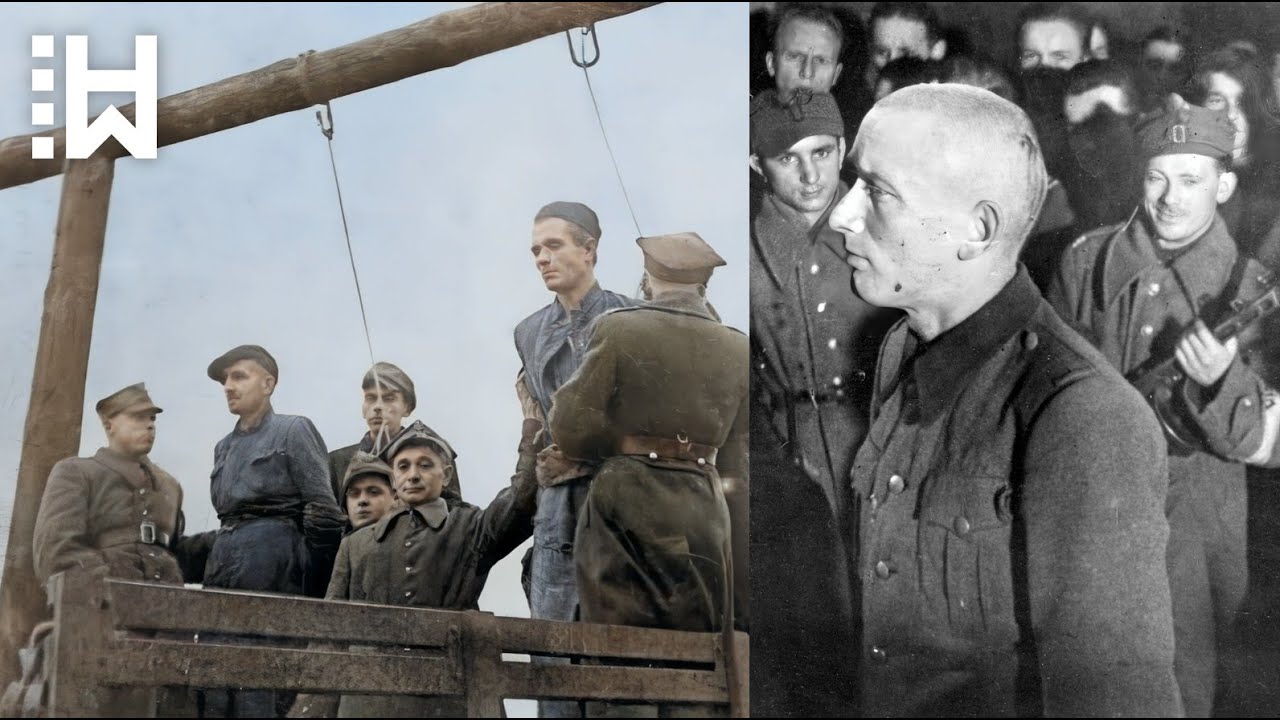
Less than five months later, on December 3, 1944, Majdanek became one of the first former Nazi sites where justice was carried out. The camp’s former personnel paid for their crimes with their own lives, executed in front of 15,000 people. The mass execution in Lublin was recorded by official press photographers and resembled a theater of horror.
Majdanek, situated in the southeastern suburbs of Lublin, was originally established in late 1941 as a camp for prisoners of war. It soon evolved into a full-scale concentration and extermination camp. Built under orders from Heinrich Himmler and administered by Odilo Globocnik, the camp was intended to serve both economic and genocidal purposes.
The camp was designed to house up to 150,000 prisoners, making it one of the largest camps in occupied Europe on paper. Logistical challenges and the changing tide of war prevented the Nazis from fully realizing this plan. Majdanek consisted of three main sectors: the SS administrative area, an economic zone, and the prisoners’ camp.
The prisoners’ camp contained five fields of wooden barracks where inmates lived in primitive, overcrowded conditions. Disease and death spread rapidly, with basic sanitation virtually non-existent. Prisoners endured freezing winters and sweltering summers, often with broken windows and little protection from the elements. Barracks intended for a few hundred people housed more than a thousand, creating a breeding ground for lice, typhus, and other deadly illnesses.
Daily life was marked by extreme hardship and terror. New arrivals were stripped of their belongings, had their hair shaved, and underwent a painful disinfection process before being registered with a number that replaced their identity. Jewish prisoners underwent selections upon arrival, and those deemed unfit for labor, including the elderly and children, were immediately sent to the gas chambers.
Prisoners came from nearly 30 countries, with the majority being Polish Jews and ethnic Poles. Others came from the Soviet Union, Slovakia, Bohemia and Moravia, and Western Europe. Among the prisoners were Soviet prisoners of war, resistance members, civilian hostages, and entire Belarusian villages deported in reprisal for partisan activity.
Punishments for even minor infractions were brutal and often fatal. Public beatings and lashings at roll call were common. Prisoners could be forced to stand motionless for hours, endure backbreaking penalty exercises, or be hanged by their wrists. Escape attempts were met with execution, usually carried out in front of the entire camp as a warning.
Children were often treated with particular cruelty. Guards would grab them by the hair and throw them onto trucks heading to the gas chambers, pulling so hard that whole tufts of hair remained in their hands. Sometimes children were murdered in front of their parents, and personnel would whip pregnant women to death.
Mass murder at Majdanek was carried out through firing squads, gas chambers, and deliberate neglect. From the autumn of 1942 to the summer of 1943, gas chambers using carbon monoxide and Zyklon B killed thousands, primarily Jews. The sick and weakened were often segregated into so-called hospital blocks, where they were left without food or medical care until they died or were taken to be gassed.
The crematoria played a key role in hiding the evidence of mass murder. Initially, bodies were buried in mass graves, but as the scale of extermination increased, open-air pyres and specially constructed crematoria were used to dispose of the corpses.
One of the most horrific single-day massacres occurred on November 3, 1943, when around 18,000 Jews were murdered in an operation called Erntefest, or Harvest Festival. Victims were forced to undress and lie down in large trenches before being shot in the back of the head. Music was played over loudspeakers to drown out the sound of gunfire and screaming.
In 1944, as Soviet forces advanced, the Nazis began hurried evacuations of Majdanek’s prisoners. In March and April 1944, around 15,000 prisoners were transported by train to camps deeper within Nazi-occupied territory. In early July 1944, the last 1,000 surviving prisoners were marched off on foot only days before liberation. Many collapsed and died along the way, and those unable to continue were often shot on the spot.
The SS made only limited efforts to destroy evidence of their crimes before abandoning the camp. Some documents were burned and certain facilities were set on fire, but much of the camp remained intact. Of the estimated 130,000 men, women, and children imprisoned at Majdanek, approximately 80,000 died, including around 60,000 Jews.

After liberation on July 23, 1944, Soviet and Polish authorities moved quickly to secure the site and document the atrocities. Unlike many other camps, Majdanek was not completely destroyed, and much of its infrastructure, including gas chambers and crematoria, remained intact.
In the following months, six former members of the Majdanek personnel were arraigned before the Soviet-Polish Special Criminal Court. These individuals included SS Oberscharführer Anton Thernes, SS Hauptscharführer Wilhelm Gerstenmeier, SS Oberscharführer Hermann Vogel, SS Rottenführer Theodor Schöllen, and two prisoner functionaries, Edmund Pohlmann and Heinrich Stalp. One defendant, Edmund Pohlmann, committed suicide in his cell, leaving five to face sentencing.
During the trial, survivor testimonies and defendant confessions brought the horrors of the camp to light. Heinrich Stalp described how Jewish mothers led their children into the gas chambers while telling them fairy tales to calm their fears. Hermann Vogel admitted that during Operation Harvest Festival, thousands of inmates were murdered by firing squads while loud music played over the camp’s speakers.
Witnesses recalled how the air was filled with music as countless Jews were systematically gunned down. The prosecution’s key witness, Piotr Sowski, testified that based on the enormous quantity of clothing and belongings found at Majdanek, as many as one and a half million people had been killed there. While these figures were later revised downward by historians, they fueled the court’s portrayal of Majdanek as a death factory.
The proceedings were broadcast to crowds gathered outside via megaphones. The crowd included people screaming and crying for loved ones they had lost at Majdanek. On one occasion, these people literally attempted to tear the defendants to pieces in the street as they were being escorted to the courtroom.
Prosecutors used the trial not only to highlight the guilt of the defendants but also to deliver sweeping condemnations of German history and culture. Defense attorneys offered only brief and largely symbolic arguments. Some pointed out that other defendants had themselves been prisoners, but these arguments had little effect.
All five surviving defendants denied their guilt in their final statements, but the outcome was inevitable. They were found guilty of war crimes and sentenced to death by hanging.

On the morning of December 3, 1944, gallows were erected at Majdanek itself, near the crematoria where so many victims had been burned. Around 15,000 people gathered, including survivors, grieving families, and residents of the city. Among them was a young girl named Fagashe, just 14 years old, who had survived Majdanek.
Still wearing her striped camp uniform, she made her way through the crowd, calling out, "Let me through. I was at Majdanek. I'm wearing a striped uniform." Moved by her words, the crowd parted, allowing her to stand at the very front.
The method chosen for the execution was the short drop hanging technique, in which the condemned were not dropped from a sufficient height to cause immediate death. Instead, they suffered a prolonged and torturous death by strangulation, which could last between 10 and 20 agonizing minutes.
When the trucks that brought the condemned men were used as a trap door and moved slowly forward, the five former members of the Majdanek staff were executed. Some witnesses described an eruption of noise from the crowd, while others remembered an eerie, almost stunned silence settling as the bodies dangled lifelessly from the gallows.
For many onlookers, the executions brought only a deeper sense of sorrow and unresolved pain. Observers later recalled that even as the guilty swung from the ropes, the terrible scale of the crimes committed at Majdanek made the punishment feel somehow inadequate. After the executions ended, the young girl Fagashe, who had watched it all unfold, turned and walked away silently.
Due to the incompetence of its deputy commander Anton Thernes, who was given the task of destroying evidence but ran out of time due to his ineptitude and lethargy, Majdanek is the best-preserved camp of the Holocaust. With the war still ongoing, it was preserved as a museum by the autumn of 1944, and the first permanent exhibition was opened the following year.
Today, Majdanek stands not only as a preserved memorial to the victims but as a lasting reminder of the horrors that unchecked hatred and cruelty can unleash. The pursuit of justice for Majdanek’s crimes, however imperfect, continues to echo as a warning to future generations that such atrocities must never be allowed to happen again.