On January 16, 1997, at approximately 1:00 a. m. , Ennis Cosby was kneeling beside his dark green Mercedes-Benz on a quiet road near the Sepulveda Pass in Los Angeles, changing a flat tire. His friend Stephanie Crane had parked behind him so her headlights could illuminate the work.
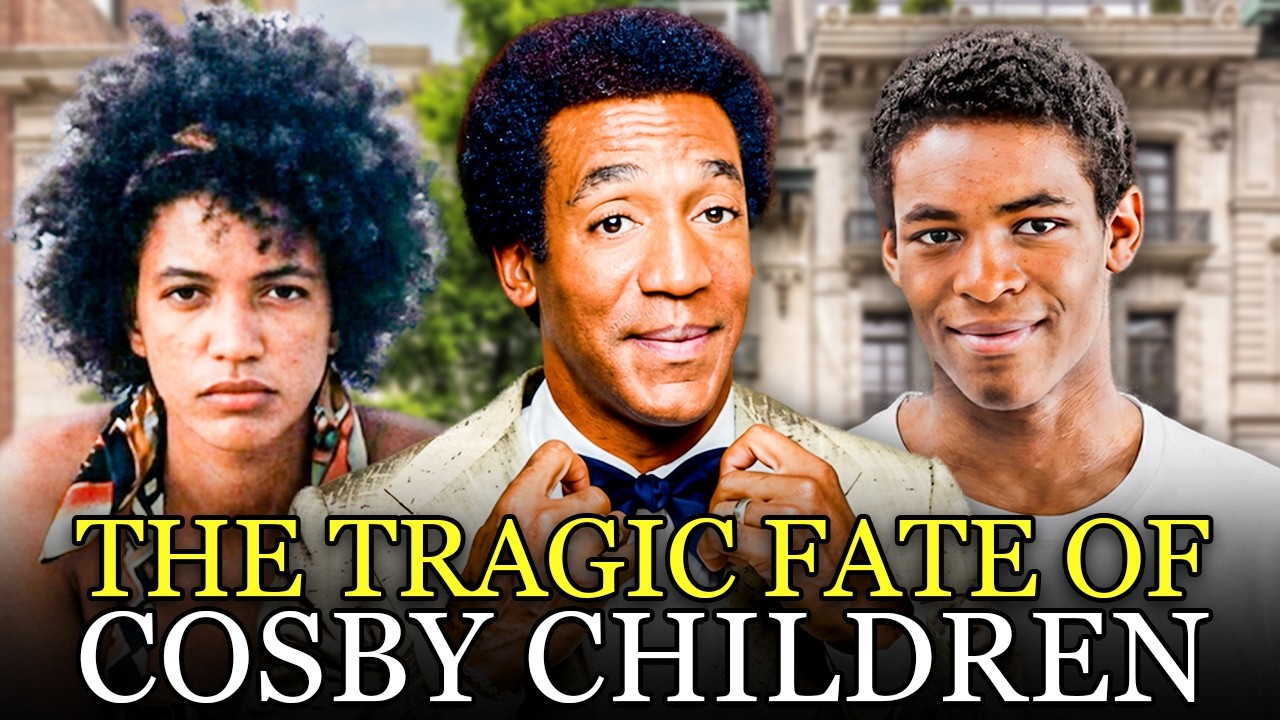
When a stranger approached her window and threatened to hurt her, she pulled away in terror. She then heard a single gunshot. When she returned, Ennis was on the ground. He had been shot in the head.
He was 27 years old, the only son of Bill Cosby, the man millions of Americans knew as television’s greatest father. The killing was not targeted. The gunman, 18-year-old Mykhailo Markhasev, was a stranger who had approached to rob. He was later convicted and sentenced to life in prison without parole.
The death was random violence on a dark road, an outcome no amount of fame or family control could prevent. But to understand what the loss meant to the surviving Cosby children, and what it cost to grow up inside a family where the image came first, the story must begin decades earlier. Bill Cosby was born in 1937 in Philadelphia and grew up in public housing. His father was frequently absent, a Navy mess steward whose absence shaped the household.
Bill learned early that charm could be currency, and comedy became his way of reorganizing the world around himself. He dropped out of high school, enlisted in the Navy, earned his diploma through correspondence courses, and later attended Temple University on a track scholarship before leaving to pursue stand-up full-time. By the early 1960s, Cosby had built a new kind of crossover identity: a warm, observational Black comedian who was commercially safe for white mainstream audiences. In 1965, he became the first Black actor to co-star in a weekly dramatic series, “I Spy,” winning three consecutive Emmys.
His stand-up filled theaters, and his record sales were enormous. He was pioneering the model of the Black entertainer that white America could trust with its living rooms, its products, and its children. He met Camille Hanks in 1963, when she was a 19-year-old psychology student at the University of Maryland. They married on January 25, 1964.
Camille became far more than a spouse: she was an intellectual partner, business manager, and gatekeeper. She later earned a doctorate in education, writing her dissertation on the representation of Black people in mass media. Together, the couple projected an image of brilliance, wealth, and domestic discipline that served as the foundation for everything that followed. All five children were given names beginning with the letter E, widely reported to stand for excellence.
They were branded from birth before they could speak. Erica was born in 1965, Erinn in 1966, Ennis in 1969, Ensa in 1973, and Evan in 1976. Each child entered a household whose fame was accelerating at a disorienting pace, and each absorbed the particular weight of being a Cosby child: watched, measured, and understood not as an individual but as an extension of the father’s philosophy. By the mid-1980s, that philosophy had become the most lucrative identity in American entertainment.
“The Cosby Show” debuted on NBC in September 1984 and remade the national conversation about race, class, and family. The Huxtables were affluent, educated, and culturally central, arguing week after week that a Black family could be the aspirational center of American television. The line between Cliff Huxtable and Bill Cosby was kept deliberately, profitably thin. The fiction fed the life, and the life fed the fiction.
When Cosby published “Fatherhood” in 1986, it became one of the fastest-selling hardcovers in American publishing history. He was no longer simply a comedian with a hit show; he was a national authority on how families should work. His advertising relationships traded on paternal warmth, and his philanthropy reached historic scale. In 1988, the Cosbys donated $20 million to Spelman College, one of the largest individual gifts ever made to a historically Black college in America.
The family occupied a position almost without precedent. They were Black, wealthy, morally instructive, and trusted by white mainstream audiences as reassurance that the system could produce excellence, and by Black America as proof that excellence could be rewarded at scale. But the family was not merely admired; it was instrumentalized. It carried meaning far beyond what any five children and two parents could reasonably sustain.
And the children were never asked whether they wanted to carry it. Erica, the eldest, found a quiet lane early. She studied at Wesleyan University and became a professional painter exhibiting widely in New York. Her public profile was minimal.
In the family system, she was the observer, the child who built a life in a different language than her father’s. She did not compete with the brand; she existed beside it. That restraint may have been the most sustainable strategy any of the Cosby children ever found. Erinn was different.
She was the daughter who struggled most visibly against the weight of the name. She did not have Erica’s gift for quiet self-construction, and in a family where containment was financially necessary, that made her the most exposed and vulnerable. Her identity kept colliding with the one her father had already written for the family, and the collision produced chaos. Ennis carried a different kind of weight.
He was the only son, which mattered in a family organized around a patriarch’s authority. He was also dyslexic, a condition that went undiagnosed for years. He struggled through school inside a household where academic achievement was non-negotiable, carrying the confusion privately because admitting failure inside the house of the man who had written “Fatherhood” felt unthinkable. When the diagnosis finally came, he called it the happiest day of his life; it replaced shame with explanation.
From that reason, he built a vocation. He earned a master’s degree in special education at Columbia’s Teachers College and began doctoral work with plans to create a school for children with learning differences. He spent time on the Upper West Side tutoring children who struggled as he once had. Professors remembered him as humble, focused, and uninterested in celebrity.
When other students asked about his father, Ennis told them his father was in business. He was trying to step out of the shadow, to become someone whose worth was built rather than inherited. Ensa, the fourth child, remained private through the family’s peak years. She would become much more visible later, during the scandal, when she stepped forward to defend her father with a fierceness suggesting loyalty hardened over decades.
Evan, the youngest, absorbed the privilege and the weight of watching four older siblings navigate the name first. The family had long lived inside a managed contradiction. Bill Cosby preached marital fidelity and family cohesion on national television and in bestsellers while conducting affairs that were known, at minimum, within the household. In a later public statement, Evan acknowledged that her father had affairs, framing them as something between her parents that they had worked through.
The children had always known. The affairs were real; the fatherhood image was constructed. The family’s response to the gap between the two was not confrontation or reckoning. It was management.
Silence was not a failure in this household; it was policy. The first public fracture came in the autumn of 1989, when Erinn was 23. Newspaper coverage described Bill and Camille Cosby employing what they called “tough love” with a daughter addicted to drugs. The phrase was brand-consistent, the language of a father who had spent years demonstrating that he always had the right answer.
Erinn’s addiction was a public contradiction, and her pain had to be narrated, managed, and folded into the existing story in which Bill Cosby always knew what to do. In 1992, Erinn appeared on television and alleged that Mike Tyson had attempted to sexually assault her years earlier. The media landscape treated it as a brief tabloid curiosity rather than a serious claim. The irony was almost unbearable: a decade before the public would begin to reinterpret Bill Cosby through the accounts of dozens of women describing drugging and assault, his own daughter was telling a story about what powerful men did in private.
The system held. The brand absorbed the blow. By the mid-1990s, the family continued to function as it always had, each member occupying their assigned position. “The Cosby Show” ended its run in April 1992 after 200 episodes, but the brand did not retire.
Cosby moved into new television projects, continued touring, lecturing, and publishing. He gave commencement addresses and was treated by journalists, politicians, and university presidents not as a celebrity but as a sage. The framework appeared intact to anyone observing from outside. But Ennis was the redemption in family terms.
He was the proof that the pressure did not have to crush you, the evidence that a Cosby child could become something other than a Cosby child. He was succeeding. He had found something real, and the world was about to take him away. On the night of the killing, Ennis was in Los Angeles during a break from his doctoral work.
He had been visiting friends, doing the unremarkable things a 27-year-old graduate student does. He was driving along Skirball Center Drive when his tire went flat. He did not call police or his parents; he got out to handle the problem himself. He called his friend Stephanie Crane and asked her to return and position her car so her headlights gave him enough light.
She came and parked behind him. A man approached her window. He told her to open the door or he would hurt her. She pulled away in terror, and the headlights swept away from Ennis.
Then she heard a single gunshot. When she returned, Ennis was on the ground beside his car. He had been shot in the head. The tire iron lay nearby; the flat tire was still flat.
Everything was the same as it had been minutes earlier, except that a man who had been alive and working with his hands was now dead on the asphalt. The killer was Mykhailo Markhasev, an 18-year-old Ukrainian immigrant with a history of petty crime who had come to rob. The encounter was not targeted or personal. Despite rumors that circulated for years, it was a random act of violence.
A stranger saw a man alone on a dark road with an expensive car and decided to approach with a gun. When the robbery met resistance or confusion, the gun was fired. The news broke across the country within hours, and the grief was national. To millions of people who had watched “The Cosby Show” for a decade, this felt personal.
Ennis was not a troubled child or one who had embarrassed the family. He was the one who had overcome dyslexia, the one building a future in education, the one whose trajectory seemed to prove that discipline and excellence could produce something genuinely good. His death was flatly devastating. Bill Cosby returned to his stand-up stage 16 days after his son was murdered.
He told audiences that their grief was his grief and that he wanted to give them a release. That detail should not be read as callousness but as reflex; he had spent more than 30 years converting private experience into public performance. The stage was his instrument of control. Whether that was courage or compulsion is a question the public can hold without needing it answered.
Camille Cosby’s grief arrived inside a system she had spent decades building. She was the organizer, the gatekeeper, the woman who kept the household running and the brand intact. She could manage scandal, addiction, and the quiet knowledge of affairs, but she could not manage random violence on a dark road. There was no strategy that could make it bearable.
Her only son was gone, and the machinery she had built could not undo a single second of what had happened. For Erinn, the loss carried a weight the other siblings could not fully share. She was the daughter who had been publicly broken and partially estranged, whose pain had been treated as a threat to the brand. Her brother had become the family’s symbol of redemption, and whatever hope his example represented was gone with him.
For Erica, Ensa, and Evan, the loss was both personal and structural. They did not lose only a brother; they lost the family member who had most clearly converted the inheritance into something useful and human. In the weeks after the murder, Bill and Camille established the Hello Friend/Ennis William Cosby Foundation, built around Ennis’s work with children who had learning differences. The name came from the way he greeted people: “Hello, friend.
” The foundation distributed educational materials, funded literacy programs, and partnered with public schools to identify and support struggling children. In 2008, more than a decade after Ennis’s death, Erinn Cosby appeared at a foundation event in Miami-Dade County, handing out 20,000 books to kindergarteners across 21 public schools. Whether that moment represented healing, obligation, performance, or some mixture of all three, the record cannot resolve. But the image of the troubled daughter carrying her dead brother’s mission into a room full of five-year-olds carries a weight no commentary can improve.
The years between Ennis’s death in 1997 and the public explosion of the accusations against Bill Cosby were lived in the shadow of two realities: private grief, and the continuing obligation to exist inside the Cosby mythology. The family did not fall apart. It regrouped and continued. Cosby intensified his public role as a moral authority, most notoriously in a 2004 address that became known as the “pound cake speech,” criticizing what he described as the failures of young Black Americans to take personal responsibility.
The collapse of his public image happened with extraordinary velocity. In October 2014, comedian Hannibal Buress performed a stand-up set in Philadelphia in which he told the audience to look up what Bill Cosby had been accused of. The clip went viral. Accusations that had lived for years in the margins of the public record moved to the center of the national conversation.
Woman after woman came forward, the number growing past 50, with accounts spanning decades and describing a consistent, terrible pattern: drugging, incapacitation, sexual assault. Within months, the brand built over 40 years was dismantled. Networks pulled reruns, universities rescinded honorary degrees, and advertising partners severed ties. The fatherhood books became grotesque in retrospect.
The entire architecture of moral authority was being reinterpreted as the most elaborate and cynical deception in the history of American celebrity. For the children, this was the destruction of the only version of their father the public had ever known, happening in real time. They were not accused of anything, but they bore the name, and the name now carried a weight no amount of personal achievement could counterbalance. The family’s old reflex activated once more: defend, close ranks, protect the image.
In 2017, both Ensa and Evan issued public statements defending their father. Evan described a man who raised her to go to college, start her own business, and be her own woman, and acknowledged his affairs as a marital matter her parents had resolved. Ensa said she believed her father was innocent and argued that racism had played a significant role in the public persecution of her family. These statements should not be mocked.
The daughters were being asked to choose between the father they had known since birth and the version the world was constructing from the testimony of dozens of women they had never met. That is an impossible position for anyone. Less than a year after she defended her father, Ensa Cosby died. She was 44 years old.
She died on February 23, 2018, in Massachusetts from kidney disease, after waiting for a transplant that never came. She had stepped into the public arena at the worst possible moment in the family’s history, defended the image, and then she was gone. The second of Bill and Camille’s five children to die. The two deaths were unrelated in cause but devastating in combination: two of five children gone.
The legal aftermath continued to churn. In April 2018, after a mistrial the previous year, Cosby was convicted in the retrial of the Andrea Constand criminal case in Pennsylvania and sentenced to three to ten years in state prison. In June 2021, the Pennsylvania Supreme Court overturned the conviction on procedural grounds, ruling that a prior prosecutor’s assurance that his deposition testimony would not be used against him had been violated. Cosby walked free.
The reversal did not vindicate him morally, and the public anger was exhausted rather than celebratory. Civil litigation continued. In 2022, a civil jury found Cosby liable in the Judy Huth case, which involved allegations of assault at the Playboy Mansion in the 1970s, and awarded $500,000. In March 2026, a California jury found him liable for drugging and sexually assaulting Donna Motsinger in 1972 and awarded $59.
25 million. The verdicts accumulated like geological layers, each reinforcing the pattern. Cultural productions followed. A&E aired “Cosby: The Women Speak,” and Showtime released “We Need to Talk About Cosby” in early 2022, a four-part documentary tracing the arc from beloved patriarch to accused predator.
What it did not feature notably was the children. The documentaries told the story of what Bill Cosby did to women; they did not tell the story of what being his child did to the five people who carried that identity from birth. Bill Cosby is now 88 years old. Camille is 82.
They remain married, a marriage that has endured more than six decades, five children, two deaths, a criminal trial, a prison sentence, a reversal, and civil judgments totaling tens of millions of dollars. The fatherhood brand is gone. The moral authority is gone. What remains is an old man with a famous name and a legal record that tells a story the old mythology cannot absorb.
Of the three surviving daughters, Erica is 61. Her official records show active exhibitions through 2025 and mentoring programs in early 2026. She appears to have survived the family’s collapse by never fully depending on the family’s image for her sense of self. Erinn is nearly 60; the reliable public record gives almost no current detail about her life.
That silence may be the most eloquent thing the story can say about her. The daughter who suffered most publicly chose the one thing the Cosby household could never truly provide: privacy. Evan is 49. The strongest on-record material about her adult life remains her 2017 statement: a career in fashion design, two children, a continuing closeness with her father.
She carries the name, the memory of the brother who died on the road, and the sister who died waiting for a transplant, and whatever version of her father she has chosen to hold on to. Ennis died at 27 with a future still opening in front of him. Ensa died at 44 after standing publicly beside a father the world had turned against. The three daughters who remain are not merely survivors of a scandal; they are survivors of a family that asked its children to be proof of a thesis, then watched the thesis collapse under the weight of the man who wrote it.
There is no neat moral in that. There is only the image of a son kneeling beside a flat tire on a dark road, a daughter handing books to kindergarteners in his memory, and three women still carrying a surname that became both shield and scar.