In February 2011, a man still permitted to call himself His Royal Highness sent an email to a convicted sex offender. Jeffrey Epstein had pleaded guilty three years earlier to soliciting a minor for prostitution in Florida and had served 13 months in jail. By then, he was a pariah to nearly everyone who once wanted a photo beside him. Prince Andrew was not among them.
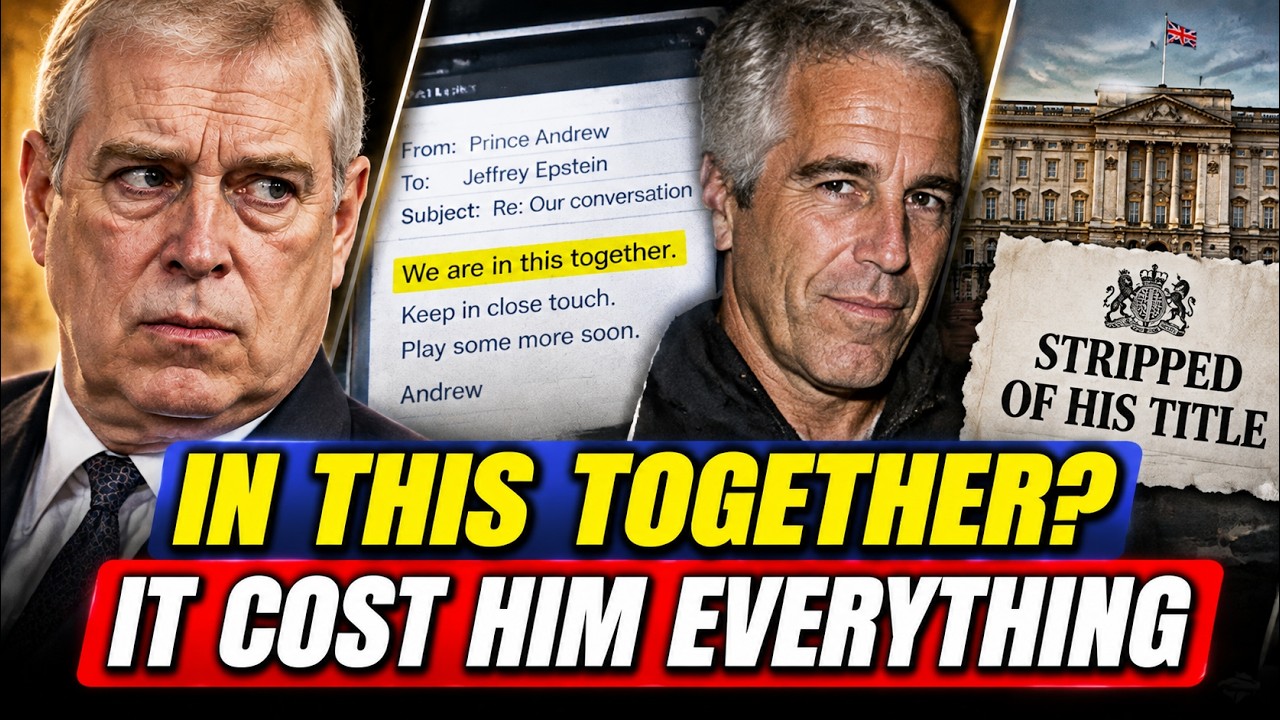
Andrew told Epstein not to worry, saying they were in this together and needed to get through whatever came next. He ended the message asking Epstein to stay in close touch and to meet again soon to play. The email remained hidden for 14 years.
Andrew had told the BBC in a widely mocked 2019 interview that he cut ties with Epstein in 2010 once he realized the scale of Epstein’s crimes. The February 2011 email proved otherwise, as did other messages released alongside it. When The Guardian published them in October 2025, the revelations did more than embarrass a royal who had already lost nearly everything. They proved he had lied publicly, on camera, about the one thing the family had allowed him to keep for the sake of his dignity. Within three weeks, a man who had been a prince since birth was no longer one.
Fourteen years is a long time for a paper trail to surface. Long enough for the writer to lose his charities, patronages, military titles, and chances to attend any major public event. Long enough for the woman who accused him of abuse to grow up, marry, have children, and end her life before seeing the moment those emails became public. Long enough for a generation of royal watchers to conclude that nothing would end this story except a corpse. They were almost right. It was not a corpse. It was an inbox.
To understand why one set of emails could do what decades of scandal could not, you have to go back to before 2025. Andrew was born in 1960, the second son of Queen Elizabeth II, and for much of his life he was one of the family’s most popular members. He flew helicopters in the Falklands War in 1982 and returned home to genuine public affection. He married Sarah Ferguson in 1986. They divorced a decade later in 1996 but never truly separated. Ferguson continued living with him at Royal Lodge, a 30-room home near Windsor Castle, for 20 years after the marriage ended.
His friendship with Epstein began sometime in the 1990s, reportedly through Ghislaine Maxwell. For years, the friendship was treated as another example of Andrew’s poor judgment in companions. He stayed at Epstein’s Manhattan home multiple times. He traveled on Epstein’s plane, later dubbed the Lolita Express. None of that, by itself, proved what Andrew knew or did. It proved only how close the two men actually were, for how long, and how little either believed they needed to hide it.
Then in 2010, two years after Epstein’s conviction and release from a Florida jail, a photo emerged of Andrew walking beside him in Central Park. The men looked completely at ease, mid-conversation, dressed for a stroll rather than a reckoning. That photo should have ended the friendship, at least in any form Andrew was willing to acknowledge publicly. The emails that surfaced 15 years later show it did not.
The turning point came in 2019, and it came fast. Epstein was arrested in July on federal sex trafficking charges. He was found dead in his Manhattan cell the following month. In November, Andrew agreed to sit with Emily Maitlis of the BBC for a Newsnight interview. He told Maitlis he could not have had sex with Virginia Giuffre in a Manhattan home in 2001 as she claimed, citing a medical condition from his Falklands service that made him unable to sweat. He said he did not remember meeting her at all, despite a widely circulated photo showing his arm around her waist while Maxwell smiled behind them. Asked why he stayed at Epstein’s Manhattan home in December 2010, after the conviction was public, he said he went there specifically to end the friendship face to face.
Within days, the interview was described as one of the worst public relations disasters in the modern history of the monarchy. Sponsors pulled support for his charities within a week. Universities cut honorary ties. He stepped back from public duties less than a week after the broadcast, saying in a statement that his continued role had become a distraction. He was 59 years old, and it was the first time in his adult life the family allowed public reaction to a scandal to cost him something tangible.
He was 65 when the emails finished him off. Between the Newsnight interview and that final collapse, six years passed. For most of that time, Andrew was allowed to remain in a state of suspension. Present and embarrassing, occasionally appearing in the news for the wrong reasons, but never fully cast out.
Giuffre filed a civil lawsuit against him in New York in 2021, accusing him of sexually assaulting her when she was 17. In January 2022, before the case developed, Queen Elizabeth stripped him of his military titles and royal patronages in one blunt, unusual palace announcement. He lost his honorary military affiliations with the army, navy, and air force. He lost dozens of civilian patronages. He lost the right to use the title His Royal Highness in any public or official context. He was barred from wearing military uniform in public. That is why he stood at his mother’s funeral later that year in a plain suit while his brothers and son wore theirs.
He settled the Giuffre lawsuit in February 2022 for a sum reported to be around 12 million pounds, without admitting any wrongdoing. The settlement documents were never fully published. The amount was enough to make the case disappear from court before a jury heard it. It was never enough to make it disappear from public memory.
At the coronation in May 2023, Andrew’s diminished status was visible to anyone watching. His name was not in the order of service. He was transported to Westminster Abbey in an ordinary official car rather than participating in the royal procession. He sat in the third row with his daughters and their husbands. Crowds outside the palace booed as his car passed. For the first time in modern coronation history, the ancient tradition of royal dukes kneeling to pay homage to the new monarch was quietly adjusted to include only William as heir to the throne. Andrew was not given the option of kneeling. He simply was no longer part of that portion of the ceremony.
For about a year and a half after the coronation, things seemed to settle at that level. Andrew kept his home at Royal Lodge. He kept his title, though it was empty of meaning. He continued to appear when allowed, at the family’s Christmas walk at Sandringham, at occasional funerals, on the margins of events where his presence caused a stir and then faded from headlines within a week.
Then in December 2024, a different kind of scandal brought him back to the front pages. A British immigration appeals tribunal ruled that a Chinese businessman named Yang Tengbo, barred from the country in 2023 on national security grounds, had formed what the court described as an unusual degree of trust with Andrew. British authorities alleged Yang worked on behalf of the United Front Work Department, a Chinese Communist Party arm used to build influence among foreign elites. One email from a senior adviser in Andrew’s office, read in court, said Yang should never underestimate the strength of his position and that outside Andrew’s inner circle, Yang ranked very highly.
By the time the Yang Tengbo story spread, Andrew had already ended his Pitch@Palace entrepreneurship initiative, launched in 2014. Yang had been a key figure in its China branch. In other words, the collapse of one project was intertwined with the collapse of the other. Andrew said through a statement that he cut all contact with Yang once concerns were raised. More documents published the following April complicated that account further.
Then in early October 2025, previously sealed court documents related to the Epstein case were released, and Andrew’s name appeared again in ways that reopened questions people thought were closed. Days later, The Guardian began publishing the emails. The February 2011 message was the most damaging because it contradicted his sworn account of the timeline, the very story he told Maitlis on camera. He said he ended everything after the conviction. The email showed him telling Epstein they were in this together more than a year after that.
During those same weeks, excerpts from Virginia Giuffre’s memoir, which she was writing before her death, began circulating. Giuffre, born Virginia Roberts, was 17 and working at Mar-a-Lago when Maxwell first contacted her. She spent the next two decades as one of Epstein’s most prominent accusers. She ended her life in April 2025 at her home in Australia. Her book, titled Girl Nobody, was published posthumously that fall. In it, she described in detail three separate encounters with Andrew, writing that he treated the idea of sex with her as an entitlement, part of his status. Andrew denied every part of her account, as he had since 2019.
But the emails were no longer just his word against hers. They were his own writing, contradicting his public defense. There was no room left for another television interview to explain it away.
Weeks before any of that came to light, on September 16, 2025, Andrew stood beside Charles outside Westminster Cathedral. They were photographed together leaving a memorial service for Katharine, Duchess of Kent. It is an ordinary image by any measure, two brothers at a family funeral. Six weeks later, the man in that photo was no longer allowed to call himself a prince.

Christopher Andersen, a biographer who has written extensively about the family, told Fox News Digital at the time that the timing carried a harsh quality. He noted the new revelations came right after Christmas at Sandringham, where Andrew walked to church with Sarah Ferguson and the rest of the family for the first time in years. A small sign that some old warmth was returning. According to Andersen, Camilla had genuine affection for Ferguson and was said to be encouraging Charles to soften toward Andrew. Any thaw ended the moment the emails were published.
Public pressure escalated quickly and from every direction. Members of Parliament from across parties demanded an official account of what the palace and successive governments knew and when. Many pushed for Andrew to be formally questioned about his financial dealings with Yang Tengbo as well as his history with Epstein. Newspapers that had spent six years publishing variations of the same headline about the Andrew problem suddenly had new documents to publish every few days.
Campaign groups representing survivors of trafficking and abuse repeatedly noted that the emails shifted public opinion in three weeks more than years of survivor testimony had done. From inside the family itself, according to multiple accounts that emerged in the following months, pressure came from a source closer than the press. Prince William, according to royal commentator Hilary Fordwich speaking to Fox News Digital, was angry and had been for some time. Fordwich said William was actively working to exclude Andrew entirely from any family activity and was considered the driving force within internal family discussions to strip Andrew of whatever titles remained.
A separate account from Closer magazine, later picked up by The Blast, described William as pushing his father for years to strip Andrew of royal privileges, describing it as something William wanted done decisively rather than gradually. None of these accounts come from the palace itself, which never confirms internal family disputes publicly. But they came from multiple outlets independently over many months, making the picture coherent even without a single named source.
Whatever the actual mix of public pressure and private family disagreement, the palace moved with unusual speed once it began moving. On October 17, 2025, Buckingham Palace issued a statement in Andrew’s name announcing he would stop using the title Duke of York and its associated honors. The statement framed it as a personal decision made after discussions with the king and the wider family. He was not stripped of the underlying title at that point. He simply agreed to stop using it. His former wife lost the right to call herself Duchess of York in the same statement.
It did not last even two weeks. Public pressure continued to build rather than recede, especially once Giuffre’s book was formally published. On October 30, Buckingham Palace issued a second, far more serious statement. This time it was not described as Andrew’s personal decision. The palace stated that King Charles had initiated a formal process to remove Prince Andrew’s title, style, and honors entirely. From that moment, he would be known as Andrew Mountbatten-Windsor. Not Prince Andrew. Not Duke of York.
The list of what he lost in that single statement was long. The Order of the Garter first, one of the oldest and most prestigious honors in the country. He also lost the lesser titles, Earl of Inverness and Baron Killyleagh, along with his position as Knight Grand Cross of the Royal Victorian Order. Most strikingly, Charles went further than removing acquired titles. He removed the title of Prince itself, a status Andrew had held since birth as the son of a reigning monarch, a status not granted by the Crown like a dukedom or knighthood and therefore not generally considered removable in the same way.
Buckingham Palace described the move as almost unprecedented. It was. The last time a British prince lost that title entirely was in 1919, when Prince Ernest Augustus, grandson of Queen Victoria who also held a German title, was stripped of his British royal status for fighting on Germany’s side during World War I. That case involved a foreign war and a British prince actually serving a hostile government. Andrew’s case involved a friendship, a financial settlement, and a set of emails.
Andrew’s daughters, Beatrice and Eugenie, kept their titles because the rule granting them was established by King George V in 1917 and applies to them as granddaughters of a monarch in their own right, independently of what happens to their father. The palace consulted the government before finalizing the decision, and ministers made clear their support. Instead of following the slow path through parliamentary legislation, Charles sent royal warrants canceling Andrew’s titles directly, a mechanism that took effect immediately.
The palace statement concluded with a sentence clearly aimed beyond Andrew, at the people whose accounts had been ignored or disbelieved for years. It read: Their Majesties wish to make clear that their thoughts and sympathies remain with the victims and survivors of all forms of abuse. It was a short sentence that carried a great deal. It was the closest the institution came in six years of managing this matter to an apology, though it apologized to no one by name and admitted nothing on Andrew’s behalf.

Andrew was also required to give up the roof over his head. He received formal notice requiring him to surrender the lease on Royal Lodge. He was expected to move to a private property on the Sandringham estate in Norfolk, a much smaller and less grand arrangement than the 30-room mansion he had occupied for two decades. Sarah Ferguson, who continued living with him there despite their divorce, had to make her own arrangements entirely at age 66.
The reaction from Giuffre’s family was immediate and direct. Her brother, Sky Roberts, spoke to the BBC in an interview that was, by all accounts, difficult to watch. He appeared deeply affected, saying Virginia was no longer a problem a prince could deny, that she was now just Andrew, and that she was celebrating from wherever she was. The family issued a statement through Roberts and his wife Amanda, putting it more bluntly. An ordinary American girl from an ordinary American family brought down a British prince with her truth and her courage. The family intends to continue pressing until the same accountability reaches every other person connected to Epstein and Maxwell who has not faced any of it.
For a story that went six years without resolution, the ending, once it came, took less than three weeks from the first leaked email to an official palace statement stripping the king’s own brother of the title he had held his entire life. That kind of speed does not usually happen inside an institution built on caution and precedent, unless something inside that institution had already changed.
According to a report published by the entertainment newsletter Naughty but Nice in February 2026, the family tensions did not end with Andrew’s titles. They moved to a different target: the relationship between Charles and William themselves. One source described the king hesitating and delaying for years before taking final action, making excuses and worrying more about Andrew’s feelings than about the impact of the ongoing scandal on the monarchy’s standing. A second source, describing the same period, said Charles simply did not want to upset his brother. A third source claimed Princess Anne and Prince Edward did not intervene during those years because neither wanted to be the one playing the villain. According to the same account, William was the one who insisted something had to be done long before the emails forced the issue.
By June 2026, reports from the UK, including an article in IB Times, described the relationship between William and his father as openly strained because of this history, tension that continued even after Andrew’s situation was resolved. A source told that outlet that William had been promised more responsibility and a greater voice in how the institution managed its affairs as he prepared for his future reign, and that he now felt sidelined while Charles continued to assert control rather than cede influence. The same reports described what they called sharp discussions behind closed doors, with William believing decisive action against Andrew should have been taken the moment the Epstein relationship became a public scandal, not six years later and a set of leaked emails later.
According to the same account, Charles was not willing to yield to pressure on this matter even now, described as a king who refuses to be told what to do, although he had already gone in October further than anyone inside the palace expected. It is a strange kind of aftermath, if these reports are accurate. The scandal that was finally settled left behind a second, quieter scandal, between a king who moved late and a son who wanted him to move early.
Sarah Ferguson has not said much publicly since the eviction, other than confirming she would return to using her own name after nearly three decades associated with a title that no longer exists. Andrew, through representatives, continued to deny all allegations against him, from Giuffre’s civil suit to her posthumously published memoir, and continued to insist his 2019 account of ending contact with Epstein was made in good faith, no matter what the emails suggested about the actual date.
Beatrice and Eugenie stayed completely out of the story. Their titles were unaffected by what happened to their father, thanks to a rule written more than a century before their birth. Their weddings, public appearances, and working relationships with the family continue largely as before. A reminder that any judgment that eventually falls on one parent does not automatically apply to the children standing beside them.
What remains after the titles are gone and all the statements are issued is a very ordinary question wrapped in a great deal of extraordinary ceremony. How long can an institution built on inherited position continue to protect someone once public records make that position indefensible? For six years, the answer in Andrew’s case was: as long as possible. The military titles went first in 2022 when the cost of keeping them was still less than the cost of removing them. The settlement was quiet and expensive, designed to end legal proceedings rather than reveal anything about the truth. The coronation turned him into a spectator at his family’s largest ceremony in a generation, present but stripped of every trapping he once enjoyed. Even then, the family kept the last remaining item, the title itself, the word Prince, treating it as something separate from all the titles already taken from him. It took his own emails, contradicting his sworn testimony on national television, to make the cost of keeping that title greater than the cost of giving it up.
Andrew Mountbatten-Windsor is 66 years old, living in private accommodation on an estate he used to visit for Christmas rather than a place he resides. He remains, as far as anyone outside the family has been able to confirm, in contact with his brother, while reports indicate a complete break with his nephew. Whether that second relationship will ever recover, or whether the reports about William’s role in all this will withstand greater scrutiny than an anonymous quote in a gossip column, cannot be stated with confidence. What can be said, because the palace confirmed it in writing, is that a title held since birth was removed because of what emails proved, not because of what anyone believed, and that it happened in three weeks after six years of complete stagnation.
There was no ceremony for any of this in the end, and that is worth noting in itself. No formal stripping before cameras, no prepared medal surrender, nothing resembling the pageantry this family has always attached even to minor occasions. A statement was issued from Buckingham Palace on a Thursday afternoon, and by the time most people read it, the man who had been a prince for all 65 of his years was no longer one. The family that built its entire public identity around ceremony, robes, honors, and processions planned months in advance ended this particular chapter with a press release and a moving van.