In October 2018, Princess Eugenie married at Windsor. After the ceremony, the photographer gathered the family in the Green Drawing Room for official portraits. Two people stood in the same frame for the first time since 1992. One was Prince Philip. The other was Sarah Ferguson.
That gap of 26 years is striking. The same family. The same castle. The grandfather on one side. The mother of his granddaughters on the other. For a quarter of a century, the royal household ran a quiet, daily operation to keep the Duke of Edinburgh from seeing her.
Most people, when they fall out with a relative, handle it in a mundane way. A cold birthday card. A brief nod at dinner. Time erases the grudge. Philip was not that type. He did not forget. He simply removed Sarah Ferguson from his life and held that position until his death.
The obvious question is simple. What did she do?
At first, Philip actually liked her. In 1985, Prince Andrew began dating a tall, freckled, loud young woman named Sarah Margaret Ferguson. She grew up around horses and polo fields. Her father managed Prince Charles’s polo team. She told jokes and treated the most reserved people in Britain like old friends.
Sarah’s childhood was marked by abandonment. Her mother left in her early teens, moving to Argentina with a polo player. A daughter raised on that kind of early abandonment grows up hungry for acceptance. That hunger explains much of what happened later.
Sarah and Andrew circled the same world for years. Princess Diana introduced them at Royal Ascot in 1985. Diana wanted an ally inside the family. For a brief moment, she found one. The family welcomed Sarah warmly, especially Philip.
Philip was obsessed with carriage driving. He invented the modern competitive version of the sport and wrote its rules. Sarah practiced it too. Their bond grew over this shared passion.
For a short time, Sarah carried the role of great hope. She proved the monarchy could let a real, chaotic personality inside without the whole building collapsing.
Then it all fell apart.
The marriage was tense from the start. Andrew, a naval officer, disappeared at sea for long periods. His new wife was left alone inside the most scrutinized family in the world. Boredom set in. Loneliness followed.
In early 1992, photos emerged showing Sarah in an intimate pose with a Texas businessman named Steve White. By March, Andrew and Sarah formally separated.
In June 1992, Andrew Morton published “Diana: Her True Story.” The book revealed that Princess Diana was miserable, that her marriage was collapsing, and that the fairy tale was a lie. The country was in shock. The palace was bleeding.
Two months later, while the family gathered at Balmoral, a French photographer captured new photos. Sarah was on holiday without her husband. Beside her sat her financial advisor, John Bryan. In the most famous image, Bryan bent over Sarah’s bare feet and kissed her toes.
The story was named the “Squidgygate” scandal. The timing was devastating. The institution was already reeling from the Morton book. Sarah chose that moment to appear in the papers with another man.
For Philip, a man who judged everyone by what they gave to the crown, Sarah had committed something close to treason.
The divorce was finalized in May 1996. Andrew and Sarah remained close friends. They raised their daughters together. Most of the family found a way to deal with Sarah. Except for one man.
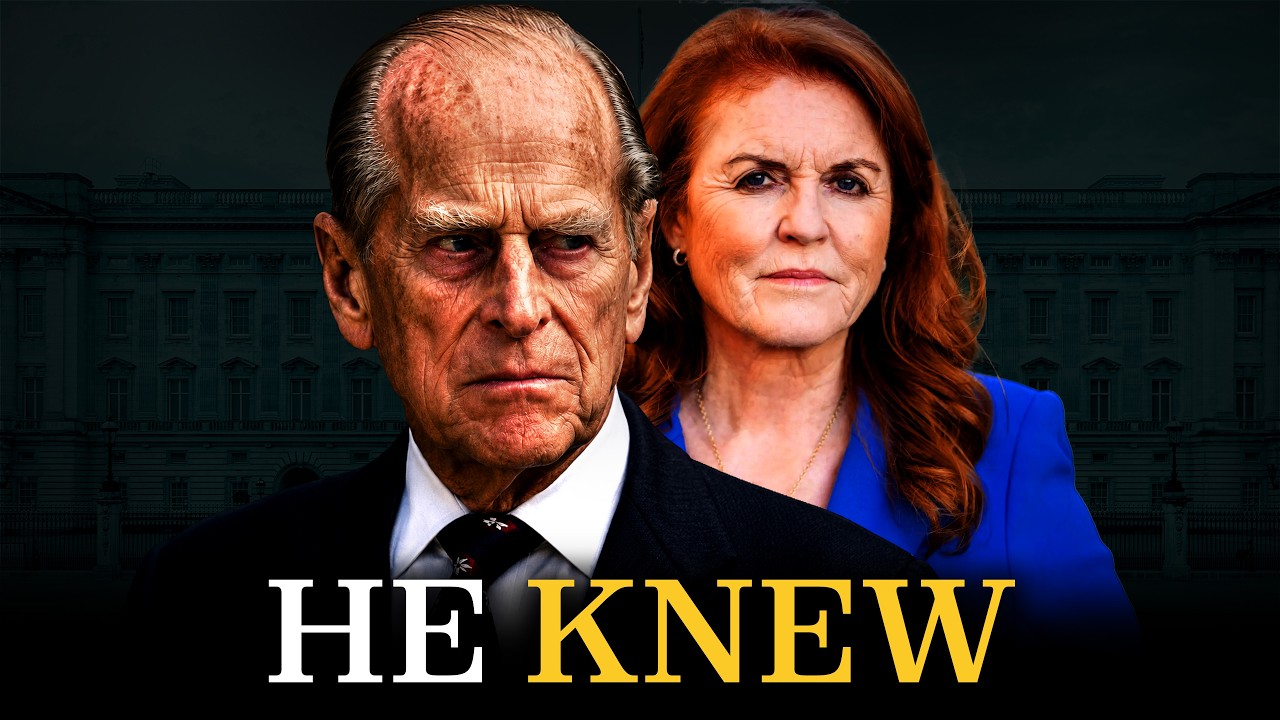
Philip imposed a rule and kept it with naval discipline. He would not sit in the same room as Sarah Ferguson. Not at dinners. Not at parties. Not at family gatherings. If she came, he left. If he stayed, she stayed away.
There was no dramatic confrontation. No resolution. A door closed and stayed closed.
The contrast with his wife was sharp. Queen Elizabeth continued to invite Sarah for tea. She kept her within the wider family circle. This was not a united family front. It was one man drawing a personal line.
Years later, Philip’s friend and biographer Gyles Brandreth asked him why. Philip answered coldly. He saw no point in seeing Sarah. No anger. No sadness. Just a silent judgment on someone who did not deserve his time.
The granddaughters always had an open door. Their mother never did.

What made the freeze stranger was the family’s tolerance for scandal. Charles and Diana exploded across the front pages. Anne divorced and remarried. Margaret’s romances filled headlines for decades. The family bent and adapted. Sarah alone was shut out.
In 2008, Sarah moved into Royal Lodge, a 30-room mansion in Windsor, living next to her ex-husband Andrew. Philip also spent much of his time at Windsor. Two people who had spent over a decade avoiding each other now shared the same estate.
The palace staff inherited a strange task. They coordinated the daily movements of an elderly prince and a divorced duchess so they would never meet. Someone tracked Sarah’s location. Someone tracked Philip’s. Someone compared the two and made adjustments daily. For years.
Sarah left the divorce deeply in debt. Reports put her debts at over 4 million pounds. To recover, she turned herself into a commercial enterprise. She became a paid spokesperson for Weight Watchers in America. She wrote memoirs and children’s books. She licensed her name. She sold interviews.
For most people, this is survival. Bills are bills. For Philip, it was desecration. He had given up his naval career, his name, his nationality, and his independence to serve the crown. He performed over 20,000 official engagements without pay. Duty meant serving the crown, not exploiting it.
Sarah turned the magic of the monarchy into income. Every paid appearance confirmed what Philip already believed.
In May 2010, a News of the World reporter posed as a wealthy businessman and approached Sarah with a hidden camera. She offered to sell access to her ex-husband, who was then a British trade envoy. She named a price of 500,000 pounds. She accepted 27,000 pounds in cash as a down payment.
The footage caused a sensation. Sarah later apologized, blaming her financial situation. The damage was done. Andrew stepped down from his trade role. Sarah’s name, already disliked inside the palace, worsened.
Philip said nothing publicly. He never said anything about her publicly. But the sting operation confirmed his view. He had been right all along.
In April 2011, at the wedding of Prince William and Catherine Middleton, Sarah was not invited. Her daughters Beatrice and Eugenie attended. Their mother watched the ceremony on television alone. She later told Oprah Winfrey she felt completely worthless and fled to Thailand.
The exclusion was not solely Philip’s doing. Wedding guest lists pass through many hands. But it happened inside an institution that had received clear signals about Sarah for two decades.

Beatrice and Eugenie grew up holding two contradictory truths. Their grandfather loved them. Their grandfather refused to be in the same room as the woman who gave birth to them. Every family gathering carried an invisible seating plan. Every occasion raised the silent question: Could mother come, or should she stay home so grandfather could attend?
In October 2018, at Eugenie’s wedding, the wall briefly collapsed. Eugenie wanted her mother and grandfather in one family photo. Philip, aged 97, stood there and allowed it. After 26 years, the two appeared in the same frame again.
Then the door closed again. No dinner invitations followed. The careful avoidance resumed.
Prince Philip died on April 9, 2021, at Windsor Castle. His funeral was held on April 17. Sarah Ferguson did not attend.
The obvious reading is a cold ending. The man ignored her for 29 years. Even in death, the arrangement held.
But the real story is less dramatic. Philip died during the COVID-19 pandemic. Britain was under strict gathering limits. The guest list at St George’s Chapel was limited to 30 people. Only senior royals attended. The Queen sat alone in her seat, wearing a mask. Prince Harry traveled alone. His pregnant wife stayed home on medical advice.
Many who loved Philip deeply watched the funeral from home. The law left no room. Sarah’s absence was not a final act of revenge. It was a pandemic restriction.
The word “despised” fits what everyone assumes because it offers easy emotions. A furious duke. A thrown newspaper. Decades of hatred. A great story. Most of it is false.
Philip never publicly attacked Sarah. He never made a statement against her. He never plotted against her. The dramatic confrontations people repeat fade under scrutiny. No revenge. No drama.
What remained was something perhaps harsher. Philip did not despise Sarah Ferguson. He decided she did not matter. He looked at a woman who embarrassed the institution he loved, then spent years selling pieces of it to survive, and reached a final, cold judgment. This woman is not worth my time. Then he executed that judgment with discipline until his death.
Hatred, at least, treats you as a worthy opponent. It gives you space in someone’s mind. Philip gave Sarah the opposite. He gave her nothing. He never saw her because, in his own words, he saw no point.
For a woman who entered that family desperate to be loved, that polite indifference may have been worse than any insult. The quality that attracted Philip initially — Sarah’s refusal to be artificial, her loud, unfiltered humanity — was the quality that lost him forever. He loved her because she refused to play the fake royal. He erased her for the same reason.
She never changed. The price with this particular man was steep. A quarter century of standing in the same estate, within the same family, with someone who quietly ignored her as if she had already left.