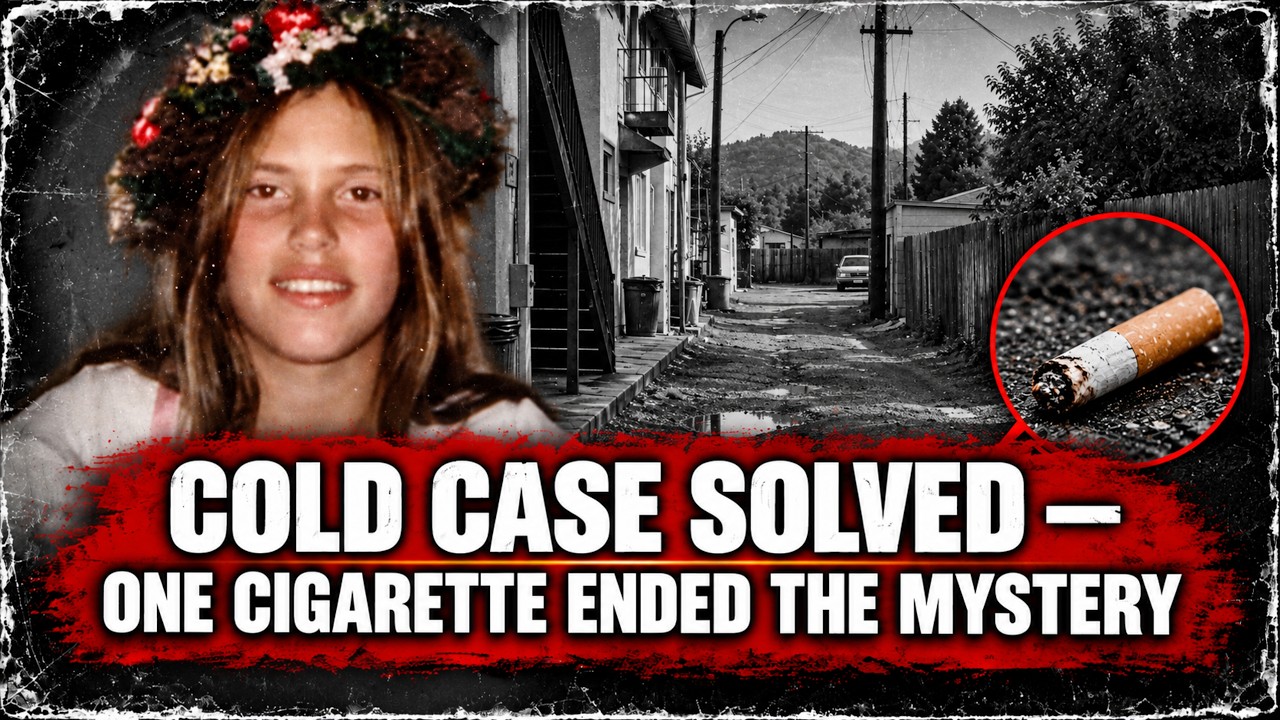
On July 22, 2024, detectives arrested James Oliver Unick at his home in Willows, California, more than four decades after 13-year-old Sarah Anne Gear was found strangled behind an apartment building in Cloverdale. The break in the case came not from a witness or a fingerprint, but from a cigarette butt the suspect discarded on the ground. Sarah was last seen alive on the night of May 23, 1982, at a video arcade on Cloverdale Boulevard. The following morning, two children playing behind an apartment building discovered her body.
Investigators collected biological evidence from her clothing and from the scene, but the DNA testing technology needed to identify a suspect did not exist at the time. Sarah lived with her mother, Susan, in a small yellow house on East 4th Street. She was a seventh grader at Washington School who loved horseback riding with her best friend Julie, often pretending the two were settlers living on the frontier. Friends remembered her as bright and imaginative, though she described herself as shy.
The investigation initially included an interview with Unick, who lived just blocks from where Sarah was last seen. A young officer named Lawrence Pina later described the conversation as brief and friendly. Unick said he had been with friends that night, an alibi that was never verified. With no criminal record and no reason to stand out, he was not considered a suspect.
By 2003, a criminalist with the California Department of Justice had developed a full male DNA profile from the biological evidence recovered in 1982. That profile did not match anyone in any law enforcement database at the time, and the case stalled again. In July 2021, Cloverdale Police Chief Jason Ferguson reopened the case and assigned Sergeant Baruso to lead the investigation. Working with the FBI, a private investigator, and Detective Katie Venon, investigators used investigative genetic genealogy to trace the DNA profile.
The results narrowed the field to one of four brothers, one of whom was James Unick. FBI agents then surveilled Unick until he discarded a cigarette butt on the ground. The DNA on that cigarette matched the 2003 profile and the biological evidence found on Sarah’s clothing in 1982. In June 2024, Detective Venon approached Unick directly and asked for a saliva sample.
He provided it and denied ever knowing Sarah Gear. The sample confirmed the match. On July 22, 2024, he was arrested and booked into the Sonoma County Jail without bail, facing charges of murder, kidnapping, and criminal acts against a child under 14. Cloverdale Police Chief Chris Parker called the arrest a bittersweet victory for justice.
While nothing can undo the pain inflicted upon the Gear family and our community, he said, we can finally offer some solace in knowing that the perpetrator will be held accountable. Unick’s trial opened in Sonoma County Superior Court in January 2026 before Judge Laura Paglia. Prosecutors built their case on three pillars: the DNA evidence, the timeline, and Unick’s inconsistent stories. Although the science had largely settled the question of guilt, Unick testified in his own defense, claiming Sarah had approached him at the arcade and that they had left together willingly.
He said they spent time near the Russian River and that he had dropped her back off afterward, suggesting someone else harmed her later. Prosecutors demonstrated that Sarah was in Santa Rosa, a 20-minute drive away, at the time Unick claimed to have met her. His own story placed her somewhere she could not have been. The defense, led by attorney Gabriel Quinon, argued that the evidence was decades old and that chain of custody over that many years deserved scrutiny.
Those arguments did not overcome three matching DNA samples. Several of Sarah’s friends, now in their late 50s, testified about that final weekend. None of them recognized Unick’s name. On February 13, 2026, after roughly two hours of deliberation, the jury found Unick guilty of first-degree murder with a special circumstance finding that the killing occurred alongside other serious crimes against the child.
The date fell on what would have been Sarah’s 57th birthday. Sonoma County District Attorney Carla Rodriguez called the case the coldest her office had ever brought before a jury. This guilty verdict is a testament to everyone who never gave up searching for Sarah’s killer, she said. Sentencing came on July 10, 2026.
Under California law, the special circumstance finding meant the outcome was already set. Judge Paglia sentenced Unick to life in prison without the possibility of parole. She told him, You robbed a child of her potential of her life and caused her to suffer in a most brutal way. Members of Sarah’s family submitted statements describing what more than four decades of unanswered questions had done to them.
Some had been children when Sarah died and grandparents by the time someone was arrested. The Sonoma County District Attorney’s Office said, No sentence can undo what was taken from this child or erase the pain her family has carried for the past 44 years. Unick showed no visible reaction and left the courtroom without addressing the judge. In the years between the murder and his arrest, Unick had become a respected figure in his own community in Willows, described by his own defense team as a beloved family member and a contributing member of his community.
Sarah Anne Gear is buried in a Mendocino County cemetery next to her mother, Susan, who died without ever learning who took her daughter. The case took 42 years to solve. The evidence that identified Unick sat in a police storage room the entire time, waiting for science to catch up with what the community already knew.