When Don Rickles walked onto a Las Vegas stage, audiences expected chaos to follow. But the man who spent six decades insulting Frank Sinatra, Johnny Carson, and audiences across America never saw himself as just a comedian. He wanted to be an actor, and he insisted until the end that his abrasive onstage persona was a carefully crafted performance. Rickles was born in New York City on May 8, 1926, and grew up in Jackson Heights, Queens.
He was the only child of Max and Eta Rickles. His father sold insurance and liked to tease people, a talent his son would absorb. Rickles later described himself as a shy child who learned early that humor could cross distances ordinary conversation could not. At New Town High School, he got involved in drama and eventually led the drama society.
After graduating in 1944, Rickles enlisted in the Navy. He later corrected interviewers who assumed he had been drafted. He served as a seaman first class aboard the motor torpedo boat tender USS Sirene, which moved through the Panama Canal into the Pacific. He remembered the Philippines and the oppressive heat.
He was honorably discharged in 1946 and returned home feeling like a man who had gone in as a kid. Civilian life did not immediately provide a clear path. Rickles tried selling insurance, air conditioners, women’s cosmetics, and even delivered meat while mopping a butcher shop floor. The work was not what he wanted.
He had always wanted to act. He enrolled at the American Academy of Dramatic Arts and graduated with the class of 1948, a school he would credit for decades afterward. Broadway did not open its doors. By the early 1950s, an agent found him a comedy job in New Jersey paying $25 a night.
More small clubs followed, including rough rooms and strip clubs where customers had not come to hear jokes. Playing to indifferent audiences became a form of training no acting school could offer. When hecklers interrupted, Rickles started answering them. He discovered that attention itself could be funny, and that the audience could become the material.
One early technique stuck. In tough clubs, he needed to shut down hecklers fast, so he began calling difficult customers “hockey puck. ” The phrase was almost meaningless, which made it useful. It sounded ridiculous rather than genuinely hateful, and it pulled a stranger into the temporary world of the act.
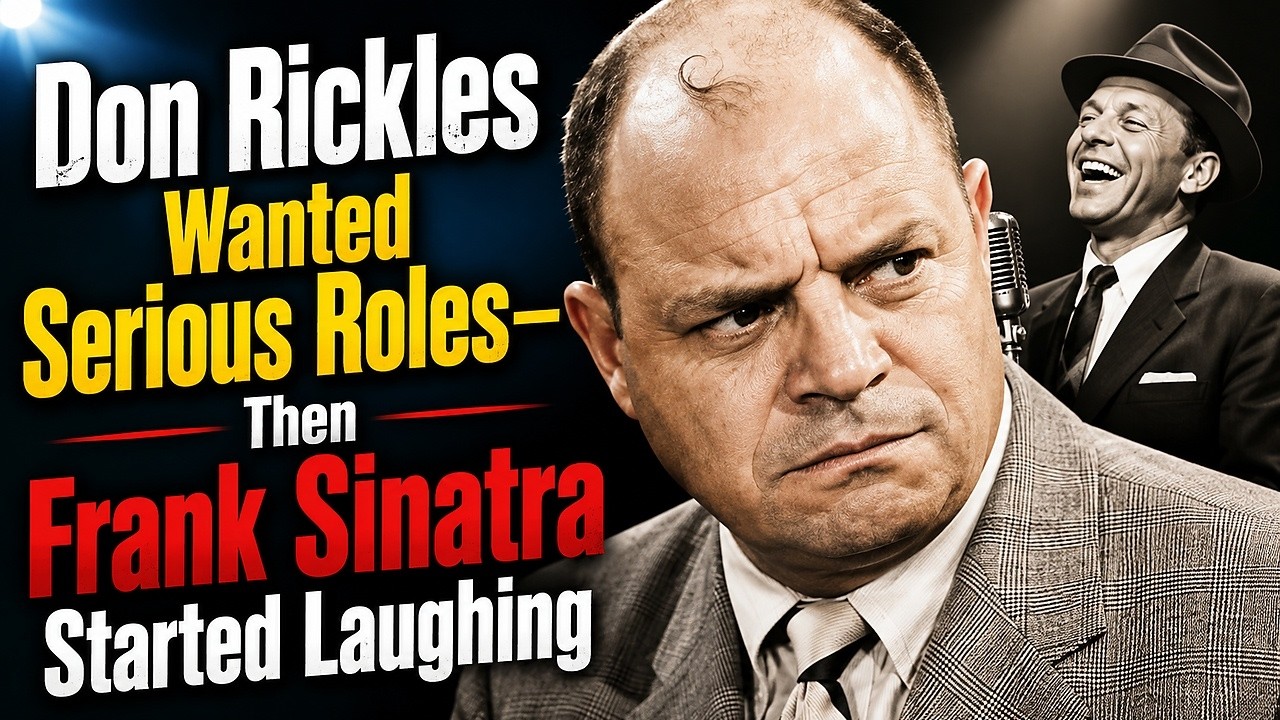
The turning point came in Miami Beach in the 1950s. Frank Sinatra walked into the club and sat within range. A struggling comic might have softened his act to impress a star. Rickles instead made Sinatra the target and told him to make himself comfortable by hitting somebody.
Sinatra laughed, and the moment became show business folklore. The approval of major stars validated the approach. Sinatra and Dean Martin became supporters, and being insulted by Rickles began to feel like a privilege. His mother, Eta, had helped push his career along.
Rickles described her as a force of nature, someone who talked to people, made introductions, and behaved as though the industry simply had not yet noticed her son. One of his stories involved Eta connecting with Dolly Sinatra, Frank’s mother, and helping persuade the singer to see Rickles work in Miami Beach. The details may have been polished over the years, but the durable fact is that Sinatra did see him and became an important supporter. By the late 1950s, Rickles was performing at the Slate Brothers Club in Los Angeles, often six nights a week in front of entertainment industry customers.
Ridiculing movie stars could have frightened an aspiring actor, but instead it made him memorable. While working there, he was cast in the 1958 submarine drama “Run Silent, Run Deep” with Clark Gable and Burt Lancaster. He played a Navy petty officer named Ruby, a fitting return for the former sailor who had entered acting school after the war. Las Vegas became his true home.
The city’s showrooms were built for performers who could command live crowds, and Rickles became associated with the Sahara and other major rooms. Bullfight music announced his entrance. He wore a tuxedo, and the formality made the attack funnier. The visual message said “distinguished entertainer” before the first lines demolished the dignity.
He scanned tables, spotted a face or posture, and began assigning roles: the tough guy, the cheap guy, the nervous husband, the waiter who should have stayed out of range. Television was slower to accept him. A club audience had chosen the room and could read his body language from a few feet away. Television broadcast the same words into millions of homes, detached from the shared understanding between performer and target.
That changed when Johnny Carson gave him room. Rickles made his first appearance on “The Tonight Show” in 1965. He interrupted, he mocked Carson’s success, and he treated the most powerful late-night host in America like an employee who had failed an inspection. Carson laughed instead of defending himself, and once again a major figure signaled that the aggression belonged inside the performance.
A pivotal friendship developed with Bob Newhart. The two made an improbable pair. Newhart’s comedy was quiet, cerebral, and controlled. Rickles seemed to have been fired from a cannon.
The contrast was part of the attraction, and each could make the other laugh. Their wives, Barbara Rickles and Virginia Newhart, became close, and the two couples traveled together and functioned almost like an extended family. Rickles frequently joked that the friendship would not have existed without their wives, but beneath the joke was a practical truth. The women created continuity that turned show business acquaintances into family friends.
Rickles married Barbara in 1965. She had worked as the secretary to his motion picture agent and did not respond to him as though she had been waiting for a celebrity comic. Rickles remembered having to pursue her. The marriage lasted for the rest of his life.
He told an interviewer in 1982 that Barbara had taught him a great deal and had helped him understand who he was, an admission from a man whose public identity depended on appearing absolutely certain of himself. They had a daughter, Mindy, and a son, Larry. The same period brought attempts to launch him in conventional television. “The Don Rickles Show” at the end of the 1960s was a comedy variety program.
A few years later, another series with the same title cast him as an advertising executive in a sitcom. Neither worked. A sitcom character repeats a set of relationships each week, while Rickles’s live power came from disrupting relationships before they settled. He had better luck with “C.
P. O. Sharkey,” which began in the mid-1970s and cast him as a Navy chief petty officer responsible for recruits. One memorable December 1976 moment captured the crossover between that show and Carson’s world.
Rickles appeared on “The Tonight Show” while Bob Newhart was guest hosting, and he broke Carson’s cigarette box while fooling around. The next night, Carson returned, discovered the damage, and walked his camera crew onto the “C. P. O.
Sharkey” set to confront Rickles in front of the sitcom audience. The intrusion surprised the production, and the comic who normally made others react suddenly had to react himself. In 1970, Rickles appeared in “Kelly’s Heroes,” an ensemble film led by Clint Eastwood. He played Crapgame, a supply sergeant caught up in a plan to steal German gold.
The film also brought him into contact with a young John Landis, who worked on the production as a gopher. Landis remembered Rickles tipping him at the end of the shoot. The connection would matter decades later. Rickles’s act grew more popular through celebrity roasts, where affection and public humiliation were already built into the evening.
A roast gave him an advantage because everyone arrived expecting abuse. The challenge was not whether he would insult somebody, but whether he could make the insult feel newly invented in that instant. He could attack the honored guest, the host, the band, another comedian, or a person seated far enough away to think they were safe. The term “Mr.
Warmth” captured the contradiction perfectly. It sounded like praise and mockery at the same time. Rickles could be introduced by a nickname that promised kindness while audiences waited for the first attack. Over the years, the ironic title became almost sincere, because the hostility had become a familiar form of welcome.
Later generations heard his ethnic and racial material differently from the mid-century club audiences who first encountered it. Some younger comics admired his fearlessness while rejecting the vocabulary. Others saw an equal-opportunity ridicule that briefly flattened status. Rickles himself insisted the act came from fun rather than hatred, and he was never mean-spirited was his own explanation and defense.
Still, humor built from race, religion, body type, accents, and national stereotypes inevitably depended on assumptions that could wound as well as amuse. He also understood the irony at the center of his career. In an interview late in life, he said plainly that he had always wanted to be an actor, not a comedian. He could laugh while saying it, but the sentence was not merely comic decoration.
The nightclub work bought the house, the car, and the comforts of family life, while movies and television were bonuses. Directors occasionally remembered he could disappear into another role. In 1995, Martin Scorsese cast him as Billy Sherbert in “Casino,” a casino manager and associate of Robert De Niro’s character. The part was restrained.
Rickles later joked that the role made him look nearly mute because he had so little dialogue. Scorsese told him his presence was enough, and for a performer who had spent decades proving himself through relentless verbal motion, that was a profound form of trust. The same year brought an entirely different reinvention. Pixar released “Toy Story,” and Rickles supplied the voice of Mr.
Potato Head. The filmmakers wanted a character who questioned authority and carried a chip on his shoulder, and Rickles’s voice already contained that history. Children who had never heard of Sinatra or the Sahara recognized the personality in a new form, and the transition proved his career could not be explained as simple nostalgia. Work also brought Larry Rickles into his father’s professional world.
Larry built a career in television production and writing, including work on “Murphy Brown” as a writer. When John Landis wanted to make a documentary about Don Rickles, Rickles resisted. His live comedy depended on the immediate room, and a recording could not fully preserve the social temperature that made it land. Larry’s involvement changed his father’s mind.
The result was “Mr. Warmth: The Don Rickles Project,” which captured Rickles performing and placed the performance beside testimony from targets, colleagues, and friends. The documentary was recognized in 2008 when Don won an Emmy for his performance. The special itself also won, with Larry among the producers recognized.
Rickles was already in his 80s, and the Emmy gave formal confirmation to something the industry had taken decades to acknowledge. The thing he had done in rooms for years was not merely verbal aggression. It was performance craft. Then came a loss no craft could organize.
Larry Rickles died in Los Angeles in December 2011 at age 41. Contemporary reports attributed the death to respiratory failure related to pneumonia. Larry had become a creative partner as well as a son. Don did not turn the death into public material, and the record shows he continued working.
Physical limitations eventually changed his stage life. Later interviews described mobility problems that led him to perform seated more often. The body could no longer execute the old choreography, but the mind and timing remained the test. He could sit and still scan.
He could pause and still make a room nervous. The act had begun as a full-body confrontation, but its core was attention. In his late 80s, Rickles continued to perform and welcomed tribute from younger comedians. Jimmy Kimmel had grown up watching Rickles and became a friend after repeatedly trying to book him.
Rickles treated the younger host with the same mock contempt he once aimed at Carson, but the generational meaning had changed. Kimmel was welcoming a figure whose legitimacy had become part of comedy history. In the last months of his life, Rickles worked on “Dinner with Don,” an unscripted series built around restaurant conversations with entertainers from different generations. Guests included Robert De Niro, Martin Scorsese, Billy Crystal, Jimmy Kimmel, Amy Poehler, Paul Rudd, Sarah Silverman, Snoop Dogg, and others.
The premise placed Rickles where he had always been strongest, inside a relationship rather than behind prepared material. People working on the series noticed the contrast between his physical frailty and the energy that appeared when cameras rolled. On April 6, 2017, Rickles died at his home in Los Angeles. He was 90.
His publicist said the cause was kidney failure. Barbara, his wife of more than half a century, survived him along with their daughter Mindy and grandchildren. The public response revealed how completely the insult had been absorbed into affection. Comedians, actors, hosts, and friends described him as sweet, generous, kind, and beloved.
There was no contradiction in those reactions for people who knew the rules. The attack had always depended on a second message: You were worth noticing. You were in the room. You were part of the event.
“Dinner with Don” was released after his death. The finished project comprised 13 episodes and became the last major work of his career. Two years later, another final performance appeared in a form Rickles could not have planned. He had agreed to return as Mr.
Potato Head in “Toy Story 4” but died before recording new dialogue. The filmmakers preserved his voice by searching more than two decades of recordings connected to the Toy Story world. They went through previous films, outtakes, shorts, games, attractions, and other material, cataloging fragments of sound that could fit the new story. The process was almost the reverse of his original art.
His nightclub comedy had depended on the unrepeatable present, but “Toy Story 4” built a new performance from the recorded past, assembling words after the performer was no longer there to see the scene. The result still sounded like him. In 2023, Judd Apatow presented a short documentary about the friendship between Bob Newhart and Don Rickles. Home movies and family memories shifted the emphasis away from the professional contrast audiences knew so well.
The private footage showed something less marketable and more durable: two families growing older together. Children, vacations, wives, repeated rituals, and decades of companionship made the friendship legible without a nightclub microphone. The simple description of Rickles as a secretly nice insult comic finally becomes too small. He was not interesting because the public man was false and the private man was true.
The public man was also true, but concentrated. He took real instincts, observation, aggression, affection, insecurity, and speed, and arranged them into a role sturdy enough to survive changing audiences. His acting ambition did not fail in the way he sometimes joked that it had. It changed form.
He did become an actor. He simply became most famous for acting a character that carried his own name, a role he wrote in real time for more than half a century.