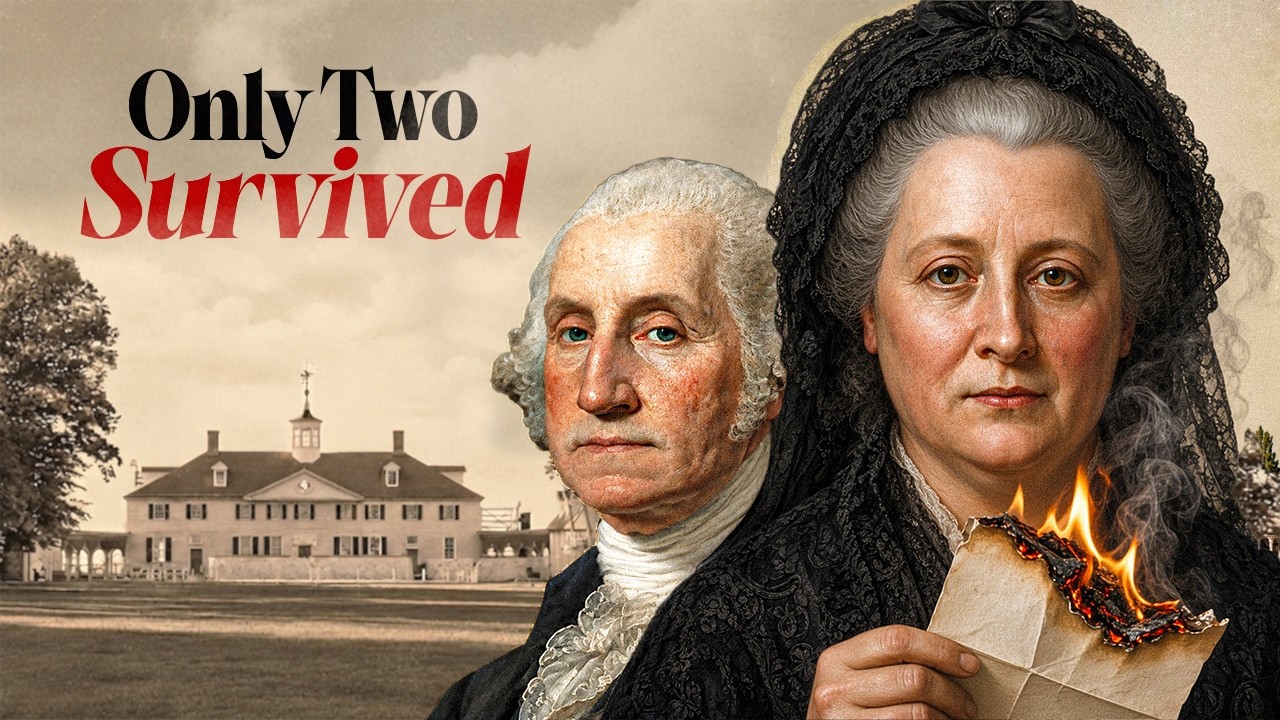
Within hours of her husband’s final breath in December 1799, Martha Washington closed the door to the second-floor bedroom she had shared with George Washington for forty years and never slept in it again. In the weeks that followed, she sat alone with a wooden box filled with letters — forty years of correspondence spanning two wars, a presidency, and every private word her husband had ever written to her. One by one, she fed them to the fire. Martha Dandridge Custis Washington was the most documented woman of the founding generation, and she made certain the world would never read a single private word she exchanged with the man who founded the nation.
Her story is not primarily about a country, though her marriage helped shape one. It is about what a person carries when history demands strength in public and never asks what it costs in private. Born in 1731 on a modest Virginia farm called Chestnut Grove, Martha was the eldest of eight children. Her father, an English immigrant who became a county clerk, gave her something many girls of her class were denied: a real education.
She learned to read early and well, to write in a clear, confident hand, to ride, to tend a garden, and to play the spinet on quiet evenings. Her early life gave no hint of either the wealth or the losses that awaited her. Her first husband was not George Washington. Before Mount Vernon, before the title “Lady Washington,” there was a plantation called White House on the Pamunkey River, where an eighteen-year-old girl married a man twice her age.
His name was Daniel Parke Custis, a 38-year-old heir to one of the largest fortunes in the colony — 18,000 acres, tobacco ships bound for London, and more enslaved people than nearly any other family in New Kent County. By the standards of the eighteenth century, it was an excellent match. For a time, it was also a happy one. Martha gave birth to four children in that house.
A son named Daniel arrived in 1751, and a daughter named Frances in 1753. Neither lived to see a fifth birthday. Then came John, called Jacky, in 1754, and Martha, called Patsy, in 1756. These two survived.
By the age of twenty-five, Martha had learned the arithmetic that would define the rest of her life: love does not protect anyone from loss. It only makes the loss greater. In July 1757, Daniel Custis fell suddenly ill with what contemporaries called a throat infection. He died within days, leaving no will and no instructions.
Under colonial Virginia law, his estate fell to his widow to administer directly. Martha, age twenty-six, sat down to review the records of one of the largest fortunes in the colony — more than 17,000 acres, tens of thousands of pounds in cash and credit, and roughly 300 enslaved people bound to the land. Overnight, she became one of the wealthiest widows in Virginia and one of the few women in the colony legally entitled to manage her own affairs. She was also, by every account, still in mourning.
Suitors arrived within months. One was Charles Carter, a planter twice her age with twelve sons from two previous marriages. Another, less famous and less wealthy, arrived in March 1758. He was a 26-year-old colonel in the Virginia militia, tall and quiet, who owned a farm called Mount Vernon that he did not yet fully own.
His name was George Washington. He visited once, then returned nine days later. Whatever passed between them in those two short visits was enough. By the time Washington returned to his regiment, both had begun planning a life together.
For the wedding, Martha ordered fabrics and shoes from London — bright purple slippers and a dress she specified in her own words: “handsome, but not extravagant, and not to be mourning. ” They married on January 6, 1759, in the parlor of the house Martha still considered her home. No letter or diary from the bride or groom describing that day survives. Only the official registry and the dress itself remain.
Historians still disagree about the foundation of that marriage. Some point to the timing, the hints, and the enormous wealth Washington gained by signing the marriage register, calling it a deal dressed as a love story. Mount Vernon’s records describe something closer to a marriage built on affection — two compatible people who built what more than one visitor called a genuine partnership. The truth probably lies somewhere in between, as colonial Virginia marriages rarely were one thing alone.
What is certain is what followed. Martha took her two surviving children — five-year-old Jacky and three-year-old Patsy — to a new home, a new farm, and a new name. George Washington, who never had children of his own, approached fatherhood with more warmth than his reserved reputation suggests. He ordered toys from London, worried over Jacky’s education, and family letters recall a doll he once ordered for Patsy that arrived, to his annoyance, months late.
For sixteen years, this was simply a family — what historians of the period call, without much exaggeration, the golden years. A working plantation, two growing children, and a marriage that settled into something far more solid than the arrangement it began as. Every morning Martha rose early to oversee a household run as much by her records as by George’s. Food for dozens of people, linens, medicines, and endless accounts for a self-sufficient estate.
She supervised cloth production, meat smoking, and the steady stream of visitors who expected Virginia hospitality and received it. George rode his fields every morning and returned home every night. It was a life measured in small, repeated tasks — the kind history rarely records and the kind Martha herself seemed to prefer. By the early 1760s, Patsy had become a source of quiet worry.
She suffered from seizures that came without warning, then receded, then returned. Treatments ranged from bloodletting and imported tonics to a metal ring she wore on her finger, sold to her by a Williamsburg doctor as a cure for epilepsy. Martha spent years searching for a cure of her own, corresponding with relatives about remedies and consulting every physician who passed through Mount Vernon. By 1768, the seizures had grown longer and closer together.
In the months before her death, Patsy suffered convulsions on 26 separate days over a ten-week period, sometimes twice a day. George Washington, always precise in his records, noted each seizure in his diary, often with a single terse word: fit. On the evening of June 19, 1773, Mount Vernon was full of guests, including Eleanor Calvert, the fifteen-year-old fiancée of Jacky. At dinner, more than one guest later recalled, Patsy seemed healthy — genuinely well, for the first time in longer than anyone could remember.
She rose from the table with a smile and went to her room to fetch a letter Jacky had recently sent from college. Moments later, Eleanor heard a strange sound from inside. She found Patsy on the floor in a seizure unlike any she had witnessed. There was no recovery this time.
Patsy Custis died within minutes, at seventeen. George Washington recorded her death that night in four words: “Died poor Patsy Custis suddenly. ” The next day he wrote to his brother-in-law with more words, though not many. The eighteenth century did not possess a wide vocabulary for this kind of grief, and Washington, never an emotional writer, chose the strongest words he could find.
“It is easier to imagine than to describe the distress of this family,” he wrote, “especially of the unhappy parent of our dear Patsy Custis. ” He described only the effect on Martha, writing that the loss had brought his poor wife to the lowest depths of misery. That is the closest written description we have of what Martha felt that summer. No letter of her own survives from those weeks.
What remains instead is the shape of her absence from the records — that silence where her voice should have been at the moment a mother’s voice matters most. Modern medical historians, based on Washington’s diaries, the number and timing of the seizures, and descriptions of her final moments, believe Patsy died of what doctors now call sudden unexpected death in epilepsy — a complication entirely unknown to eighteenth-century medicine. Martha was forty-two. She had now buried three of her four children.
Only Jacky remained. The war came to Mount Vernon in June 1775, when Congress appointed George Washington commander-in-chief of the Continental Army. For most of the next eight years, he did not see his home except for one brief visit. Martha made a decision that surprised no one who knew her: she would not simply wait at Mount Vernon for letters.
In nearly every winter of the war, when fighting slowed and the army settled into camp, she traveled north to join him — to Cambridge, to Morristown, and to a frozen stretch of Pennsylvania farmland called Valley Forge. She did not go as a spectator. At Valley Forge, during the brutal winter of 1777–1778, Martha organized officers’ wives into sewing circles, mending uniforms and knitting socks for soldiers who had none. She copied Washington’s correspondence by hand, hour after hour, so his letters went out faster than one man could write alone.
She dressed plainly before visiting officers — a deliberate choice, according to more than one account. Soldiers who left accounts of that winter remembered her not as a general’s wife but as an essential part of camp life: present, useful, indifferent to the cold and the smell of illness moving among the tents. Jacky did not go with her, at least not at first. Twenty years old when the war began, he showed little interest in soldiering.
He married Eleanor Calvert in 1774, bought his own farm, and spent most of the war managing his lands rather than fighting. He asked to join only in 1781, when Washington’s army marched south toward Virginia to besiege a British force under Lord Cornwallis at a small tobacco port called Yorktown. He asked his stepfather directly that spring for a place on his staff — not to command men, which he had never trained for, but for a role close enough to matter. Washington agreed.
Jacky joined the army not as a soldier but as a civilian aide to his stepfather. The siege of Yorktown lasted three weeks. On October 19, 1781, Cornwallis surrendered his entire army. It was, by every measure, the victory that ended the war.
Somewhere in the crowded camp, Jacky had already picked up what soldiers called camp fever. Most historians now believe it was typhus, spread by lice and filth in crowded conditions. He was too ill to travel far. His family moved him to Eltham, a nearby plantation owned by his uncle Burwell Bassett — the same uncle who had received the letter about Patsy’s death eight years earlier.
Martha and George rode to his bedside as soon as news reached them. By the time they arrived, the medicine of that age could do little but keep him comfortable and wait. John Parke Custis died at Eltham on November 5, 1781, at twenty-six, seventeen days after the surrender that would remain in American memory as the moment of the war’s victory. The war that made George Washington a legend took, at the same time, the last child Martha Washington had left to call her own.
She was fifty. She had now buried a husband and every child she had carried. Four out of four over thirty years, none of them reaching thirty. There would be no more children.
What remained instead were Nellie and Washy, Jacky’s two youngest children, aged four and seven, whom his widow agreed to send to Mount Vernon to be raised by their grandparents. They arrived within a year, too young to fully understand what they had lost, moving into a house that had already lost so much. George Washington, who had raised Jacky and Patsy without fathering children of his own, began the process again as a grandfather in practice, if not yet in law. Martha, who had already raised two children through a war and buried them both, began again as well.
It was not a life she had planned. But she did it anyway. The war ended officially in 1783. Washington retired to Mount Vernon, hoping for a quiet final chapter.
It lasted six years. In 1789, the newly formed United States asked him to become its first president, and asked Martha to become something the country had never seen and for which it had no word. Martha arrived in New York to find the city had already decided what to call her. “Lady Washington” was common, as was “Mrs.
President,” an expression no one much liked but no one could improve upon. There was no precedent for the role because the role had never existed. Every Friday evening, Martha hosted a formal reception, or “drawing room,” where she stood for hours receiving members of Congress, foreign diplomats, and anyone of standing who wished to be seen shaking the president’s wife’s hand. The evenings were governed by strict rules of protocol.
She could not simply walk through the streets of New York the way she had freely ridden in Mount Vernon. Even a short errand to a shop could draw a small crowd within blocks. Every appearance was watched, reported, and judged. Five months into the role, she confided her feelings to her niece in a letter with a frankness she rarely showed: “I think I am more like a state prisoner than anything else.
There is certain bounds set for me which I must not depart from. ”
She held the position for eight years across two capitals and never stopped feeling that way. She missed Mount Vernon specifically and by name in letter after letter, asking about the garden roses, the state of the fence, whether the geese had returned that spring. Small, ordinary questions from a woman running a household she was simply not allowed to return to.
In 1797, the second term ended, and George Washington did something few leaders in history have done voluntarily: he gave up power while still holding it and returned home. Martha was sixty-five. She had spent nearly a decade as a symbol. They had two years.
For a while, it seemed they had recovered their golden years. Then, in the second week of December 1799, Washington went out to inspect his fields in freezing rain and came home with a throat infection he dismissed. By the following evening, it had worsened into something that made breathing difficult. For nearly two days, the household did what families of that age did when facing serious illness: called every available doctor, tried every possible treatment, and waited.
The doctors bled him repeatedly — the standard treatment of the time, which certainly did more harm than the disease itself. Tobias Lear, Washington’s secretary, recorded those final hours with precision. Martha sat at the foot of the bed through the worst moments, silent, doing what could be done, which by the second night was little. George Washington died at Mount Vernon on the night of December 14, 1799.
His last recorded words, as he felt his own pulse in his final moments, were simple: “Tis well. ” Martha’s first act as a widow left no room for doubt. Within hours, she moved out of the second-floor bedroom she had shared with George for forty years and never slept in it again. She set up a small room on the third floor, tucked under the roof, and there she spent nearly two and a half years of her remaining life.
Visitors who met her there described a simply furnished room with one window, containing little that hinted at the life she had lived downstairs for four decades. One thing remained undone. No single record identifies the exact day. What survives is a family memory passed down through generations, eventually recorded by someone who was in that house: the memory of Martha Washington in the weeks after her husband’s death, sitting alone with a box of letters and a fire that did not stop until the box was empty.
According to her granddaughter Martha Parke Custis Peter, who was in her twenties at the time and close enough to the family to visit constantly: “Soon after General Washington’s death, Mrs. Washington burnt all these letters except two, which appeared to have escaped by accident. ”
Forty years of letters, condensed in her account to a single sentence. Every page her husband had written her across two wars, a presidency, and a marriage watched by the entire world from the outside, without ever being allowed to read a single private word of it.
One by one, she fed them to the fire. It was not one letter thrown in a moment of anger. It was forty years, reread page by page, by a woman who had spent her adult life learning how to let go of the things she loved. She did not burn everything in the house.
Washington’s public papers, his official correspondence, his military orders — the vast archive that would eventually fill the Library of Congress — she left untouched, understanding even then that they belonged to history, not to her. What she destroyed was smaller and far more private: letters between a husband and wife, the ones that had no reason to exist except that two people, over forty years, were sometimes apart and wanted to say so to each other. By the time she finished, almost nothing remained. Historians who have searched every archive, every family collection, every attic and desk connected to the Washington and Custis families over two centuries have found only two letters surviving from that entire correspondence.
Both were written in June 1775, in the earliest and most uncertain days of the war, immediately after Congress asked George to take command of an army he was not sure he could lead to victory. One is dated June 18, 1775, four days after Congress appointed him commander-in-chief. He wrote to tell her what he had agreed to and why. He told her he had tried to avoid the appointment.
He told her that if fate decreed he should not return home, he had already written his will and wanted to ensure her care. The letter is hesitant, almost apologetic in parts — a far cry from the composed public character history remembers. It survived because Martha chose not to burn that particular page. One letter out of forty years, a single exception she made and never explained.
Historians still argue about why she burned the rest. The most common explanation, offered by biographers and repeated by Mount Vernon itself, is privacy: Martha, who spent a decade as a public figure watched and written about by strangers, made a final decision about what the public would never be allowed to see. Other historians point to something more concrete: a woman protecting not only her privacy but the public image of her husband at a moment when his letters — unedited, hesitant, sometimes anxious, sometimes quick-tempered — might have complicated the solemn, perfect image the young country was building around him. According to this theory, the fire was not an erasure of herself.
It was a final act of care for a man who could no longer decide for himself what the world would see of him. Both theories are reasonable. In the end, both are only theories. Martha left no letter of her own explaining why she burned the rest.
Of course she did not. Consider what this means. Martha Washington is among the most documented women in American history. Her household accounts survive line by line.
Her recipes for food still exist. Her wedding dress remains, preserved at Mount Vernon to this day. The letters written about her — by her husband, by visitors, by generals and presidents and grandchildren — fill volumes. Historians can tell you what she served at dinner at Valley Forge, how many enslaved people worked her land, down to their names, and in which year she ordered new curtains for a sitting room she rarely sat in.
What no one can tell you with any real confidence is what she actually felt, in her own words and her own hand, about the husband she married at twenty-seven, the four children she buried, the war that took the last of them, or the forty years in between. She made sure of that. The most documented woman of the founding generation chose, in the end, to be the least known. Perhaps that was the final private decision available to a woman who spent decades with almost no decisions of her own.
Everyone else in her story got to keep their letters. Martha kept only silence. And one letter, folded and unburned, unexplained by anyone — not even by herself. Her final two and a half years were quiet.
She kept mostly to her small third-floor room, where visitors noted she could look toward the spot where George was buried. In January 1801, she freed the enslaved people owned by George Washington, complying with his will’s instructions a year earlier than the will itself required. The enslaved people she owned herself — those she had inherited decades earlier from her first husband Daniel Custis — she did not free. She kept them until her death and beyond.
That fact, like other parts of her story, is not easy to accept. Her health, never entirely strong, began to fail in early May 1802. What her family called yellow fever took hold of her. She recognized within days that this illness was different.
She asked her family to come. They came. Children, grandchildren, and in-laws arrived from across Virginia to sit with her while there was still time. She received her last communion.
She said goodbye to everyone one by one in a room crowded with people. According to more than one family account, she chose the dress she wanted to be buried in — a simple white gown set aside and ready before her breathing stopped. She died at Mount Vernon on the evening of May 22, 1802, at seventy. Her granddaughter’s husband, Thomas Law, was in the house that week and later described the scene.
“She exhibited in everything fortitude and resignation,” he said. “She met death as a relief from the infirmities and dejection of old age, bereft of all that she held valuable in life. ” A harsh sentence, but by his account not a cruel one. In his view, it was simply fact.
Newspapers across the young country ran brief obituaries in the weeks that followed. They wrote that Martha Washington was the most worthy partner of the most worthy man. It was intended as the highest praise that age could offer. It was also, in its own way, the final small irony of her story: a woman defined in her obituary entirely by her relationship to someone else, in a country that never asked and would never know what she thought of it all, in her own words.
She was buried beside George in the old vault at Mount Vernon, within sight of the room where she had spent her final years watching the world. Martha Washington spent her life learning how to lose the people she loved. A husband, then a second husband, four children, and finally, by her own hand, the private record of a marriage that outlived them all. She was among the most written-about women of her era, and she made certain that the only voice absent from all of it was her own.
The fire went out long ago. The wondering has never stopped.