At 1:00 in the morning on January 27, 1949, agents knocked on the door of Lina Stern’s apartment in Moscow. They told the 70-year-old scientist that Lavrentiy Beria, the head of Stalin’s secret police, had invited her for an interview. She suggested it could wait until morning. They said it would be impolite to keep the director of State Security waiting.
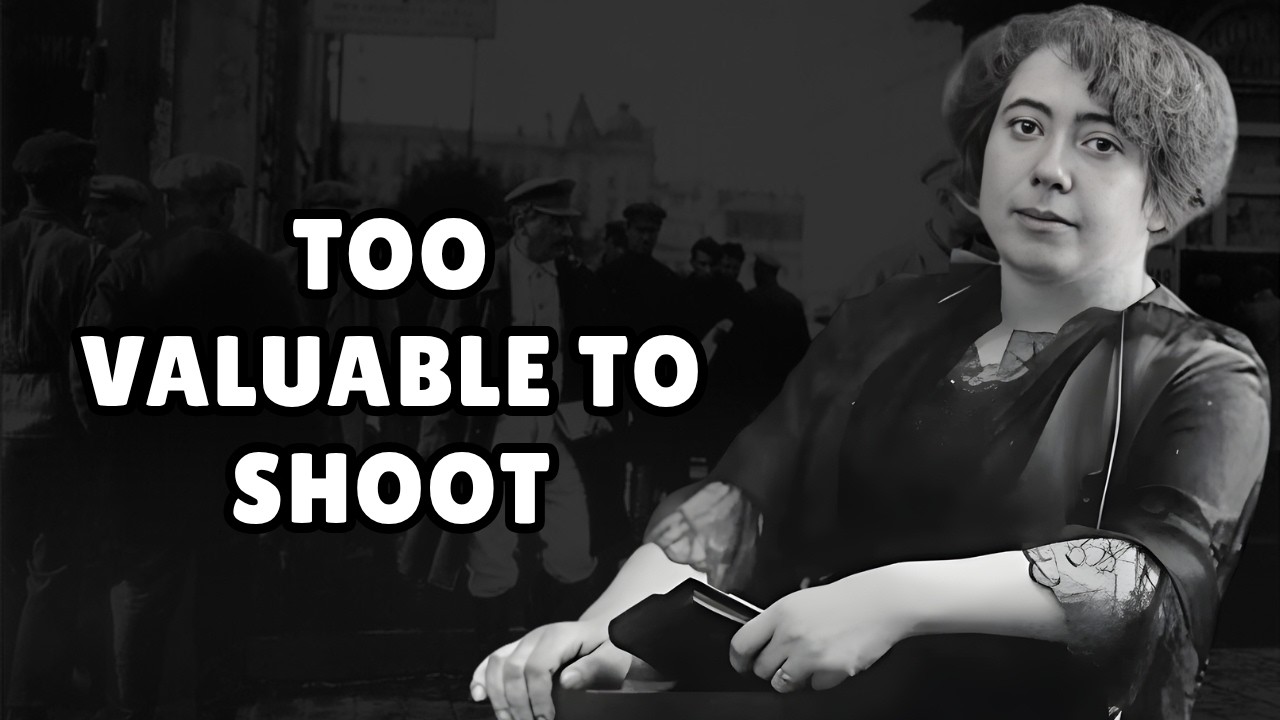
Stern had spent her life refusing powerful men. She had defied the Tsar’s empire, the oldest university in Switzerland, and even Stalin’s own daughter. But this time, refusal did not work. She was taken to Lubyanka, the notorious prison where Stalin’s enemies disappeared.
Born in 1878 in Liepāja, a Baltic port city in what is now Latvia, Stern grew up in a prosperous Jewish family. In the Tsar’s empire, that meant certain doors would never open. She wanted to study medicine at Moscow University, but the institution rejected her because she was a woman and Jewish. Russian universities were closed to both.
In 1898, at age 20, she went to Geneva. She was far from alone. Nearly half the students in Geneva in those years were Jewish women from Russia, all turned away by the same empire, all arriving in the same Swiss city because there was nowhere else to go. In Geneva, Stern worked and earned her doctorate in 1903.
She returned to Russia briefly but found nothing, as her Swiss degree was not recognized. She went back to Geneva when her professor offered her a post. She did not return to Russia for 22 years. She published, researched, and taught.
In 1918, the University of Geneva awarded a woman a full professorship for the first time in its history. The institution had never done it before, but the work was too important and the scientist too good to justify refusing any longer. On April 21, 1921, Stern stood before the Medical Society of Geneva and introduced a concept that had never been named. She called it the hematoencephalic barrier, now known as the blood-brain barrier.
The term is still used in every neuroscience laboratory in the world, and every pharmaceutical company developing drugs for the brain works around the mechanism she defined. By the early 1920s, she was a professor, a published scientist in multiple languages, a consultant to pharmaceutical companies, and financially independent. Russia had told her she was not good enough. She had built all of it without the country.
In 1924, an old colleague from Geneva, biochemist Alexei Bach, wrote to her from Moscow. He offered her the chair of the physiology department at the Second Moscow State University. Her Geneva colleagues urged her not to go, and they kept her professorship and apartment open for five years in case she changed her mind. She did not change her mind.
On March 31, 1925, Stern arrived in Moscow at age 48. She celebrated that date as a second birthday for the rest of her life. She adapted to the shortages, the cold, the communal living, and the bureaucracy. But she did not adapt to being controlled.
In Stalin’s Soviet Union, science was not a free pursuit. Ivan Pavlov, the Nobel laureate and most celebrated scientist in Russian history, had been elevated to something close to official doctrine. Alignment with Pavlov meant political reliability. Disagreement meant suspicion.
Stern and Pavlov did not get along. They appeared together at International Physiological Congresses in Boston in 1929 and Rome in 1932, but their scientific views clashed and their personalities were incompatible. In Geneva, that would have been an interesting professional disagreement. In Moscow, it was a political signal.
In 1935, Stern organized the 15th International Physiological Congress in Moscow and Leningrad, the largest international scientific gathering the Soviet Union had ever hosted. Hundreds of leading scientists came at her invitation. In 1939, she became the first woman ever elected full member of the Soviet Academy of Sciences. In 1943, Stalin awarded her the Stalin Prize, the highest civilian honor the state could give.
Still, she would not conform. When Stalin’s daughter, Svetlana, personally requested streptomycin for a sick child of close friends, Stern refused. The antibiotic was for research only, she said. She had said no to Stalin’s daughter.
The state had honored her with its highest prize and used her name, reputation, and Western connections for its own purposes. But it had never controlled her. In Stalin’s Soviet Union, that was not something the state would tolerate indefinitely. In early 1942, with German forces deep inside Soviet territory, Stalin made a calculation.
He needed money from the West, and he needed Jewish communities in the United States and Britain, which had money and political influence, to support the Soviet war effort. He created the Jewish Anti-Fascist Committee, appointing Solomon Mikhoels, the most celebrated Yiddish actor in the world and director of the Moscow State Jewish Theater, as its chairman. In 1943, Mikhoels and poet Itzik Feffer toured the United States, Canada, Britain, and Mexico, drawing enormous crowds and raising over $45 million for the Soviet war effort. Stern’s international scientific reputation made her too valuable to leave out.
Stalin attached her to three of his five Anti-Fascist Committees simultaneously: the scientists, the women, and the Jews. Her name, reputation, and Western contacts were now in Stalin’s service. When the war ended, the committee’s usefulness ended with it. The Western connections it had been built to exploit were reframed.
They were no longer assets. They were evidence. In the Cold War logic of Stalin’s post-war Soviet Union, every relationship with the West was now a potential act of treason. In January 1948, Stalin had Mikhoels murdered.
He was lured to a house outside Minsk, killed, and his body dumped on a road. The death was staged as a traffic accident. Stalin signed the obituary himself. By the end of 1948, Stalin had dissolved the Jewish Anti-Fascist Committee and declared it an anti-Soviet organization.
Its members were being arrested one by one. The attack on Lina Stern began the same year. On October 5, 1948, a joint scientific session of the Academy of Sciences and the Moscow Society of Physiology was convened. It was not a scientific meeting.
One by one, eminent scientists who had sat at her conferences stood at the podium and attacked her. Her research was called anti-Pavlovian, her methods pseudo-scientific, and her Western connections proof of disloyalty. When they were done, Stern stood up alone and answered every word. The session had one purpose: to silence her publicly before the state acted against her privately.
It did not silence her. On January 27, 1949, they came for her at 1:00 in the morning. Interrogations lasted up to 24 hours. She was sent to the punishment cells of Lefortovo prison, which she later described simply as hell.
At interrogation, they accused her of prostituting herself at scientific conferences abroad. She responded that at her age, she would be the one who had to pay. She was charged with espionage for the West, the West whose scientists she had brought to Moscow on the Soviet state’s behalf, whose money she had helped raise for the Red Army, and whose contacts she had maintained because the state had asked her to. The trial ran from May to July 1952.
There were no defense attorneys, only three military judges. The evidence was confessions extracted under torture. Even the presiding judge expressed doubt about whether the evidence justified the verdict. The Politburo overruled him.
Thirteen of the fifteen defendants were sentenced to death. One had already died in prison. The Minister of State Security recommended all defendants be executed with one exception: Stern should be exiled. On the night of August 12 and 13, 1952, the night of the murdered poets, 13 members of the Jewish Anti-Fascist Committee were shot in the basement of Lubyanka prison.
Mikhoels had been murdered four years earlier. Now the rest followed. Stern was put on a train to Dzhambul, Kazakhstan. Stalin died on March 5, 1953.
Stern had spent 10 months in Kazakhstan. She returned to Moscow. At 76 years old, she was given back a laboratory, resumed her research on the blood-brain barrier, and organized five more international conferences before she died. She never spoke publicly about what had happened, not once.
Lina Stern died on March 7, 1968, at age 89. She is buried at Novodevichy Cemetery in Moscow. The Tsar said she could not study medicine in Russia. She went to Geneva and became its first female professor.
The Soviet state said conform to Pavlov. She refused. Stalin’s daughter asked her for a favor. She said no.
Stalin built a committee around her name and connections, used her reputation to raise $45 million, then arrested her for the very connections he had told her to maintain. At 70 years old, in the punishment cells of Lefortovo prison, she did not break. Stalin could not shoot her. Her mind was too valuable to him.
He could not break her. He closed her institute, dismissed her colleagues, erased her from official histories, shot the people who had stood beside her, and sent her to Kazakhstan. But he could not erase what she had already put into the world. The blood-brain barrier carries her name.
The building in Geneva carries her name. Every drug developed for diseases of the brain works around the mechanism she defined in 1921, in a city that had opened its doors when Russia would not.