Judy Garland walked onto the stage at Carnegie Hall on April 23, 1961, wearing a tuxedo jacket. By that point she had endured two failed marriages, a career that had nearly collapsed, and years of dependence on pills that had been administered to her by studio doctors since she was a teenager. The audience lost themselves completely that night. What makes the recording remarkable decades later is not just the voice, but the feeling behind it, the sense of someone performing from a place most performers never reach, because most performers have not survived what she survived just to get there.
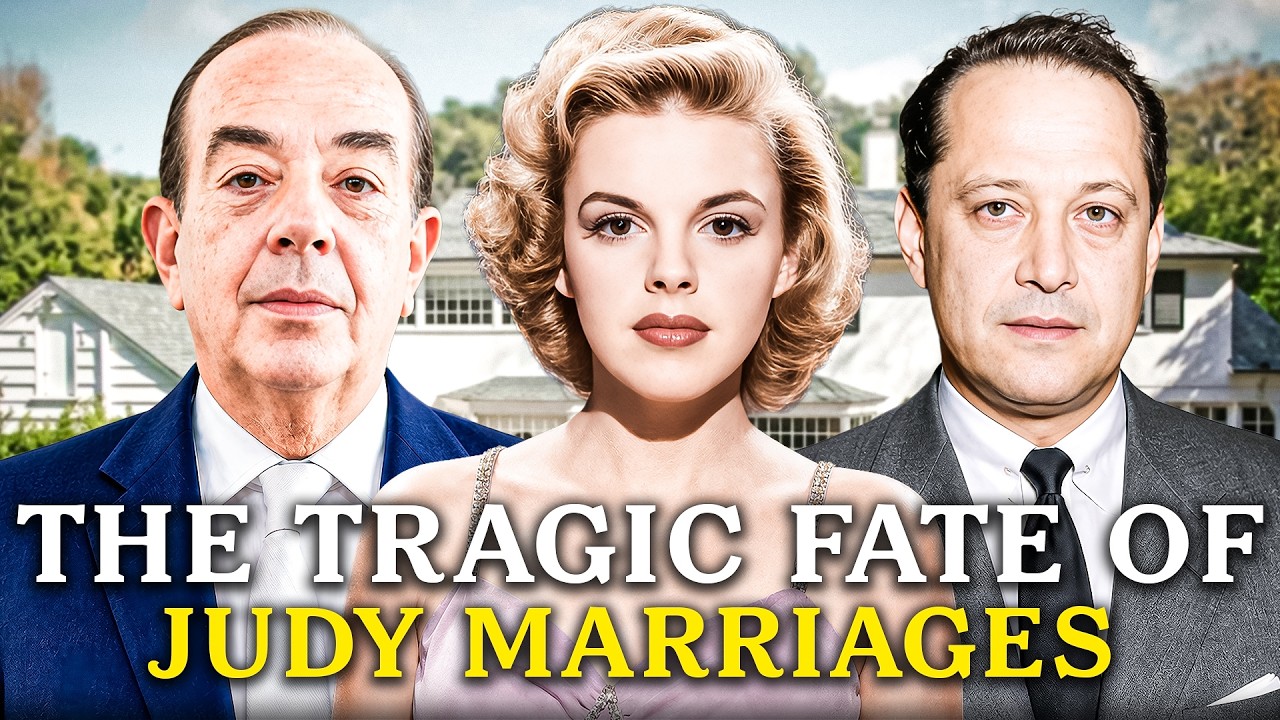
Garland was married five times. Each marriage, in its own way, reflected who she was at that moment in her life, what she needed, what she hoped for, and what the world she lived in was willing to give her. To understand any of those marriages, it is necessary to understand what had been done to her before the first one began. Frances Ethel Gumm was born on June 10, 1922, in Grand Rapids, Minnesota.
She was the youngest of three daughters of Frank and Ethel Gumm, both vaudeville performers who put their children on stage from the moment they could walk. Frances was performing publicly by the age of two and a half. Her mother, Ethel, was the driving force, a woman whose own frustrated ambitions were transferred wholesale onto her daughters, and onto Frances in particular, with an intensity that the word “pushy” does not fully capture. The family moved to California when Frances was four.
She performed in local theaters, radio spots, and any venue that would have the Gumm sisters. Her talent was recognized immediately by even the most jaded entertainment professionals. She was not just a pretty child who could sing, but someone with an emotional directness in her voice that was genuinely unusual. In 1935, at age 13, she was signed by Metro-Goldwyn-Mayer.
What happened to her at MGM over the following decade was, by any honest account, a form of sustained harm inflicted on a child and then a young woman by an institution interested in her output, not her well-being. Louis B. Mayer, who ran the studio with absolute authority, reportedly made demeaning remarks about her. The studio made decisions about her body, her diet, her sleep, and her schedule that had consequences she would live with for the rest of her life.
She was told consistently, from her earliest years at the studio, that she was not pretty enough. Her nose was the wrong shape. She was too short. She did not have the right look.
Then the pills began. MGM put Garland on amphetamines to keep her energy up through brutal filming schedules, and on barbiturates to bring her down afterward so she could sleep. She was a teenager when this started. The studio doctors administered them.
Her mother did not object, or if she did, it made no difference. By her late teens, Garland was chemically dependent in a way that had been not just permitted, but actively engineered by the people responsible for her care. She made film after film. The Wizard of Oz in 1939 made her a global icon before she was 18.
Meet Me in St. Louis in 1944 confirmed that her talent had deepened into something extraordinary. The Clock in 1945, The Harvey Girls in 1946, Easter Parade in 1948. Behind each production was the same grinding schedule, the same dependency on pills, the same apparatus of control.
Alongside this, the studio gave her fame on a scale few people in entertainment history have experienced. Audiences loved her in a way that was almost uncomfortably personal. They did not simply admire her talent; they felt she was somehow theirs. That connection was real and sustained her through the worst years.
But it also placed an enormous weight on her. She was expected to always deliver, always be present, always be the Judy Garland audiences had come to need. She carried this while dealing with substance dependence, profound uncertainty about her own worth, and a hunger for love and stability the studio system had never provided and had no interest in providing. By her late teens, she was also eating very little.
The studio had controlled her diet for years, concerned about her weight in the way Hollywood has always been concerned about the weight of its women. By the time she was old enough to marry, she had already been shaped into someone for whom healthy relationships were almost structurally impossible. Her first marriage was to David Rose. He was 29 when he married Garland on July 28, 1941.
He was a musician and composer, a serious and sophisticated man who had previously been married to actress Martha Ray. For a young woman who had grown up with little genuine security, his age and stability were profoundly attractive. MGM was not enthusiastic about the marriage. The studio had a financial interest in maintaining her image as a young, available star, and a married Garland complicated that.
Louis B. Mayer reportedly expressed his displeasure directly and repeatedly. Shortly after the marriage, Garland became pregnant. MGM, by some accounts, pressured her to terminate the pregnancy, framing it as a career necessity.
The exact sequence of events around this period has been discussed and disputed across decades of accounts, but what is clear is that Garland did not have the child, and that whatever the circumstances, the decision was not made in a context that gave her genuine freedom of choice. She was 20, under contract, surrounded by people whose primary concern was protecting the studio’s investment, not her own health or wishes. The marriage did not survive. The studio’s interference, Garland’s increasingly difficult relationship with the pills that controlled her schedule, and the fundamental incompatibility between what a marriage requires and what her life at MGM permitted, all ground the relationship down.
They divorced on June 8, 1944, after just under three years of marriage. Rose would go on to a long and successful career in music, composing the theme for The Red Skelton Show. They parted without the acrimony that would mark some of her later separations. But the end of the marriage left her, at 21, carrying a particular kind of sorrow.
And the man who would become her second husband was already in her orbit. Vincente Minnelli was 38 when he married Garland on June 15, 1945. He was a director, genuinely brilliant and visually distinctive. He had worked in theater and design in New York before arriving in Hollywood, and had established himself at MGM as one of the studio’s most valued creative talents.
He and Garland had worked together on Meet Me in St. Louis in 1944. The working relationship between them was, by accounts of people present during production, genuinely electric. Minnelli understood her instinctively as a performer.
Minnelli was a gay man in an era where that identity had to be concealed completely. He was drawn to Garland genuinely, and there was affection, creative partnership, and deep mutual recognition between two people who had each been performing through life for as long as they could remember. But the romantic foundation of the marriage was not what Garland, who needed passionate, consuming love, required. The wedding was a significant event in Hollywood social life.
Louis B. Mayer gave the bride away. On March 12, 1946, their daughter Liza was born. Liza would become one of the most celebrated performers of her own generation.
She was deeply loved by both parents. But the marriage itself was struggling almost from the beginning of the years following Liza’s birth. Garland’s dependence on pills had deepened. Her emotional state was increasingly volatile, not because she was simply difficult, but because she was a person in genuine distress.
MGM finally suspended her contract in 1950 after years of missed days and collapsed productions. The suspension was, in some respects, a kind of liberation, the apparatus that had been controlling her since she was 13 finally releasing its grip. But it was also a catastrophic professional blow to a woman who had defined herself entirely through that work and the validation it provided. She and Minnelli separated, and the divorce was finalized on March 29, 1951.
It was handled with relative civility. They maintained a relationship oriented around their daughter for the rest of their lives. Minnelli would marry three more times. He died in 1986.
The years with Minnelli gave her some of the finest work of her career. Meet Me in St. Louis remains one of the warmest and most beautifully made American musicals ever produced. The Clock showed a different side of her entirely, a quiet, realistic romantic drama that demonstrated how much she was capable of beyond big musical numbers.
But creative partnership and romantic partnership are different things. In the months following the divorce, Garland hit what those who knew her described as the lowest point of her life to that point. She attempted to harm herself. What pulled her back gradually and painfully was her love for Liza and the arrival of a new figure who would become her third husband.
Sid Luft was a film producer and entrepreneur, a large, energetic, self-confident man who had previously been married to actress Lynn Bari. He was not a creative talent in the way Minnelli was, but he was something Garland needed just as much at that moment: a person who believed absolutely in her and had the drive and connections to help her rebuild. They began their relationship in 1951 in the wake of her breakdown and split from Minnelli. He became the central stabilizing force in her professional life, organizing her return to performing.
The London Palladium engagement in 1951 was the beginning of that return. She was 30, recently divorced, recently emerged from the lowest point of her life, and she walked onto that stage and delivered a performance that by all accounts was electrifying. The audience stood on their seats and refused to let her leave. She and Luft married on June 8, 1952, in Hollister, California.
It was in many ways the most practical of her marriages, a partnership built not just on romantic feeling but on a shared professional mission. They had two children together. Lorna Luft was born on November 21, 1952, and Joey Luft was born on March 29, 1955. In 1954, they produced A Star Is Born, the musical drama directed by George Cukor that became one of Garland’s finest performances on film.
The production was difficult and extended, going over budget and over schedule. Garland’s health was a persistent concern during the shoot. There were days when she could not work. Cukor was patient with her in ways not all directors would have been, and Luft managed the practical realities of the production with determination.
The finished film was undeniable. Her performance of “The Man That Got Away,” performed in a rehearsal space before a small group of musicians, is considered by many critics one of the greatest individual musical performances ever committed to film. She was nominated for the Academy Award for Best Actress and was the favorite to win. She gave birth to Joey during the Oscar ceremony and was photographed in her hospital bed waiting for the announcement.
The award went to Grace Kelly for The Country Girl. The loss, which has become one of the most discussed Oscar decisions in the history of the ceremony, affected Garland deeply. It was not simply professional disappointment. It was the latest in a series of moments when she had given everything she had and had not received what she was reaching for.
The marriage to Luft lasted longer than her two previous marriages, but it was also more turbulent. They separated and reconciled repeatedly across the decade. Luft’s management of her finances was a persistent source of conflict, with questions about where the money was going and whether his role as her producer and manager gave him too much control over the economic realities of her life. The costs of her career were considerable, and their financial situation through the late 1950s was in a state of persistent instability.
Luft was also genuinely complicated as a partner. He loved her, in his way, but he was also capable of behavior that was hurtful and destabilizing. The divorce from Sid Luft was finalized on May 29, 1965. It had been a 13-year marriage, the longest of her five.
The legal proceedings, particularly questions about money and custody, were contentious and generated press coverage. Garland was 42. She had been through three marriages, had three children, and was one of the most famous performers alive. She was also in significant financial difficulty, in continuing struggle with her health, and about to make two more attempts at finding in marriage whatever she had been looking for since the beginning.
Her fourth husband was Mark Herron, an actor whose career was relatively obscure. He was 34 when he married Garland on November 14, 1965, in Las Vegas. He had been in her social circle for a couple of years, and the relationship had a quality of dependency and shared instability that people close to Garland found worrying from the beginning. In 1964, during a period when she and Herron were traveling together in Asia, Garland suffered a serious medical episode, a collapse reported internationally.
Herron was with her, and the experience of having been beside her through a genuine crisis created a bond, however fragile its foundation. Garland’s financial situation in 1964 was precarious. Her career in Hollywood had not fully recovered. The Judy Garland Show, which ran as a weekly series on CBS from 1963 to 1964, had been canceled after one season despite producing genuinely beautiful television.
The cancellation was another near miss, a moment when the entertainment industry decided it was done with her before she was done giving. The marriage was troubled almost immediately. Herron was not equipped to manage the realities of life with Judy Garland in 1965. She was a major star whose career was in an uncertain phase, whose finances were a persistent problem, and whose dependence on substances remained serious.
Herron was also, like Minnelli, a gay man in an era when that identity required concealment, and the romantic dimension of the marriage was not its strongest element. They separated in early 1966, just months after the wedding. Garland filed for divorce, which was granted on April 11, 1967. Herron largely disappeared from public view and died in 1981.
The marriage to Herron tends to receive the least attention in accounts of Garland’s life, perhaps because it was the briefest and the one in which least happened that changed her story. But it matters because of what it says about where she was in 1965, still reaching for something in the form of a man, still believing the right marriage might provide what had always been missing. What came next, the fifth and final marriage, was in its own way the most heartbreaking chapter of all. Mickey Deans was 29 when he married Judy Garland on March 15, 1969, in London.
She was 46. He was a former nightclub manager and entertainment promoter who had come into her orbit through the industry’s social world, and who, by the time they married, had become her constant companion and the person most responsible for managing the practical details of her daily life. They had met in 1967 when Deans was managing a New York discotheque. He was attentive, energetic, and devoted, genuinely awed by her and genuinely determined to be useful to her.
The London period, the months leading up to and following the marriage, is the part of the story hardest to sit with. Garland was performing at the Talk of the Town nightclub, a residency arranged to address her persistent financial difficulties. The performances were inconsistent in ways the press reported with varying degrees of sympathy. There were nights when she was late to the stage or when the performance did not go well.
The London press could be brutal, describing her struggles without the filter of admiration for what she had once been. But there were also nights when she was extraordinary, when whatever she had left gathered itself and came through with the clarity and power that had defined her since she was a girl in Minnesota. Deans was genuinely attached to Garland and genuinely trying to help her. He worked to organize her affairs and structure the performing schedule in a manageable way.
He was also ill-equipped for what the relationship required. He was young, and did not have the professional background or personal resources to manage the medical and emotional realities of her situation. By the time of the London residency, Garland was physically more fragile than she had ever been. Years of substance dependence, inconsistent sleep, and erratic nutrition had worn on a body that had never been properly cared for.
Her doctors in London were aware of the seriousness of her condition. The wedding itself was a relatively small affair given who she was. A few friends, a registry office in London, a brief celebration afterward. The photographs show Garland smiling, Deans beside her, looking like people who were genuinely glad to be there.
They had been married for three months and 12 days when Judy Garland died. On the morning of June 22, 1969, Mickey Deans found her in their home in the Cadogan Lane neighborhood of Chelsea, London. She had passed away during the night. She was 47 years old.
The official cause of death was an accidental barbiturate overdose, an accidental accumulation of the sleeping medication she had been taking. There was no evidence of any intentional act. What there was, instead, was the long consequence of a dependence installed in her at 13 by the people responsible for her care and sustained across 34 years by her own attempts to manage the unmanageable and a medical culture that did not adequately address the nature of what was wrong. She had been married five times.
She had three children. She had produced a body of work on film, on stage, and on record that was by any measure one of the most significant artistic outputs of the 20th century. The Wizard of Oz alone would have been enough to secure her place in the history of American culture. The Carnegie Hall recording, A Star Is Born, the Palace Theatre run, the international tours, taken together they constitute something the entertainment industry has not produced again in quite the same form, because the particular combination of vulnerability and power she brought to every performance cannot be replicated by talent alone.
There is a question that runs underneath the entire story of her five marriages, and it is not a complicated question, though its answer is. She was looking for what had been taken from her before she was old enough to know it was being taken: safety, the feeling of being loved not for what she could do but for who she was, a place where the performance could stop at least sometimes and she could simply exist without earning her right to be there. David Rose offered steadiness, but not the right kind of partnership for where she was in life. Vincente Minnelli offered creative recognition and genuine affection, but not the consuming romantic love she craved.
Sid Luft offered belief in her and practical support, but also conflict and complication that wore them both down across 13 years. Mark Herron offered companionship at a moment when she was fragile, but not the foundation to sustain her. Mickey Deans offered presence and devotion at the very end, but there was simply not enough time. None of them were simply villains in her story, and she was not simply a victim in theirs.
She brought to each marriage the full complexity of who she was. She was capable of enormous generosity and enormous humor, and also capable of making the people closest to her genuinely exhausted. What she never got from any of the five men she married was the thing she most needed, not because they withheld it out of cruelty, but because the version of love and security she was searching for was one no individual relationship could have provided. What had been done to her at MGM had created a wound no marriage could have healed.
Her children, Liza, Lorna, and Joey, have spoken about their mother with a love that is both obvious and clearly complicated. Liza Minnelli has said her mother was the most magnificent person she ever knew. She has also, in other contexts, been honest about how difficult growing up with Judy Garland was. Both things are true simultaneously, and neither cancels the other.
The Carnegie Hall concert of April 1961 happened in the middle of her marriage to Luft, during one of their calmer periods. She was 38. She sang “The Man That Got Away,” “San Francisco,” “Over the Rainbow,” and two hours of everything she had. The audience would not let her leave.
They were on their feet before the first number was finished. They were crying. She received those ovations and kept going. That is perhaps the most accurate summary of her life possible in a single phrase: no matter how many times the machinery failed her, she kept walking back onto the stage.
The five marriages were five different attempts at the same thing: a life that had something in it beyond the performance, a place to go when the stage lights went down, someone who would be there regardless of how the show had gone. She deserved to find it. She did not find it in any of the five. What she found instead was the audience.
And the audience, at least, loved her back. She died eight years after Carnegie Hall at 47, in a rented house in London, with her fifth husband sleeping in another room. The voice that had been performing since she was two and a half went quiet on a June morning in Chelsea.