In 1649, an Iroquois man captured by the Huron Indians was subjected to one of the most brutal and ritualized executions recorded in North American history. The account survives in Elizabeth Tooker’s An Ethnography of the Huron Indians, 1615 to 1649, originally published by the Smithsonian in 1964, which remains one of the few written records of a tribe that was conquered and dispersed by the Iroquois that same year. The Huron had encountered some 25 or 30 Iroquois fishing on Lake Ontario and captured eight of them. Seven were brought back to Huronia; only the head of the eighth was kept.
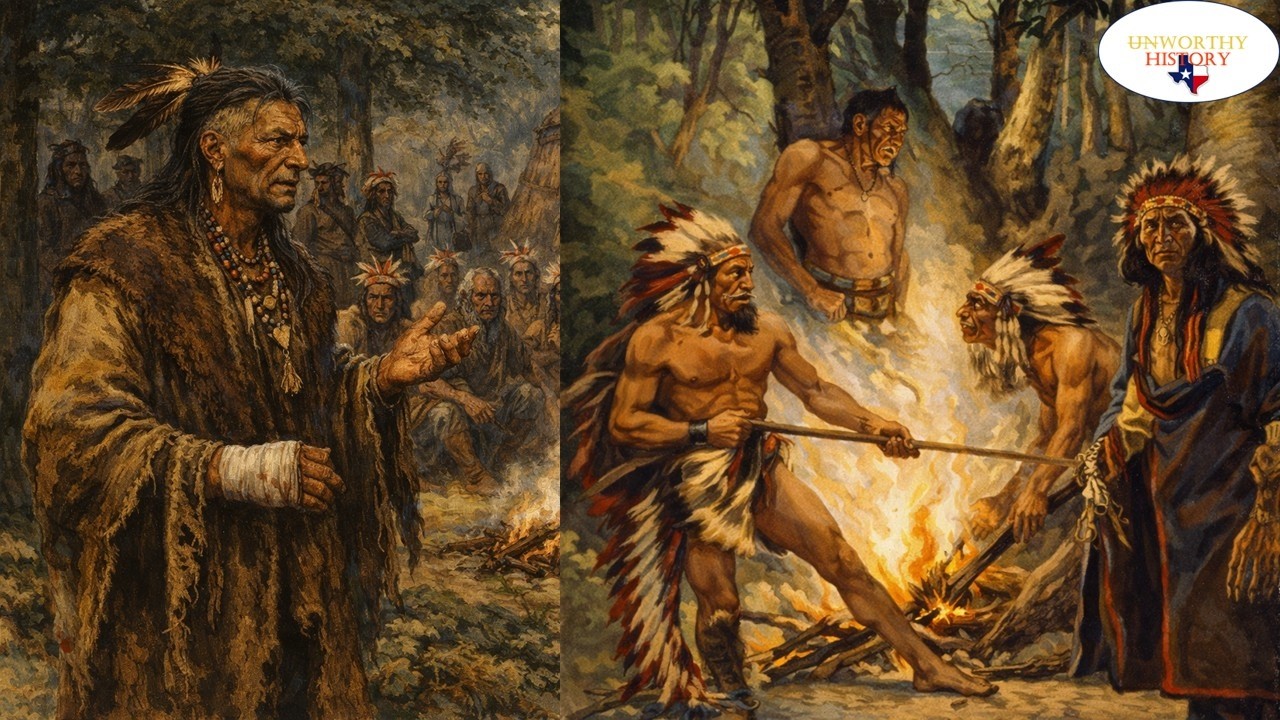
Once safely beyond the reach of the enemy, the war party held a council and decided to divide the prisoners among three Huron nations that had composed the expedition: the Ataronchraton, the Arendaronon, and the Atigouantan, the last receiving the prisoner who was brought to the village where the Jesuits were stationed. It was customary for prisoners to be given to notable people who had lost relatives in war, in order to dry their tears and ease their grief. When the Jesuits saw the captive approaching his destination, he was singing in the midst of 30 or 40 escorting Indians, dressed in a beautiful beaver robe and wearing wampum beads around his neck and as a crown on his head. He was already badly injured: one hand was bruised by a stone, a finger had been violently wrenched away, the thumb and forefinger of his other hand were nearly severed by a hatchet blow, and both arms bore deep cuts and burns.
Despite his pain and the fact that he was over 50 years old, the prisoner sang vigorously, as he had done day and night since his capture. A chief addressed him, saying, “My nephew, you have good reason to sing, for no one is doing you any harm. Behold yourself now among your kindred and friends. ” A feast was prepared, and when a dog was cooked, the captive was made to eat a large piece of it, since he could not use his hands.
When he asked for air, his hands were unwrapped and refreshed with water; they were half putrefied, swarming with worms, and the smell was almost unbearable. He asked that the worms be removed, and they were. The next day he was taken to another village, where he feasted, sang, and danced for most of the night. The following day, the chief to whom he had been given spoke to him at length.
The chief explained that he had originally intended to spare the prisoner’s life, thinking the captive could replace a relative he had lost in war. But seeing the man’s ruined hands, the chief changed his mind. “I am sure that you yourself would now regret to live longer,” he told him. “I shall do you a greater kindness to tell you that you must prepare to die.
” He said the Tontorats, an enemy group, had treated the prisoner so poorly that they had caused his death, and he urged him to be courageous and not fear the tortures. When the prisoner asked how he would die, the chief replied that he would die by fire. Throughout the conversation, a sister of the deceased Huron whom the captive had been meant to replace brought him food and treated him almost like a son, her eyes full of tears. The chief repeatedly placed his own pipe in the prisoner’s mouth, wiped sweat from his face, and fanned him.
At noon, the captive made his farewell feast, which everyone was free to attend. Walking through the house, he said in a loud, confident voice, “My brothers, I am going to die. Amuse yourselves boldly around me. I fear neither tortures nor death.
” He then sang and danced through the entire length of the house. The torture took place that evening in the house of the war chief, where all war councils were held. Around 8:00 p. m.
, 11 fires were lit along the house at intervals of about a brasse. Old men took places on platforms extending along both sides, young men gathered below, and the house was so crowded that there was hardly a passage between the fires. Cries of joy resounded on all sides. Each person provided himself with a firebrand or piece of burning bark.
Before the prisoner was brought in, a chief encouraged everyone to do their duty, reminding them that this act was viewed by the sun and by the god of war. He ordered that at first only the prisoner’s legs should be burned, so that he might hold out until daybreak. When the captive entered, the cries redoubled. He was made to sit on a mat, his hands were bound, and he rose and made a tour of the house, singing and dancing.
The war chief then announced that the prisoner’s robe would be taken from him, and that the Adarondacks would cut off his head, which would be given to the Odesseny, along with one arm and the liver, to make a feast. After that, each person armed himself with a burning brand, and as the captive ran around the fires, each attempted to burn him as he passed. He shrieked, and the crowd imitated his cries or smothered them with shouts. Some broke the bones of his hands, others pierced his ears with sticks and left them there, and others bound his wrists with cords and pulled them with all their might.
When he paused to catch his breath, he was made to rest on hot ashes and burning coals. On the seventh round, his strength failed him. After he rested briefly on the embers, they tried to make him rise, but he did not move. When one Indian applied a brand to his loins, the prisoner fainted.
The chiefs ordered the torturers to stop, saying it was important that he live until daybreak. He was placed on a mat, most of the fires were extinguished, and many people left. After about an hour, he began to revive and was commanded to sing. At first his voice was broken and dying, but finally he sang so loudly that he was heard outside the house.
The youth then assembled and began torturing him again. Since they took turns, they had leisure to devise new methods to make him feel the fire more keenly. He was barely burned anywhere except his legs, where the flesh hung in shreds. Some applied burning brands and did not withdraw them until he cried out.
As soon as he stopped shrieking, they burned him again, repeating this seven or eight times, often blowing on the fire to revive it. Others bound cords around him and set them on fire, slowly burning him. Some made him place his feet on red-hot hatchets and pressed down on them. They struck him on the head with clubs, passed small sticks through his ears, broke the rest of his fingers, and stirred up the coals.
Throughout, the torturers made mocking remarks. One said, “Here, uncle, I must burn you. ” Another called the prisoner a canoe: “Come, let me caulk and pitch my canoe. It is a beautiful new canoe which I lately traded for.
I must stop all the water holes well. ” Another asked him, “Come, uncle, where do you prefer that I should burn you? ” And the captive had to indicate a particular place. Another torturer said, “For my part, I do not know anything about burning.
It is a trade that I have never practiced,” while performing tortures more cruel than those of the others. Some pretended the prisoner was cold: “Ah, it is not right that my uncle should be cold. I must warm you. ” Another said, “Now as my uncle has kindly come to live and die among the Hurons, I must give him a present.
I must give him a hatchet,” and with that, he applied a red-hot hatchet to the prisoner’s feet. Another made him a pair of stockings from old rags and set them on fire. After making him utter loud cries, he asked, “And now, uncle, have you had enough? ” When the captive replied, “Yes, nephew, it is enough,” they answered, “No, it is not enough,” and continued to burn him at intervals, demanding each time if it was enough.
From time to time they gave him food and poured water into his mouth so he would last until morning. Green ears of corn roasted at the fires alongside the red-hot hatchets, and sometimes they gave him ears of corn while placing heated hatchets on his feet. If he refused to eat, they said, “Indeed, do you think you are master here? ” and added, “For my part, I believe you were only chief in your country.
But let us see, were you not very cruel to prisoners? Now just tell us, did you not enjoy burning them? You did not think you were to be treated in the same way, but perhaps you did think you had killed all the Hurons. ”
As day began to break, fires were lit outside the village to display the cruelties to the sun.
The victim was led to a scaffold six or seven feet high, where two Indians made him mount it. Three or four others followed him, and he was tied to a tree that crossed the scaffold in such a way that he was free to turn around. They then burned him more severely than ever, leaving no part of his body untouched. When he tried to avoid one torture, he fell into the hands of another.
New brands were thrust down his throat and even forced into his fundament. They burned his eyes, applied red-hot coals to his shoulders, and hung brands around his neck, placing them on his back and then his breast depending on how he moved to avoid their weight. If he tried to sit or crouch, someone thrust a brand from beneath the scaffolding to make him rise. Eventually they put him out of breath.
Fearing he would die other than by the knife, one man cut off a foot, another a hand, and almost at the same time a third cut off his head. The head was thrown to the crowd, where someone caught it and took it to the village chief to whom it had been promised, so that he could make a feast. The trunk remained where he had been killed, and a feast was made of it that same day. If a prisoner had been particularly brave, the Indians would eat his heart, blood, and roasted flesh in order to become courageous as well.
Sometimes a man made an incision in his own neck and let the blood of the tortured prisoner run into it, believing that with enemy blood mingled with his own, he would never be surprised by the enemy. The dead prisoner might be cut up and cooked piece by piece in a kettle. At this feast, the head of the animal was normally given to the chief, but instead it was given to the lowest person in the company. Some ate of the prisoner with horror, others with relish.
After sunset, the victim’s soul was expelled from the houses by making a horrible and universal noise. The episode comes from a broader history of violence in the region. The Huron Confederacy had allied with the French, who were settling near Montreal, while the Iroquois were backed by the Dutch and the English. By the late 1640s, the two groups were in a constant state of war.
The Iroquois finally conquered and dispersed the Hurons in 1649. Beginning in 1650, branches of the Hurons relocated; the Wyandots moved near Detroit, Michigan, and often engaged in attacks on American frontier settlements during the French and Indian War, Pontiac’s War, the American Revolution, and the Northwest Indian War during George Washington’s presidency. The narrative also notes that torture practices of this kind were not universal across Native American tribes. Plains tribes such as the Sioux, Cheyenne, Arapaho, and Comanche did often torture and maim prisoners, though elaborate ritual torture followed by consumption is more commonly documented among tribes of the northeastern United States and eastern Canada.
The account suggests that some Plains tribes were more likely to mutilate captives after they had already been killed. The narrator also notes that he has not encountered similar accounts of torture among southeastern tribes such as the Cherokees, Creeks, Catawbas, Choctaws, or Chickasaws.