Five women in European and American history have been vilified across the centuries as murderers, poisoners, and traitors. New historical research suggests that many of these dark reputations were built more on rumor, political propaganda, and family scandal than on proven facts. From Renaissance Italian nobles to a Mexican interpreter and a British duchess, these women’s stories reveal how reputation can diverge sharply from reality. Lucrezia Borgia was born in 1480 into one of the most powerful families in Renaissance Italy.
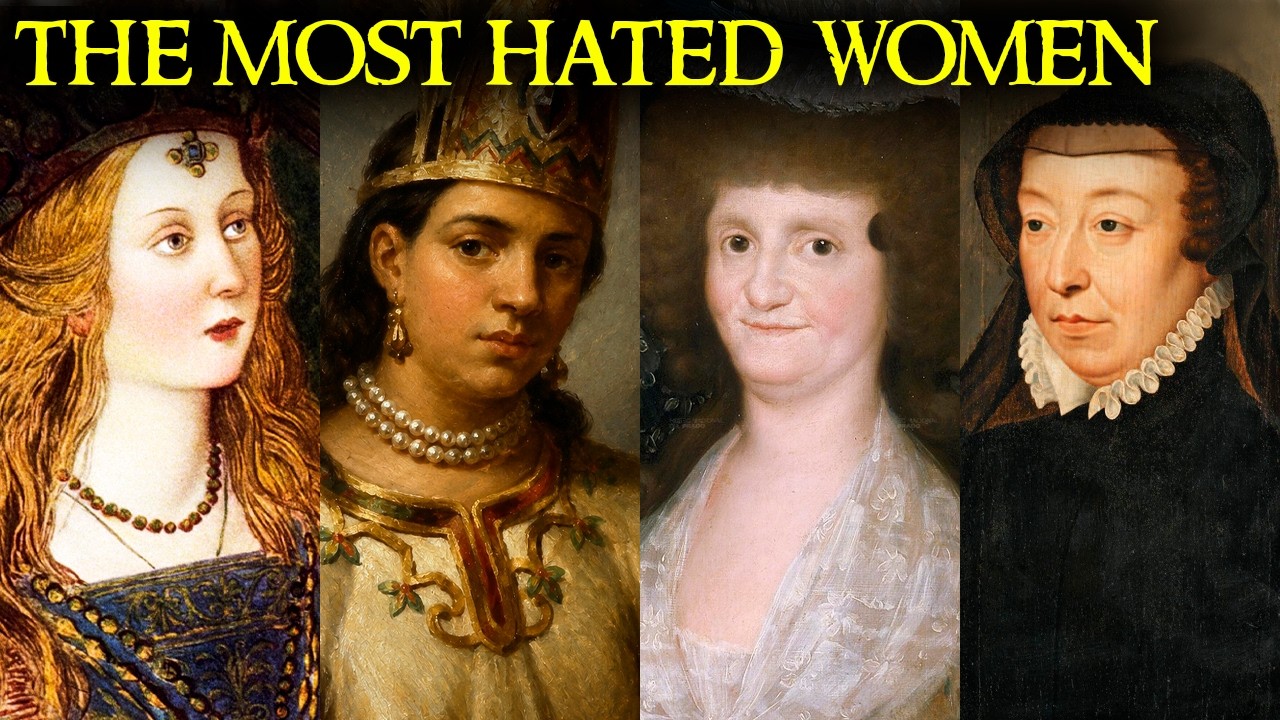
Her father, Rodrigo Borgia, was a cardinal who would later become Pope Alexander VI. As the daughter of a prominent church official, Lucrezia received a first-rate humanist education and became fluent in multiple languages. Her father arranged her marriages strategically, negotiating alliances through her to strengthen the Borgia family’s position. Her first marriage to Giovanni Sforza ended in annulment in 1497 when the alliance was no longer useful.
The humiliated Sforza spread rumors that Lucrezia had engaged in incestuous relationships with her father and brothers. Around the same time, a servant named Pedro Calderón died in the Tiber River after rumors circulated that Lucrezia had borne his child. Her second husband, Alfonso of Aragon, was murdered in 1500 as the Borgias shifted their allegiance from Spain to France. Lucrezia’s third marriage to Alfonso d’Este of Ferrara lasted until her death and produced several children.
Throughout her life, she was rumored to be a seductress who poisoned her enemies with a hollow ring filled with venom. The infamous “Banquet of Chestnuts” allegedly involved an orgy with the Borgia family and prostitutes, but historians now believe the sole account of this event may have been fabricated to defame them. After her father died in 1503 and her brother Cesare was killed in 1507, the Borgia dynasty collapsed. Lucrezia spent her remaining years in Ferrara, where she died in 1519 at age 39 following a difficult childbirth.
Modern scholars view her as a victim of her family’s ruthless reputation rather than a villain in her own right. Catherine de’ Medici was born in Florence in 1519 when the Medici bank family dominated the city. She married Henry of Orleans, the future king of France, at just 14 years old. For the first decade of their marriage, the couple produced no children, which made Catherine deeply unpopular in France.
She was suspected of witchcraft and sorcery for her attempts to conceive. After a decade, she finally had children and ultimately bore ten over fourteen years. When her husband Henry II died in a jousting accident in 1559, their eldest son inherited the throne but died just 17 months later. Catherine served as regent for her young sons during a period when the Protestant Reformation was splitting France apart.
The Huguenots, as French Protestants were called, entered into war with the Catholic government in 1562, beginning the French Wars of Religion. As the most powerful figure in France for three decades, Catherine sought a middle path between radical Catholics and Huguenots. She negotiated a marriage between her daughter Margaret and Henry of Navarre, a Protestant prince, in 1572, hoping to reconcile the factions. Just six days after the wedding, Catholics in Paris attacked thousands of Huguenots who had gathered for the ceremony.
The Saint Bartholomew’s Day Massacre killed at least 5,000 and possibly as many as 20,000 people. Catherine was blamed for orchestrating the massacre and gained the nickname “the Black Queen. ” However, it was likely the Guise family who attempted the assassination that triggered the violence, and Catherine actually called a royal council meeting to restore order before the bloodshed began. Her weak and ineffectual son Charles is reported to have said “Kill them all” when urged to stop the killing.
After the massacre, Catherine became the subject of endless accusations including poisoning and providing prostitutes to her sons. Most of these claims had little evidence. She continued to steer French politics until her death in January 1589 at age 69. Just nine months later, her son Henry III was assassinated, and Henry of Navarre became King Henry IV.
He ended the religious wars by issuing the Edict of Nantes in 1598, granting Protestants the freedom of worship they had long demanded. Wallis Simpson was born Bessie Wallis Warfield in Pennsylvania in 1896. Her father died of tuberculosis when she was just six months old, forcing her mother to rely on relatives. Wallis married naval aviator Winfield Spencer in 1916, but the marriage was unhappy because he was an alcoholic.
She divorced him in 1927, then married shipping executive Ernest Simpson, who had extensive business interests in Britain. In January 1931, Wallis met Edward, Prince of Wales and heir to the British throne. Their relationship did not become intimate until 1934, while Wallis was still married. In 1936, Edward became King Edward VIII upon the death of his father.
He was determined to marry Wallis, who was then in the process of divorcing Ernest. Prime Minister Stanley Baldwin and his government made clear that Britain would not accept her as queen, believing the public would not tolerate a two-time divorcée on the throne. On December 11, 1936, after less than eleven months as king, Edward abdicated. His brother Albert became King George VI.
Edward and Wallis were given the titles Duke and Duchess of Windsor and a generous financial settlement, then moved to France. The couple married in June 1937 in the south of France after her divorce was finalized. In October 1937, the Duke and Duchess visited Nazi Germany as guests of the state. They were hosted by top Nazi leaders including Joachim von Ribbentrop, Joseph Goebbels, and Hermann Göring.
They met with Adolf Hitler at his mountain retreat near the end of their two-week stay. When Germany invaded Poland in September 1939, Britain and France declared war, beginning World War II. After German forces overwhelmed France in 1940, the Duke and Duchess fled south to Spain and then to Portugal. In Lisbon, British intelligence suspected they may have been plotting to conspire with the Nazis.
The couple stayed with a Portuguese banker with extensive German connections, and correspondence suggested Edward might have been planning for a possible return to the British throne if Germany won the war. British authorities swiftly arranged for the couple to be sent to the Bahamas, where Edward was appointed governor for the duration of the war, keeping them far from Britain. After the war, Edward and Wallis resumed their lives as royal exiles in Paris. Throughout the following decades, rumors of their alleged sympathies with the Nazis continued to follow them.
Edward died in Paris in May 1972 at age 77 from lung cancer. Wallis survived him by nearly fourteen years, spending her final years with dementia and losing the ability to speak in 1980. She died in Paris on April 24, 1986, at age 89. Malinalli was born around 1500 in the Yucatán Peninsula among the Nahuatl people.
When she was about eight years old, she was enslaved, perhaps captured in a raid or sold by her own family. Living among the Maya people who spoke the Yucatec Maya language, she became bilingual. When Spanish conquistador Hernán Cortés arrived in 1519 and was given 20 enslaved women as a gift by Maya authorities, Malinalli was among them. After baptism and being renamed, she was given to one of Cortés’s men, but was then found to be invaluable because she spoke both the local Mayan language and the Nahuatl of the Aztecs.
Since Cortés intended to conquer the Aztec Empire, Malinalli was made the interpreter bridging communication between Cortés, a Spanish priest who learned some of the Mayan language, and the Nahuatl-speaking peoples they encountered. The Spanish conquest required allies, and Malinalli was crucial to Cortés’s negotiations with the Tlaxcalans and Texcocans, who resented Aztec rule and their requirement of human sacrifices. She became known as “Malintzin,” a Nahuatl honorific, and gained tremendous importance within Cortés’s retinue. When the Spanish entered the Aztec capital Tenochtitlan in November 1519, Malinalli was present as interpreter when Cortés met Emperor Moctezuma.
Contrary to popular belief, the Aztecs did not worship the Spanish as gods, though a legend suggested that Moctezuma might have thought Cortés was the god Quetzalcoatl, who was expected to return in 1519, the very year Cortés arrived. Tensions escalated, leading to the “Night of Sorrows” on June 30, 1520, when the Aztecs attacked the Spanish in Tenochtitlan. Malinalli survived and warned Cortés of the impending attack. After the Spanish retreated, they spent months gathering indigenous allies, returned to Tenochtitlan, which had been decimated by a smallpox epidemic to which the Aztecs had no immunity, and conquered the city in the summer of 1521.
After the conquest, Malinalli continued living with Cortés and bore him a son in 1522, making her the mother of the first mestizo child, a group that would become significant in Latin America. She eventually married Juan Jaramillo, one of Cortés’s captains, and bore a daughter. She died of smallpox in 1529, likely in her late twenties. Malinalli, later known as La Malinche, has become a symbol of betrayal in Mexico.
While she clearly aided the Spanish in their conquest of her people, historians increasingly recognize that she was enslaved as a child and had little choice in her service. She helped the Spanish against the society that had enslaved her, and her role was forced on her once Cortés realized she could be useful. Whether she was a traitor or a victim of circumstance remains debated. Maria Luisa of Parma was born in Italy in 1751 and married Prince Carlos, the heir to the Spanish throne, in 1765 at age 13.
Her marriage was difficult, and she suffered numerous miscarriages and lost many children. She experienced approximately 24 pregnancies, with only seven children surviving to adulthood. Due to her repeated pregnancy losses, rumors emerged in the Spanish court that she was cursed. When Carlos became King Charles IV in 1788, Maria Luisa became queen consort.
Her husband was a weak ruler more interested in hunting than governance, and Maria Luisa took a much larger role in state affairs. She promoted education and culture and was the primary patron of the painter Francisco Goya. Throughout her time at court, Maria Luisa was accused of constant adultery with many lovers. Specifically, rumors claimed she was romantically involved with Manuel de Godoy, a young man who rose to become prime minister of Spain thanks to royal favor.
The queen’s own confessor wrote on his deathbed that none of her children were born from legitimate marriage, though historians have little concrete evidence to support this claim. Maria Luisa was also accused of poisoning rivals, including the Duchess of Alba, who died suddenly in 1802 at age 40. Historians now agree the duchess actually died of tuberculosis, but the accusation stuck to Maria Luisa. She was also suspected of poisoning her own daughter-in-law, Maria Antonia of Naples and Sicily, who also died of tuberculosis.
By the early nineteenth century, more serious matters arose. After the French Revolution, Spain initially joined the coalition against France but then switched sides and allied with the new French Republic in 1794. This alliance became increasingly unequal under Napoleon Bonaparte, who became emperor in 1804. In 1807, Spain agreed to the Treaty of Fontainebleau, allowing French troops to cross Spain to invade Portugal.
French intervention in Spanish affairs culminated in placing Napoleon’s brother Joseph Bonaparte on the Spanish throne in 1808. Maria Luisa, Charles, and Godoy left Spain and spent most of the period as semi-prisoners in France before moving to Rome in 1812. Ferdinand, their son, returned to Spain in 1814 and regained the throne, but forbade his parents from returning to Madrid. Maria Luisa died in Rome on January 2, 1819, at age 67.
Charles died two and a half weeks later. Maria Luisa had made Godoy the main beneficiary of her will, and her will was eventually contested. The queen was intensely unpopular in her own country and became a target of vicious rumors.
Yet many historians now believe that the accusations against her stemmed from jealousy of her power and political influence in a male-dominated world.