In October 1892, laborers digging a trench in the Sydney suburb of Macdonaldtown made a horrifying discovery: the decomposed body of an infant, initially mistaken for a cat. The next day, they uncovered a second baby’s body buried nearby. Within weeks, police investigating the grim finds would unravel one of the most disturbing criminal cases in Australian history—one centered on a married couple accused of running a brutal baby-farming operation. The remains were found at 25 Burren Street, a rented house whose previous tenants, the Makin family, had lived there for just seven weeks before moving to nearby Redfern.
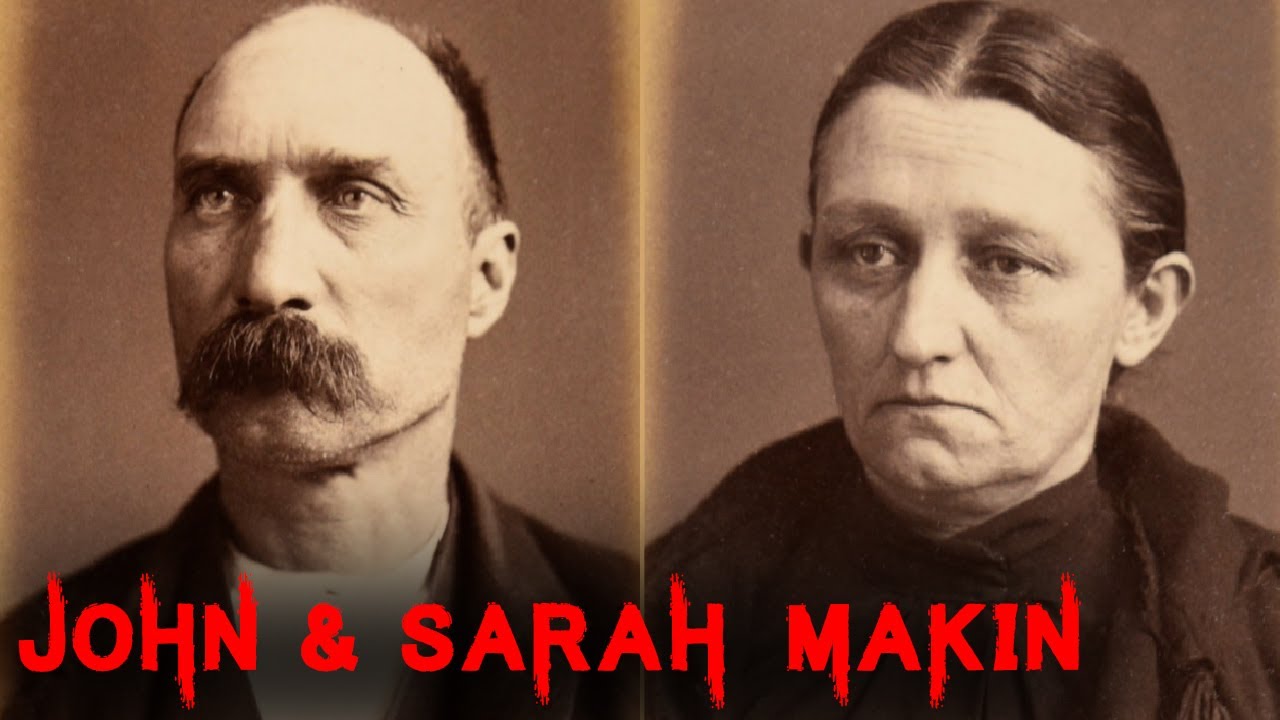
When Senior Constable James Joyce visited the Makins at their new residence, he noticed recently disturbed earth in the yard. Nothing was found there, but his suspicions were raised. He soon learned that Sarah Makin had been advertising her services as a midwife. John and Sarah Makin were both born in 1845.
Sarah, the daughter of a former convict, had married a mariner at 19 before marrying John Makin in 1871. John, also the son of a former convict, worked as a brewery drayman but had drifted in and out of employment. By early 1892, during a severe economic depression that had devastated Australia, he was out of work and often seen idling outside his home, claiming he lived on private means. Those who knew the family described them as miserably poor, though John maintained he received a weekly income from property he had inherited from his mother.
The first inquest, held on October 26, 1892, heard testimony from the workmen, doctors, police, and neighbors. Sarah Makin told the court that shortly after moving into the Macdonaldtown house, she had taken in a two-week-old female infant as a wet nurse, paid ten shillings a week. She insisted that the child’s mother had reclaimed her in mid-August, planning to move to Melbourne, and that this was the only child she had ever taken into her care. Her husband and daughters corroborated her statement.
The jury returned an open verdict, acknowledging the circumstances were suspicious but lacking sufficient evidence to determine how the three infants had died. The case took a darker turn on November 2, when police excavated the yard at Burren Street and uncovered five more infant bodies buried in shallow graves. John, Sarah, and their daughters, Blanche and Florence, were arrested. During questioning, Blanche admitted that her mother had cared for three infants simultaneously, contradicting her earlier testimony.
She said her parents had instructed her to deny knowing about other children in the house. Police identified one of the deceased infants as Mabel Bothamley, the illegitimate child of Horace Bothamley and Minnie Davis, born June 10, 1892. The couple told police a harrowing story. Facing difficult circumstances, they had placed an advertisement in the Sydney Morning Herald seeking a kind-hearted person to adopt their child.
A man using the alias Bates answered, agreeing to take the baby for ten shillings a week and reassuring them they could visit whenever they wished. The couple said they soon became concerned. They noticed a card reading “Mrs. Makin, lady’s nurse and qualified midwife,” and confronted the woman, who admitted she had not disclosed her real name.
Weeks later, they were told the baby had a cold, then that her health had taken a severe turn. John Makin promised to take her to a doctor, but a day or two later sent a telegram claiming the child had died. On August 4, the couple went to the Makin residence with flowers to view their daughter one last time. The baby was laid out on a board, dressed in a long white gown.
Minnie Davis tearfully recalled John Makin looking at them and saying, “Perhaps it’s better that it dies. ” When she asked about the cause of death, he said the child had wasted away and assured her he would obtain a doctor’s certificate. He then asked for two pounds to cover burial costs. As police investigated further, more identities came to light.
Agnes Ward, a domestic servant, said she had given birth on February 12, 1891, and arranged for the Makins to adopt her son Charles for five pounds. Clara Risby told officers her baby daughter had been born on April 15, and she too had paid five pounds for the Makins to adopt her. Mary Stacy, another domestic servant, had answered an advertisement from a family looking for a baby; in June 1891, the Makins, posing as the Avery family, offered to look after her child for three pounds. Agnes Todd had paid John Makin three pounds in December 1891 to take her baby girl, Elise.
In May 1892, eighteen-year-old Amber Murray gave birth to a baby boy she named Horace. She placed an advertisement seeking a motherly person to adopt her child, offering a small premium. The Makins, using the pseudonym Hill, answered, expressing willingness to adopt the child for three pounds and assuring her they could provide the baby with a mother’s love. When shown the clothing found on one of the dead infants, Murray confirmed it belonged to her son.
The Makins were charged with causing the deaths of Horace Murray and Mabel Bothamley and committed to stand trial at the Central Criminal Court. The trial commenced on March 6, 1893, before Justice Stephen. Both pleaded not guilty and were represented by attorney Thomas Williamson. The proceedings were highly dramatic.
John Makin appeared disinterested, crossing his legs and folding his arms in the dock, while Sarah concealed her face with a handkerchief throughout. Amber Murray gave emotional testimony, identifying clothing found on the remains as the gown she had personally made for her son. On the second day, Edward Jordan, a horse trainer who had been incarcerated alongside John Makin, testified that Makin had told him he had “done away with eight babies” and boasted that no doctor could ever prove he had poisoned any of them, as he had never acquired chemicals from a chemist. The Crown’s case concluded on the third day.
The Makins chose not to make a statement or present any evidence in their defense. After initially failing to reach a verdict, the jury reconvened on March 9, 1893, and returned a unanimous guilty verdict for the murder of Horace Murray. In a notable development, they strongly recommended mercy for Sarah Makin. Justice Stephen delayed sentencing, awaiting a Full Court decision on the admissibility of certain evidence raised by the defense.
The appeal was heard on March 23, 1893, and after a week of deliberation, the Full Bench upheld the convictions. The Makins returned to court for sentencing, where Justice Stephen declared they had been engaged in “baby farming in its worst phase and its most hideous and revolting aspect. ” He said the evidence from their homes showed they were “carrying on this nefarious and hellish trade, destroying the lives of those infants for the sake of gain. ”
He sentenced both to death by hanging.
In Sarah Makin’s case, he said he would forward the jury’s recommendation of mercy to the executive. As he finished speaking, Sarah collapsed and cried out, “Oh my babies, oh my babies,” as two constables carried her from the court. The Makin family appealed for clemency to the Governor of New South Wales. Sarah’s death sentence was commuted to life imprisonment, but John’s appeal was denied.
He was executed by hanging on August 15, 1893, at Darlinghurst Gaol, facing his fate with resignation. Sarah Makin served eighteen and a half years in prison, holding various positions within the correctional system, including hospital attendant. Her health deteriorated, and in 1911 she was quietly released.
She spent the rest of her life with her family and died on September 13, 1918, at the age of 72.