The night Franklin Roosevelt was inaugurated as the 32nd President of the United States on March 4, 1933, Eleanor Roosevelt stood in the cold Washington crowd wearing a ring her husband had not given her. It was a sapphire set in diamonds, a gift from Lorena Hickok, the most celebrated female reporter in the country at the time. No one in that crowd knew what the ring meant. For 30 years, Eleanor Roosevelt, the most admired first lady in American history, carried on a deeply private relationship with Hick, preserved in more than 3,000 letters.
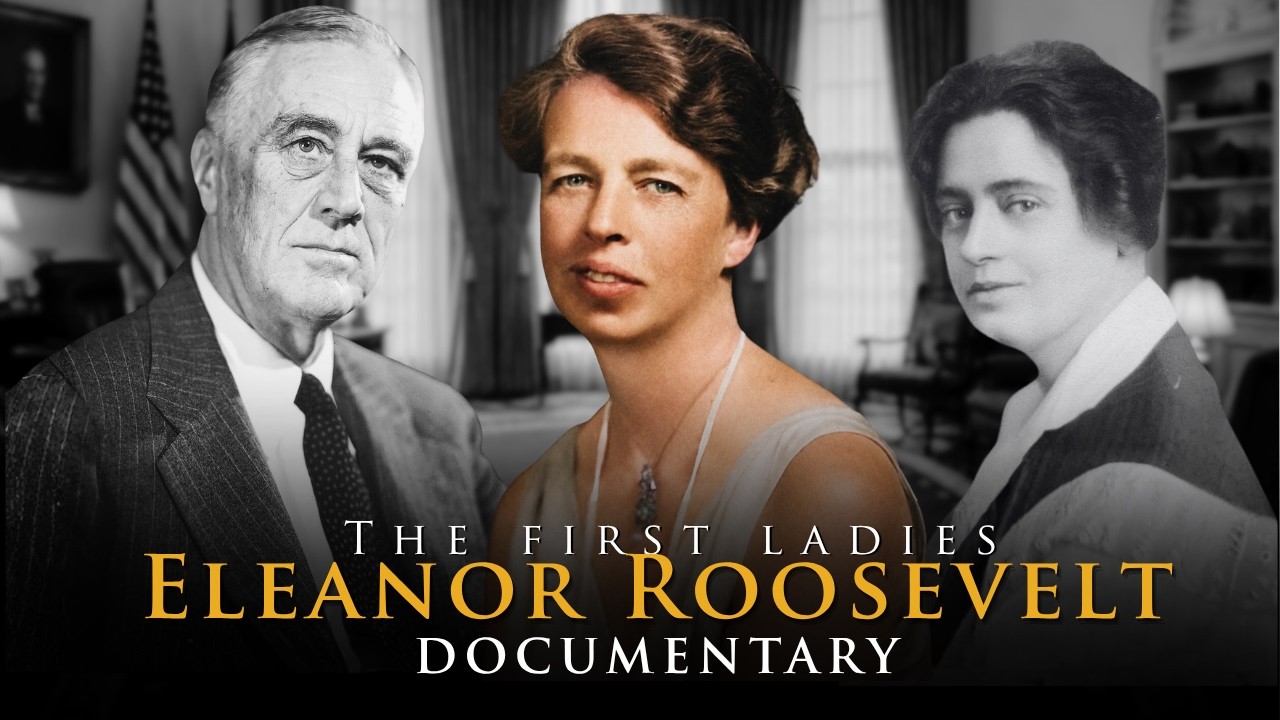
The letters were sealed from public view until 1978, ten years after Hick’s death, when historians at the Roosevelt Library in Hyde Park opened 18 cardboard boxes and began reading. Eleanor’s early life gave little hint of the public figure she would become. Born into New York society, she was the daughter of Anna Hall Roosevelt, a great beauty who called her eldest child “Granny” and, more directly, “the ugly duckling. ” Eleanor was eight when her mother died of diphtheria in 1892.
Her father, Elliott Roosevelt, was warm and affectionate but struggled with alcoholism, spending much of Eleanor’s childhood in sanatoriums. He died in 1894 at age 34. Eleanor was nine years old. Raised strictly by her grandmother Mary Livingston Hall, Eleanor was sent abroad at 15 to Allenswood Academy in Wimbledon, outside London.
There she met headmistress Marie Souvestre, who recognized her intellectual promise and took her on as a special student. Souvestre told Eleanor she was among the most intellectually promising students she had taught. It was the first time Eleanor had been fully seen. She returned home in 1902 and entered society.
At a dinner party, she met Franklin Roosevelt, a distant cousin. They married in March 1905 at her cousin Theodore Roosevelt’s townhouse, with the president giving the bride away. Over the next decade, they had six children, and Eleanor learned to perform the life expected of her. For a while, she believed her marriage was solid ground.
That belief unraveled in September 1918. Franklin had returned from Europe gravely ill with pneumonia. While sorting through his suitcases, Eleanor found a packet of letters tied together, written to Lucy Mercer, the young woman she had hired as her social secretary in 1913. According to multiple biographers, including Joseph Lash, Eleanor confronted Franklin and offered him a divorce.
Franklin’s mother, Sara Delano Roosevelt, intervened. She made clear that a divorce would cost Franklin the family fortune, the house at Hyde Park, and the income that funded his political life. His political advisers warned that a divorce would end his career. Franklin stayed in the marriage and ended his relationship with Lucy Mercer, pledging not to see her again.
Their son James later described the marriage as “an armed truce that endured until the day he died. ” Eleanor reportedly told a friend, “I have the memory of an elephant. I can forgive, but never forget. ” She did not leave.
Instead, she threw herself into political life, campaigning and organizing. When Franklin was stricken with polio in 1921 and lost the use of his legs, it was Eleanor who kept his name alive in the rooms where it needed to be heard. Lorena Hickok was born in 1893 in Wisconsin. Her childhood was marked by hardship; her father was violent, and her mother died when Lorena was 14.
She left home and worked as a domestic servant before finding her way into journalism. By 1932, known to everyone as “Hick,” she was the AP’s most celebrated female reporter, covering politics, crime, and human misery with ferocity. In the summer of 1932, Hick was assigned to cover Eleanor Roosevelt, the wife of the Democratic presidential nominee. Hick initially saw the assignment as a non-story.
She was wrong. Sitting down with Eleanor, she found a woman unlike anyone she had encountered in a decade of covering public figures. Eleanor spoke directly, admitted her fears and doubts, and looked at Hick as a full person worth telling the truth to. Over the months of the campaign, the two women found each other again and again in hotel lobbies and on long train rides across the country at night.
By the time of the inauguration, Hick had given Eleanor the sapphire ring. On the night of March 5, 1933, Eleanor sat at her writing desk in the White House and wrote: “I cannot go to bed tonight without a word to you. I felt a little as though a part of me was leaving tonight. You have grown so much to be a part of my life that it is empty without you.
”
The following morning she wrote again: “I can’t kiss you, so I kiss your picture good night and good morning. ” Later that week, looking at the ring, she wrote, “Your ring is a great comfort. I look at it and think, she does love me, or I wouldn’t be wearing it. ” Hick wrote back in December of that year, remembering Eleanor’s eyes and “the feeling of that soft spot just northeast of the corner of your mouth against my lips.
”
The letters were frank about longing in ways the era’s public discourse did not permit. Eleanor and Hick developed a private language, including the French phrase “je t’aime et je t’adore. ” One evening in 1933, Eleanor called Hick but could not say the phrase because her son James was nearby. She wrote afterward instead: “I couldn’t say je t’aime et je t’adore as I longed to do, but always remember I am saying it, and that I go to sleep thinking of you and repeating our little saying.
”
Within months of the inauguration, Hick resigned from the Associated Press. Her editors noted she could no longer report objectively on the Roosevelt administration. She took a job investigating New Deal relief programs under Harry Hopkins, traveling to 32 states and filing candid reports. She was no longer the celebrated reporter she had been, but she had moved closer to Eleanor.
By the late 1930s, the intensity of their correspondence had cooled into something quieter and more durable. Hick had become, in the careful phrase of Eleanor’s biographer, more demanding, asking in various ways for more than the situation could give. In 1940, Hick moved into the White House, serving as executive secretary to the women’s division of the Democratic National Committee. For nearly five years, she slept under the same roof as Eleanor.
On April 12, 1945, Eleanor was at a benefit concert in Washington when she received a message that Franklin had collapsed. He had suffered a cerebral hemorrhage in Warm Springs, Georgia. By the time she made the calls, he was already gone. On the way to Warm Springs, someone told her the rest: Lucy Mercer Rutherford, the woman Franklin had promised in 1918 he would never see again, had been at his side when he died.
What cut deeper, according to those close to Eleanor, was that her daughter Anna had known. Anna, Franklin’s gatekeeper in his final years, had facilitated the renewed contact with Lucy. Eleanor said almost nothing about this for a long time. The wound of Anna’s involvement ran deeper than anything Franklin had done.
Seven days after Franklin’s death, a reporter from The New York Times asked Eleanor about her plans. She stopped, considered the question, and said quietly, “The story is over. ” That same day, April 19, 1945, she sat down in the emptied White House and wrote to Hick: “The upstairs looks desolate. And I will be glad to leave tomorrow.
It is empty and without purpose to be here now. ” Near the end of the letter, she wrote, “I hope you and I will be working together,” and “I think of you and your love for travel and wonder if you would have enjoyed it. ”
Eleanor lived 17 more years. Harry Truman appointed her a delegate to the United Nations, where she chaired the committee that produced the Universal Declaration of Human Rights, the document she considered the most important work she had ever done.
She became known as the First Lady of the World, and Gallup’s annual poll named her the most admired woman on Earth year after year. Hick was somewhere nearby through it all. Her health declined from diabetes, which took her mobility, her stamina, and eventually most of her sight. In 1955, Eleanor sent her car, and Hick moved to Hyde Park, to a house on the Roosevelt property a few minutes from Eleanor’s own.
Eleanor died on November 7, 1962, at age 78. She was buried in the rose garden at Hyde Park beneath a simple white stone. Without her, Hick’s decline was swift. She died on May 1, 1968, at age 75, in the house at Hyde Park, a short walk from where Eleanor lay.
According to accounts of her final years, her ashes remained unclaimed for a long time before she was buried at Rhinebeck Cemetery in 1993. In 1978, ten years after Hick’s death, as she had arranged, staff at the Roosevelt Library unsealed the 18 cardboard boxes. Inside were the letters, 30 years of them. The first ones they read were dated March of 1933: “I cannot go to bed tonight without a word to you.
” The ring, the letter, the boxes, and the library are all still there in Hyde Park, available to anyone who wants to look.