A woman was last seen walking into the forest with her boyfriend on July 4th weekend in 1983. It took more than four decades before anyone was held to account for her death. Teresa Joanne Peroni was 27 years old the summer she disappeared. She stood about 5’4″ with blue eyes and long dark hair.
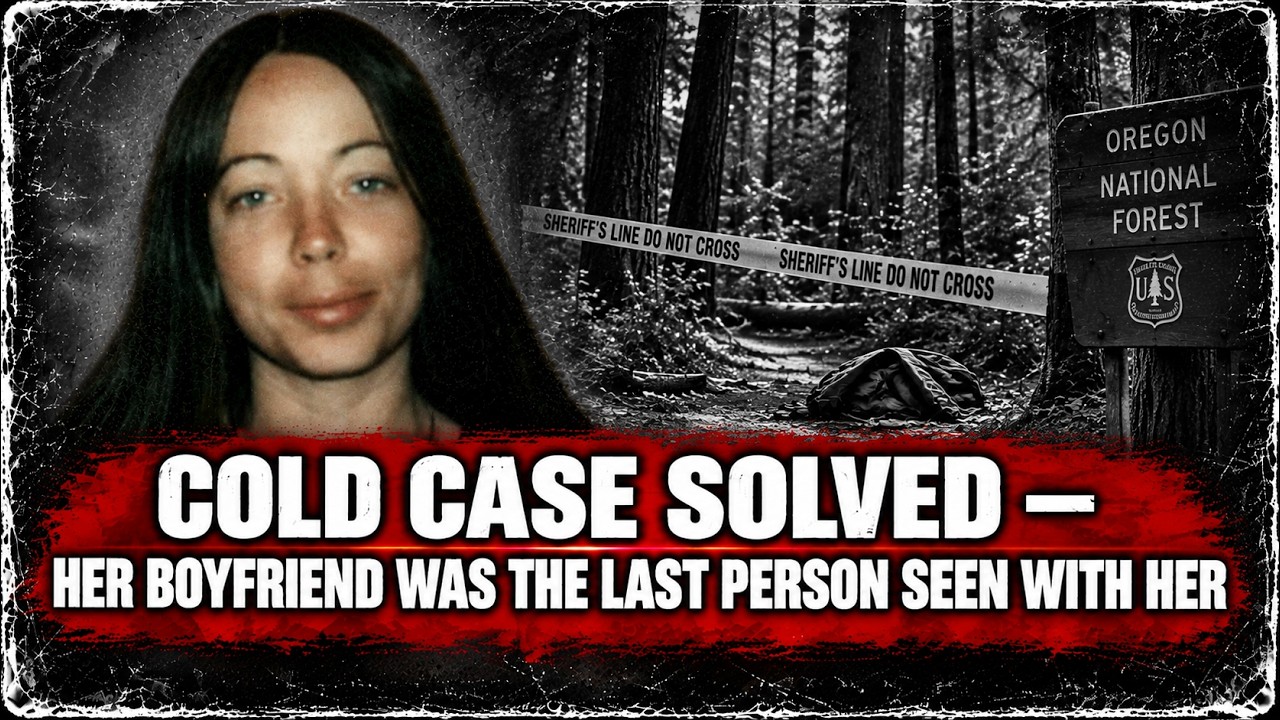
Friends later described her as a free spirit. She was from the Grants Pass area in Josephine County in southwestern Oregon. She had recently moved back to Oregon after a divorce. Her family was in the area.
Teresa also had epilepsy, and she got her medicine regularly from the county health clinic. The 4th of July in 1983 fell on a Monday, creating a long holiday weekend. In the hills near Selma, along Illinois River Road, a gathering was underway. Teresa was there with her boyfriend, Mark Sanfartello, who also goes by Marcus.
He was 29 years old, two years older than she was. According to a national missing persons profile, there was an argument over Teresa having another lover. Then Teresa and her boyfriend went into the woods. The profile states simply: “Peroni never returns.
”
A local podcast later added detail from people who knew the couple. It reported that their relationship was stormy. Friends described the arguments as heated and said Sanfartello had the more controlling personality. The two had been fighting earlier that same day but were still seen walking into the forest together to sleep for the night.
That was the last anyone reported seeing Teresa Peroni. The public record is thin on when her family realized she was missing. One account says her family reported her missing about a month later. Deputies who took the report were looking at a cold trail.
The sheriff’s office found her disappearance suspicious but lacked probable cause to charge anyone. Without a body, prosecutors had no way to show how Teresa died or that she had been harmed at all. There was also a false lead. A witness told investigators they had seen Teresa drunk at a nearby bar later in July.
It was wrong, but it slowed the case. Then something odd happened about a year after Teresa vanished. Someone brought a brown purse to the Josephine County Sheriff’s Office. Inside were papers with her name, including her Oregon ID, and her epilepsy medicine.
Nobody has ever said who carried it in. A search team went out to the land on Illinois River Road with a cadaver dog but found nothing. In 1997, 14 years after Teresa walked into those woods, a landowner found a human skull on private property near where she was last seen. Investigators searched with a cadaver dog but found no other remains.
Investigators gathered DNA from Teresa’s sister to compare against it. The skull was sent to the University of North Texas for examination. But the science of that era had a problem. Investigators sent a sample to the FBI, but it turned out to be a tooth filling, which doesn’t hold usable DNA.
The test couldn’t be done. In 2004, a new detective named Ken Selig picked the case back up. He wanted to send the FBI a better sample from the skull. But nobody could find it.
The most important piece of physical evidence in the case was lost. Years later, the skull turned up at a genetic lab at the University of North Texas. Josephine County had sent it there for safekeeping, and then it slipped out of memory. In 2020, tests were finally done, and a new DNA sample matched Teresa’s sister.
The skull found in 1997 was Teresa Peroni’s. Meanwhile, Sanfartello had moved to Northern California about a year after Teresa vanished. He was convicted of attempted murder there in the 1980s in an unrelated case and sentenced to more than 15 years in prison. He was released in the late 1990s.
After his release, he settled in Butte County, California. He lived in Gridley and later in Chico. People there told a local newspaper he went to karaoke on Tuesdays and Thursdays at a bar on Park Avenue. He wore a leather jacket and sang heavy metal and rock songs.
In 2024, the Josephine County Sheriff’s Office reopened the case. Detective Sergeant Kyle Heinrich looked for anyone still alive who had involvement with the case and knew details of the original 1983 investigation. The Oregon Department of Justice came in with prosecutors and investigators. The Josephine County District Attorney’s Office joined, and Oregon State Police forensic anthropologist Dr.
Niesha Vance was part of the effort. Investigators re-interviewed witnesses, reviewed the evidence collected in 1983, and collected new DNA from people connected to Teresa. Those samples went to the University of North Texas Center for Human Identification. In July 2024, a podcast episode titled “Is Teresa Peroni 1997 Jane Doe?
” came out. The podcast team didn’t know the case had just been reopened. Later, Detective Sergeant Heinrich contacted journalist Gwen Berringer, who runs a nonprofit called the Josephine County Missing Persons Project, and asked her to keep her reporting quiet. He was close to an indictment.
On June 27th, 2025, prosecutors presented the case to a Josephine County grand jury. The grand jury indicted Mark Sanfartello for murder in the second degree. The next day, police in Chico, California arrested him. He was taken into custody without incident.
He was 72 years old. He was extradited to Oregon, and in July of 2025, he was arraigned in Josephine County Circuit Court. Attorney General Dan Rayfield said it was important not to prejudge the outcome, but he also said the arrest showed what’s possible when law enforcement persists and adapts to new tools. On Tuesday, April 21st, 2026, the case ended with a plea.
Mark Sanfartello pleaded guilty to manslaughter in the first degree. That’s a lower charge than the second-degree murder count he had been indicted on. According to the plea petition, he was “under the influence of an extreme emotional disturbance” at the time of Teresa’s death. The plea petition uses legal language and doesn’t tell a story.
Sanfartello’s attorney, Elizabeth Baker, told the Associated Press her client had strong motivation to resolve the matter because of a diagnosis of a complex health issue. She added that the resolution gave the family closure and gave him the treatment he urgently needs. On that same day, Sanfartello was sentenced to 20 years in prison. He was 73 years old.
Under the plea agreement, he must serve at least 10 years. Attorney General Rayfield called it a 43-year wait for an answer that Teresa’s family never should have had to wait for. According to every report, no other remains were ever recovered. The skull found in 1997 is the only part of Teresa that has been found.
Teresa Joanne Peroni was 27 years old when she was last seen on or around July 4th, 1983, in the woods near Selma, Oregon. For 42 years, she was a name in a missing person’s file. Now she had a court record and a finding of what happened to her.