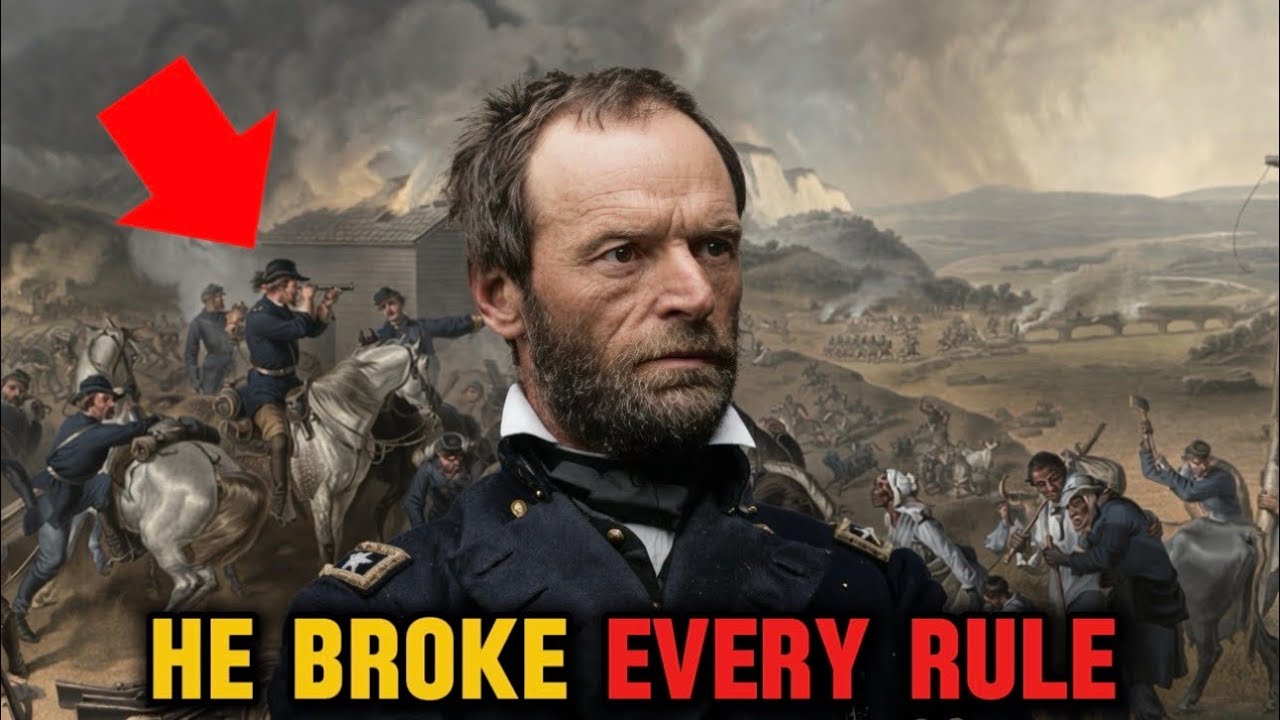
In the autumn of 1864, a Union commander executed a maneuver so audacious it bordered on institutional heresy, severing his own supply lines with deliberate intent and vanishing into the heart of enemy territory with sixty thousand men, leaving his superiors in Washington paralyzed with a mixture of terror and disbelief. This was not the calculated gamble of a reckless gambler, but the cold, methodical application of a brutal new philosophy that would forever alter the conduct of American warfare. William Tecumseh Sherman had concluded that the path to victory did not run through the destruction of enemy armies, but through the annihilation of the very society that sustained them, a concept so radical it continues to ignite fierce debate more than a century and a half later.
To grasp the sheer magnitude of Sherman’s departure from convention, one must first understand the rigid, almost chivalric framework that governed Civil War generalship in 1861. Commanders like Robert E. Lee, George McClellan, and even a younger Ulysses S.
 Grant operated under a set of European-derived rules from the previous century, where war was a formalized contest between opposing forces. The armies would meet on a field of battle, align in their respective lines, and engage in a brutal, concentrated exchange of fire until one side’s resolve broke, leading to a retreat and the subsequent capture of a strategic capital. It was a system that prized order and honor, but it was also agonizingly slow and, by 1864, demonstrably ineffective against a Confederacy that refused to capitulate despite suffering catastrophic losses on the battlefield.
The fundamental flaw in this traditional approach was that it failed to address the engine that powered the Confederate war machine. Lee could be outmaneuvered and his army battered, yet the Confederacy would not surrender because the battle itself did not touch the southern farms, the railroads, the factories, or the unyielding will of the civilian population that continued to send their sons to die. After three years of horrific slaughter at Antietam, Gettysburg, and Chickamauga, with hundreds of thousands of casualties mounting on both sides, Sherman began to ask a question that was considered heretical by his peers.
He wondered if the entire focus on defeating the enemy’s military forces was a fundamental strategic error, and whether the true target should be the very infrastructure and morale that allowed those armies to exist in the first place.
Sherman was not merely a detached, cold-blooded theorist; he was, by most accounts, a man of intense, almost obsessive, brilliance who was prone to severe bouts of anxiety and depression so profound that newspapers in 1861 reported he had gone insane. He nearly lost his command that year due to concerns over his mental stability, but that restless, analytical mind was precisely what set him apart from his contemporaries. He possessed an intuitive understanding of systems, not just battlefields, a perspective forged by his pre-war experiences as a banker in California, a lawyer, and the head of a military academy in Louisiana.
This diverse background gave him a unique insight into logistics, finance, and the intricate workings of institutions, allowing him to see the war through a lens that extended far beyond the smoke and chaos of the front lines.
His time in Louisiana was particularly formative, as it placed him in the heart of the society he would later be tasked with destroying. He lived among the southerners, gaining a firsthand understanding of their pride, their agricultural economy, and their deep reliance on cotton and enslaved labor. This intimate knowledge meant that Sherman, more than any other Union general, knew precisely what the Confederacy needed to sustain its fight: food, railroads, factories, and the unwavering belief of its people in their cause.
 When Grant, now the overall commander of the Union armies, gave Sherman a free hand with the simple directive to do what needed to be done, Sherman had already formulated a plan that would target these very pillars of southern society, a strategy that went far beyond the traditional scope of military engagement.
It is crucial here to correct a common misconception about Sherman’s campaign, as his actions were not a mandate for the indiscriminate slaughter of civilians. He did not run death squads, and his orders were not for mass murder. What he did was something more precise, and in its own way, more chillingly methodical: he declared that the entire infrastructure of the South was a legitimate military target, not just its armies.
After the burning of military and industrial facilities in Atlanta in September 1864, Sherman made the decision that shattered every convention of warfare. He completely cut his lines of communication and marched his army 285 miles toward Savannah, living entirely off the land, a logistical gamble that military planners of the era considered to be sheer madness for a force of that size.
As his army advanced, his men methodically tore up railroad tracks, heating the iron rails and bending them around trees into what the soldiers called Sherman’s neckties, rendering them completely useless. They burned cotton gins, warehouses, and mills, seized livestock and food for the army’s sustenance, and systematically destroyed the economic capacity of the region. While private homes were generally spared, barns, depots, and railroads were not, and the logic behind this destruction was as harsh as it was consistent.
Sherman’s philosophy was encapsulated in his correspondence with the mayor of Atlanta, where he wrote that war is cruelty and you cannot refine it, and that the more brutal it is, the sooner it will be over. This was the entire strategy in a single sentence: to make the war so physically unbearable that the South’s capacity to fight would simply cease to exist.
 The goal was not to 𝓀𝒾𝓁𝓁 every soldier, but to burn the railroads that fed them, destroy the cotton that financed them, and shatter the confidence of the civilians who believed their government could still protect them. Sherman did not need to defeat Lee’s army in Virginia; he needed to prove that the Confederacy was hollow, a shell of a nation incapable of defending its own homeland. This is where the story becomes genuinely unsettling, and it should be, because the success of Sherman’s march was as much psychological as it was physical.
An army that could disappear from communication for a month, live entirely off the enemy’s land, and then emerge after 285 miles leaving a trail of destruction behind it was not just a logistical marvel; it was a devastating demonstration that the government was powerless to protect its people.
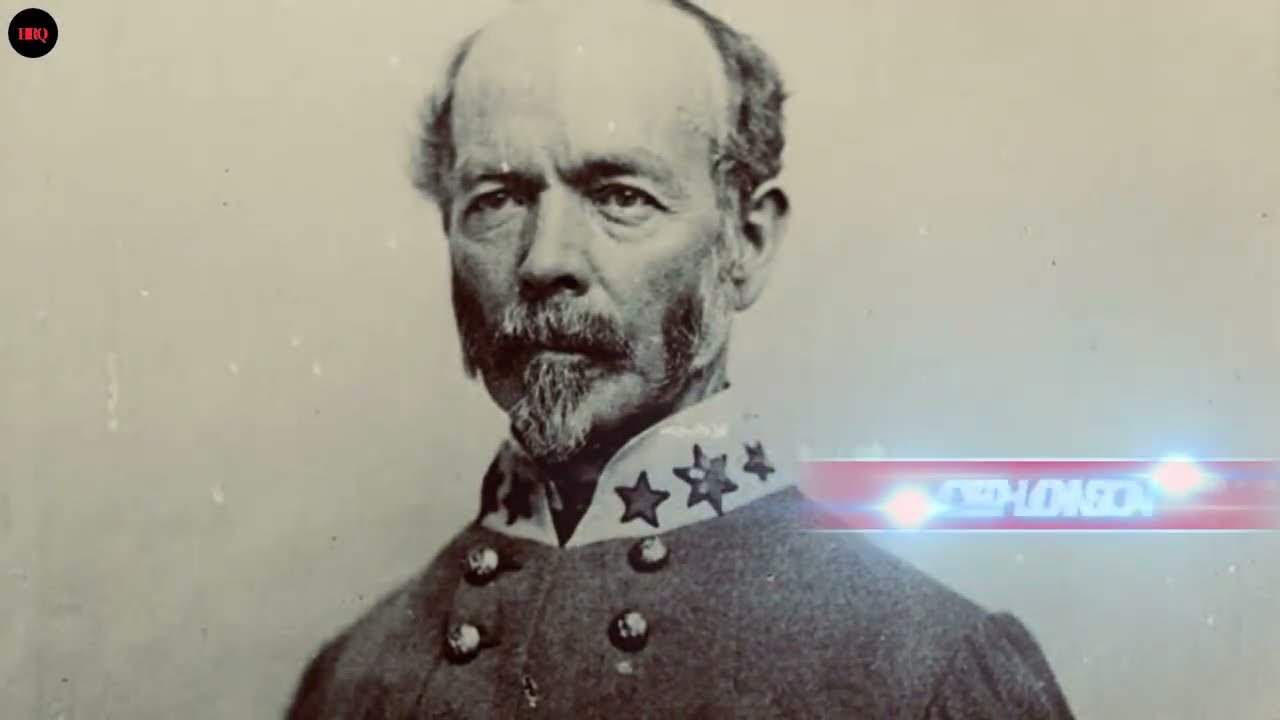
Confederate General Joseph Johnston famously called Sherman’s march the most decisive campaign of the entire war, not because of the men it killed, but because of what it proved to the southern population. The Confederacy could no longer defend its own soil, and that was a catastrophic truth to reveal to the civilian population. This is precisely why Sherman remains one of the most controversial figures in American history, his name spoken with genuine bitterness across the South for generations, with some families reportedly refusing to name their children William Tecumseh for a hundred years after the war.
Whether his actions were justified is a debate that has never truly concluded, but from a purely strategic standpoint, his campaign succeeded in a way that three years of conventional battles had failed to achieve.
The most significant legacy of Sherman’s march is that military historians still study it with obsessive fascination, as he effectively pioneered and refined what we now call total war. The core idea is that a nation’s ability to fight depends on its entire economy and society, not just its army, and that it is a legitimate strategy to target that entire system. Before Sherman, war was theoretically waged between armies while civilian economic life continued in a parallel fashion, but after his campaign, that boundary was permanently erased.
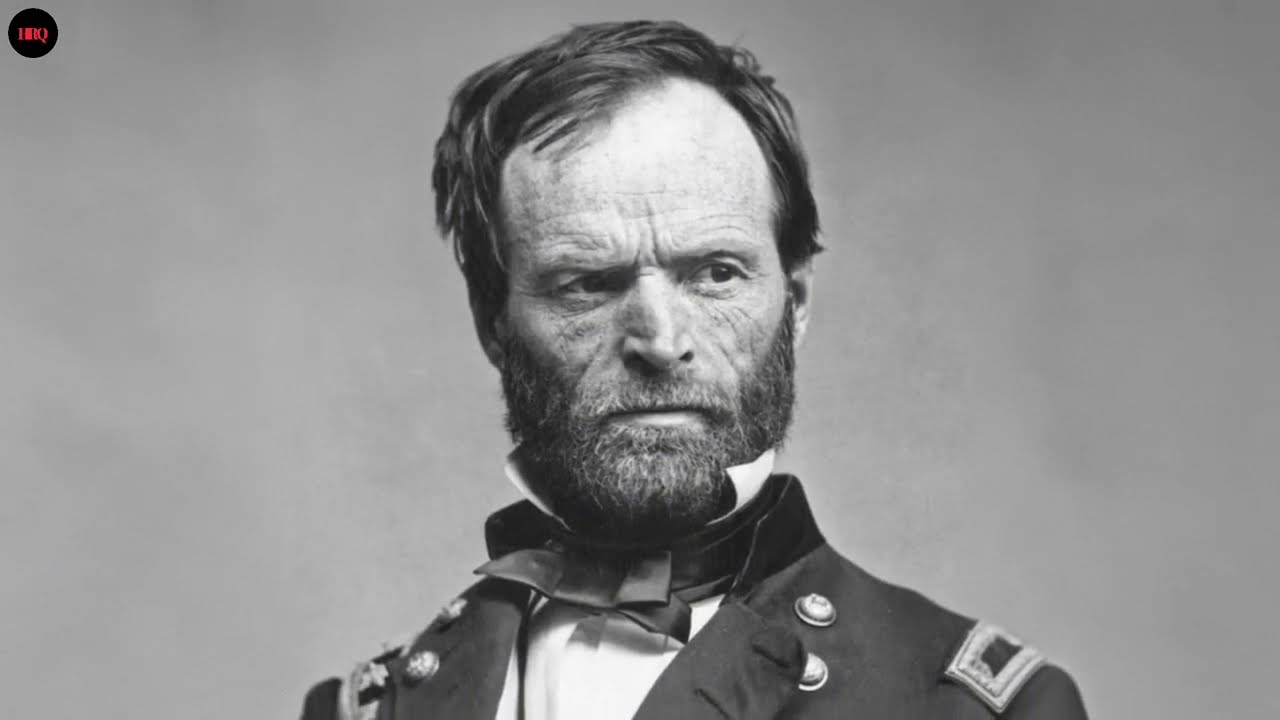 Every major conflict since, from the sieges of World War One to the strategic bombing of factories and cities in World War Two, and even modern economic sanctions, can trace its logical roots back to this single idea: you can defeat a nation by breaking its ability to sustain war, not just by defeating its soldiers.
Grant understood this in his own way, with his 1864-1865 strategy against Lee being one of attrition and resource depletion that ground down the Confederacy’s ability to replace men and materiel. But Sherman pushed the concept further and made it explicit, turning infrastructure and economy into the new battlefield. This is the refusal referenced in the title: Sherman refused to fight a nineteenth-century war with eighteenth-century rules, choosing instead to wage the kind of war that could actually make the Confederacy lose.
After the war, Sherman became the commanding general of the entire U. S. Army, and he is famously, though with some historical debate over the exact wording, attributed with the quote that war is hell, and that those who caused it deserve all the curses they can heap upon them.
He was not celebrating his actions; he genuinely seemed to believe that making war unbearable was the fastest, and therefore the most merciful, way to end it. It is a cruel logic, but it is logic nonetheless. Today, military academies still teach the Georgia campaign not as a model of cruelty, but as the first modern proof that logistics, infrastructure, and civilian morale are not separate from war; they are the war itself.
Sherman did not refuse to fight; he refused to fight the battle everyone expected him to fight. By doing so, he ended the Civil War faster than any battlefield victory could have, while opening a door in military strategy that the entire world has walked through over the following century and a half. So the next time you hear about a war waged through economic sanctions, blockades, or strategic bombing campaigns, remember that it all truly began with a 285-mile march through Georgia by a general who decided that the rules were the problem.
Whether Sherman was right remains a contentious question in classrooms and living rooms across the country, but there is no doubt that he was the general who understood something his peers did not: sometimes the way to win is not to fight harder, but to fight differently.