In November 1992, Madeleine Duncan Brown stood convicted of forgery in a Texas courtroom, a conviction later overturned on a legal technicality. The woman who had spent years claiming to be the secret mistress of President Lyndon B. Johnson, and who alleged he foretold President John F. Kennedy’s assassination, was publicly discredited.
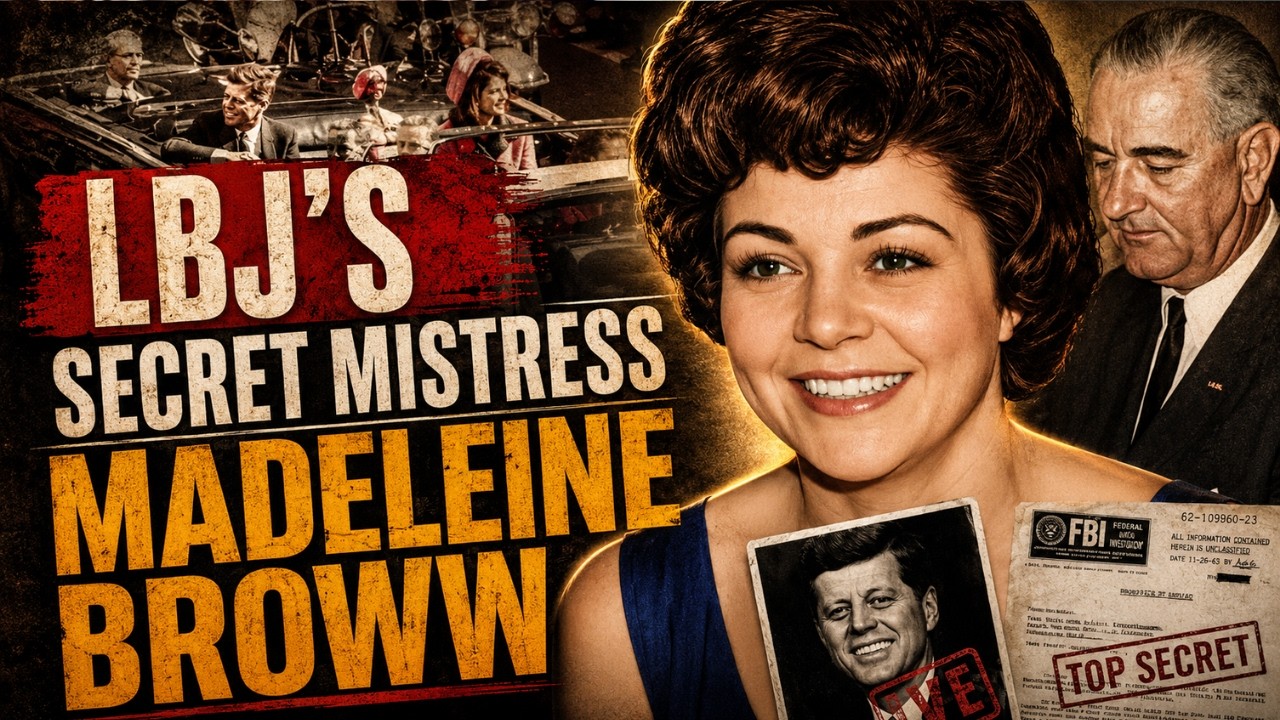
She died on June 22, 2002, maintaining her story to the end, though historians and legal records had systematically dismantled its foundation. Madeleine Brown was born on July 5, 1925. She married James Glen Brown at nineteen, a former Marine who returned from service suffering from chronic paranoid schizophrenia. Their marriage quickly devolved into a pattern of severe domestic violence.
By early 1948, her husband was institutionalized in a Veterans Administration psychiatric hospital for long-term care, and Madeleine, at twenty-three, was left alone with their two-month-old son, Jimmy Glen Brown. Desperate for financial stability, she secured a position at Glenn Advertising in 1948. Her performance there caught the attention of KLIF, a leading local radio station, which hired her as a media buyer. In this role, she negotiated high-stakes advertising deals with executives and wealthy business owners, building a wide network while working in the heart of the city’s communications industry.
In late 1948, while attending a victory celebration at the Adolphus Hotel in Dallas for Lyndon Johnson’s controversial Senate win, Madeleine caught the senator’s attention. Johnson was a physically imposing figure known for his aggressive dominance. Despite the presence of his mistress at the time, Alice Glass, Johnson focused on Madeleine. Within a week, Johnson’s aide Jesse Kellam, who managed the Johnsons’ Austin radio station KTBC, called Madeleine under the pretense of discussing advertising business.
The call was actually a vetting process to arrange a relationship. Their first meeting took place at the Driskill Hotel in Austin three weeks later. Johnson maintained strict control over the affair. He provided her with money and luxury goods through untraceable channels, but forbade her from calling him directly, mentioning his name publicly, or dating other men.
To conceal her unexplained wealth from Dallas society, Johnson’s associates arranged a sham marriage to a local businessman. The marriage was never consummated, and the couple never lived together. After five years, the arrangement ended when the man committed suicide. In April 1950, Madeleine discovered she was pregnant—a potentially career-ending scandal for Johnson, who was actively building his political power.
The situation was handed to Jerome T. Ragsdale, a prominent Dallas lawyer loyal to Johnson. Ragsdale constructed a legal containment strategy. When Madeleine’s son, Steven Mark Brown, was born in December 1950, the birth certificate legally named James Glen Brown—her institutionalized ex-husband—as the father, a man utterly incapable of disputing the claim.
Ragsdale also purchased a $15,000 home for Madeleine in a quiet Dallas neighborhood, provided a full-time maid, and issued credit cards for her expenses. He presented himself to neighbors and to young Steven as a father-figure, maintaining close surveillance over the household. The financial support came with a single non-negotiable condition: silence about Steven’s true parentage. As Johnson’s power grew—becoming vice president in 1961—the containment protocols tightened.
Physical meetings became rarer and more dangerously arranged. In 1967, Madeleine was severely injured in a car accident driven by her teenage son. The prolonged hospitalization and rehabilitation effectively ended the physical affair. Their final face-to-face meeting occurred in 1969 at the Shamrock Hotel in Houston, a subdued ending of a twenty-year arrangement rather than a reconciliation.
The financial support continued, and the demand for silence remained. Johnson became a central figure in the effort to suppress any investigation into the Kennedy assassination, despite the fact that he had spent much of the 1950s amassing power through a system that benefited from a complex web of alliances across Texas political and business circles. His political future appeared threatened, and he feared being removed from the Democratic ticket in the 1964 election. On the night of November 21, 1963, Johnson allegedly attended a private gathering at the Dallas mansion of oil tycoon Clint Murchison, where he met with figures from oil, intelligence, and organized crime.
According to Madeleine, Johnson emerged from a closed meeting and told her, “After tomorrow, those damn Kennedys will never embarrass me again. That’s not a threat, that’s a promise. ” The following day, Kennedy was assassinated in Dallas. Madeleine claimed that on New Year’s Eve 1963, she confronted Johnson at the Driskill Hotel and demanded to know if he was responsible.
She alleged he replied that the assassination was the work of Texas oil interests and rogue intelligence operatives from Washington, and that he had stood aside to fill the power vacuum. For decades, Madeleine told no one. After Johnson’s death in 1973, she remained silent, fearing retribution from the system he had built. In February 1987, during a near-fatal heart attack, she allegedly told her son Steven that his biological father was Lyndon Johnson.
In 1987, Steven Brown filed a $10. 5 million lawsuit against the Johnson estate, naming Lady Bird Johnson as the primary defendant, and seeking a court-ordered DNA test to prove his paternity. The case was dismissed in 1989 on procedural grounds—specifically, Steven’s failure to appear due to legal and financial obstacles. Before Steven could refile, he was diagnosed with a fast-spreading lymphoma in 1990 and died at age thirty-nine.
His death eliminated the most significant legal threat to Johnson’s legacy. In 1997, Madeleine self-published her memoir, “Texas in the Morning,” to bypass the legal scrutiny of major publishing houses. She became a sought-after speaker at conspiracy conferences, but her claims were soon challenged by independent historians. Court records revealed that in 1980, Steven Brown himself had filed a lawsuit seeking inheritance from Jerome Ragsdale’s estate, claiming Ragsdale was his biological father—seven years before Madeleine’s supposed deathbed confession.
Historians also established that Johnson was verifiably in Fort Worth on the night of the alleged Murchison gathering, making his attendance at the Dallas mansion logistically impossible. Official FBI records placed Hoover in Washington, and Murchison was incapacitated by a stroke at the time. Moreover, Madeleine’s 1992 forgery conviction, even though overturned, permanently ended her credibility in mainstream media. Madeleine Duncan Brown died at age seventy-six, leaving behind a story that has been widely discredited by historians and legal evidence.
She remains a figure of intense interest to those who see in her allegations a reflection of public distrust of political power in mid-twentieth-century America, despite the fact that her narrative has been thoroughly undermined by documented facts.