Just before 7:30 a. m. on June 6, 1944, a 51-year-old American brigadier general stepped off a landing craft onto Omaha Beach and did what no professional soldier is supposed to do. While machine-gun fire cut down men around him, Brig.
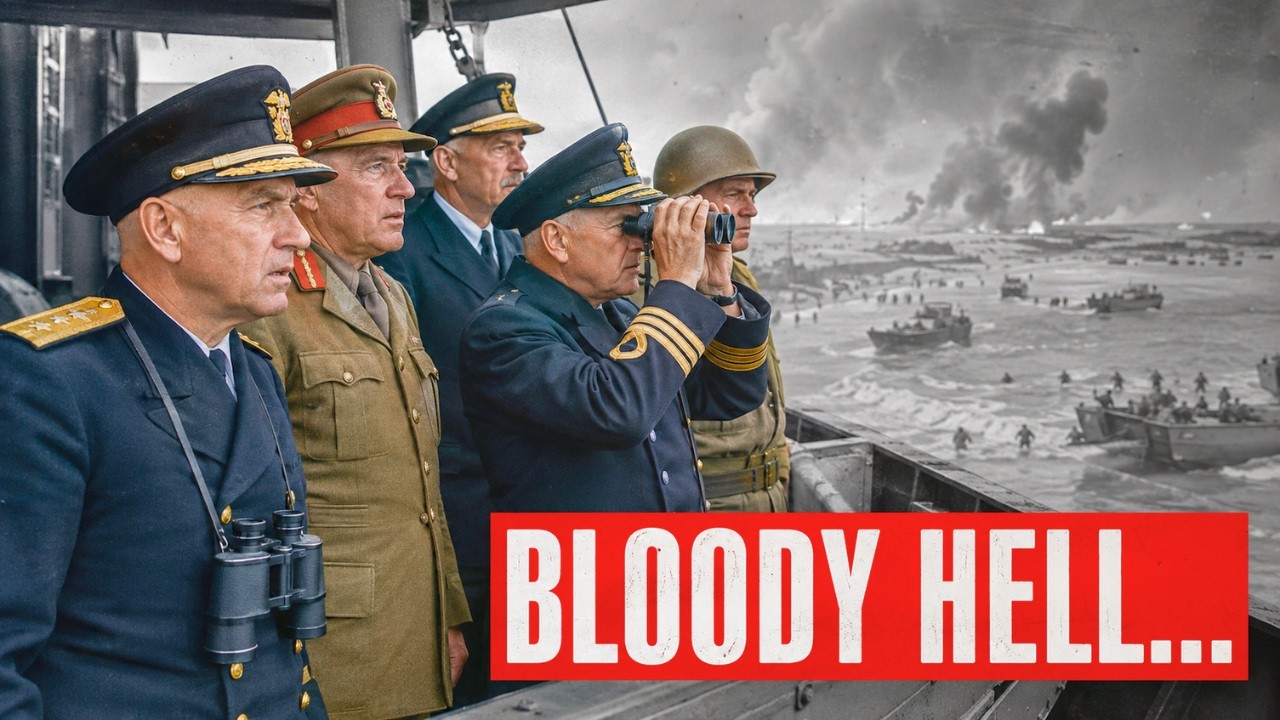
Gen. Norman “Dutch” Cota stood upright and walked, not ran, across the open sand. He was there to lead the 29th Infantry Division ashore, and what he did in the next hours would help change how Britain’s military leadership viewed the American soldier. Seven miles offshore, aboard the heavy cruiser USS Augusta, another American general watched the invasion through salt-sprayed binoculars.
Lt. Gen. Omar Bradley commanded the U. S.
First Army, and by mid-morning he faced an unthinkable decision: evacuate the survivors from Omaha Beach or admit the American assault had failed. At the same time, 5,000 miles away in London, a 60-year-old British field marshal named Alan Brooke waited for news. For two years, Brooke had written in his private diary that the Americans could not fight, and that sending untrained U. S.
divisions against Hitler’s Atlantic Wall was a recipe for catastrophe. The roots of that distrust stretched back sixteen months, to February 1943, at a narrow pass in the mountains of Tunisia called Kasserine Pass. There, for the first time, American soldiers faced the German army in battle. Field Marshal Erwin Rommel sent his battle-hardened Africa Korps veterans through the pass, and what followed was not a battle but a collapse.
Newly raised American units fell apart and fled. Commanders lost their radios, then their composure, then their men. Entire companies surrendered to an enemy they had not even seen that morning. In four days of fighting, the Americans suffered more than 6,000 casualties, lost 183 tanks, more than 100 half-tracks, and over 200 artillery pieces.
Rommel advanced 85 miles before the line finally held. In London, Alan Brooke read the reports as they arrived. As Chief of the Imperial General Staff and Winston Churchill’s closest military adviser, Brooke had watched the French army, once considered the best in Europe, disintegrate in six weeks. He had watched his own men evacuated from Dunkirk.
He had watched Singapore, the supposedly impregnable fortress, surrender to the Japanese. He had learned not to trust optimism or confidence in any plan that had not yet been paid for in blood. Now the Americans wanted to cross the English Channel and assault the most heavily fortified coastline in the world. U.
S. Army Chief of Staff Gen. George Marshall called his strategy “concentration of force”: strike the enemy at his heart and end the war quickly. Brooke privately called it a slaughterhouse waiting for its butchers.
The British favored a peripheral strategy: bomb Germany from the air, bleed it in Italy, and only invade France once the Wehrmacht was too weak to respond. At the Casablanca Conference in January 1943 and the Trident Conference in Washington that May, the Allies agreed to keep planning. But at the Tehran Conference in November 1943, Soviet leader Joseph Stalin asked simply when the invasion would begin. Roosevelt sided with Stalin, and Churchill, outnumbered two to one, agreed to a date in May 1944, later postponed to June due to a shortage of landing craft.
Three American officers in particular carried the weight of the U. S. assault. The first was Cota, a Massachusetts native who had studied British methods as a U.
S. liaison officer for British combined operations. He had watched their amphibious planning and their failures, and understood amphibious warfare as few other American generals did. Now he was assistant commander of the 29th Infantry Division, a National Guard formation of citizen soldiers who had never heard a shot fired in real battle.
The second was 56-year-old Brig. Gen. Theodore Roosevelt Jr. , son of the former president, who walked with a cane, suffered from severe arthritis and a heart condition, and had written three letters begging his commander to let him land with the first wave on Utah Beach.
The third was 51-year-old Lt. Gen. Omar Bradley, a quiet Missourian commanding the entire U. S.
First Army, who would watch the invasion unfold and alone decide whether to save the survivors or send more men in. In May 1944, at an assault training center conference in England, Cota stood before Allied planners and told them exactly what would happen if they attacked Omaha Beach in daylight. Strategic surprise was already lost, he said, but tactical surprise was essential and required a landing before dawn or in darkness. Maj.
Gen. Leonard Gerow, who would command the U. S. V Corps at Omaha, and Rear Adm.
John L. Hall, who would command the bombardment force, agreed. Three senior officers who would actually fight the battle told the planners the daylight landing would fail. The planners overruled them, reasoning that naval and aerial bombardment would compensate for the loss of surprise.
Cota accepted the order but quietly prepared his men for the reality he knew was coming. On the afternoon of June 5, Cota addressed his troops. He told them the landing craft would not arrive on schedule, that men would be put ashore in the wrong place, and that some would not land at all. “We must improvise,” he said.
“We must keep going. We must not lose our heads. ” The word improvisation made every British planner in the room deeply uncomfortable. But by then it was too late to argue.
That evening, at a country house called Southwick House, Supreme Allied Commander Dwight Eisenhower sat alone with a pen. The 53-year-old former Kansas farm boy held the fate of an ocean full of ships and 156,000 men. Earlier that day, based on a precise weather forecast, he had issued the irrevocable order to proceed. Now he took out a small scrap of paper and wrote sixty-six words in trembling handwriting: “Our landings in the Cherbourg-Havre area have failed to gain a satisfactory foothold and I have withdrawn the troops.
My decision to attack at this time and place was based upon the best information available. The troops, the air and the Navy did all that Bravery and devotion to duty could do. ” Then he added the most important sentence: “If any blame or fault attaches to the attempt it is mine alone. ” He underlined the last two words with a thick deliberate stroke, folded the note, put it in his wallet, and drove through the darkness to visit paratroopers of the 101st Airborne Division.
He had written his resignation before a single soldier set foot on French soil. What Eisenhower did not know was that Allied intelligence was outdated by three months. Throughout nearly the entire Overlord planning cycle, intelligence told the men headed for Omaha Beach they would face the German 716th Static Infantry Division, a low-grade garrison force with older men and forcibly conscripted Poles and Ukrainians. But in late March 1944, quietly, the full-strength German 352nd Infantry Division had moved into the Omaha sector.
It was a combat division of 12,020 men, including 6,800 experienced soldiers, many transferred from the hell of the Eastern Front. Its commander, 55-year-old Lt. Gen. Dietrich Kraiss, had spent the spring building fortified positions, obsessively registering every inch of the beach for artillery, and creating interlocking fields of fire.
Allied intelligence had missed every report, every photograph, every intercepted transmission. The young Americans of the 29th and 1st Infantry Divisions climbed down into their landing craft expecting to fight exhausted old men; instead they were about to join a division that had been waiting for months with professional patience. At 6:00 a. m.
, the sea was gray and cold, five-foot waves rolling under the flat bottoms of the landing craft. The men inside were seasick, soaked, and carrying seventy pounds of equipment. Around them, the largest fleet ever assembled in human history moved toward the shore: 6,000 ships, including 4,000 landing craft, battleships, cruisers, destroyers, and hospital ships. Above them flew 11,000 aircraft.
At 6:25, the naval bombardment fell silent, five minutes before the first ramps dropped. The water was cold enough to kill a man in twenty minutes, chest-deep or deeper, full of steel obstacles planted by the Germans at low tide to tear apart any landing craft that tried to cross. The first wave hit the sand at 6:30 and was slaughtered. Company A of the 116th Infantry Regiment, 29th Division, from the small town of Bedford, Virginia, landed directly in front of a German strongpoint known as WN72.
The company had 230 men at dawn. Within ten minutes, more than 90 percent were killed or wounded. When the ramps opened and machine-gun fire poured in, the men standing in the first three rows never set foot on French soil. They died where they stood, packed in the boats they had crossed the Channel in.
Two of them were brothers, Bedford and Raymond Hoback, aged 30 and 24, who had grown up on a farm outside Bedford. Their mother had given Raymond an engraved Bible for Christmas in 1943, writing his name and the year inside the cover. Raymond carried that Bible in his pack when he came down the ramp. Bedford was killed in the waves, likely in the first minutes.
Raymond was killed on the beach itself. His body was never found. The Bible fell into the sand. On one morning, on one beach, 19 young men from Bedford, Virginia, population 3,200, died.
It was the highest per capita daily loss of any American community in the entire war. The situation worsened. Thirty-two Duplex Drive Sherman tanks were supposed to swim ashore in the first wave, fitted with canvas flotation screens and propellers. The 741st Tank Battalion launched 29 tanks 6,000 yards from the beach in waves designed for half a foot, under skies that were already running five-foot seas.
Twenty-seven sank in open water before they ever saw the Germans. The canvas screens tore and seawater flooded in. Five men per tank, 35 tons of steel dropping straight to the bottom of the Channel. Only two DD tanks from the battalion swam to shore.
But farther west, in the sector belonging to the 743rd Tank Battalion, Col. John Upham watched the same waves breaking over the bow of his landing craft, watched the canvas covers on his tanks swinging in the wind, and in about ten seconds made a decision that defied orders. He ordered his landing craft to carry the tanks all the way to the beach and drop them directly onto the sand. All 32 tanks reached the shore.
By 6:50, the American assault on Omaha had lost its bombardment, lost most of its armor, and lost its plan. The German 352nd Division opened fire in full force. The MG42 machine gun fired 1,200 rounds per minute, described by veterans as the sound of a bedsheet being torn in half. The Germans had roughly 85 machine-gun positions covering Omaha.
By 7:00 a. m. , the beach was covered with dead and wounded. The wounded who could not move drowned in place.
Men hid behind steel obstacles designed to tear apart landing craft because those obstacles were the only cover on the beach. By 7:30, men huddled behind a low concrete seawall and refused to move. Some were terrified, some in shock, some still able to move but out of ideas. Then Cota’s landing craft hit a sandbar off the White sector.
The ramp dropped, and three men in front of him were killed instantly. Cota waded forward into chest-deep water, a 51-year-old man carrying a Colt . 45 and a walking stick, and saw a beach that looked exactly as he had described it in that training conference a year earlier. He did not stop to say he had been right.
He walked, not crouching, not running, upright across the open sand under machine-gun fire that was killing men all around him. From group to group he kicked frozen men behind obstacles. “Get off the beach! ” he shouted.
“We’re being killed on the beaches. Let’s go inland and be killed. ” The men who had been paralyzed for over an hour raised their heads and saw a general older than most of their fathers standing upright in the open. Something broke inside them.
Near the base of a bluff, Cota came upon a group of soldiers with Ranger insignia. “What outfit is this? ” he asked. “Fifth Rangers, sir,” came the reply.
Without hesitation Cota said, “Well, Goddamn it, Rangers, lead the way. ” That sentence, spoken to a major named Max Schneider, became the official motto of the U. S. Army Rangers, and it remains their motto today.
When the men behind him froze after a Bangalore torpedo blew a gap in the wire at the base of the bluff, Cota walked through the gap himself and began climbing. When he turned, he saw men following him, not many at first, then more, then dozens. By 9:00 a. m.
, small groups of Americans were moving inland from multiple points along Omaha. Not because the plan had worked, but because a sergeant, a lieutenant, and a private had decided that moving forward was better than dying in place. Among them was a 23-year-old medic from Alabama named Ray Lambert of the 16th Infantry Regiment, 1st Division. Before he left the boat, he shook hands with his brother Bill, who was in the same landing craft.
“If I don’t make it, take care of my family,” he said, “and I’ll do the same for yours. ” Thirty-one men were on his boat; only seven survived. Lambert was shot in the elbow before he got out of the water but kept going. He set up an aid station behind a concrete block protruding from the waves, an ordinary beach obstacle so unremarkable that the men who died there never named it.
For hours, Lambert treated the wounded there. Bullets passed around him. Fragments hit him twice more. He was hit again in the leg, but he kept working.
He waded into the waves to pull the drowning from the water. Eventually a landing craft ramp weighing hundreds of pounds fell on him while he tried to pull a wounded soldier out from under it. His back broke, and he lost consciousness face-down in the shallows. Another medic saw him and pulled him out.
When he woke, he was on a ship bound for England. His brother Bill was in the bed next to him. Both had survived, barely. Today that concrete block is called Ray’s Rock, with a memorial plaque mounted on it.
Lambert lived to 100, dying in 2021. Seven miles offshore on the Augusta, Bradley watched through his binoculars. Reports from Omaha were fragmentary and terrible. Whole units were missing, their radios burning.
By about 10:00 a. m. , Bradley faced the decision that could have ended the invasion. He began to consider evacuating Omaha, pulling the survivors off the sand, diverting follow-up waves to Utah or the British sectors, or admitting the American assault on the eastern half of the invasion had failed.
He later wrote in his memoir that it was the darkest hour of his career. If he had given the withdrawal order, every fear Alan Brooke had recorded over two years would have been confirmed. He did not give the order. Not yet.
He waited. As he waited, the U. S. Navy did something that saved the invasion.
Rear Adm. Carleton Bryant, aboard the battleship USS Texas, sent a radio message to all ships of the bombardment group, words still preserved in naval archives: “Get on in there, men. They’re raising hell with the men on the beach. We can’t have any more of that.
We must stop it. ” Capt. Harry Sanders, commander of Destroyer Squadron 18 aboard the USS Frankford, took that message as an order. Naval doctrine required fire support from thousands of yards offshore, inside swept channels.
Sanders ignored the doctrine. He led his destroyers straight toward the shore, to within 800 yards, in some cases 600 yards, close enough that German riflemen on the bluffs could fire at officers on the bridge with small arms. Some destroyers scraped the bottom. The water was so shallow that their propellers churned up mud.
But they reached point-blank range and opened fire, their five-inch guns aimed directly at targets the commanders could see with the naked eye. On the USS McCook, Cmdr. Ralph Ramey held his ship in position in front of a fortified German gun on the bluff for over fifteen minutes, firing consecutive salvos at the base of the position until the cliff face itself collapsed, the gun position sliding into the sea. Years later, the chief of staff of the 1st Infantry Division would state plainly that naval fire support was what enabled them to get in.
Without the naval gunfire, they could not have crossed the beaches. Fifteen miles to the west, a different kind of American miracle was unfolding. Brig. Gen.
Theodore Roosevelt Jr. , 56, walked with a cane but carried a pistol as his Higgins boat approached Utah Beach. He had fought for this. His commander, Maj.
Gen. Raymond Barton of the 4th Infantry Division, had refused him twice. Roosevelt’s third request, in a formal letter dated May 26, 1944, stated: “I personally know the officers and men of these advance units, and I believe that their knowledge of my being with them will steady them. ” Barton signed the papers.
He later told his staff he expected Roosevelt to die on the beach. At 6:30, Roosevelt’s landing craft touched sand, but in the wrong place, pushed by the current about 2,000 yards south of the intended landing zone. Officers immediately began organizing a redirect of the troops north along the beach through exposed fire. Roosevelt sized up the situation, walked forward on his cane, reconnoitered the ground himself, and returned to his officers with the sentence that would follow him into history: “We’ll start the war from here.
” He turned the entire direction of the assault 90 degrees, redirected the following waves to his new position, and walked back and forth on the sand with a cane in one hand and a map in the other, guiding units to their new objectives. He limped so calmly through German fire that one sergeant later described him as looking like a man strolling through inspecting a property. A detail almost no one knows: that same morning, on another beach, another Roosevelt landed. His son, Capt.
Quentin Roosevelt II, named after the uncle shot down over France in 1918, came ashore with him. They were the only father and son who landed together on D-Day. By the standards of that terrible morning, Utah was a success. 23,000 American soldiers came ashore by sea.
Only 197 died, not because they were lucky, but because a 56-year-old man on a cane with a weak heart made the right decision in the wrong place and refused to move. Four years later, after the war, when Omar Bradley was asked to name the single most outstanding act of heroism he had witnessed in his entire military career, he did not hesitate. He said one sentence: “Ted Roosevelt at Utah Beach. ”
By the evening of June 6, the Americans held a foothold, though not a deep one.
The 29th Division was on the bluffs. The 1st Division was on the bluffs. The 4th Division was six miles inland. The German 352nd Division, the elite unit Allied intelligence had missed for three months, had lost 20 percent of its strength in one day.
Its commander sent a radio message that night saying he could not hold if the Americans attacked again in the morning. The Americans attacked again in the morning. In London, Alan Brooke read the fragmentary, contradictory reports, some hopeful, some catastrophic. He had feared this day for two years, believing in his private diary that the Americans would not be able to do it.
But the diary entries that night and in the following days became a quiet, honest, professional accounting of the fact that the young men from Iowa, Alabama, Virginia, and Texas had done something on the beaches of Normandy that deserved to be taken seriously. He did not change his mind all at once. Alan Brooke was not a man who changed his mind quickly; he was a man who changed his mind honestly. On the morning of June 7, Bernard Montgomery, the 56-year-old commander of all Allied ground forces in the invasion, boarded the destroyer HMS Faulknor and crossed the Channel.
Standing on the bridge, he watched the coast of Normandy emerge from the mist and saw what the men of the 29th Division had done the day before: smashed landing craft, smoke still rising from the bluffs, bodies still floating in the waves. Montgomery had spent his career being hard to please, and had written in his own diary before D-Day that the Americans had great potential but needed British direction. On June 12, five days after the invasion, Winston Churchill, accompanied by Alan Brooke and Adm. Sir Bertram Ramsay, crossed to Normandy aboard the destroyer HMS Kelvin.
Churchill, 69, wanted to see the beaches himself, walking on French soil for the first time since 1940. Brooke walked beside him. Photographs still exist: Brooke in uniform, standing on a beach that days before had been the 29th Division’s battlefield. His face reveals almost nothing, but a close look shows a man absorbing the scale of what had happened here: wreckage stretching for miles, graves dug in the sand, endless crates, helmets, barrels of gasoline, the remnants of an army that had crossed an ocean and refused to leave.
In his diary, Brooke wrote that above all he was struck by the enormous weight of American logistics, the mountains of supplies piling up on the beach, the Mulberry harbors under construction. The 29th Division had climbed the cliff under machine-gun fire. He realized this was something Britain could not have done alone. In the days and weeks that followed, Brooke kept writing that American tactics were broad, wasteful, that they were willing to attack everywhere at once rather than focus on one knockout blow.
The criticism was not unjustified; historians still debate it. But the nature of the criticism had changed. Before June 6, Brooke questioned whether the Americans could fight at all. After June 6, he only questioned how they fought.
That, from one of the greatest professional soldiers Britain ever produced, was a form of respect. There is a scene worth pausing on, a ceremony held shortly after the invasion in a field in Normandy. Bernard Montgomery, in his black beret and old battle jacket, walked between rows of American officers, carrying a small box holding the Distinguished Service Order, one of Britain’s highest military decorations, rarely awarded to foreign officers, almost never for a single day’s work. He stopped in front of Brig.
Gen. Norman Cota, the 51-year-old man who had walked upright on a beach where every instinct screamed to lie down. Montgomery, who three months earlier had privately dismissed American soldiers as weak, pinned that ribbon onto Cota’s chest with his own hands. He was not required to do so.
The British War Office had not asked for it. He could have sent the paperwork. He chose instead to do it himself, in public, in front of British and American troops. In a field in France, it was as close to an apology as Montgomery would ever offer.
Cota did not talk much about D-Day. In August 1944 he took command of the 28th Infantry Division and led it through some of the war’s fiercest battles: the Hürtgen Forest, where American infantry died in numbers that shocked the surviving veterans, and the Battle of the Bulge. He retired from the army in 1946 as a major general and returned to his hometown of Wichita, Kansas. When people asked him about the beach, he changed the subject.
When historians knocked on his door, he was polite and uncooperative. He believed firmly that the credit belonged to the soldiers on the sand, not the general who happened to be among them. He died on October 4, 1971, at 78. His obituary in the Wichita paper mentioned his military service without detail.
It did not mention the personal decoration from Montgomery, or that he had created the motto of the U. S. Army Rangers with one sentence spoken in frustration at the base of a cliff in Normandy, or that he had walked off a beach where the plan had failed with everything upside down. Efforts since 2004 to upgrade Cota’s Distinguished Service Cross to the Medal of Honor have not yet succeeded.
On the night of July 12, six days after Utah Beach, Brig. Gen. Theodore Roosevelt Jr. lay in a captured German truck converted into his mobile quarters near the village of Méautis.
He had a reading lamp, a cot, and a set of maps. He spent his days, as he spent every day, along the front line, visiting his men, staying where the fighting was heaviest, so the young soldiers around him would know the old man was still with them. He did not know that Eisenhower had already signed orders promoting him to major general, with command of the 90th Infantry Division. The orders arrived by mail, but he never learned of them.
That night, alone in the small captured truck in the middle of a French field, Theodore Roosevelt Jr. suffered a fatal heart attack. He was found in the morning. Maj.
Gen. Raymond Barton, who had once told his staff he expected Roosevelt to die on Utah Beach, wept when he heard the news. He told an Associated Press reporter that Roosevelt was the bravest soldier, officer, and man he had ever known, that no soldier or officer in the division would fail to feel his loss personally, and that Roosevelt had died a victim of battle in every sense of the word. On September 28, Roosevelt was posthumously awarded the Medal of Honor for his actions on Utah Beach.
He was buried in the Normandy American Cemetery on the bluff overlooking Omaha Beach, Section D, Row 28, Grave 45, a white marble cross facing east, above the sand where so many other American boys lay. Eleven years later, a decision was made about his younger brother Quentin Roosevelt, the fighter pilot shot down over France in July 1918, buried for decades in a small American cemetery from the First World War at Chamery, France. The Roosevelt family arranged for Quentin’s remains to be moved, and he was buried beside Ted, both brothers, two wars, both killed in France, now buried in the same earth. They are the only brothers buried side by side in that cemetery, where 9,386 other Americans also lie in long rows of white crosses and Stars of David across 172 acres of land given by the French people to the United States in perpetuity.
Down the bluff at the water’s edge, there is a smooth rock about the size of a car, known as Ray’s Rock, where a 23-year-old medic from Alabama treated the wounded for hours. A plaque is mounted on it now, slowly dissolving in the sea air. Somewhere in the sand beneath all of it, a Bible fell from a young man’s pack in the first ten minutes of the invasion, made its way by strange kindness from West Virginia to a mother in Bedford, Virginia, who kept it on a shelf in her front room and said that having her son Raymond’s Bible was the closest she ever came to having him back. This is what happened on Omaha Beach and Utah Beach on the morning of June 6, 1944.
It is what forced Alan Brooke, the man who had doubted the Americans for two years, to finally write in his private diary an acknowledgment that the young men from Iowa, Alabama, Virginia, and Texas had passed a test that many experienced soldiers would have failed. They took losses that should have broken them, and they kept fighting. Some Americans collapsed, of course; they froze, they ran, they died in place. But other Americans took their places, and the assault simply did not stop.
Rommel had warned his officers before the invasion that the battle would be decided on the beaches. If the Allies got ashore, he said, Germany would lose the war. The Allies got ashore. Germany lost the war.
The alliance changed too. Before D-Day it had been like an agreement between a teacher and a student: Britain had the experience, America had the factories. After D-Day it became an alliance of equals. By the end of the war, the majority of Allied forces in Western Europe were American.
The center of gravity of the Western world shifted permanently across the Atlantic. NATO was founded five years later, in 1949, on trust earned with blood on the beaches of Normandy. Had Bradley issued the order to evacuate Omaha that morning, none of it would have happened. He did not surrender, because a brigadier named Dutch Cota refused to lie down while every other man clung to the sand, and brought a paralyzed army back to its senses with his refusal to hide.
Or because a 56-year-old man on a cane with a weak heart stood on the wrong beach and said, “We’ll start the war from here. ” Or because a 23-year-old medic refused to stop working even after his back was broken. Or because a Navy captain led his destroyers into rifle range and blew German guns off the bluffs. Or because two brothers from Bedford, Virginia, and seventeen of their neighbors fell from a ramp into a wall of German fire and never came home.
In the morning of June 6, 1944, the young men of the American invasion, the sons of farmers, clerks, and factory workers who could not have pointed to France on a map ten years earlier, proved to the world, and to the British military leader who had doubted them for two years, that every doubt recorded in those private diaries was finished. Alan Brooke closed his diary that night in London. He kept writing for another year until the war ended, and kept criticizing the Americans, Churchill, Cota, Montgomery, Eisenhower, everyone who entered a room with him. He was that kind of man.
But he never wrote again in that diary that the Americans could not fight.