The full article is below.
—
For forty years after the end of World War II, historians wrestled with a question that had no clear answer. Why did Dwight Eisenhower, the most cautious commander in the United States Army, a man who weighed every word and calculated every order, choose George Patton, the loudest, most reckless, and most unpredictable general in his command, to be his right hand in the most diplomatically sensitive theater of the war? The answer was not in battle reports. It was not in official historical records. It was buried in the small details. A dinner in Morocco, a salute given a moment too soon, a single word spoken in French in a room where everyone expected to hear English.
It began on a night when the Atlantic was black, not just dark, but black. November 7, 1942. A heavy cruiser named the USS Augusta cut through the waves 200 meters off the coast of French Morocco. Its engines were muffled, its decks blacked out, its radio silent. Inside was George Smith Patton Jr., a man writing about the men he was about to kill. It was not an easy thought. American soldiers had already died in the darkness. Somewhere under the moonlight lay Casablanca. And somewhere beyond Casablanca, two years and a thousand miles away, there was a war he could not yet see.
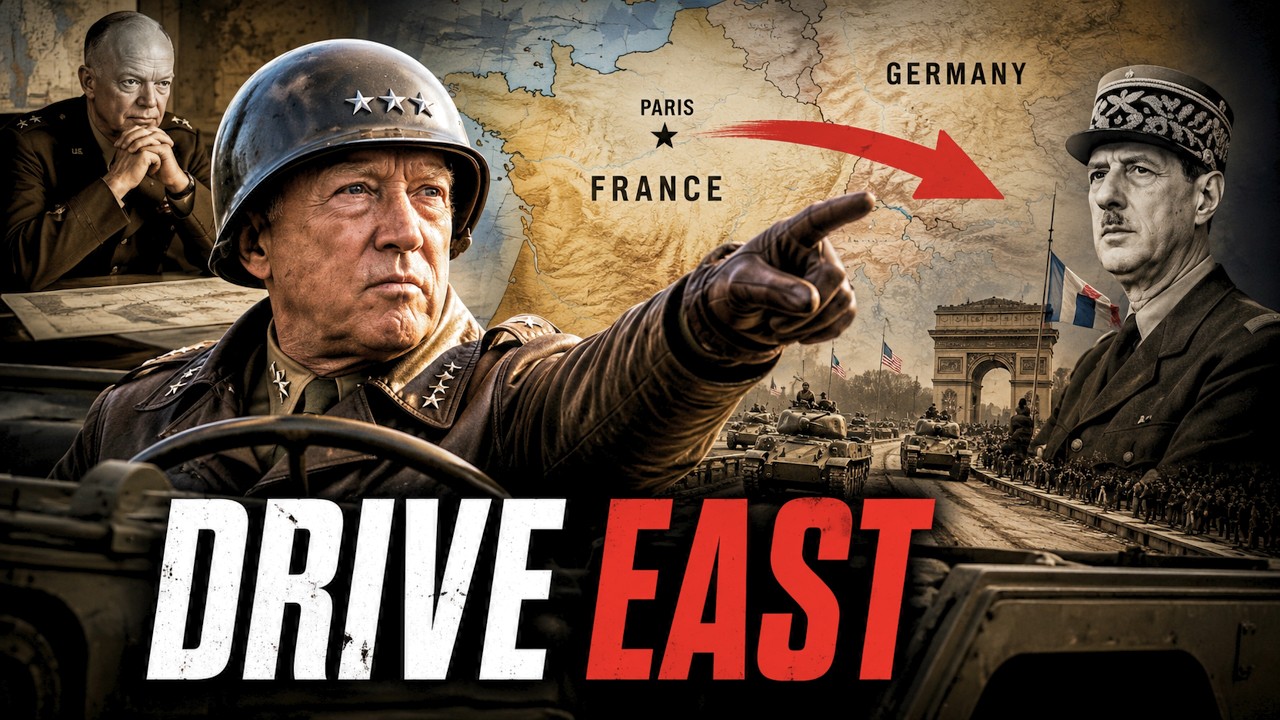
This is the story of how George Patton became Dwight Eisenhower’s most useful weapon and how that weapon was forged—not in the deserts of Tunisia, not in the wheat fields of Sicily, not in the snows of the Ardennes, but here, on a moonlit night off the coast of Morocco in November 1942. Because the secret mission did not begin in Paris. It began with the harsh French dawn of November 8. Shells fell within 20 yards of Patton’s cruiser. Allies were killing allies on the beaches of Morocco. Then, on November 11, the day the world remembered as Armistice Day, the guns fell silent.
Inside a building was General Auguste Noguès, who expected humiliation. Patton did not meet Noguès in a command tent. He met him in a hotel, the Hôtel Miramar. Patton had ordered the dining room cleared. Then he spoke French. His French was not perfect. But for a French general expecting a lecture from an American who spoke only English with contempt, hearing his own language from Patton’s mouth was a small revolution. The French commander stopped seeing Patton as an invader. Three days later, Patton made an official visit to the Sultan of Morocco. In a country where the French Resident General was supposed to speak for the throne, the American general had addressed the throne directly.
Two thousand miles away, in a smoke-filled office in Algiers, the new Allied commander, 52-year-old Lieutenant General Dwight David Eisenhower, read the reports from Morocco and rubbed his temples. The problem was not the Germans. He read about Patton’s refusal to lower the French flag over any captured fort. This was not written in an order. It was a quiet realization stored in a man’s mind, waiting for the day it would be desperately needed. That day would come twenty months later in Normandy, on August 1, 1944, at Utah Beach. The morning sky was the color of pewter, and the waves crashed a tired gray on the same sand where thousands of American boys had died eight weeks earlier. One of those landing craft carried a man with a face like a hawk and a swagger stick in his right hand.
The 2nd Armored Division. Sixteen thousand men. Two hundred Sherman tanks. Patton had studied at the French war college in Paris before the war. In French, he was ready for many things. He was ready, as he told his staff that morning, to find the Americans inexperienced, untried, and unskilled. When General Omar Bradley drew up the battle plan for the breakout from Normandy, the French 2nd Armored Division could have gone anywhere. Instead, it went to Patton’s Third Army and to the XV Corps under command of General Haislip. And one of the reasons was that twenty months earlier, in a hotel dining room in Morocco, an American had shown he could make a French general feel like an honored ally instead of a defeated subordinate.

The secret mission was not new. It was not invented in the summer of 1944. Now, with the toughest of the Free French standing inside his tent, Patton was about to use it for the biggest political problem of the war. In the second week of August 1944, while George Patton’s tanks carved through the wheat fields of central France at speeds the Wehrmacht itself never achieved, de Gaulle sat in a borrowed villa in Algiers looking at a map of his country. Not the man Roosevelt loved, not the man Churchill tolerated, but the man the French people saw. Patton’s tanks had broken out of Normandy on August 1. They were not just advancing. Fuel trucks could not keep up. And every kilometer Patton captured was a kilometer no Frenchman would liberate. Every town that fell to a Sherman tank with a white star was a town that did not fall to a Sherman tank with the Cross of Lorraine.
Inside a farmhouse, Dwight Eisenhower was waiting. The two men had met before. There were maps. There was coffee. There was an interpreter who barely spoke, because Eisenhower had been advised by a colonel he trusted that de Gaulle understood far more English than he let on. Eisenhower did not answer immediately. He stood and shook the French general’s hand. He needed information, and he needed to know what George Patton’s Third Army was doing, because the answer was already arriving from somewhere in the dust of the Beauce plains. At 2 a.m. on August 22, a staff officer woke George Patton in a command tent 40 kilometers east of Chartres. A young French officer, 39 years old, had repeatedly asked to speak to the Supreme Allied Commander. He did not care about formalities. He ordered the officer brought through the night to the 12th Army Group headquarters, 90 kilometers away. The order was given. The French 2nd Armored Division would be released from George Patton’s Third Army.
Note this well, because this is the moment historians describe in a single sentence, and the men who lived it understood it deeply. The decision to liberate Paris, the most controversial political decision of the war in France, depended in its final form on the credibility of George Patton, who had guaranteed a Free French officer he had met only 30 minutes earlier while wearing swimming trunks. This secret mission worked not as an order, not as a conspiracy, but as a system. That was Eisenhower’s genius in how he used him.
Meanwhile, 200 kilometers east, the Third Army was crossing the Marne River. George Patton stood in an advanced command post in Champagne country north of Châlons. De Gaulle was expected to enter Paris within hours. While the world’s cameras turned toward the Champs-Élysées, while every newspaper in the free world prepared its front page with photos of de Gaulle walking through the jubilant crowds, the man whose army had made it all possible had already advanced 50 kilometers further east than any major Allied formation. And George Patton proved on the afternoon of August 25, 1944, to every Frenchman watching, that the American who was most feared did not want Paris.
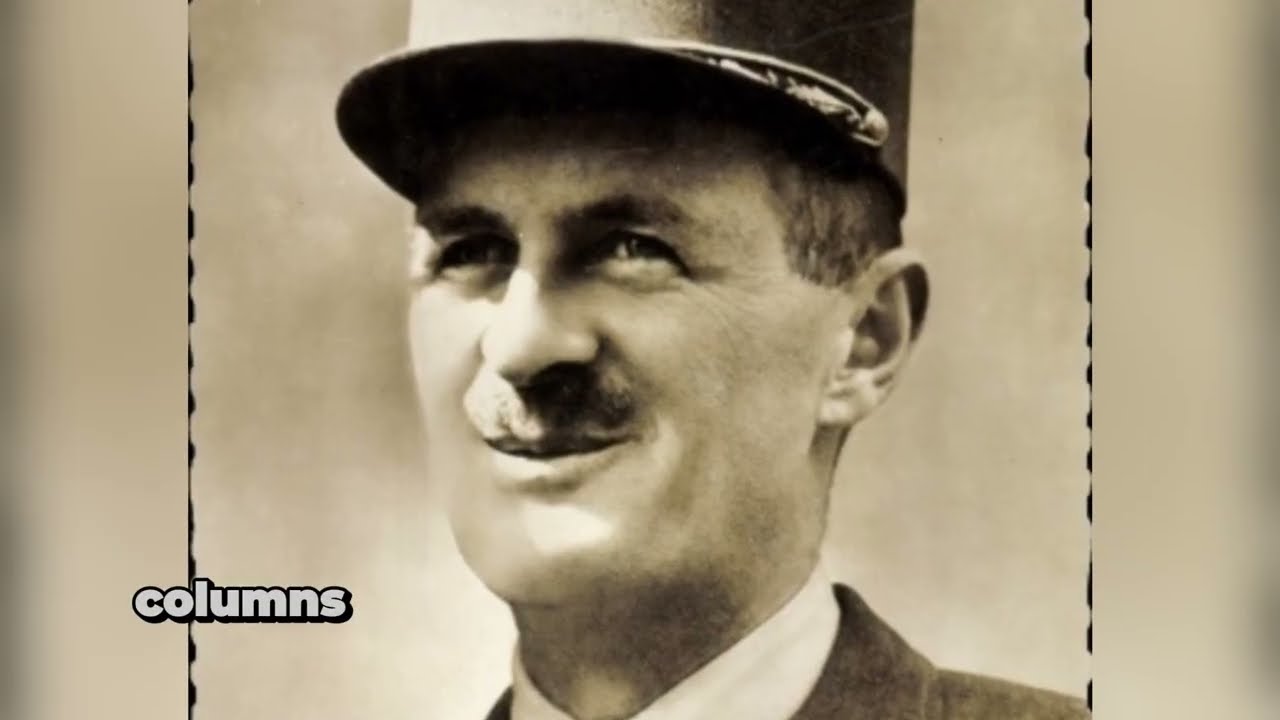
George Patton, the American who bowed to a Sultan and quoted Voltaire from memory and made French generals feel like equals in a Casablanca hotel two years earlier, was already 100 kilometers deeper into the war than de Gaulle’s army would get for another month. On August 28, 1944, two days after de Gaulle walked down the Champs-Élysées under sniper fire, refusing to duck even as bullets whizzed past his head, because he knew in a way no one else in France did that a leader who flinches is not a leader. De Gaulle did not negotiate. Why? Because of the map. Because every man in Paris, communist, Gaullist, or just French, realized the war was not over. The Germans still held the Atlantic ports. And the army pushing them back, kilometer by kilometer, day by day, was not French. It was Patton’s army.
The man at the eastern end of the supply line, the man whose army was the spearhead of the unified Allied advance, was a 59-year-old general with no patience for politics. There was no need to voice a threat. There was no order from Eisenhower directing Patton to intimidate the French Forces of the Interior. There was no need. He did it without firing a single shot at another Frenchman, and the man who made it possible was crossing the Meuse River 200 kilometers to the east, never knowing in his lifetime that he was the reason.
By the second week of September, the war had moved elsewhere. Patton’s Third Army was in Lorraine. The supply trucks had finally caught up after the great fuel crisis of late August, when Eisenhower was forced to choose between giving gas to Patton or to Montgomery, and chose Montgomery. Patton raged, then reluctantly halted for 10 days within sight of the Moselle River. Leclerc, the proud Frenchman who had not wanted to serve under Americans, who had told his officers that summer that if the American was a fool, there was no reason for the Frenchman to be one, had asked for one thing. By the end, more than 60 German armored vehicles were burning in the valley, including most of their tanks. There were no photographers. He said in French, “One sentence.” The man who had landed in Normandy expecting to find the Americans inexperienced, the man who had begun the summer believing he could learn nothing from a country that had only joined the war in 1941, stood at attention with tears streaming down his face.
The price they asked for returning France to the French was nothing more than for the French to stop fighting each other and start fighting the Germans again. It was never about silencing French rivals. It was about making silence unnecessary. In a small office in Versailles in late September, Dwight Eisenhower received a cable from Patton’s headquarters describing the battle at Dompaire and the medal ceremony that followed. Eisenhower considered George Patton his most useful officer. Not because of his temper, or his uniform, or his ivory-handled pistols, but because Patton never realized the purpose for which he was being used. The man who did not know remained himself. And that, in the summer and fall of 1944, was worth more than a thousand diplomats. Because the great fear of every French person in 1944 was not the return of the Germans. It was the staying of the Americans. That France would be governed as Italy was, by an Allied military government, with American colonels signing decrees in towns where the State Department had chosen the mayors.
Not to silence rivals, not to threaten de Gaulle, not to disarm the Free French forces, but to prove by his simple visible presence that the United States of America had not crossed the ocean to take what was not theirs. George Patton died in December 1945, sixteen months after the liberation of Paris, in a hospital in Heidelberg from complications of a slow-speed car accident on a German country road. He was 60 years old. He never gave an interview discussing the political role he played in France. He was the man whose presence made political crises stop happening. He was, without knowing it, the most effective ambassador the United States Army ever sent to another country.
Every French person who read that passage knew who was meant. The American general who bowed to a Sultan in Rabat in 1942, who quoted Voltaire in French to a defeated colleague in a hotel dining room in Fédala, who pinned a silver star on a soldier’s tunic in an outdoor field and told him in his own language that he was proud to have soldiers like him in his army. The man who never raised his voice, never threatened, never even attended the victory parade in Paris, and who simply, on the morning of August 25, 1944, while the world’s cameras focused on de Gaulle and the Champs-Élysées, looked east, gestured to his driver, and said one word.