On February 14, 1929, Chicago was in the grip of a freezing winter morning. Inside a brick garage on North Clark Street, seven men stood against a wall with their hands up. They were experienced gangsters from the North Side, men who knew the dangers of their city. Yet they remained calm and cooperative because they believed police had just walked in.
A black Cadillac pulled up, and men stepped out dressed as Chicago cops. Badges, uniforms, and gun belts made the scene look authentic. The North Siders followed the standard protocol for a routine shakedown. They put down their guns, turned toward the wall, and waited. Then the room exploded.
Two Thompson submachine guns opened fire from behind. The sound bounced off the concrete as bodies folded and blood hit the wall. The men never had time to reach for the weapons they had just surrendered. Within seconds, the garage became a slaughterhouse. When the shooting stopped, the only living thing left was a terrified German Shepherd chained near a truck.
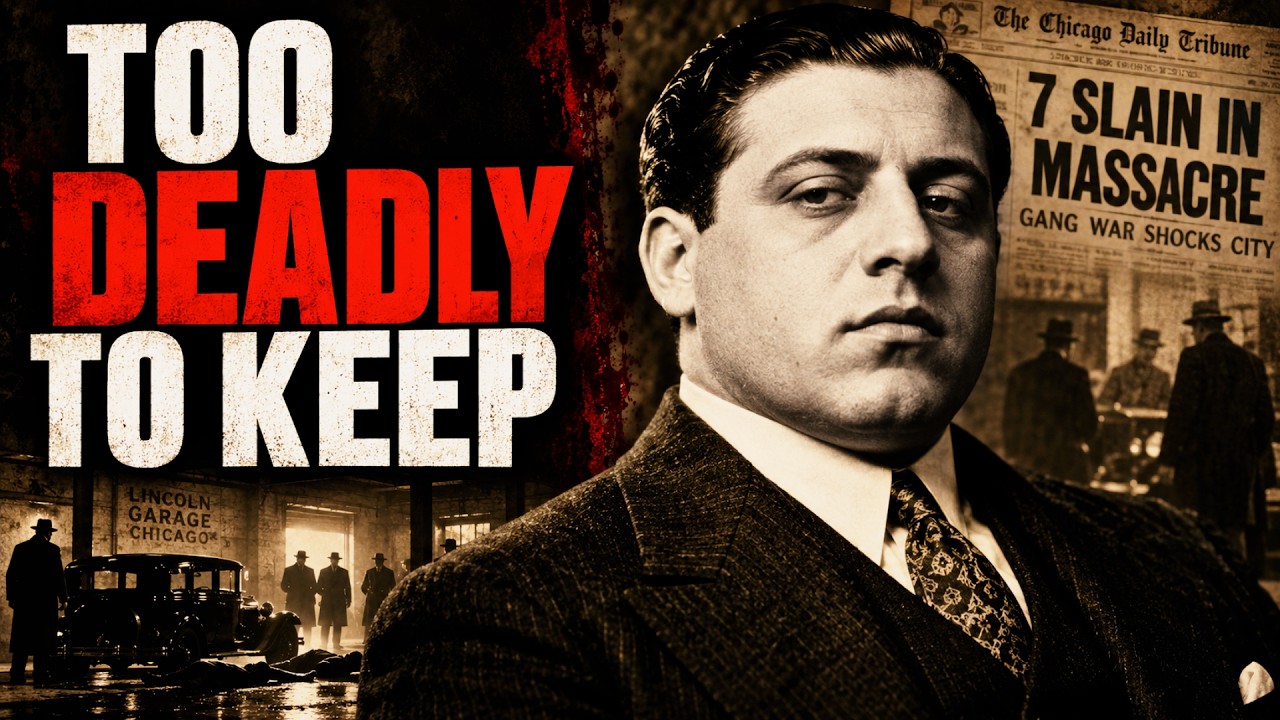
That scene became known as the St. Valentine’s Day Massacre, one of the most infamous gangland killings in American history. But the man associated with designing the operation was nowhere near the garage. He was miles away, well-dressed and visible. That was deliberate.
Jack McGurn sat in a luxury hotel with a beautiful actress, making sure people could see exactly where he was. That told you almost everything about the kind of killer he had become. He was not loud or sloppy. He wanted distance, planning, and control. He wanted the murder to happen exactly as designed while he built his alibi somewhere else.
But Jack McGurn did not start as that man. He did not begin as a born psychopath looking for an excuse to kill. He started as an athlete, a boxer, a golf caddy, a disciplined young man with a real chance at a legitimate life. Then one murder changed him. After that, revenge became more important than the life he could have had.
Before Chicago knew him as Jack McGurn, his name was Vincenzo Antonio Gabaldi. Born in Sicily in 1902, his childhood was unstable. His biological father was mostly absent and was eventually murdered in a New York barber shop. But the man Jack built his life around was his mother’s second husband, Angelo DeOre.
Angelo was the stable one, hardworking and protective. He gave Jack structure and moved the family away from Brooklyn’s gang-heavy waterfront neighborhoods toward Chicago’s Little Italy. The idea was simple. Get the family somewhere safer, build a life, stay out of trouble. For a while, Jack seemed capable of doing exactly that.
He was physically gifted. Not a huge guy, about 5’5”, but quick, strong, and compact with fast hands. He got into boxing and attracted attention. He fought under an Irish-sounding ring name, Battling Jack McGurn. That name stuck. Later, when people thought of Machine Gun Jack McGurn, it sounded like a nickname invented for a gangster. It really started in the ring.
Jack’s first identity was not killer. It was athlete. He trained, stayed disciplined, and did not drink heavily or use drugs. He earned legitimate money caddying on golf courses. He liked golf, physical control, and getting better at things. His personality was visible before the mafia ever got involved. He was competitive, precise, and proud.
But Chicago in the early 1920s was not a normal environment. Prohibition had turned parts of the city into open criminal territory. In Little Italy, one of the dominant forces was the Genna family, six Sicilian brothers who were violent and deep in bootlegging. They produced huge amounts of illegal liquor and needed a lot of sugar. So they started leaning on local grocers. Sell to us, sell cheap, do not argue.
That was not a negotiation. It was a reminder that the people asking had guns. Then they got to Angelo DeOre, and Angelo refused. He had a large family to support and could not hand away the margins from his grocery business. When the Genna people pushed, Angelo pushed back. That took courage. It was also extremely dangerous.
On January 8, 1923, three gunmen went to Angelo’s grocery store. They did not come to scare him. They shot him and left him bleeding on the floor. Jack’s entire life changed right there. His mother was pregnant at the time, and the shock of hearing about Angelo’s murder triggered a miscarriage. One act of violence took two lives from the family. Angelo and the unborn child were buried together.
Jack was 21 years old, young enough that his whole future should have been in front of him. Instead, he was helping hold together a devastated household. He did not process the murder as something tragic he had to survive. He processed it as a debt that had to be repaid. He stood over Angelo’s grave at Mount Carmel Cemetery, and grief turned into cold rage.
Jack decided the men responsible were going to die. According to the story that grew around him later, he did not just want them dead. He wanted them to suffer. That was an important shift. Revenge was no longer about restoring justice. It was about inflicting pain. The boxing gloves were done. The ring no longer mattered.
But Jack understood that anger alone was useless. You could not walk up to a major gang and challenge them because you were angry. The Gennas had men, money, weapons, and protection. Jack had fast hands. That was not enough. So he started thinking practically. If he wanted to kill these men, he needed access, guns, information, and people who knew how the underworld worked.
That was the real point of no return. He did not stumble into organized crime. He walked toward it because organized crime gave him the tools revenge required. A few months after Angelo was killed, Jack entered the Circus Cafe. It was a speakeasy tied to a violent crew led by Claude “Screwy” Maddox. These guys were connected to the South Side Italian organization under Johnny Torrio and a rising Al Capone.
Jack started low. Bodyguard work. Muscle. That made sense. He was a boxer who already knew how to hurt people. But that was not why he stayed. He was learning, watching, and listening. He figured out who handled weapons, who planned jobs, how targets were followed, and how a hit got carried out without getting everybody arrested afterward.
Jack treated the underworld like a new discipline. The same personality that made him train seriously as an athlete now got applied to murder. He moved from fists to firearms and took to the guns quickly. He did not get loud or brag constantly. He stood around quietly and learned. That quietness became one of the reasons people trusted him with more.
During all of this, he had not forgotten the original reason he came in. The three men tied to Angelo’s murder. For years, he listened for names, checked stories, and tracked rumors. He waited. Revenge stories usually get told like somebody snaps and immediately goes hunting. Jack did not. He waited. Waiting told you he was already becoming more dangerous.
Then in 1926, Jack finally believed he had the names. Over roughly eight days, the men were hunted down one by one. The exact details were not fully documented. A lot of Jack McGurn’s story becomes legend very quickly. But the outcome was clear. The men associated with Angelo’s murder were eliminated.
The reaction from the surviving Gennas was almost as important as the killings themselves. They did not come after Jack. This was a family known for violence. Retaliation should have been automatic. But Jack’s revenge created enough fear that people hesitated. That was the moment his reputation started changing. He was no longer just the boxer who joined the wrong crowd. He was now somebody killers were afraid of.
Around this period, he started using a calling card, a buffalo nickel. Sometimes left in the victim’s hand, sometimes near the body. The message was simple. This was not random. Somebody did this intentionally. Jack wanted anonymity from police and recognition from gangsters. That combination was dangerous, but it was also exactly what got Al Capone’s attention.
Capone had no shortage of violent men. The useful ones were the men who could control the violence. Jack looked disciplined. He could plan, wait, hit the intended person, and then go back to looking like a gentleman. He wore beautiful suits, kept himself in shape, liked jazz clubs, and could tap dance well enough that people noticed. He played serious golf and rarely drank.
Capone pulled him closer. Jack moved into Capone’s direct circle as a personal bodyguard and then trusted assassin. Capone gave him responsibility for training other men. A private gym was built at the Lexington Hotel. Jack was supposed to help shape the physical standards of Capone’s enforcers.
Jack started building his own crew. John Scalise, Albert Anselmi, and a younger enforcer who would later become one of the most important names in Chicago organized crime, Tony Accardo. At this stage, they were part of Capone’s violence machine, and Jack was helping direct it. Competitors got hit, bootlegging enemies disappeared, and threats were removed.
The source places Jack’s confirmed number of kills at at least 25. Whether the exact total was 25, higher, or wrapped partly in legend, the reputation was undeniable. Jack McGurn was one of Capone’s premier killers. But success started creating the next problem. Killing that many enemies made him famous to everyone who wanted revenge.
The North Side gang understood what Jack was doing. They knew he was part of the reason Capone was so difficult to reach. Bodyguard, planner, assassin. So they made the logical decision. If we cannot get Capone, remove the man protecting Capone. A bounty went out. $50,000. An enormous amount of money. Overnight, the hunter became the target.
By 1926, Chicago was basically at war. The beer wars were getting uglier. The North Side Gang and Capone’s organization were hitting each other constantly, and a lot of the violence was sloppy. Jack McGurn hated that kind of chaos. Not because he had developed a conscience, but because chaos was inefficient.
To Jack, murder was not supposed to be emotional. It was supposed to be planned, measured, and controlled. Capone saw how useful that mindset was. At only 24 years old, Jack became something close to Capone’s field commander. He was the guy trusted to turn violence into something organized.
Jack built intelligence before he built the hit. Taxi drivers, shoe shine boys, cafe owners, people on corners, all feeding information. Where was the target? What car did he use? What time did he leave? Jack wanted patterns because patterns made people predictable. Once somebody became predictable, they became vulnerable.
He started using multiple observation points, rooms rented near places the target was known to visit, weapons staged in advance, escape routes planned, and crossfire positions arranged. That was a different level of violence. Less street impulse, more military thinking.
One of the clearest examples came in October 1926. The target was Hymie Weiss. Weiss was one of the most dangerous men in Chicago. His side had already sent a massive convoy past Capone’s Hawthorne Hotel and unloaded more than a thousand rounds into the building. Even Capone feared Weiss.
Jack did not rush. He studied Weiss and locked onto a detail that was almost mundane. Religion. Weiss was deeply Catholic and attended mass regularly. That gave Jack a routine. A routine is a target’s greatest enemy.
Jack and one of his shooters, a man known as Golf Bag Hunt, rented an apartment across from Holy Name Cathedral. Hunt got his nickname because he carried rifles inside a golf bag. On October 11, 1926, Weiss approached the area. He was crossing toward a flower shop near the cathedral when the windows opened and gunfire erupted. Machine guns and shotguns. Weiss got hit 10 times.
In the confusion, Jack’s side disappeared. According to the source, Jack left the Thompson near a dog kennel and slipped into the crowd. Kill, drop the weapon, disappear into ordinary people.
Hymie Weiss was dead. The North Side gang had to replace him. That brought Bugs Moran to the top. Moran did not forget who had been killing his people. Neither did the Gutenberg brothers, Frank and Peter Gusenberg. They became obsessed with getting Jack.
Jack’s life started turning strange. He was still one of the most feared killers in Chicago, but he was also being hunted constantly. Ambushes, attempts, gunmen waiting, people watching his movements. The $50,000 bounty was not theoretical anymore. Men were trying to collect it. Jack kept surviving.
On March 7, 1928, the Gusenberg brothers finally caught him at the McCormick Hotel. Close range. They got close enough to pour bullets into him. Jack was hit badly. One round tore through his shoulder. Another ripped through his right lung. His bodyguards had to drag him away. The Gusenbergs left believing they had finally done it.
Jack went into emergency surgery and somehow survived. His physical conditioning was a major reason. Then the police came to the hospital. They wanted names. Who shot you? Jack knew, of course. But he made it clear he had no intention of helping the police. He would handle it himself.
He walked out of the hospital about two weeks later, scared but alive. Instead of making him more cautious, it made him famous. The press loved him. Violence, survival, good looks, a dramatic personality. He became front page material.
Then Louise Rolfe entered the picture. Young, blonde, glamorous, an actress. Together, they looked almost designed for the tabloids. Jack in the suit. Louise beside him. Hotels, vacations, movie premieres, golf photos. The whole thing turned Jack from underworld figure into celebrity.
That was a massive problem. An assassin is supposed to be difficult to identify. Jack was becoming the opposite. His face was everywhere. Rival shooters did not need intelligence to know what he looked like. They could open a newspaper.
Inside the outfit, people noticed. Frank Nitti especially. Nitti did not like Jack. He did not like the vanity, the attention, or the celebrity. From Nitti’s perspective, Jack was becoming exactly what organized crime should avoid. Visible, predictable, hot.
Whispers started. Jack was too famous, too recognizable, too reckless with attention. His position started slipping. Not because he suddenly became bad at violence, but because he became bad for the organization’s invisibility.
Jack could feel it happening. Rooms changed when he entered. Men who once looked at him like Capone’s chosen killer started treating him like a problem. He needed something big. Something that reminded Capone why he mattered. Something that destroyed the North Side threat.
By late 1928, Moran was hurting Capone’s business badly. The North Siders were hijacking liquor shipments. Drivers were getting shot. Trucks disappeared. Capone lost money. Jack saw the opening.
He went to Capone with a different kind of plan. Not another drive-by, not another messy assassination. He wanted to wipe out the entire leadership of the North Side gang in one operation. One strike, no civilians, no street chase. Just remove the leadership all at once. Capone approved it.
Jack understood the obvious problem. You could not walk into a garage containing seven heavily armed gangsters with your guns raised and expect everybody to cooperate. They would shoot back. Someone would escape. Someone would identify you. Jack did not want a gunfight. He wanted an execution.
The real challenge was how to get seven armed killers to willingly stand still with their backs turned. Jack solved that problem psychologically. Do not make them think killers are coming. Make them think police are coming.
Gangsters understand what to do when rival shooters enter a room. Fight. But when police enter, a different script applies. Hands up, weapons down. Maybe you get arrested, maybe you pay somebody off later. But you do not start a firefight with uniformed cops unless you want the entire city hunting you.
Jack was going to use that instinct against them. He was not simply planning superior firepower. He was planning the victim’s behavior. He wanted the North Siders to cooperate with their own execution.
First, he needed to get all of them into the same place. That required bait. Jack turned toward Detroit’s Purple Gang. They had their own problems with Moran. The bait was whiskey. Premium whiskey, cheap enough that Moran could not resist.
The message went out through supposed independent bootleggers. A huge shipment was available. Old Log Cabin whiskey. Excellent product. Absurdly favorable price. Delivery was arranged for February 14 at 11 in the morning at the SMC Cartage Company garage on North Clark Street.
Moran sent his people. The Gusenbergs, bookkeepers, enforcers, top men. Exactly what Jack wanted.
The alibis had to be built before the bodies hit the floor. Capone went to Florida, Miami Beach. He did not hide. He did the opposite. Parties, reporters, public visibility. Plenty of people could say Al Capone was nowhere near Chicago.

Jack created the same protection for himself. Stevens Hotel. Louise Rolfe. Valentine’s Day. He made sure staff saw him. Concierge, bellhops, room service. Everybody got the image. Jack McGurn was not out shooting people. He was spending Valentine’s Day with his glamorous girlfriend. Then he closed the door and waited.
By the morning of February 14, everything was ready. The bait had worked. The North Side men were coming. The alibis were in place. At the SMC Cartage garage, the targets were gathering. Seven men, coffee, cold air, a dog wandering around. They thought they were waiting for whiskey.
Then at around 10:30, a black Cadillac pulled up. The car was made to look like a police vehicle. Siren, official appearance. Four men got out. Two were dressed as police officers. The other two were in heavy coats.
To the North Siders, the scene made sense immediately. Police raid. Annoying, maybe expensive, but not fatal. That assumption killed them. When the fake cops came inside and started giving orders, the gangsters did not fight. They cooperated.
Guns down. Hands up. Face the wall. The trap closed.
The fake officers stepped back. The men in the long coats moved forward. Two Thompson submachine guns came up, and the garage erupted. The sound inside those walls must have been deafening. Rounds hitting brick. Rounds hitting bodies. Men collapsing into each other.
The whole thing was over in seconds. Frank Gusenberg took an unbelievable amount of punishment, 14 bullets according to the source. Somehow, for a short time, he was still alive.
But there was one crucial problem. Bugs Moran was not there. The man Jack most wanted was late. The trap worked, the killers got inside, the victims surrendered, and the firing happened exactly as planned. But the head of the North Side gang survived because he simply did not walk into the garage in time.
Still, the damage was enormous. The leadership around Moran was devastated. The Gusenberg brothers were hit. Key enforcers were down. The room was full of bodies.
The killers left calmly. No frantic sprint, no obvious escape. The fake officers appeared to be escorting the other men out. To anyone watching from the street, it looked like a police action wrapping up. Then they disappeared.
Jack was still miles away. No blood on the suit. No witnesses putting him in the garage. No weapon in his hand. Louise Rolfe stayed with the alibi. Hotel staff had seen him. Everything was built to say Jack McGurn was not there.
On the narrow tactical level, the operation was brilliant. The targets were concentrated. The guns were overwhelming. The victims were disarmed psychologically before they were shot physically. The shooters got out. The organizer was insulated.
But Jack made the same mistake a lot of very successful gangsters eventually make. He confused tactical success with strategic success. Tactically, the hit was devastating. Politically, it was a disaster.
The pictures got out. Once America saw that garage, nobody was thinking about clever organized crime maneuvers. They were thinking this was barbarism. Seven men lined against a wall. Bodies shredded. Blood everywhere. Tommy guns used like military weapons in an American city.
The massacre became national news. Public outrage. Federal attention. Washington. The crime was too dramatic, too theatrical, too memorable. Jack wanted to create a hit nobody in the underworld would forget. He succeeded. The problem was that the government did not forget it either.
The St. Valentine’s Day Massacre turned the Chicago mob from a local criminal problem into a national symbol. Suddenly, everybody wanted somebody punished. Capone, McGurn, the outfit, the entire machine.
Jack’s greatest achievement started becoming his greatest liability. The massacre proved exactly how dangerous Jack had become. And that was why people inside his own organization started asking a different question. Not how useful is Jack McGurn, but how much heat does Jack McGurn bring with him?
That is a very dangerous question for any gangster. Once the answer becomes too much, skill stops protecting you. Loyalty stops protecting you. Even history stops protecting you.
The outfit did not care how many enemies Jack killed last year if his face was now bringing federal investigators to the door. Jack’s face was everywhere. The massacre had made him part of the national story. Not just a killer, a symbol. And symbols are hard to hide.
The operation Jack designed to restore his value inside Capone’s empire started doing the opposite. It made him radioactive. The heat rose. The press kept pushing. The political pressure got worse. The same organization that once needed Jack to survive was about to start wondering whether Jack himself had become the problem.
In April 1930, the Chicago Crime Commission published its first Public Enemies list. Al Capone was number one. Jack McGurn was number four. That ranking told you how far Jack had come. A few years earlier, he was a boxer and golf caddy. Now he was officially being presented to the public as one of the most dangerous criminals in the city.
The outfit started feeling the pressure. Police surveillance, federal scrutiny, political attention. Every connection became more dangerous. Capone looked at Jack and reached a brutal conclusion. Walk away.
No more command. No more being the general. Lie low. Play golf. Disappear. For most people, that sounds like survival. For Jack, it felt like suffocation. Being useful to the outfit was not simply a job. It was his identity.
Then in 1932, the foundation under him collapsed completely. Al Capone was convicted of tax evasion. The man who pulled Jack upward, protected him, and gave him rank was removed from Chicago and eventually sent to prison.
Jack’s power was never independent. He was powerful because Capone believed he was useful. That distinction became painfully obvious once Capone was gone. Frank Nitti took control. Nitti did not share Capone’s affection for Jack.
To Nitti, Jack was heat. A walking reminder of the massacre. A man whose name brought police questions. Nitti started freezing him out. No dramatic announcement, just distance. In the mafia, distance can be terrifying.
Jack walked into places where he used to belong. Casinos, speakeasies, rooms full of mobsters. People left. Conversation stopped. Men who once wanted to sit beside Capone’s famous killer now acted like standing too close to him might get them arrested.
So Jack tried something almost unbelievable. He went back toward legitimacy. Golf. The game he loved before all of this. He tried competing under a variation of his birth name, Vincent Gebardi. Maybe he could build another identity.

Law enforcement was not interested in letting him reinvent himself. The police knew exactly who he was, and they started following him onto the course. Public arrest. Vagrancy charges. Anything that gave them an excuse to drag him away. The charges did not even have to become serious cases. The humiliation was the point.
Eventually Jack gave up on golf. That seemed small compared with everything else in his life. It was not. Golf was one of the last links back to the man he might have been. Once that went, the decline accelerated.
Prohibition ended in 1933, and the whole criminal economy changed. The bootlegging money that created fortunes in the 1920s started drying up. The city did not need men like Jack in the same way anymore.
Jack’s money went. The lifestyle went. The hotels, the cars, the jewelry. He and Louise moved from luxury into a small run-down apartment. The public image of the perfect gangster couple started falling apart.
Then Jack did something he almost never did during the height of his power. He started drinking heavily. This was a man who built his identity around discipline, training, and control. Now that control went. The polished assassin started looking worn down, bloated, tired, and angry.
Drunk Jack had another problem. He talked. That is one thing a retired killer absolutely cannot afford to do. Jack started boasting about old stories. Capone, the hits, the glory days. He complained about Nitti. Said Nitti was destroying the outfit. Threatened to expose secrets.
From the outfit’s perspective, a bitter former insider with nothing left to lose was one of the most dangerous people alive. Jack knew things. Names. Murders. People. If he kept drinking and talking, eventually the wrong person heard something. Or Jack got arrested and decided the government could give him something the outfit no longer would.
Jack had spent years enforcing the rule. When somebody becomes dangerous to the organization, you remove the problem. That logic does not disappear simply because the problem used to be the general. Frank Nitti’s patience ran out.
Then came February 15, 1936. Seven years and one day after the St. Valentine’s Day Massacre. Jack was 33 years old. He walked into the Avenue Recreation bowling alley on Milwaukee Avenue. No entourage. No Capone. No personal security detail. Just Jack, broke, faded, and barely recognized by the ordinary people around him.
Somebody handed him an envelope. A Valentine. One day late. The card showed a poor couple standing beside a for sale sign. Inside was a mocking poem about losing everything. The job, the money, the jewelry, the cars, the houses. The punchline was cruel. At least you still have your trousers.
Jack tossed the card aside and picked up a bowling ball. He never got to throw it.
Three men stepped out. No speech. No warning. Weapons came up. Gunfire filled the bowling alley. Jack got hit in the chest. His body turned. Then two rounds hit him in the back of the head. Execution. Clean, fast, professional. The kind of hit Jack himself would have appreciated.
Police searched him. Nothing. No fortune. No expensive roll of cash. Lint. That was basically all. Investigators found his safe deposit box empty. The man who once lived around enormous amounts of criminal money had reached the end with nothing left.
Then came the funeral. The mafia royalty was absent. No grand procession of powerful bosses. No major demonstration of respect. Nitti did not come. The organization did not surround the grave. Louise was there in the cold, crying, as Jack was buried.
The man who once moved through Chicago with Capone’s protection was almost alone. That is how the underworld remembers people once they stop being useful. It does not. Not really.
Jack spent years believing he was becoming permanent. Every killing added to the legend. Every headline added to the identity. Every promotion made him feel more central. But organizations like the Outfit do not love their killers. They consume them.
As long as you solve problems, you are valuable. Once you become the problem, the history does not protect you. Jack learned that in the most literal way possible.
His entire life felt almost circular. He started as a young man trying to escape the violence around him. Then Angelo was murdered. Jack decided the only way to survive monsters was to become worse than they were. So he became a killer. Then a professional killer. Then Capone’s killer. Then one of the most feared men in Chicago.
And finally, the same world he joined for protection killed him.
He wanted power because he once knew what helplessness felt like. He watched his stepfather die because ordinary people could not defend themselves from gangsters. Jack swore he would never be that powerless. For a while, he succeeded. Nobody treated Machine Gun Jack McGurn like a helpless grocer.
But the price of never being powerless was that Jack became permanently tied to the people who gave him power. Capone, the outfit, the criminal machine. The moment that machine stopped needing him, he discovered that all the power was conditional. Exactly like the protection. Exactly like the loyalty.
The St. Valentine’s Day Massacre ultimately did that to Jack. It gave him the greatest demonstration of his skill and destroyed the conditions that allowed him to keep using that skill. The operation was almost too successful, too visible, too shocking, too famous. It turned McGurn into a national symbol of gangland violence. Once that happened, he became harder for his own organization to keep around.
He reached the peak, and the peak turned into the cliff.
The Valentine’s Day card at the end felt like the perfect final insult. Seven years earlier, Jack orchestrated a massacre on Valentine’s Day. Seven years and one day later, he got a Valentine reminding him that he had lost everything. Minutes later, he was dead.
Vincenzo Gebaldi could have been a boxer. Could have been a golfer. Could have spent his life doing something completely different. Instead, one murder filled him with enough rage that he decided the only safe place in Chicago was beside the monsters.
For a while, that worked. Then the monsters no longer needed him. When that happened, Machine Gun Jack McGurn discovered the rule he had spent his whole career enforcing on everyone else. There are no retired weapons. Only weapons that are still useful and weapons that need to disappear.
Jack McGurn’s story tells you something about the mafia. Loyalty lasts exactly as long as utility. He became Capone’s perfect weapon. Then he became too famous, too unstable, and too dangerous to keep.
In the end, the man associated with one of the most carefully engineered massacres in American history died in a bowling alley with empty pockets. Killed by men who planned his execution with the same cold efficiency he once brought to everybody else.