In the spring of 1798, a man named Cornelius Threlkeld walked west out of the Shenandoah Valley with his wife, two oxen, and one cracked iron pot. He was 31 years old, and he carried a land office paper promising him 160 acres on the far side of an unnamed ridge. He found the ridge in late June, the hollow beyond it in early July, and the well three days after that.
The well was already there when Cornelius arrived. The stones around its mouth were the size of a man’s chest, fitted without mortar and worn smooth in a way that did not fit the hundred or so years white settlers had been in that part of the country. Cornelius noted the well in his almanac with a practical hand: “Good water, cold, deep, no need to dig.” He did not write about who might have stacked those stones or why a well would sit in a hollow with no sign of a cabin or clearing. He was a practical man, and the well saved him weeks of work.
Cornelius and his wife Drusilla drank from the well that first summer. By the end of it, they had a cabin, a garden, and the beginnings of a community that would come to be called Stone Penny Hollow. A portrait of Cornelius painted in 1811 shows a long, narrow man with pale cheekbones and light brown eyes, the color of a held-up glass of cider. That detail matters.
The couple had one son who lived past his first winter, a boy named Absalom, born in 1803. He drank well water from a bottle as an infant and grew up tall and quiet. Drusilla lived into her late 70s and once said of the well, “The water remembers everybody who drinks it.” A neighbor’s son who heard her thought she was joking. He wrote later that she did not laugh, and he never went back to the Hollow again.
By the time Absalom was an old man, the Hollow was a small, sealed-off community of maybe 60 people, almost all of them Threlkelds or married into the family. They all drank from the well. It was the first rule of the Hollow, and nobody had to say it out loud.
In 1842, a Methodist circuit rider named Reverend Phineas Ott passed through Stone Penny Hollow and kept a journal. He wrote that the people were polite and clean and that the singing in the chapel was more solemn than was the custom. But he also wrote of the family’s eyes: “The color is wrong somehow. As if the brown of an ordinary eye had been steeped too long in a pot and turned the color of strong tea and then turned again toward something I have no word for.”
Reverend Ott wrote of Absalom, the patriarch, asking if he had ever drawn water from a well so deep that the bucket came back colder than the air around it. When Ott said he had not, Absalom smiled and said, “Then you have never had real water, Reverend.” The reverend noted that Absalom’s eyes in the firelight were not the eyes of any man he had met in a long life of meeting men.
That was generation two and generation three, some 40 years into the drinking. Cornelius’s eyes had been the color of cider in 1811. By 1842, the eyes of his son and grandson had gone past tea into something the reverend could not name. Nobody in the Hollow noticed because the change had happened slowly, over two generations, and because they all had the same eyes now, looking at each other every morning.
Other outside accounts surfaced over the decades. A peddler in 1861 wrote, “They none of them look quite at you. They look just past you the way a cat looks at a corner.” A surveyor in 1888 crossed out but did not erase the words, “I do not believe these people see what I see when I look at them.” A Pinkerton man in 1903 noted the family was uniform in feature and gaze to a degree he had seen only in inbred populations. A county doctor in 1922 wrote to his wife that the woman who walked him to his buggy did not blink once in a quarter of an hour.
The last person to marry into the Threlkelds from any meaningful distance was a woman named Marcelina Quillen, who came to the Hollow in 1851. Within five years of drinking from the well daily, her eyes had gone dark enough that her own sister, visiting in 1856, refused to sit across the table from her at supper. The sister wrote to her mother that Marcelina did not remember their father or the song he used to sing. She wrote, “I felt looked at the way a deer feels looked at in a clearing when there is no wind and no sound. I do not believe Marcelina was, in the parts of her that matter, in that house with me at any time during the three days I spent there.”
The sister never went back. Marcelina lived another 41 years in the Hollow and bore four children, all born with eyes the color of wet bark.
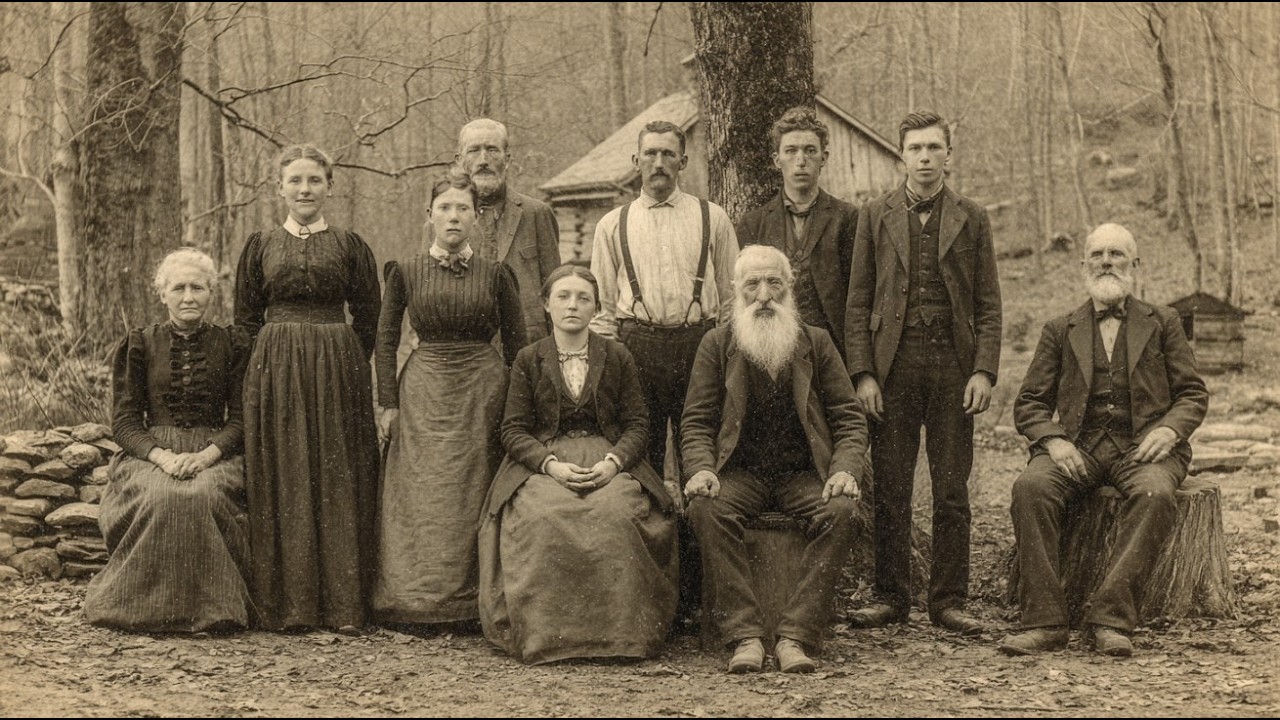
Generation four was a man named Purnell Threlkeld, born in 1861. He married his second cousin, and they had three sons. The middle son, Wendell, born in 1894, was generation five. In 1914, a traveling photographer named Lemuel Streke took a portrait of the family in the dooryard. He wrote in his ledger that the plates came out cleaner than any he had ever taken, that he was not going to sell them, and that he was not going back up that hollow.
The photograph survived. It shows nine people in Sunday clothes, all with the same eyes, black as the bottom of a kettle, with no iris visible. In the older members, a little white still showed at the corners. In the younger ones, the white had gone almost gray, like the inside of an oyster shell. They were all looking right at the camera.
A county surveyor named Hollis Marbury first went up to Stone Penny Hollow in the summer of 1941. He was 39 years old, sent to walk a property line for tax purposes. The walk in was silent. No birds, no insects, no sound except his own boots. He found a stone marker by the track with the initials C.T. and the date 1799. When he knelt to look at it, the earth under his knee gave slightly, as if there was a hollow space underneath.
At the house, he was met by Wendell Threlkeld, then in his late 40s, tall and thin in clean overalls and a white shirt. Marbury later described Wendell’s eyes as having no whites at all. From corner to corner, they were the color of dark water in a deep well. There was no pupil distinguishable from iris, no iris distinguishable from sclera.
Wendell was polite. He shook Marbury’s hand and invited him inside. There were six people in the house: Wendell, his wife Tessaline, his mother Verena, and three grown sons. All six had the same eyes. All six looked at Marbury the whole time he was there. None of them looked away, not once.

Tessaline brought Marbury a glass of water. It was colder than it should have been, and it tasted very faintly of iron, not the iron of rust in a pipe but the iron of blood in a cut on the inside of your cheek. He drank the whole glass because to not drink it would have been an insult to his host. When he set the glass down, all six of them were still looking at him.
Before he left, Marbury went out to look at the well. It was in the middle of the dooryard, with stones the size of a man’s chest fitted together without mortar. The water was very far down, black the way water gets when it is deep enough that no light reaches it. While he was looking down into it, he had the very clear feeling that something was looking back up at him. When he turned around, all six Threlkelds were standing in a half circle behind him, watching him look at their well. None of them had made a sound coming out of the house.
Marbury left without finishing his work. He fudged the file and went home. The taste of that water stayed in his mouth for three days. Then, about a week later, he started having a dream in which he was at the bottom of the well, looking up at the small circle of daylight, with the faces of the Threlkelds around the circle looking down at him. He had that dream four nights in a row. Then it stopped.
He did not go back for 15 years, but he started reading. He found the reverend’s journal, the schoolteacher’s letter, the photographer’s ledger, and the letter from Marcelina’s sister. He wrote to a hydrologist named Dr. Crispin Vail, who replied that the geology of that part of the country did not support a hand-dug well of the depth described. He wrote, “Whatever water is in that well is not coming from anywhere I can put on a map.” When Marbury wrote again, the hydrologist’s daughter answered. Her father had died, and among his papers she found a folder marked “Stonepenny” containing a single sheet of paper on which he had written, “Do not pursue.”
Marbury also found a map drawn in 1873 by a surveyor named Alpheus Sennett. The map showed the Hollow as an oval depression, and under the creek, the surveyor had drawn a faint dashed circle with the note, “Ground sounds wrong here. Echo as of hollow beneath. Did not survey further.” Sennett quit surveying six years later, moved to Indianapolis, and became a clock maker. His grandson later told Marbury that Sennett had said, “There are places in those mountains that have a floor and a ceiling. And the ceiling is the part you walk on. I made the mistake of measuring through the floor one time. I did not like what I measured.”
In the winter of 1958, Marbury drove back up to Stone Penny Hollow. He was 56 years old, his wife had been gone two years, and he had nothing left to be afraid for except himself. He went in February, when the Hollow was stripped down, with no leaves and no insects to hide anything.
The house was still there, but it was empty. No smoke from the chimney. A layer of fine dust on the kitchen table. The beds were made. There was a Bible on a nightstand and a glass of water beside it, half full, with no dust on the surface.
In the dooryard, the well was exactly as he remembered it. There were footprints in the snow around it, bare feet, several pairs, going to the well and not coming back. He counted six sets of prints, all adult. They had been there between four days and two weeks.

He lifted the cover. The well was dry. The bottom was bare earth, some 60 feet down. And on the bare earth, looking up at him, were six pairs of eyes. Not people. He was clear about that. There were no people down there. There were eyes, six pairs, floating just above the bare earth, open, looking up, the color of dark water with no whites visible. The same eyes he had seen in 1941. The same eyes as in the 1914 tintype.
He did not scream or run. He took out his notebook and measured. He wrote down the depth, the diameter, the number of pairs of eyes, and their positions. The pattern they made was a circle, six pairs of eyes evenly spaced, all facing inward toward the center. None of them were facing up at him.
While he was leaning over the well, he heard a sound from the bottom. It was not a voice, not exactly water. It was the sound a man makes when he is far away and trying to call to somebody, the rise and fall of it with none of the words. The sound came from the center of the circle. It was his name. Somebody was calling his name from the bottom of a dry well in a hollow that had been empty for he did not know how long.
He lowered the cover. He walked back to his truck. He did not look behind him. He drove home, poured himself a cup of coffee, and shook for about an hour.
The next morning, he went to the county records office, pulled the Threlkeld file, and wrote across the front of it in red pencil the word “closed.” He locked the file in a drawer in the basement. He never went back to Stone Penny Hollow.
He retired in the spring of 1963. A young surveyor took his job, and on his first week, Marbury drove him around the three counties. They went to most of the hollows. They did not go to Stone Penny. The young man asked about it. Marbury told him the file was closed, that there were no taxes owed and no living owner to talk to. He told him to leave it alone.
The dreams started again last winter. The same dream as before. Marbury is at the bottom of the well, looking up at the small circle of daylight, and there are faces around the circle looking down at him. This time, he recognizes one of the faces. It is his own, 56 years old, in his surveyor’s coat, leaning over the lip of the well in February of 1958. The version of him at the top is looking down at the version of him at the bottom. The version at the bottom is looking up. The version at the bottom has eyes the color of dark water, with no whites in them anywhere.
Marbury does not know which version is the real one. He has been telling himself that the version with his wife’s photograph on the dresser and the cup of coffee in his hand is the real one. But he admits that when he looks in the mirror these mornings in the dim light before he turns the lamp on, he cannot always tell what color his eyes are. He says it is probably nothing.
He does not drink water out of any well he cannot see the bottom of. And when he dreams about that hollow and that circle of daylight and the curious faces looking down, he no longer tries to wake himself up. He has started to wonder whether waking up is the part he has wrong.