The story of Bonnie and Clyde has been told many times, but Hollywood has always left out the most brutal chapter. The death of Buck Barrow, Clyde’s older brother, took ten agonizing days. It did not happen in a dramatic shootout with a clean ending. It happened slowly, in a rusting amusement park, with his brain exposed to the air.
Buck Barrow’s real name was Marvin Ivan Barrow. He was born in 1903 and was known as the more hot-tempered of the brothers. By 1933, he had done something Clyde never managed. He turned himself in, served his time, and received a full pardon from Texas Governor Ma Ferguson on March 22, 1933. On paper, Buck was a free man with no reason to pick up a gun again.
His wife, Blanche, had fought hard for that life. She married him, convinced him to serve his sentence, and wanted nothing more than a quiet, uneventful existence. Then Bonnie and Clyde called. Blanche later told the story that Buck simply wanted to see his younger brother. The plan was to visit, maybe talk some sense into him, and then go home. They went to Joplin, Missouri, and everything fell apart.
The Joplin shootout, later known as the Joplin Massacre, left two lawmen dead. Buck Barrow, a newly pardoned man, was suddenly on every front page in the region. There was no going back after that. He had walked away from the criminal life, but he walked back into the fire for his younger brother. The fire took a long time to finish him.
On July 19, 1933, the gang checked into the Red Crown Tourist Court near Platte County, Missouri. It was a small brick cabin complex with a garage in the middle and a restaurant nearby. Blanche rented the cabin and paid in coins. She ordered five fried chicken dinners for what was supposed to be just her and her husband. Then she went into town asking about newspapers. She also walked around in shorts, which was not common for respectable women in Platte County in 1933. Within a day, half the town knew something was off.
Local police chief Holt Coffey put together a posse of men who were not amateurs. They arrived in the dark with a steel-armored car ready for war. The gang burst out firing, as they always did. In the flash of gunfire, a Missouri Highway Patrol captain named William Baxter fired a shot into their car. That bullet hit Buck Barrow in the head.
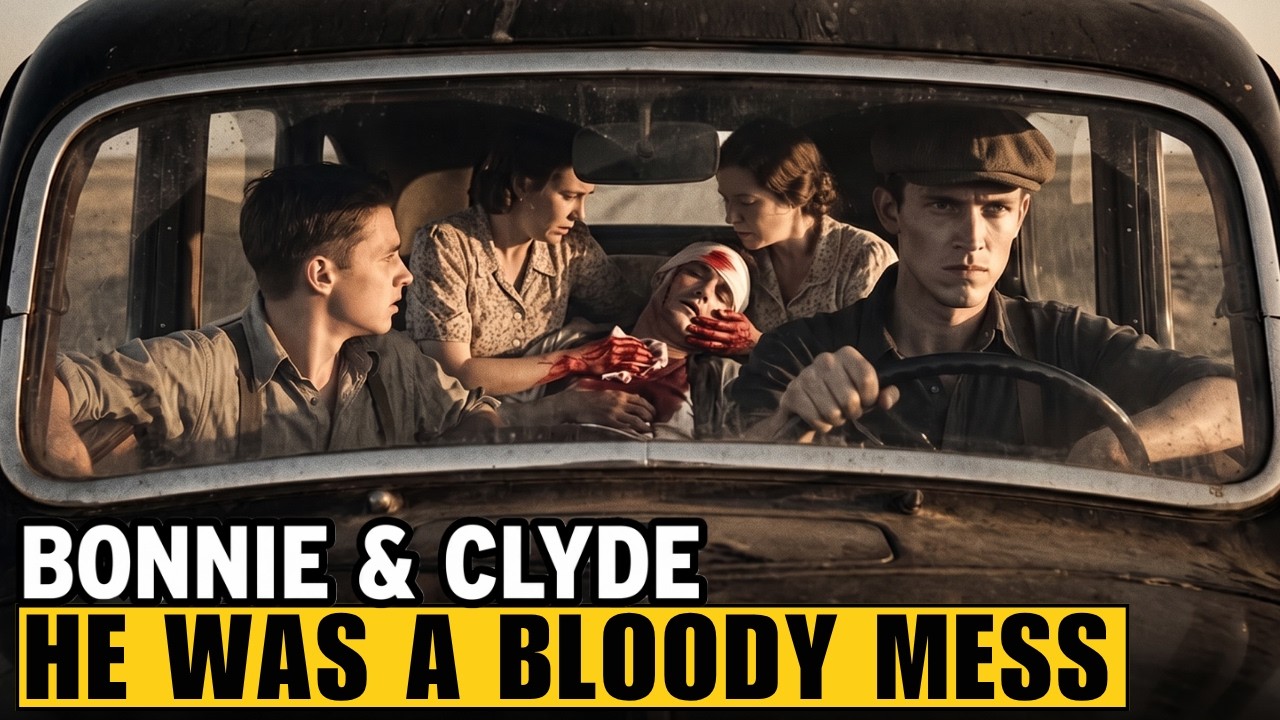
It was not a graze. The bullet tore a hole in Buck’s forehead, leaving his brain exposed. Blood poured from the wound the way blood pours from the head, which is to say, all of it. At the same moment, shattered glass from the car windows cut Blanche’s face and eyes. She was nearly blind, screaming, while her husband leaned against her with part of his skull gone.
Somehow, all five of them escaped alive. Blanche was half-blind. Buck, by every rule of the human body, should have been dead. But there were no hospitals in this story. The gang was too wanted. If any of them walked into an emergency room, they would be cuffed or carried out in a coffin. So the most wanted criminals in the middle of the country drove around with a man whose brain was open to the air.
The plan was to keep driving. They treated the wound with hydrogen peroxide from a cheap pharmacy. They poured it directly into the hole in Buck’s head. When real doctors finally examined the wound days later, they noted how clean it was. Outlaws with a bottle of peroxide had managed to keep a shattered skull cleaner than expected. That was the level of care. Peroxide and a lot of hope.
Buck stayed alive through all of it. He did not stay conscious the whole time. He dipped in and out, sometimes talking, sometimes recognizing people around him. He had real conversations whenever he surfaced. The human body is a stubborn machine, and Buck Barrow refused to give up. This went on for five days.
Blanche still could not see, but she kept going. The wound would not heal, no matter how much peroxide they used. They needed a place to stop and let him rest, somewhere no one would think to look. They found an abandoned amusement park.
Dexfield Park, outside Dexter, Iowa, had once been the largest amusement park in the state. By 1933, it was completely deserted. Weeds covered the old playground. The rides rusted in the dark. The Barrow gang set up camp there, trying to save Buck’s life in a place built for children to laugh.

Clyde went into Dexter every day. He came back with food, medicine, and fresh bandages. The townspeople noticed the same thing every day. The strangers always parked their Ford in the lot and left the engine running. Nobody does that unless they plan to leave in a hurry.
Buck was not getting better. He was getting worse. The bleeding did not stop. The fever rose. He lost consciousness for longer stretches each day. Clyde looked at his older brother, the man who had come back for him, and made a decision. He decided Buck would die there. Clyde and W.D. Jones dug a grave while Buck was still able to open his eyes and talk.
The grave was never used. The blood-soaked bandages Clyde had been buying in town led the locals straight to the park. The trail of bloody rags was impossible to miss. Someone picked up the phone.
On July 24, 1933, five days after Platte City and ten days after the gang entered that part of the country, a posse arrived. Then an angry crowd gathered. Word spread, and townspeople grabbed their guns. Between one hundred and two hundred people surrounded the camp in the ruins of Dexfield Park. Gunfire erupted.
It was another shootout, and it was the end for Buck. As the gang tried to flee on foot, Buck, already nearly dead, took six more bullets in the back on top of the hole in his head. Bonnie, Clyde, and W.D. Jones escaped into the countryside, all of them wounded. Buck could not run. He fell in the weeds of the dead fairground.
Blanche, blind and screaming, threw herself over him and would not let go. When they arrested her, she was lying on top of her husband, trying to protect a body that had more bullet holes in it than any man should survive.

Here is the shock. He did not die. They took him to King Daughters Hospital in Perry, Illinois. When the doctors put him on the table, Buck Barrow was conscious. He was talking. He was polite. He answered questions and confessed his crimes to the officers standing there. He told them plainly that his head was not the problem. Aspirin handled the headache fine. What he wanted them to look at was the bullet wound in his back.
A man telling trained doctors that the hole in his head was just a bad headache, and that the real problem was the six bullets in his back. By all accounts, he was mentally coherent. The doctors were not. They looked at the head wound and knew no one survived what had happened to Buck’s brain.
Infection set in. Pneumonia settled in his chest. The body that had refused to stop for ten straight days finally gave out. Buck Barrow died on July 29, 1933, at the age of 30. He had been pardoned and free for exactly four months.
We know all of this because one of the four lived to old age and wrote everything down. That was Blanche. She served ten years in the Missouri State Penitentiary for her role in the Platte City shooting. She lost sight in her left eye for the rest of her life. While in prison, between 1933 and 1939, she wrote her full story from beginning to end. She wrote it while grieving the husband who died beside her.
When she was released, she folded the manuscript inside a large unused greeting card and put it in the back of a closet. She barely spoke of it again. She lived a quiet life. The manuscript stayed hidden until after her death in 1988, when a friend found it and brought it to historian John Neal Phillips. He edited and published it as “My Life with Bonnie and Clyde.”
Phillips spent years comparing Blanche’s account with police records, newspaper archives, and survivor testimonies. That is why we can say with confidence that the hydrogen peroxide, the grave Clyde dug, and the ten days all really happened. The woman who held Buck’s hand is the one who recorded it all.
In the 1967 film, Warren Beatty plays Clyde, Faye Dunaway plays Bonnie, and Gene Hackman plays Buck. Buck is a big, gentle man. When he dies, the scene is tragic and brief. The camera glides away smoothly. You feel some pain, then you return to Faye Dunaway looking glamorous in her hat. That is the version people remember.
The real Buck Barrow spent the last ten days of his life dying slowly with his brain exposed to the air. It happened in the ruins of a children’s amusement park. His brother dug his grave while he was still talking. His wife lost her sight trying to save him. There was no swelling music and no graceful transition to the next scene. Just a man telling his doctors, cheerfully, that the real problem was his back, not the hole in his head. That is what Hollywood leaves out.