On the afternoon of May 6, 1910, a 42-year-old woman in a long dark coat arrived at a side entrance of Buckingham Palace carrying a letter. It had been written to her nine years earlier by King Edward VII, on the day he ascended the throne. In it, he promised that if he ever became seriously ill, she would be sent for. She handed the letter to Queen Alexandra.
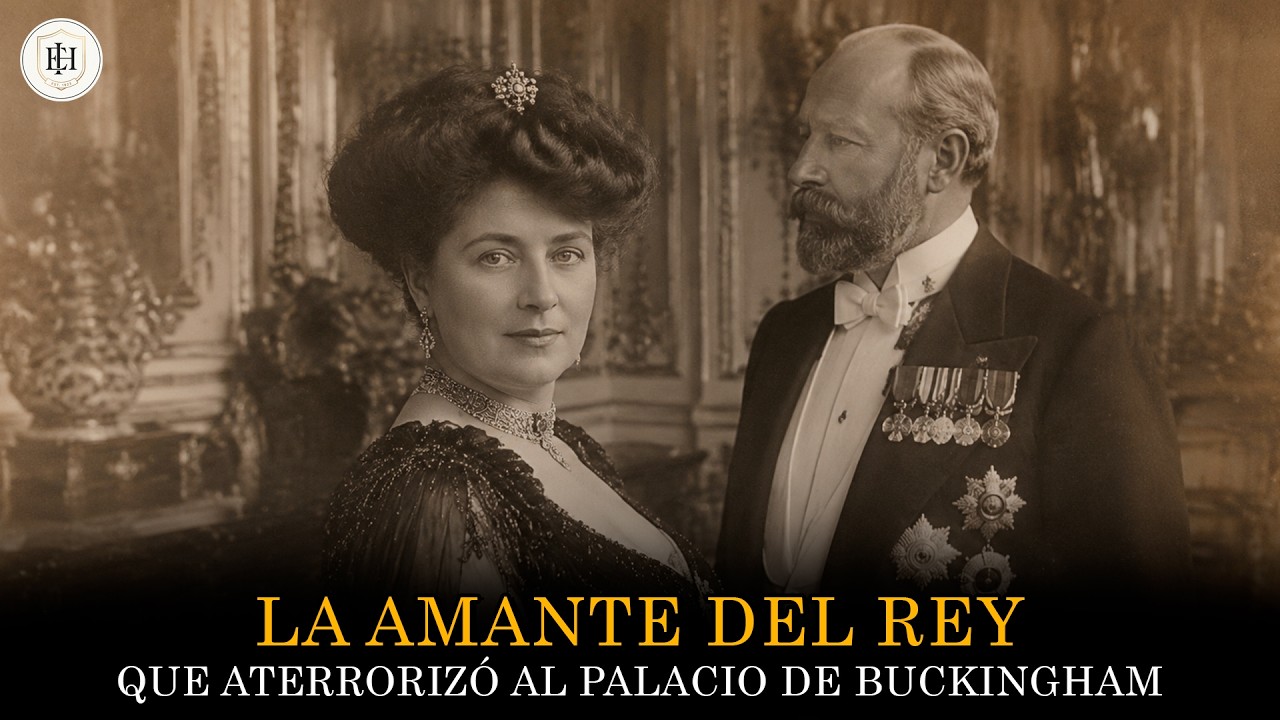
The Queen read it silently. Then she let the woman into the room where the King was dying. That woman was Alice Keppel. She was not the Queen.
She was the King’s mistress. Alice was born on April 29, 1868, the youngest of nine surviving children of Admiral Sir William Edmonstone and his wife Mary. Her family held Duntreath Castle in Stirlingshire, a fortified tower house given to an ancestor by King Robert I of Scotland in 1425 as a wedding gift. For 500 years the castle had passed down through one family.
The Edmonstones were landed gentry of ancient lineage, but they were not wealthy. Eight daughters meant eight dowries, and small ones at that. Alice would have to marry, and marry well, on the strength of face and manner alone. In July 1891 she married the Honourable George Keppel, a 27-year-old lieutenant in the Gordon Highlanders, a third son of an earl who stood to inherit nothing.
His army salary was around £120 a year, a figure that could never support a wife with Alice’s social ambitions. The couple began their marriage in Belgravia and soon moved to larger houses in Portman Square, including the grand 30 Portman Square in 1899. The arithmetic did not add up. George’s salary had not changed; Alice had no fortune of her own.
Yet the houses kept getting bigger. George Keppel understood the arrangement. He was charming, affectionate, and openly devoted to his wife. He reportedly told friends he did not care what Alice did as long as she came back to him in the end.
They had two daughters, Violet in 1894 and Sonia in 1900. Both were officially George’s. London gossip later insisted that Sonia was the King’s child, but the family never confirmed it and the girls grew up calling George their father. He took a nominal position with Lipton’s merchants, where his duties were vague and his salary substantial.
He died ten weeks after Alice and was buried beside her in Florence. The relationship with the King began at a dinner party in February 1898. The Prince of Wales, then 56 and heir to the throne, looked across the table and saw the 29-year-old wife of an army officer. Within weeks the affair had begun.
It would last twelve years and survive his accession as Edward VII, his coronation, his reign, and his illnesses. Nothing broke it. The Prince had kept mistresses on rotation before, including the actress Lillie Langtry and Daisy Greville, Countess of Warwick. Alice eclipsed them all within eighteen months and became the only one who mattered.
Her genius, by every account, was that she asked for nothing. She wanted no jewels, no honors, no titles. The jewels and shares came anyway. What she gave the King was a place where he could sit, drink tea, smoke his cigars, and drop the burden of being sovereign.
At 30 Portman Square the staff enforced a system of absolute discretion. The front door was closed to callers at around 4 p. m. The King arrived twice a week.
The servants were paid ordinary wages and received no special privileges, yet in twelve years not a single leak ever came from the household. Servants who spoke would lose their references and their livelihood; the system was enforced by survival as much as loyalty. The money behind the household did not officially exist. Alice’s income could not be explained by George’s salary.
The King’s financier, Sir Ernest Cassel, arranged discreet share allocations in companies such as Mexican Eagle Petroleum and various mining ventures, with dividends paid into Alice’s own bank account. By the King’s death in 1910, historians estimate she controlled capital worth the equivalent of £6 to £12 million today. It was this money that paid for the rest of her life. By 1905 the Foreign Office had quietly accepted that the most direct route to the King’s ear passed through Mrs.
Keppel. Senior officials would explain a policy matter to her at a country house weekend and then change the subject. Days later the King would decide that perhaps he had been mistaken and that the Foreign Office line was right. Lord Hardinge, the King’s Regent of India, later admitted in his memoirs that he had used Mrs.
Keppel to persuade the King to follow the government’s line at critical moments. Very few others ever recorded the fact in writing. Alice developed close working friendships with Liberal leaders including Sir Henry Campbell-Bannerman, Herbert Asquith, and Sir Edward Grey. She moved in the highest political circles and steered the King’s ear with extraordinary skill.
She did not write memoranda, she made no speeches. She simply said the right thing at the right time in the right tone, calibrated for a tired 60-year-old monarch who hated being lectured. In the spring of 1910 the King returned from Biarritz already ill. He was 68, overweight, suffering from bronchitis and angina.
Within three weeks he could no longer climb a single flight of stairs. On May 4 he arrived at Buckingham Palace from Sandringham, exhausted. On the morning of May 6 he was very weak. By early afternoon he was barely conscious.
At four o’clock he suffered a severe heart attack. It was that afternoon, with the King already dying, that the Queen sent for Alice Keppel. The letter Alice carried had been written in 1901, promising that if the King ever fell seriously ill she would be summoned. Alice arrived at the side entrance, was admitted without difficulty, and was shown to an antechamber on the second floor.
A royal official brought the letter to the Queen, who read it silently. Then she let Alice into the room. Two versions of what happened next have survived, and they contradict each other. In the version passed down through Alice’s own family, she entered calmly, knelt by the bed, took the King’s hand, and was recognized by him.
The Queen made no objection and the two women parted with silent nods. In the version recorded by courtier Lord Esher and partly corroborated by Queen Alexandra’s biographer, Alice entered visibly distressed, the King barely recognized her, and she lost control, making a noise that disturbed the room. The Queen coldly told a doctor to have the woman removed. Two members of the household escorted her out.
What is not in dispute is the basic sequence. Alice was admitted, she entered the room, she was taken out, and she left the palace. The King died at 11:45 that night with the Queen by his side. Alice returned to Portman Square and did not appear in public for weeks.
She gave no interviews and made no statements, then or ever. In the following 37 years of her life she never spoke publicly about the deathbed scene. The Queen never spoke of Alice either. The two women never saw each other again, by an unspoken agreement neither signed.
After the funeral, King George V made it clear through his usual discreet channels that the world his father had built around Mrs. Keppel was over. In November 1910, Alice and George left London on an extensive world tour that lasted almost two years. When she returned in 1912, the Edwardian era was finished, the Georgian era had begun, and Mrs.
Keppel was merely a wealthy aristocratic widow. She rebuilt her life quietly. In 1925 she and George sold the London house and moved permanently to Italy, buying a villa above Florence called the Villa dell’Ombrellino. The astronomer Galileo had lived nearby.
The family hired architect Cecil Pinsent to lay out the gardens, and Alice gave one of them a private name: the Union Jack Garden, because the paths crossed in the pattern of the British flag. At the villa she received exiled European royalty and prominent British expatriates. Her guest list included King George II of Greece, King Peter II of Yugoslavia, and Queen Victoria Eugenie of Spain. Winston Churchill visited at least once.
Alice remained the same composed hostess, drawing the curtains at 4 p. m. , serving tea from the same silver service, keeping the same discipline of household staff and silence. In June 1940, with Italy entering the war on Germany’s side, the Kills packed three suitcases and fled the villa, leaving the furniture, the silver, and the orchids behind.
They crossed into France, reached the Channel just before France fell, and arrived in London in early July. They took a suite at the Ritz and waited out the war. The Ritz suite became a small reproduction of the world Alice had built 40 years earlier, with the same silver-framed photographs, the same orchids in silver pots, the same heavy curtains drawn at 4 p. m.
In 1946, with peace restored, they returned to Italy. The villa was intact, the garden overgrown. Alice had little time to enjoy her return. She had been a heavy drinker for years and her liver was failing.
On September 11, 1947, at the villa, she died of cirrhosis and septicemia. She was 79. George died ten weeks later of a stroke and was buried beside her in the Protestant cemetery outside Florence. The English newspapers of September 1947 were careful and respectful.
They described her as a prominent Edwardian hostess. The Times buried a single line near the end of her obituary noting that she had been a confidante of the late King. That was all. Even in her obituary, discretion was maintained.
What she could not have known was that the pattern would continue through her own bloodline. Her daughter Sonia had married Roland Cubitt, and their eldest child, Rosalind, married Bruce Shand. Their first child, Camilla, was born on July 17, 1947, eight weeks before Alice died. Camilla grew up in Sussex, was sent to finishing school in Switzerland, and made her debut in 1965.
In her own circle she was known to be proud of her great-grandmother, and friends later recalled that she liked to mention that her great-grandmother had been the mistress of King Edward VII. Camilla met Prince Charles in 1970. They had a brief affair. Charles went to sea with the Royal Navy, and Camilla married Andrew Parker Bowles in 1973.
She continued to move in the same circles as the Prince. When Charles married Diana Spencer in 1981, the marriage foundered publicly, and by the early 1990s the relationship between Charles and Camilla was an open secret in the British press. Camilla and Charles finally married in 2005, after the death of his first wife and the end of her marriage. When Queen Elizabeth II died in September 2022, Charles became King Charles III, and Camilla became Queen.
She was crowned at Westminster Abbey on May 6, 2023. The date is worth pausing for. May 6 is the same date on which her great-grandmother had arrived at the side entrance of Buckingham Palace with the King’s letter in her handbag 113 years earlier. There is no record that the date was chosen for that reason.
The coincidence is real. Alice Keppel built the modern version of her role through twelve years of late afternoons, through absolute household discipline, through a refusal to ask for what she received, a refusal to write down what she heard, and a refusal to speak about what she remembered. She lived 37 years in quiet, beautiful privacy and died without breaking her silence once.
The invisible role she constructed would return a century after her death, filled by her own great-granddaughter.