The famous factory gate entrance almost looks like a failure. Willy Wonka steps forward in a dark coat, leaning on a cane, appearing older and frailer than the stories that preceded him. The cane touches the pavement, then sticks. Wonka pitches forward.
For a breath, the crowd believes they are watching an old man lose his balance. Then the fall changes shape. He tucks his body, turns the collapse into a somersault, rises cleanly, and accepts the applause. For years, that entrance has been remembered as a perfect flash of improvisation.
It was not. Gene Wilder had planned it. He wanted the audience to understand from the first moment that they could never be entirely sure when Wonka was telling the truth. That small piece of business contains a clue to Wilder himself.
His most famous characters often looked as though they were coming apart in front of us. Leo Bloom clutched his blue blanket as if civilization depended on it. Frederick Frankenstein could move from scholarly dignity to volcanic outrage in seconds. Willy Wonka could offer warmth, withdraw it, become frightening, then return to gentleness before anyone had decided which version was real.
Yet the actor creating those eruptions had spent years learning not to chase laughter, not to signal the joke. He had learned something else much earlier in a Milwaukee house with a sick mother. Laughter could be an action taken for another person. Before he was Gene Wilder, he was Jerome Sberman, born in Milwaukee on June 11th, 1933, to William and Jeanie Sberman.
His family called him Jerry. The name that would later seem inseparable from his face did not yet exist. What did exist in his memory was a household changed by his mother’s heart trouble. Wilder later recalled that his mother suffered a heart attack when he was eight.
After she returned home, her heart specialist took the boy aside and gave him an instruction frightening in its simplicity: do not get angry with her, and try to make her laugh. A child could hear more in that than a doctor intended. Anger now seemed dangerous. A wrong emotional move might carry consequences larger than the moment.
Wilder never claimed that one warning explained every part of the adult man, but he did say the experience affected him enormously. The second half of the instruction was practical: make her laugh. He tried. When he succeeded, his mother’s response gave him something every performer needs before technique, the knowledge that he could change another person’s emotional state.
Wilder later described this as the first time he consciously tried to make someone laugh. Comedy in that memory did not begin with applause. It began as work inside a family. Wilder would spend much of his career resisting the idea that comedy was simply a personality trait.
He did not want to be a funny man who happened to act. He wanted to be an actor who could be funny because the character situation was real to him. He was drawn to performance early, but the direction became clearer in adolescence. He briefly attended the Black Fox Military Institute in Los Angeles, returned to Milwaukee, and finished high school there.
At 16, he saw Arthur Miller’s “Death of a Salesman,” and the play changed his ambition. Until then, Wilder said he had thought more in terms of becoming a comedian. Afterward, he wanted to be an actor, perhaps a comic actor, but an actor first. Comedy tempts a performer to show the audience where the joke is.
Wilder increasingly wanted the opposite. If a character was frightened, let him be frightened. The laugh should come because the character means what he says. The University of Iowa gave him a place to test that seriousness.
He acted in student productions, worked in summer stock, and earned his degree in 1955. From there, he went to the Bristol Old Vic Theater School in England, where the training was physical as well as vocal, including fencing, gymnastics, judo, and voice work. The later screen image of a nervous man whose body could suddenly fly into extravagant motion had disciplined foundations. Then military service interrupted the direct route toward a theatrical career.
Wilder was drafted into the United States Army in September of 1956. After medical training at Fort Sam Houston, he was assigned to the department of psychiatry and neurology at Valley Forge Army Hospital in Pennsylvania, where he worked as a paramedic. He was honorably discharged in 1958. Even during those army years, New York remained close enough to matter.
Wilder took acting classes at the Herbert Berghof Studio. In later accounts, he also spoke about personal therapy during this period and connected it to compulsive behavior he had experienced earlier. What can be seen is the density of the apprenticeship: classical stage work, movement training, hospital duty, New York classes, therapy, and summer productions. His private life was taking shape at the same time.
In 1960, Wilder married Mary Mercier, an actor and playwright he had known in New York. The marriage lasted through years when neither fame nor financial certainty could be assumed. They divorced in 1965. He had adopted the professional name “Gene Wilder” in 1959 at the age of 26.
He later explained that the “Gene” appealed to him because of Eugene Gant, the Thomas Wolfe character, while “Wilder” came from his admiration for Thornton Wilder. New York theater came first. His Off-Broadway debut arrived in the early 1960s, and Broadway followed. He worked in serious plays including “The Complaisant Lover” and “Mother Courage and Her Children.
” The latter mattered for reasons that had nothing to do with its reviews. Anne Bancroft was in the company, and through her, Wilder met the man who would change his career: Mel Brooks. Those years explain why the later image of Wilder as an almost purely cinematic creature is misleading. Before close-ups and editing could help him, he learned to hold an audience in a room.
Theater imposed consequences that film could soften. He also discovered that his appearance worked differently from conventional leading-man charm. The pale face, the alert eyes, the tightness that could suddenly become movement were not qualities he had designed as a brand. In serious roles, audiences sometimes laughed before he expected them to.
The experience could be unsettling. It raised a professional question that would follow him into film: should he resist the response, or learn what the audience was hearing that he was not? Wilder moved the other way. He trusted training.
He wanted the character’s need to stay intact. The more desperate Leo Bloom later became to preserve order, the funnier his collapse would be. Brooks was not yet the filmmaker whose name would become inseparable from Wilder’s. He was Bancroft’s partner, a writer and comic force with a project about a desperate Broadway producer, a timid accountant, and the possibility of making more money from a theatrical failure than from a success.
The script was then called “Springtime for Hitler. ” Wilder remembered Brooks reading him the beginning backstage. Brooks saw something in the serious young actor that Wilder himself had not fully trusted. Wilder had noticed an odd problem in the theater: sometimes he would play a scene sincerely and audiences would laugh.
Brooks heard the same laughter differently. He did not think Wilder was failing at seriousness. He thought Wilder’s seriousness was funny. The tension in his face, the effort to remain reasonable while panic pressed against the surface, the sudden leap from restraint into alarm, Brooks recognized a comic instrument that did not need to announce itself.
Brooks promised Wilder the role of Leo Bloom if the film was ever made. Then nothing happened quickly. Wilder kept working. Roughly three years passed.
Wilder was appearing on Broadway and removing his makeup after a matinee when there was a knock at the dressing room door. Brooks stood there with producer Sidney Glazier. The old promise had suddenly become practical. Even then, nothing was automatic.
Brooks told Wilder he still had to read with Zero Mostel. The next morning, Wilder arrived carrying all the anxiety that would later seem so natural on screen. Mostel was a formidable theatrical presence, and Wilder knew the role could disappear in one bad reading. Then Mostel did something that broke the tension.
Wilder later remembered putting out his hand and being pulled toward Mostel, who kissed him. The nervousness vanished. They read together. Wilder got the part.
During those unsettled years, Wilder also formed another family. Mary Joan Schutz was a friend of his sister and already had a daughter, Catherine. Wilder married Mary Joan in 1967 and adopted Catherine. His first film appearance arrived in that same period.
In “Bonnie and Clyde,” Wilder played Eugene Grizzard, one of the young people abducted by the bank-robbing pair. The part was small, but it already showed his ability to make fear and social awkwardness occupy the same body. By the time “The Producers” reached production, Wilder was not a newcomer without technique. Leo Bloom could be childish, frightened, indignant, and absurd, but Wilder played his needs as real.
The blue blanket was not a prop that knew it was funny. To Leo, it was protection. Zero Mostel’s Max Bialystock operated at a different comic scale, huge, voracious, theatrical. Their pairing should have been lopsided.
Instead, the contrast created rhythm. Mostel surged outward. Wilder compressed inward until compression became impossible. Wilder’s performance was recognized by the Academy with a nomination for supporting actor, while Brooks won for his original screenplay.
The nomination established that Wilder’s peculiar combination of intelligence, alarm, tenderness, and sudden hysteria could carry a film. A few years later came the role that would outgrow almost every argument he ever made about his own career. “Willy Wonka and the Chocolate Factory” was released in 1971. Roald Dahl’s story was built around a child’s passage into a morally unstable wonderland.
Wilder understood the uncertainty before the first factory door opened. He proposed the cane and somersault entrance because, as he later explained, once the audience had seen Wonka deceive them about something as basic as his own physical condition, they would never be completely sure of him again. Inside the factory, his job was to keep Wonka from becoming either a soft host or a simple villain. He could do warmth.
He could withdraw it in an instant. A line might begin as reassurance and end as warning. The shifts worked because they seemed chosen by Wonka, not imposed by an actor searching for variety. The film’s later status grew through television broadcasts, home viewing, and repeated childhood exposure.
Decades later, it entered the National Film Registry. The performance refuses the pressure to explain a character’s emotional position at every moment. Wonka is not unreadable because Wilder lacks a choice. He is unreadable because withholding certainty is the choice.
That made the role difficult to imitate. Costume and cadence could be copied, but the deeper mechanism was less visible. Wilder understood when stillness had more authority than eccentric movement. He understood that a soft voice could become more threatening than a shout if the audience had expected comfort.
The famous entrance shows how carefully the illusion of spontaneity could be built. In the middle of the 1970s, his partnership with Mel Brooks reached its most fertile period. For “Blazing Saddles,” Wilder almost did not play the part of the Waco Kid at all. Brooks initially thought Wilder was too young for a worn-out gunfighter.
Another actor was cast. Then production ran into trouble, and Brooks called Wilder with urgency. Wilder rearranged a commitment, flew to join Brooks, and was working almost immediately. In a film designed to detonate the conventions of the western, Wilder often became funniest by seeming to stand a few feet away from the explosion.
He played exhaustion instead of manufacturing age. The Waco Kid seemed like a man who had already spent his energy on being legendary and now regarded legend with mild embarrassment. The origin of “Young Frankenstein” did not begin with Brooks. It began with Wilder’s childhood fear of the old Frankenstein movies and with an adult impulse to revise that fear.
Looking back, Wilder said he wanted the story to come out with a happy ending. He began writing pages. His agent, Mike Medavoy, hoped Brooks might direct. Wilder was doubtful because Brooks generally directed ideas he had originated, but the possibility moved forward.
What followed was not one comic mind swallowing the other. It was a negotiation between two different senses of what could be funny. Wilder wrote during the day. Brooks came to the house, read pages, responded, suggested what the story needed, and left Wilder to write again.
One disagreement became famous. Wilder wrote the sequence in which Dr. Frankenstein presents the creature to a scientific audience and the pair perform “Puttin’ on the Ritz. ” Brooks thought the number was too frivolous.
Wilder argued so fiercely that he was soon shouting. Brooks finally yielded, explaining that the force of the argument had convinced him. The number stayed. The comedy had to grow from Frederick Frankenstein’s sincere desire to prove that the creature could become civilized.
The song was funny because the scientist took the demonstration seriously. The film earned two Academy Award nominations, including one for the screenplay by Wilder and Brooks. But the middle of the 1970s also carried a private fracture. Wilder’s marriage to Mary Joan Schutz had deteriorated.
The family they had formed did not survive intact. Their relationship ended, and in time, Wilder also became estranged from Catherine, the daughter he had adopted and raised. Years later, when Larry King asked whether he had children, Wilder said that he had had a daughter and had lost her a long time before. The phrasing was striking because he did not describe a death.
He described an absence. Success in “Young Frankenstein” created another temptation. The adventure of “Sherlock Holmes’ Smarter Brother” allowed him to write, direct, and star. “The World’s Greatest Lover” gave him another chance to shape the entire comic machine.
Some results pleased him more than others. Wilder later looked back on “The World’s Greatest Lover” with unusual clarity. He thought he had made the central character too neurotic. A bizarre world, he reasoned, needs some point of stability, and he had made both the world and the man inside it unstable.
The nervous intensity that made Leo Bloom unforgettable could not simply be copied into every story. At almost the same time, another partnership was about to push Wilder in the opposite direction. The script that became “Silver Streak” reached him while he was abroad doing publicity. The person he imagined for the other principal role was Richard Pryor.
When the two men met in Calgary, Wilder remembered a quiet first encounter. They expressed admiration for each other, hugged, and went to work. Then Pryor did something Wilder had not expected. In a scene, Pryor added a line that was not in the script.
Wilder answered without stopping. Pryor answered the answer, and then they returned to the written material. Wilder had improvised in acting classes, but he later said Pryor taught him how to do it on camera. Pryor showed Wilder that spontaneity could still be disciplined enough to survive the machinery of filmmaking.
Their partnership also produced a scene that requires more careful memory than nostalgia usually gives it. In “Silver Streak,” Wilder’s character disguises himself in blackface to evade police. The premise carries a long and ugly history. It also troubled Pryor before the scene was filmed.
Wilder later recounted that the two actors read through the bathroom scene the evening before shooting. Pryor became increasingly unhappy. Outside afterward, he told Wilder that the scene, as written, would hurt Black people. Wilder listened as Pryor reframed the comic logic.
The revised scene made the disguise itself look foolish. The comedy moved toward the white man’s ignorance and stiffness, with Pryor instructing him in behavior and rhythm. The revision did not erase the historical ugliness of blackface, but it changed where the scene placed intelligence and ridicule. Wilder had spent years developing a sense of what belonged in a scene.
With Pryor, that sense had to include the humility to be corrected. “Silver Streak” became the first of several films they made together. “Stir Crazy” followed, and the Wilder-Pryor pairing became one of the most recognizable screen comedy partnerships of its era. By the late 1970s and early 1980s, Wilder had become a star who could write, direct, and anchor commercial comedies.
Then a relationship entered his life that would reorder far more than his work. Gene Wilder met Gilda Radner while they were making “Hanky Panky. ” She came from “Saturday Night Live” with a public identity built around comic characters and the willingness to look ridiculous. Their connection was not a tidy movie romance.
Radner’s own memoir described the force with which Wilder entered her emotional life. She said it felt as though her life had gone from black and white to technicolor. In September of 1984, they married in southern France in a civil ceremony. Wilder directed and starred in “The Woman in Red” around this period, then made “Haunted Honeymoon” with Radner.
The couple also wanted a child. Wilder later described fertility treatment, a pregnancy, and its loss. Those details belong to a private medical history that both partners eventually discussed publicly. Radner began experiencing symptoms in 1986.
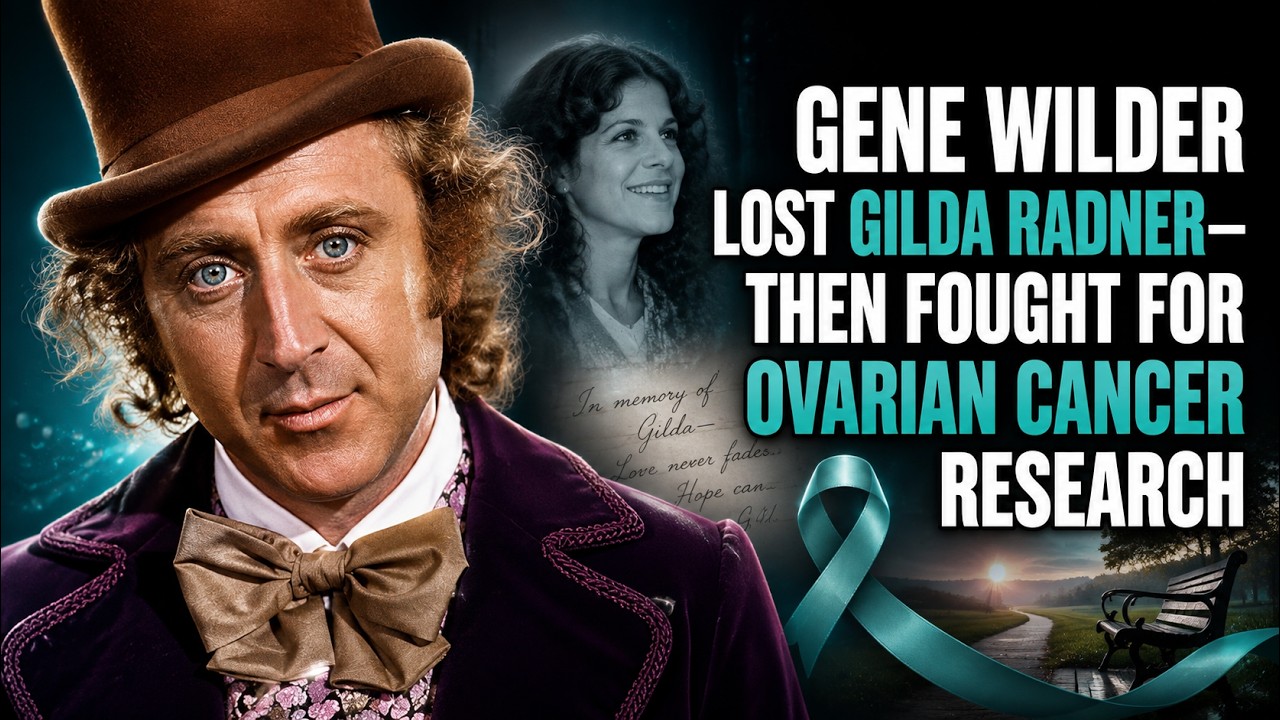
On October 21st of that year, by her own account, she was diagnosed with ovarian cancer. Her memoir, “It’s Always Something,” became a record of illness, doctors, hospitals, family, hope, fear, and uncertainty. Wilder became a husband inside that uncertainty. He later remembered appointments, treatment, hope, recurrence, and the constant effort to read signs that could not be controlled by performance.
Radner also found support among other people living with cancer, an experience that would later influence the creation of a place bearing her name. Their marriage had contained work, jokes, frustration, desire for a child, ordinary domestic time, and then the increasing presence of medicine. During these same years, Wilder was still working. His partnership with Richard Pryor continued, and in preparing for “See No Evil, Hear No Evil,” he undertook research for the role of a deaf man.
One of the people he met in that process was Karen Webb. The timing matters. The professional meeting belonged to the preparation of a film completed before Radner’s death. What can be said securely is that Karen entered Wilder’s life through the work, and that Wilder and Karen would marry in 1991, two years after Radner’s death.
When Gilda Radner died of ovarian cancer in May of 1989 at age 42, there was no better beat to find. She was gone. Wilder later described returning to the Connecticut house where Radner had lived and choosing to remain there. In the years after Radner’s death, Wilder became involved in public efforts around ovarian cancer awareness, hereditary risk research, and support for people living with cancer.
In 1991, he spoke publicly and testified in Washington about ovarian cancer. Another effort grew from Radner’s experience of community support. Wilder, psychotherapist Joanna Bull, Radner’s friends and family, and others helped build what became Gilda’s Club. The first New York clubhouse opened in 1995, giving people with cancer and their families a place to find companionship without being reduced to diagnosis.
Grief did not freeze his private life. Karen Webb, whom Wilder had first met through the research for “See No Evil, Hear No Evil,” became part of the life that followed. They married in 1991 at their Connecticut home. Karen would remain his wife for the rest of his life.
They lived in Connecticut. They painted watercolors. They built routines that did not depend on studios or premieres. His screen partnership with Richard Pryor continued into the early 1990s with “Another You,” which was poorly received.
It became one of the last major theatrical chapters in Wilder’s career. Wilder became increasingly dissatisfied with the scripts he was offered and with trends in mainstream movies. He disliked much of the violence and vulgarity he encountered in new material. During this period, another serious illness entered his life.
Wilder was diagnosed with non-Hodgkin lymphoma. He underwent treatment at Memorial Sloan Kettering, including chemotherapy and a stem cell procedure. Later speaking publicly about the experience, he said he was in complete remission. He also resisted making his outcome into a promise for anyone else.
By the early 2000s, he was choosing work rather than pursuing it continuously. A guest appearance on “Will & Grace” brought him back before a large television audience. In 2003, the Television Academy gave him the Emmy for outstanding guest actor in a comedy series. Increasingly, the work that interested him happened at a desk.
His memoir, “Kiss Me Like a Stranger,” appeared in the middle of the decade. The title came from words associated with Radner near the end of her life. The book moved through childhood, acting, marriage, anxiety, grief, failure, and art with a frankness that surprised readers. Wilder published fiction as well as memoir.
He could begin writing without waiting for a studio to decide whether an older comic actor still fit a market. When asked why he was not appearing more often, Wilder spoke about scripts. He received many and found very few that interested him. He left the door open for something he considered wonderful.
Karen shared the quieter decades that followed. They lived in Connecticut, away from the daily machinery of Hollywood. Wilder painted watercolors, read, wrote, appeared for interviews, and could discuss old scenes with remarkable specificity. For Wilder, more than two decades remained after Radner’s death.
He was a husband again, a cancer patient who reached remission, an occasional television actor, a memoirist, a novelist, a painter, and a man whose daily life was increasingly detached from the schedule of movie production. Karen remained beside him through the later career, his cancer, his writing years, and the illness his family kept private near the end. The Gene Wilder papers at the University of Iowa contain scripts, drafts, contracts, photographs, correspondence, and production material across decades. Archives preserve decisions made before the familiar scene became familiar.
A viewer remembers two actors as if chemistry simply appeared when the camera rolled. Production material reveals the practical structure that allowed chemistry to happen. Wilder’s greatest work argues against the mythology of the solitary genius. Mel Brooks heard comedy in Wilder’s seriousness before Wilder fully trusted it.
Richard Pryor taught Wilder to improvise on camera and forced a scene to confront a problem Wilder had not understood well enough. Gilda Radner carried her own comic language and later her own account of illness. In the final years of his life, Gene Wilder developed Alzheimer’s disease. His family kept the diagnosis private while he was alive.
By then, Wilder’s world had already become quieter. Karen was beside him. When Wilder died in Stamford, Connecticut on August 29th, 2016, he was 83. His family announced that he had died from complications of Alzheimer’s disease.
The corrected record gives August 29th. His death produced the kind of public response that reveals which images have won the contest of memory. Willy Wonka appeared everywhere. But other Wilders surfaced with it.
Older moviegoers remembered “The Producers” and “Blazing Saddles. ” Comedy devotees returned to “Young Frankenstein. ” Audiences of the late 1970s and 80s remembered Richard Pryor beside him. Theater people remembered the trained actor underneath the film star.
People involved with cancer support remembered a widower who used a famous name to draw attention toward research that did not have his name on it. Different generations had met him at different doors. Near the end of his life, the contradiction that had run through so much of his work became harder to ignore. Gene Wilder became famous for men who seemed one breath away from losing control.
His craft depended on knowing what that loss of control was for. A breakdown without structure was noise. A surprise without character was merely a stunt. Even improvisation worked because there was something solid enough to depart from and return to.
Life offered no comparable structure. His mother recovered from the childhood crisis that frightened him, but the lesson stayed. His first marriage ended. His second marriage ended.
The daughter he had adopted became estranged from him. Gilda Radner died despite hope and treatment. Karen entered his life first through work and later became his wife for a quarter of a century. His own cancer went into remission.
Alzheimer’s disease did not yield to craft. Years after Wilder’s death, the documentary “Remembering Gene Wilder” brought together his recorded voice, home movies, collaborators, friends, and Karen. It did not need to reveal a secret man hiding behind the performances. And yet the factory gate remains the right place to return.
Wonka approaches the crowd with the cane. The body looks uncertain. The cane sticks. The man falls.
For one breath, failure appears to be the truth. Then the body turns. The collapse becomes a somersault. He rises.
The crowd applauds. From that instant onward, no one can be completely sure when Willy Wonka is deceiving them. Gene Wilder knew exactly what he was doing.
The deeper truth of his life is that he also learned how much could never be planned.