On April 17, 2021, only thirty people were allowed inside St. George’s Chapel for the funeral of Prince Philip. Every name on that list was a member of the Windsor family, married to one, or part of his scattered German relatives. Then there was the thirtieth guest, a woman who belonged to none of those categories. Her name was Penelope Knatchbull, and for nearly thirty years, she had been the closest companion to Prince Philip outside of his marriage.
The country always had a word ready for a woman like her. This is the story of how that word took hold, what it was actually built on, and the quieter, stranger truth it concealed, told from that single seat in the chapel that no one could quite explain.
The story begins with a butcher’s daughter. Penelope Eastwood was born in London in the spring of 1953 to a family whose wealth went back only one generation. There were no titles behind her, no inherited country estate, no aristocratic ancestors. What stood behind her instead was meat. Her father, Reginald Eastwood, started his working life as a butcher’s apprentice at fifteen. From that beginning, he built a fortune. In the early 1960s, he launched a chain of steak restaurants in London. At its peak, the business was said to be turning over around £20 million a year.
The money made Penny a wealthy girl. But it did not make her a lady of the velvet class. In the England she was born into, the two were not the same thing. She was educated in Switzerland and then at the London School of Economics, graduating in 1976. She was a young woman who learned how to think and how to keep her own counsel. Those two habits, thinking and silence, would carry her deeper into the royal family than her father’s millions ever could.
She met the Queen and Prince Philip in the mid-1970s, through horses and the outdoors. Prince Philip, born in the summer of 1921, was thirty-two years her senior, the age of her father. She entered his world through weekends in the country, the natural element for a man who had given up polo in 1971 and was turning seriously to a new and demanding sport.
In the autumn of 1979, she married into a family that was in mourning. On August 27 of that year, at Mullaghmore on the coast of County Sligo in Ireland, the IRA assassinated Lord Louis Mountbatten. He was 79 years old, the last Viceroy of India, and Prince Philip’s uncle. A bomb of an estimated 50 pounds of gelignite was detonated by signal from the shore. Nicholas Knatchbull, a fourteen-year-old boy and one of twins, was killed. Paul Maxwell, a local fifteen-year-old boy helping on the boat, was also killed. Lady Brabourne, aged 83, died of her wounds the next day. The boys’ parents, John and Patricia, and the surviving twin Timothy, were badly injured.
Eight weeks after the bombing, Penny Eastwood married Norton Knatchbull, Lord Romsey, on October 20, 1979, at Romsey Abbey. He was Lord Mountbatten’s grandson and Prince Philip’s godson. The wedding brought the entire grieving circle together in one church. Prince Charles stood as best man. Penny was 26 years old. She entered the royal circle not through a party or a triumph, but at the edge of the grave.
To understand why Philip allowed her so close, you first have to understand the boy he once was. Prince Philip learned at a very young age that the people who were supposed to be permanent could disappear. He was born in the summer of 1921 on the island of Corfu, reportedly on a kitchen table. Before he was two, his family was driven from Greece into exile. His mother, Princess Alice, was taken to a sanatorium when he was around nine and effectively vanished from his daily life for years. His father drifted off to the south of France. His four sisters all married into German princely families. A family scattered to the wind, and a small boy stood in the space where a family used to be.
He was passed between relatives, and above all to his Mountbatten relatives in England. He was sent to Gordonstoun, that austere school on the Moray coast in northern Scotland. He joined the Royal Navy and served with real distinction during the Second World War. By the time the country knew him beside a young Queen, he was a straight-backed, self-contained naval officer. But the self that is assembled that way keeps its oldest debts. The person who learns as a boy to expect nothing and ask for less does not easily give up the few who were kind to him before the walls were built.
This is the deep structure of the man. His loyalty ran backwards toward everyone who was there in the cold years. Penny became one of his people. Then, in the autumn of 1991, the two were given the one thing that would bind them forever. A five-year-old child was buried in the grounds of Broadlands, and the nature of their friendship changed forever.
Penny and Norton had three children. Their youngest was a daughter named Leonora, born in the summer of 1986. While she was still very young, she developed kidney cancer. On October 22, 1991, Leonora died. She was five years old. Penny did not bury Leonora in a distant churchyard. She buried her within the grounds of Broadlands itself, in the garden of the great house, where she could see the spot from her windows. A friend later put her reasons into words for a magazine. She wanted Leonora to be somewhere she could see her and stay with her forever. So she will never leave Broadlands, ever.
Ingrid Seward, the royal biographer who studied his life longer than anyone else, records that moment simply. She writes that Philip befriended Penny when her life was falling apart. He encouraged her to take up carriage driving. He drew a shattered young woman toward the one thing he knew might piece together a broken person, hard physical work outdoors. Then he stayed beside her while she learned it.
He knew, with his own body, the specific loneliness of the bereaved. He had lost a mother who was still alive, a father who drifted away, a family scattered across a continent, and a beloved uncle blown apart on a boat. He saw in Penny someone standing exactly where he had stood before. The thing that drew them together was the thing no one outside the edge of the grave can truly fake. It was a sense of likeness.
In the name of her daughter, Penny helped found a children’s cancer charity, the Leonora Children’s Cancer Fund. In 2010, it merged with the Edwina Mountbatten Trust, and in February 2014, the unified entity was renamed the Edwina Mountbatten and Leonora Children’s Foundation. The name of her daughter lives on, attached to a working charity that does good in the world.
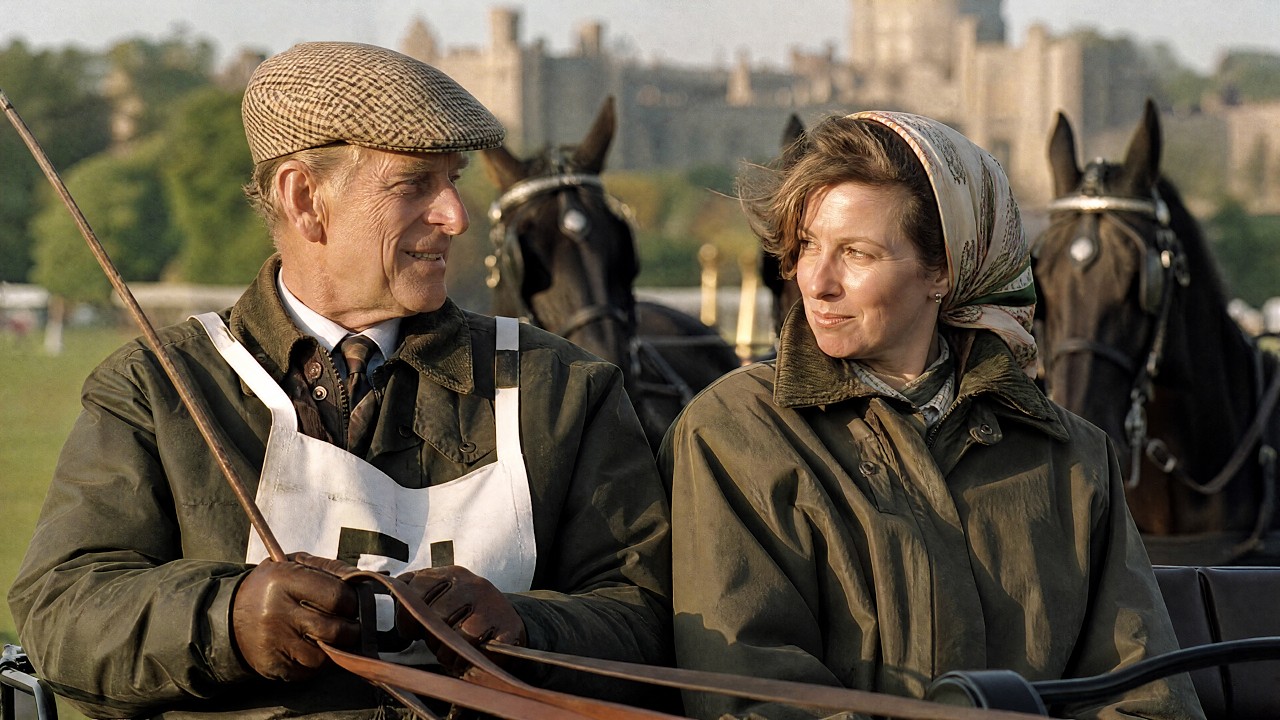
The friendship settled into a fixed, lifelong relationship that continued for the next thirty years. The place where it lived was the strange, demanding, and completely unglamorous world of competitive carriage driving. Philip gave up polo in 1971 and threw himself into carriage driving, a sport where a driver controls a team of horses pulling a carriage through three demanding phases. He helped popularize it in Britain, competed for the country, and continued into his eighties. It was, by any measure, the passion of his later years. Into this world he drew Penny after 1991.
They appeared together at the Royal Windsor Horse Show year after year, an elderly prince and his driving companion, in a public and utterly ordinary place. A secret affair hides itself. This friendship did the exact opposite. It was conducted in the most watched sporting arena the royal family owns, in broad daylight, season after season for nearly 30 years. You do not hide a love affair at the Royal Windsor Horse Show. What you can do there in perfect safety is accompany a friend.

Penny was never the only person Philip drew into his sport. He also encouraged his daughter-in-law Sophie, Countess of Wessex, to take it up. In the next generation, his granddaughter Lady Louise Windsor learned it and took over the care of his horses and carriage after his death. Carriage driving was not a secret language spoken by two people. It was a shared family discipline across three generations of the Windsors.
Ingrid Seward, in her 2020 book “Prince Philip Revealed,” described Penny as the second most important woman in the Duke of Edinburgh’s life. Not a mistress, but the second most important woman in a life where the most important woman was the Queen of the United Kingdom. She described Penny as his confidante, his loyal companion, his keeper of secrets. Seward also records that neither of them cared who saw them or what anyone might say. She is clear about the boundaries. Her considered judgment, drawn from years of study, is that nothing improper ever happened between him and Penny.
The reach of that trust widened over the years. Seward records that Penny offered her perspective on outside matters to both the Duke and the Queen. After Philip’s road accident late in his life, she was brought into the family conversation about whether he should continue driving. When the most private family on earth had to make a delicate and painful decision about their elder’s independence, Penny Knatchbull was in the room for it.
In Philip’s guest lists, her name appeared so regularly that she acquired a nickname in the household. She was known simply as “and others.” Wherever the Duke was going, she was there, added to the list as a matter of course. A presence so familiar she stopped being a name and became a habit.
The one person who could have ended the friendship with a single word chose instead to seat this woman closest of all. The Queen watched this friendship between her husband and Penny Brabourne entirely under her own eyes, at her own horse shows, in her own homes, within guest lists she reviewed herself. If there had been anything to fear, she would have been the first to see it. She had the power to extinguish it. A quiet word, an adjusted invitation, a gentle marginalization, and Penny would have faded to the margins of royal life. None of that ever happened. The opposite happened. Penny stayed close, year after year, decade after decade.
Seward’s judgment, widely reported, is that the Queen was confident nothing was going on between Philip and Penny, and that the bond between the two women and the man they shared was, in Seward’s words, rather complementary. When it came time to bury Prince Philip, and the cruel arithmetic of the pandemic reduced attendance to just 30 people, the guest list was the Queen’s personal choice. She could have filled those thirty seats with Windsors and blood relatives. Instead, she allocated one of those irreplaceable seats to Penny.
The Queen, a widow of 73 years burying her husband under the harsh rules of a pandemic, was given the smallest guest list for any major royal funeral in living memory, and the power to decide every name on it. She chose Penny. Not as an insult to be hidden, not as a scandal she was forced to swallow, but as a deliberate act of inclusion from the only person who had every right to exclude. If the Queen had ever believed there was something to resent, that was the moment to leave the seat empty. She filled it instead.
The Sun reported that the list of thirty had been chosen by the Queen, and that Penny, then 68, attended partly as a representative for her husband Norton, Earl Mountbatten of Burma, then 73 and too ill to attend himself. In the same period, an aide described her as heartbroken. A woman who had lost, in the aide’s words, her dearest friend. Both things were true. She was there for her husband’s family. She was there for herself as well. She was a stand-in. She was also the chief mourner of a private grief.

The scandal that never found its story hovered for 40 years. In the spring of 2015, a Scottish newspaper published an extended report under the headline: “Still charming at 93,” “Philip and his flirtatious admirer.” That was all it was. There was no revelation under the headline, no witness, no document, no confession. It was a collection of photographs of an older man and a younger woman at a horse show. Philip himself offered a response to the broader infidelity rumors that had followed him for decades. He was quoted as saying: “For the last 40 years, I have moved nowhere without a policeman accompanying me. So how the hell could I get away with anything like that?”
The palace never issued a denial. It never filed a lawsuit. It never ran a counter-campaign. It said nothing at all. The logic of that silence is profound. A denial is a kind of admission. The palace understood that the surest way to keep a whisper a whisper was to starve it. Never confirm. Never deny. Never explain.
In 2022, a television series finally gave the rumor the one thing it had always lacked: a script. “The Crown,” in its fifth season, dramatized the friendship between Prince Philip and Penny Knatchbull, with actress Natascha McElhone playing Penny. The series was not built on new evidence because there was no evidence. It was built on appearance, on how the friendship might have looked, and filled that appearance with invented scenes and dialogue that never happened between the real people. Jonathan Pryce, who played Philip, rejected the implication in interviews, saying of the friendship: “It’s not what people think.”
The funeral itself made the point impossible to miss. Under pandemic rules, mourners sat apart, scattered across the old stone. There were no crowds to hide among. Each of the thirty was visible, exposed, unmistakable. And there, clearly among the family and not behind it, sat the friend. The Washington Post, reviewing the guest list name by name, placed her at number thirty and explained her presence simply, noting that Philip taught Penelope carriage driving and she had since attended countless royal events.
The word the country reached for was “affair.” It is a small, sharp, exciting word, and it fit the shape of things from a distance. An older man, a younger woman, a lifelong closeness never explained. From a distance, the word seemed obvious. Only up close, in the actual record of two real lives, does that word dissolve in the hands. Because what was actually there was stranger, quieter, and much harder to sell.
There was a boy who lost everything that was supposed to be permanent, and grew into a man who could not bear to lose anyone else. There was a young woman who lost a marriage, a child, and needed someone who understood loss without needing it explained. There was a child’s grave in a wide green garden, and a set of reins, and a sport that allowed two grieving people to stand side by side in daylight and call it something ordinary. There was a wife who watched all of it with her own eyes, and kept that woman close even to the edge of the grave itself.
That was what was there. None of it was an affair. All of it was deeper than that.
Ingrid Seward, who studied the man’s life longer than almost anyone, finally settled on three simple words to describe what Penny Knatchbull meant to Prince Philip. Not the other woman. Not a mistress. A confidante. A loyal companion. A keeper of secrets. There is no scandal in those words. There is only a friendship that lasted 40 years in broad daylight, blessed by the palace, and guarded to the end by a silence that never broke.
The country wanted a story, so it chose the wrong one. The truth was quieter and kinder. And it was sitting in that thirtieth seat all along.