In the months leading up to the Nuremberg trials, U.S. Army psychiatrist Major Douglas Kelly was assigned a task that appeared straightforward on paper. He was to evaluate whether the captured Nazi leadership was mentally fit to stand trial. In practice, the assignment became one of the most psychologically complex examinations of the twentieth century.
Kelly’s most significant subject was Hermann Göring, Hitler’s designated successor and the highest-ranking Nazi in custody. What Kelly found during his sessions with Göring did not match the image of a broken or deranged man. Instead, he found a defendant who was alert, confident, and fully in control of his faculties.
From their first sustained encounters, Kelly noted that Göring was not merely cooperative. He was commanding. Göring spoke deliberately, followed complex lines of reasoning, and often anticipated questions before they were asked. For a man facing execution, he displayed a level of composure that unsettled those around him.
The stakes of the evaluation were immense. The moral and legal foundation of the Nuremberg trials depended on the idea that the defendants were responsible for their actions. If Göring could be framed as unstable or psychotic, the entire architecture of the proceedings would be weakened. Kelly understood this pressure and resisted it.
Kelly subjected Göring to intelligence testing, structured interviews, and sustained observation. The results were striking. Göring scored an IQ of 138, well above average. His thinking was flexible, his memory was intact, and his emotional responses were selective rather than chaotic.
Kelly found no evidence of hallucinations, thought disorder, or loss of reality testing. What emerged instead was a personality built around dominance. Göring did not plead his case. He performed it. He spoke about himself constantly, framing every event through his own central role in history.
This pattern was consistent across multiple testing environments. Göring’s responses aligned across different days and different methods. There were no dramatic swings, no fragmentation, and no loss of coherence. A man feigning stability eventually slips. Göring did not.
Göring quickly positioned himself as the informal leader among the prisoners. Other defendants deferred to him. Guards noticed it. Interrogators noticed it. Kelly noticed it. Even stripped of rank and power, Göring projected an authority that others responded to.
Kelly observed that Göring understood hierarchy instinctively. He spoke fluent English, joked with guards, and corrected officials on protocol. He treated interviews less like examinations and more like negotiations. Every exchange carried an undertone of positioning, a calculation about how he would be remembered.
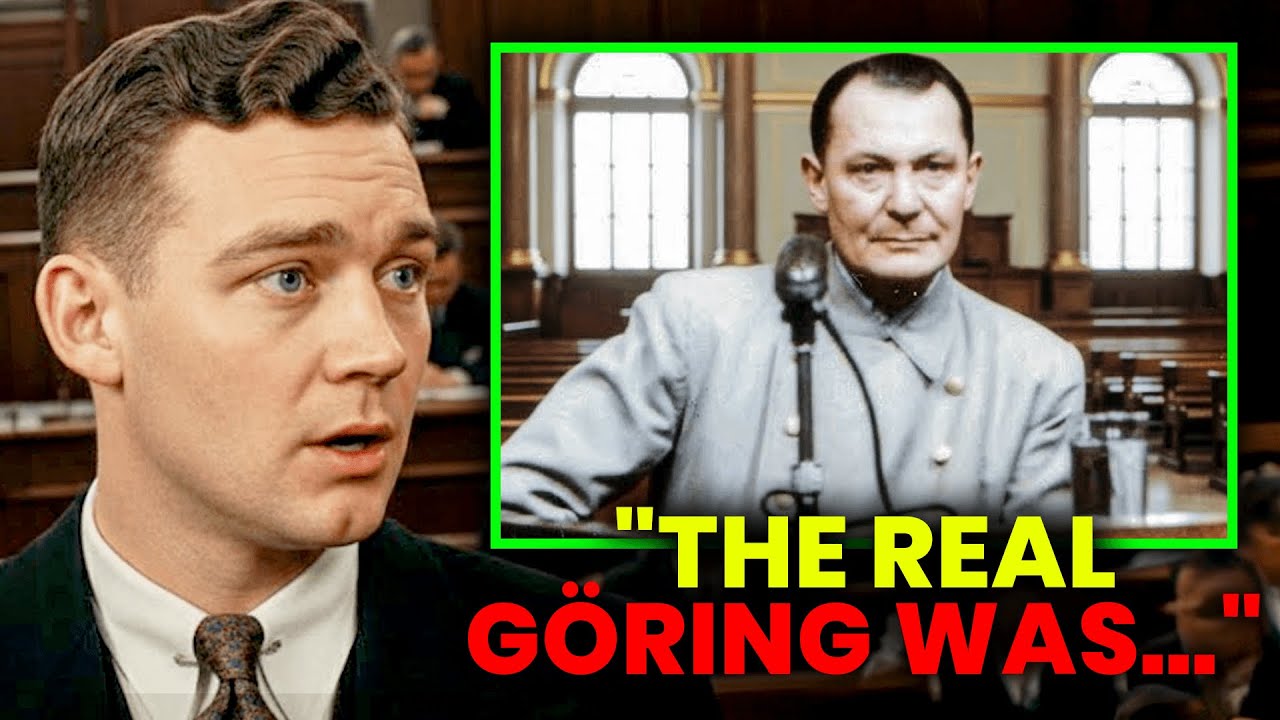
What distinguished Göring was his awareness of the stakes. He did not deny the possibility of execution. He acknowledged it calmly, almost clinically. But he returned again and again to one idea: legacy. Göring was fixated on how history would judge him, not the court.
Göring also proved difficult to read in interpersonal settings. He appeared cooperative and personable, greeting Kelly warmly and maintaining eye contact. On the surface, this looked like compliance. Kelly quickly realized it was something else. Göring adjusted his tone depending on who entered the room, calibrating each interaction to maintain leverage.
This was charisma used as a tool. Göring did not demand control. He generated it. Kelly noted that prolonged exposure to Göring often softened resistance. People talked longer than they planned. They explained more than necessary. Göring created momentum and let others carry it forward.
The testing environment was controlled and repetitive by design. Kelly used structured interviews, intelligence assessments, projective tests, and direct observation. Göring treated each method as an opportunity to assert mastery. He did not struggle with abstraction. He did not lose focus. He did not fatigue.
On projective tests, Göring’s responses were controlled and vivid, often centered on dominance, violence, or self-reference. He consistently interpreted ambiguous stimuli through frameworks that placed himself at the center of action. The world, as Göring described it, was something to be acted upon or conquered.
What stood out was not extremity but consistency. Göring’s responses aligned across tests and across days. Kelly emphasized this point repeatedly in his notes. A man feigning stability eventually slips. Göring did not.
Kelly also noted that Göring frequently attempted to reverse roles during sessions. He asked questions of the examiner, steered conversations, and subtly challenged authority. These were not outbursts. They were calculated probes. Göring wanted to know who held leverage and how firmly.
By the time Kelly completed months of evaluations, a quiet divide had formed among the experts. Fellow examiner Gustav Gilbert leaned toward pathology, describing Göring as sadistic, aggressive, and psychologically deviant. Kelly did not dispute Göring’s cruelty or ego, but he rejected the idea that these traits constituted mental illness.
The disagreement went to the heart of responsibility. Kelly believed that labeling Göring as disordered created an escape route. If Göring were sick, his actions could be reframed as symptoms. Kelly refused that framing. He saw something more dangerous: a man operating within the normal range of personality, using intelligence and ambition without internal breaks.

Kelly was explicit about this concern. In his notes and later writings, he argued that calling Göring insane would turn him into an anomaly, a monster separate from ordinary people. That separation, Kelly believed, was comforting but false. Monsters don’t require explanation. People do.
This stance isolated Kelly. The public wanted reassurance that the architects of genocide were fundamentally different from everyone else. Gilbert’s interpretation offered that comfort. Kelly’s did not.
Kelly’s final assessment was precise and deeply unsettling. Göring was not insane. He was not psychotic. He was not detached from reality. He was mentally intact, intellectually capable, and fully responsible for what he had done.
Kelly described Göring’s personality as highly intelligent, charismatic, and intensely narcissistic, but fundamentally normal in a clinical sense. Göring knew where he was. He knew why he was there. He understood the charges against him. He understood the moral framework being applied, and he rejected it anyway.
Kelly found no major mental illness that could explain away Göring’s behavior. What he saw instead was a disciplined workaholic, someone who had thrived on pressure, decision-making, and command. Göring approached the trial the same way he had approached power, as a system to be managed.
The real Göring was not driven by madness but by calculation. Kelly wrote that Göring displayed what he called a normal basic personality layered with deep narcissism and ambition. His crimes were not impulsive. They were administrative. Göring evaluated outcomes, accepted costs, and moved forward.
This conclusion directly challenged the idea that evil requires abnormal psychology. Kelly rejected the notion that Göring was a monster in the clinical sense. Monsters don’t weigh consequences. Göring did. Monsters don’t manage perception. Göring obsessed over it.
Kelly’s assessment carried an implicit warning. If Göring was mentally normal, then the capacity for his actions did not belong to a rare psychological category. It belonged to a personality type that could exist anywhere power and opportunity aligned.
The Nuremberg trials moved forward, but Kelly did not leave them unchanged. His findings informed how prosecutors approached Göring, reinforcing the idea that he was a calculating, responsible actor. But outside the courtroom, the response was colder. Kelly’s interpretation did not match what many people needed to believe in the aftermath of the war.

After leaving Nuremberg, Kelly wrote and lectured extensively. He warned that people like Göring were not historical accidents. He argued that ambition, opportunism, and moral flexibility could exist inside ordinary personalities when circumstances allowed them to flourish. These warnings were often met with discomfort.
The war was over. The public wanted closure, not vigilance. Kelly’s book did not achieve the influence he expected. His lectures reached audiences, but the message failed to embed itself culturally. Kelly had delivered an answer that few were prepared to carry forward.
Privately, the toll became visible. Colleagues noted growing frustration. Kelly drank more heavily. He became increasingly preoccupied with the implications of his own conclusions. The question he could not escape was the one Nuremberg had forced into the open: if Göring was not insane, then how easily could similar personalities rise elsewhere?
When Göring took his own life on the eve of his execution, the act closed the legal chapter but not the psychological one. For Kelly, the suicide did not contradict his assessment. It reinforced it. Göring’s final decision was controlled, deliberate, and consistent with the personality Kelly had documented months earlier.
There was no breakdown, no collapse, no sudden loss of reality. It was, in Kelly’s view, a final assertion of agency. Göring chose the manner of his end for the same reason he had shaped every interaction during captivity: to control how the story concluded.
In the years that followed, Kelly warned that the most dangerous mistake was to treat figures like Göring as psychological outliers. Doing so, he argued, allowed societies to externalize blame and disengage from warning signs closer to home. If Göring had been insane, the lesson would have ended with him. Because he wasn’t, the lesson extended outward.
Kelly’s own life ended tragically, and historians have debated how much Nuremberg contributed to that outcome. What is clear is that he never retreated from what he had learned inside those prison cells. He did not romanticize Göring. He did not excuse him. He did not simplify him.
The real Göring was not a puzzle to be solved by diagnosis. He was an example of what happens when intelligence, ambition, and ego operate without restraint inside a system that rewards them. Kelly believed that recognizing this reality was essential, not to absolve, but to prevent repetition.
The Nuremberg trials were designed to prove that law could confront atrocity. Kelly’s role ensured something else: that responsibility would not be diluted by psychiatric mythology. Göring stood trial not as a madman, but as a man who made choices.
That conclusion leaves a question that remains uncomfortably current. If Hermann Göring did not require madness to become what he became, how would the same personality traits be recognized before they are handed power again.