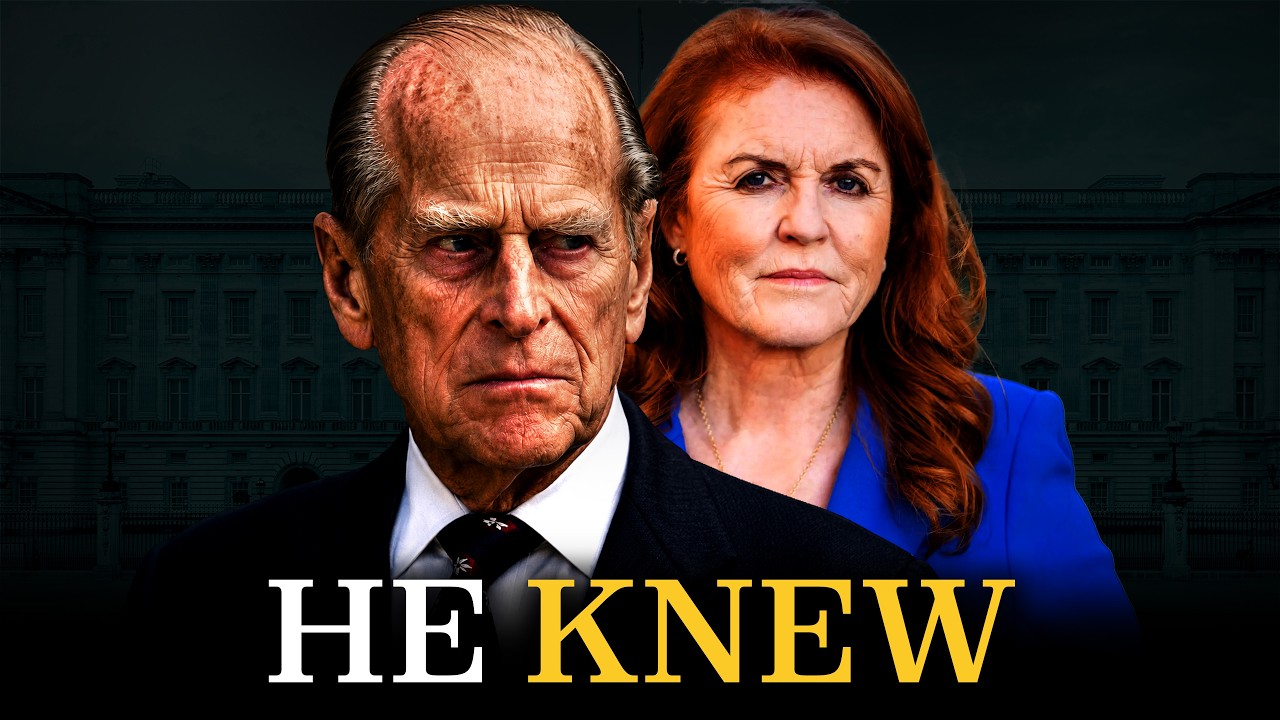
In October 2018, Princess Eugenie married at Windsor. After the ceremony, the photographer gathered the family in the Green Drawing Room for official portraits. Two people stood in the same frame for the first time since 1992: Prince Philip and Sarah Ferguson. It had been 26 years since the last photograph had included them both.
The gap is striking. The same family, the same castle, where both spent long stretches of the year. The grandfather on one side, the mother of his granddaughters on the other. For a quarter of a century, the royal household managed a quiet, daily operation across Windsor with one goal: keeping the Duke of Edinburgh from seeing her.
Most people, when they fall out with a relative, handle it in a dull way. A cold birthday card, a brief nod at dinner. Philip was not the type to settle for dull, and he was not the type to forget. He erased Sarah Ferguson from his life and held that line until his death, nearly three decades later.
The obvious question is simple: what did she do?
### The Early Years
At first, Philip was genuinely fond of her. In 1985, Prince Andrew, the Queen’s second son, began dating a tall, freckled, loud young woman with a high laugh and red hair named Sarah Margaret Ferguson.
Sarah grew up around horses and polo fields. Her father managed Prince Charles’s polo team. She entered royal life with the energy of someone who never worried about which fork to use. She told riding jokes and treated the most reserved people in Britain like old friends.
Her childhood carried wounds. Her mother left in Sarah’s early teens, running off to Argentina with a handsome polo player named Héctor Barrantes. A daughter raised with that kind of early abandonment grows up hungry for acceptance, desperate to belong, and deeply sensitive to exclusion.
Sarah and Andrew had circled the same world for years. Their mutual friend Princess Diana introduced them at Royal Ascot in 1985. Diana wanted an ally inside the family, someone fun beside her. For a brief moment, she found one.
The family welcomed Sarah warmly, especially Philip. Despite his intimidating reputation, he spent his life surrounded by people afraid to act naturally around him. Sarah refused to hesitate or bow. She shared his one true passion: carriage driving.
Philip had invented the modern competitive version of the sport, written its rules, and spent weekends in the countryside driving horse-drawn carriages well into his eighties. Sarah practiced it too. Their bond formed around this private hobby that no one else in the family understood.
Those early years were genuinely warm. Sarah brought fresh air into a house that ran on tradition, strict silence, and suppressed emotion. After the strained marriage of Charles and Diana, here was a daughter-in-law who seemed to enjoy herself. For a short time, she carried the role of great hope.
### The Man With the Eraser
To understand the freeze, you need to understand the man holding the eraser. Prince Philip, the loyal guardian of royal dignity, began life as a penniless refugee with no country to call his own.
Born in 1921 on a dining table on the Greek island of Corfu, he was a prince of Greece and Denmark in name only. Before he turned two, a revolution forced his family to flee Greece. Legend says the British navy rescued the infant prince in a cradle made from an old fruit box.
His childhood was turbulent and cruel. His mother, Princess Alice, spent years in a sanatorium battling a nervous breakdown and a schizophrenia diagnosis. His father moved to the south of France to live quietly with a mistress. His sisters married into German aristocracy, some of whom later became entangled with the Nazi regime.
Young Philip bounced between relatives across Europe with no fixed home, no fortune, and no nationality. When a poor, freckled young woman married into the wealthiest family in Britain and then used that position to survive, Philip understood the reality. He had lived something harder.
The difference lay in what each of them did inside the institution. Philip gave up everything connected to the outside world. He renounced his Greek and Danish titles, took British citizenship, abandoned a naval career that men around him swore would reach the highest ranks, and signed a contract to walk behind his wife with no authority and little salary.
More than 22,000 official engagements followed. Decade after decade, he spent himself on an institution he treated as sacred. He turned the deprivation of his youth into a principle of absolute sacrifice.
Sarah, handed the same golden opportunity, reached the opposite conclusion. When her money ran out, she sold what she had. For a man who had given up everything and asked for nothing, her choice had no trace of survival in it. She smelled of betrayal, of selling the one thing he worshipped. He could never forgive her for failing the test he had passed.
### The Marriage and the Collapse
Andrew and Sarah married on July 23, 1986, in Westminster Abbey. Around 500 million people watched. She became the Duchess of York. The public loved her. The press loved her. The Queen, by all accounts, adored her.
One famous story claims Philip took the new duchess aside and warned her: “Now that you are part of the family, you can do whatever you like, but you will always be found out.” The story sounds cinematic, perfect for a documentary. The problem is the source. It traces back to a single incident in 1996, written by a former friend of Sarah’s who had a book to sell and a grudge to settle. Historians avoid it.
The marriage strained almost from the start. Andrew, a naval officer, disappeared at sea for long stretches, sometimes most of the year. He left his new wife alone inside the most scrutinized family in the world, with nothing to do and nowhere to hide. Boredom crept in, followed by loneliness.
The press, after crowning her, began measuring her waistline and inventing cruel nicknames. A woman who could charm a room full of dukes slid into choices that turned her charm into a weapon.
To understand why a batch of photographs exploded the way they did, you need to know what 1992 was like inside the palace. The Queen herself later called it her “annus horribilis.” She chose the words carefully.
In early 1992, holiday photographs appeared showing Sarah relaxed and deeply intimate with a Texas businessman named Steve White. These were not images a married duchess wanted public. Someone allegedly left the photos in a London flat where a cleaner found them. By March, Andrew and Sarah had formally announced their separation.
In June 1992, Andrew Morton published “Diana: Her True Story.” The book detonated. It revealed, with undeniable detail, that Princess Diana lived a miserable life, that her marriage was collapsing, and that the fairy tale the public believed in 1981 had been a lie from the start. The country was in shock. The palace, built on a strict rule of never airing its dirty laundry, was suddenly exposed on the front pages of the world.
Diana herself had secretly cooperated with the book. The monarchy was bleeding, the press smelled blood, and every journalist in Britain was hunting for the next royal humiliation.
Guess who offered herself up?
### The Toe Sucking Scandal
Two months after the Morton book, while the family gathered at Balmoral to weather the storm, a new set of photographs appeared. In August 1992, a French photographer with a telephoto lens crouched near a villa in the south of France. The Duchess of York was on holiday without her husband. Beside her sat her financial advisor, a Texan named John Bryan. They maintained no distance.
The most famous image showed Bryan bending over Sarah’s bare feet and kissing, or sucking, her toes, depending on which newspaper you read and how much profit that paper wanted to make. Fleet Street nearly caught fire. The story gained a name within hours: “The Toe Sucking Scandal.”
John Bryan, Sarah’s alleged financial advisor, was closely connected to Steve White, whose photographs had already ended the marriage months earlier. Andrew learned about the sunbed photos the same way the rest of the country did: from the newspaper racks.
The timing sealed any hope of a quiet reconciliation. The incident confirmed a verdict that no longer needed confirming. Sarah, the bright personality who had once charmed the coldest house in Britain, was now feeding the same tabloid machine devouring Charles and Diana.
Imagine the scene at Balmoral. The entire royal family sat under one roof. Newspapers arrived every morning as usual. There, on the breakfast table for the Queen, Prince Charles, Princess Anne, and Prince Philip to read over their eggs, lay the mother of two young princesses, her toes being sucked by her financial man on a French sun lounger.
A popular version of that breakfast room still circulates today: Philip storms in, throws the newspaper down, and exits in angry silence. No one who was actually in that room has ever officially confirmed a word of it. The breakfast room scandal became royal folklore, told so many times it hardened into memory.
What can be said about the photos needs no embellishment. Whatever affection Philip held for that red-haired woman who loved carriage driving evaporated in August 1992. The timing alone was unforgivable. The royal institution was collapsing, stained by the Morton book, and his daughter-in-law chose that exact moment to appear topless in the papers with another man kissing her feet.
For a man who judged everyone by what they contributed to the dignity of the crown, Sarah had not made a mistake. She had committed something close to high treason against the family’s interests.
### The Freeze
People expected an explosive reaction from Philip. They imagined the duke famous for his sharp tongue attacking her personally. He did nothing of the sort. What he chose instead was colder.
He simply erased her from his life.
The divorce between Andrew and Sarah was finalized in May 1996 on very generous terms. The two remained, against all logic and most royal conventions, close friends. They lived near each other, raised their two daughters together, and by all accounts Andrew never stopped loving her. Many expected them to remarry.
Under this strange post-divorce arrangement, almost every family member found a way to deal with Sarah. Except one man.
Philip imposed a rule and stuck to it with the discipline of the naval officer he had been trained as. He would not sit in the same room as Sarah Ferguson. Not at dinners, not at parties, not even at informal family gatherings. If she came, he left. If he stayed, she stayed away.
There was no dramatic confrontation. No showdown. A door closed and stayed closed.
The contrast with his wife sharpened the distance. Queen Elizabeth, who could have followed her husband’s lead and cut Sarah off entirely, did the opposite. She continued inviting her former daughter-in-law for tea, remained fond of her, and kept Sarah inside the broader family circle, scandals and all.
Years later, Philip’s friend and biographer, Gyles Brandreth, sat with him and asked why. Why the total avoidance? Why never repair things?
Philip answered with cold finality. He did not see Sarah, he explained, because he saw no point in it. Not anger, not sadness, not a score to settle. Just a man issuing a silent judgment on someone not worth his time. Brandreth left certain that Philip had classified her behavior as “unacceptable” and would never revisit the verdict.
The granddaughters always found the door open. Their mother never did.
The silence did Philip’s work for him. He lived by the principle royals wear like armor: never complain, never explain. He used it against Sarah with full force. No reprimand reached the press. No information was leaked against her. The deprivation of his presence was everything. In a family where presence equals approval, this withdrawal hit harder than any insult.
### The Logistics of Avoidance
What makes this freeze even stranger is how much the family forgave everyone else. This house weathered affairs, divorces, public separations, and successive scandals, swallowing most of it and moving on.
Charles and Diana’s relationship exploded across the front pages. Anne divorced and remarried. Margaret’s romantic entanglements filled headlines for decades, and the palace quietly sheltered the man she loved. Rather than marginalizing Margaret herself, the family bent and adapted, keeping its rule-breakers inside the tent.
Sarah alone had the tent closed behind her, with a guard posted to prevent her return.
In 2008, Sarah moved into Royal Lodge, a 30-room mansion in Windsor, settling next door to her ex-husband Prince Andrew. They remained a couple in all but name. But Philip spent a great deal of time at Windsor. Two people who had spent over a decade carefully avoiding each other now shared the same royal estate.
The palace staff inherited a job that sounds invented but is entirely real: coordinating the daily movements of an elderly prince and a divorced duchess so they never met.
Someone tracked where Sarah was. Someone tracked where Philip was. Someone compared the two and made adjustments daily, for years. A man in his late eighties and the mother of his granddaughters shared an estate the size of a small town without breathing the same air even once.

Royal correspondents who covered the palace, including Richard Kay of the Daily Mail, described this kind of careful, hidden management behind Windsor’s high walls. It worked. Year after year, the system held. Two people, one estate, no meetings.
### Selling the Crown
The toe-sucking scandal lit the fire. What kept Philip from letting the embers cool ran deeper, colliding with every principle he had built his life on.
Sarah emerged from the divorce drowning in debt, reportedly more than £4 million at its worst. No apology or quiet retreat could fill that hole. To escape, she did something unbelievable by the standards of the man in question.
She turned herself into a business. She became a paid spokesperson for Weight Watchers in America, appearing on television talking about points and portions under a contract reportedly worth millions. Then came the memoirs, the children’s books, the licensing of her name, the paid interviews, the commercial deals built on having once been a member of the royal family.
To most of us, this is survival. A woman doing what the bills require. To Philip, it was desecration.
Understand the man and you understand why it stung so badly. Prince Philip gave up his naval career, his name, his nationality, and his entire independent future to walk three steps behind his wife for 70 years without asking for anything in return. He performed more than 20,000 official duties in his lifetime, unpaid, for an institution he believed in like a religion.
Duty meant serving the crown and never exploiting it financially. The monarchy meant responsibility, not a brand.
There stood Sarah, in his view, committing the one act he found truly vulgar: turning the magic of the monarchy into income. Every Weight Watchers advertisement, every paid appearance, every chat show couch in America confirmed what he already believed. According to Brandreth, this relentless commercial pursuit, more than the toes, cemented Philip’s verdict in stone.
Not the scandal. Scandals came and went with the seasons. What he could never forgive was her taking the thing he had devoted his entire life to and putting a price tag on it.
### The Sting
If Philip needed final proof, wrapped as a gift, that he understood her correctly, May 2010 provided it.
A News of the World reporter disguised as a wealthy businessman approached the Duchess of York. On hidden camera, Sarah offered to sell him access to her ex-husband. Prince Andrew then held an official position as a British trade envoy, opening doors for British companies around the world.
On video, Sarah named a price of £500,000 for an introduction. She accepted £27,000 in cash as a down payment, on camera. The footage spread and caused an uproar. The Duchess of York appeared in grainy hidden-camera video selling access to a working royal as if he were a used car.
She apologized later, blaming her financial situation, a moment of madness, a desperate place in her life. Perhaps every word she said was true. None of it changed what the recording showed.
Andrew clung to his trade envoy position briefly before stepping down. Sarah’s name, already hated inside the palace, worsened. For a man who had spent 18 years arranging his life around the certainty that she brought trouble, the recording looked like a note he had written himself.
Philip said nothing publicly about it, because he said nothing publicly about her, ever. But no quote was needed. For 18 years, he had warned everyone who would listen, often through his actions, that this woman was a liability to the family. His refusal to engage with her came from clear vision, not cruelty.
Money for access. The sting delivered the same grim idea to every man in the palace at once. Whatever guilt anyone felt about the old man’s hard line toward Fergie, the hidden camera erased it. The ignoring no longer looked like a grudge. It looked like a verdict.
### The Wedding She Watched on TV
The price of all this fell hardest on Sarah herself. The most striking example came in April 2011 at the wedding of Prince William and Catherine Middleton.
The whole world watched that wedding. Nearly the entire family gathered in Westminster Abbey to see the future king marry Kate. Beatrice and Eugenie, Sarah’s daughters, attended in those famously controversial hats. Their mother, the Duchess of York, who had married into the family in that same abbey 25 years earlier, received no invitation.
She watched the ceremony on television alone, like everyone else.
Sarah described that day a month later in an interview with Oprah Winfrey, not hiding the pain. She admitted feeling completely worthless, that her exclusion confirmed everything she believed about herself. Instead of attending the family event, she fled the country to Thailand.
The most photographed family on earth during the wedding of the decade, and Fergie, once beloved, escaped to the other side of the planet to avoid the silence of her non-invitation.
Was the snub Philip’s alone? No one can blame him exclusively. A royal wedding guest list passes through many hands. But the exclusion did not happen in a vacuum. It happened inside an institution that had received its direction on Sarah for two decades from the man at its head, a man who had made his position unmistakable. The frost affected the temperature of the entire house.
### The Daughters
A less visible victim runs through all of this: the two girls who grew up in the middle of the contradiction.
Beatrice and Eugenie remained Philip’s granddaughters, nothing less. By all accounts, he loved them genuinely and deeply. He stayed interested in their lives and kept them close. Brandreth confirmed that Philip’s door was open to the girls no matter how firmly it was shut to their mother.
The girls grew up holding two conflicting truths: their grandfather adored them, and their grandfather refused to be in the same room as the woman who gave birth to them.

Imagine a child processing that contradiction. Every family gathering carried an invisible seating chart. Every occasion raised the same silent question: could mother come, or should she stay home so grandfather could attend?
Beatrice and Eugenie lived a childhood where their grandmother’s warmth and their mother’s rejection appeared on the same calendar year after year, treated as normal by the adults around them.
This equation explains why one wedding photograph in 2018 became news in itself. It was not about tension toward Sarah. Philip loved Eugenie enough to tolerate Sarah’s presence for as long as the photographer needed to say “hold still.”
The granddaughters formed the only bridge strong enough to cross a gap nothing else could close. While two months of scandals and 26 years of hostility built a wall, one young woman’s wedding day removed a single brick, for a brief moment.
### The Photograph
Back to October 2018. The Green Drawing Room at Windsor, Princess Eugenie’s wedding. For one moment, the wall collapsed.
Not through forgiveness. Not through a great behind-the-scenes reconciliation. Because a grandfather did for his granddaughter what he refused to do for anyone else. Eugenie wanted her mother and her grandfather in one family photograph on her wedding day.
Philip, aged 97, showed up, stood there, and let it happen. Twenty-six years after the toe-sucking scandal, the two appeared in the same frame again.
Do not mistake it for a thaw. There was no thaw. It was a single exception granted for a young woman they both loved. Then the door closed again. Philip sent no dinner invitations to Sarah. The careful avoidance resumed.
What the 2018 photograph actually proves is how cruel the freeze had been from the start. It took a royal wedding, a beloved granddaughter, and a man approaching 100 years old to arrange a few minutes of coexistence, minutes any other family would consider nothing at all.
### The Funeral
Prince Philip died on April 9, 2021, at Windsor Castle, two months short of his 100th birthday. His funeral took place on April 17 at St George’s Chapel.
Sarah Ferguson did not attend.
On the surface, that looks like the perfect cold ending to the whole story. The man ignored her for 29 continuous years. Even in death, the arrangement seemed to keep her from saying goodbye.
But the real story is less dramatic. Philip died at the height of the COVID-19 pandemic, when Britain still had strict limits on how many people could gather, including at funerals, including royal ones. The guest list at St George’s Chapel was capped at 30 people. Senior royals only.
The Queen sat alone in her seat, wearing a mask, separated from her family by the same restrictions. Prince Harry traveled alone, his pregnant wife absent on medical advice, while rows of cousins and lifelong friends watched the service from home. Many people who loved Philip deeply stayed away from that chapel for one reason: the law left no room.
So no, Sarah’s absence from the funeral cannot really be read as a final deliberate snub from beyond the grave. Thirty seats and a pandemic lockdown were the cause, not revenge.
The funeral, if anything, warns against this entire story. How easy it is for an ordinary, sad fact to dress up as another act of cruelty, when the less sensational explanation is the true one.
### The Real Verdict
The word in the title is “despised.” It matches what everyone assumes because it offers easy, exciting, tabloid-ready emotions. An angry duke, a thrown newspaper, a decades-long simmering hatred. A great story, mostly fabricated.
Search for evidence of real hatred and you will find none. Philip never publicly attacked Sarah. He never made a statement against her. He never plotted against her, never schemed for her destruction, never aimed his famous cutting remarks at her. The dramatic confrontations everyone repeats, the breakfast room newspaper toss, the terrifying first warning, dissolve under source checking.
No revenge. No drama. What lay underneath may be worse.
Philip did not despise Sarah Ferguson. He decided she did not matter.
He looked at a woman who embarrassed the institution he loved, then spent years selling pieces of it to stay afloat, then appeared on hidden camera auctioning off her ex-husband, and reached a final, cold, decisive verdict. This woman is not worth my time, and I will arrange my life so I never waste any on her.
Then he executed that verdict with discipline that lasted until his death. No drama, no mess. Just erasure.
Hatred, at least, treats you as a worthy opponent. It gives you space in someone’s mind. A reaction, a foothold under the skin. Philip gave Sarah the opposite of that. He gave her nothing. He never saw her because, in his own blunt words, he saw no point.
For a woman who entered that family desperate to be loved, charming every room she walked into, needing the warmth of belonging the way others need air, that polite, profound indifference may have landed harder than any insult.
Here is the final irony. The very quality that attracted Philip in the beginning, Sarah’s refusal to be artificial, her loud, unfiltered, financially messy, attention-grabbing humanity, became the quality that lost her forever. He loved her because she refused to play the fake queen. He erased her for the same reason.
She never changed. The price of that, with this particular man, was enormous. A quarter century of standing on the same estate, inside the same family, with someone quietly ignoring her as if she had already left.
Years later, Sarah Ferguson outlived the freeze itself. She returned to Royal Lodge publicly and held onto the family bonds she could keep. The man who erased her never softened while he breathed. His verdict on her outlasted his marriage, his career, and nearly a century of his own life, fixed in place from August 1992 to his final spring.
Whatever you call that, contempt is not a strong enough word. The discipline of it was something far colder.