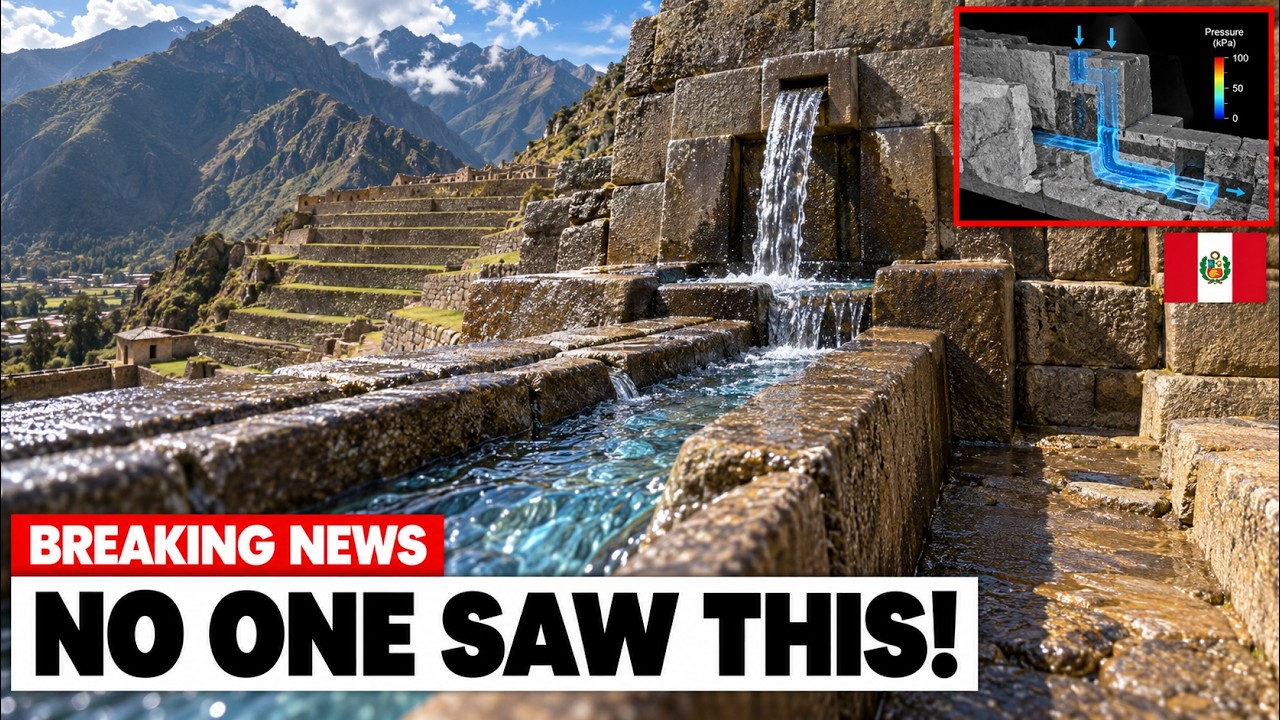
Water has flowed through the stonework of Ollantaytambo for 600 years, not around it, but through it. Channels carved into the masonry of this Inca fortress in Peru’s Sacred Valley have always been visible to anyone looking. Fountains, carved conduits, and the integration of flowing water into walls and terraces are features no other Inca site replicates at the same scale and complexity. What the water was actually doing inside the stone, and why the Inca built a hydraulic system into the structural fabric of their most precisely engineered site, has never been fully decoded until now.
What the water turns out to be doing makes the architecture mean something entirely different from what it appeared to be. Ollantaytambo sits at the northwestern end of the Sacred Valley in Peru, roughly 60 kilometers from Cusco by land and at an altitude of about 2,800 meters, where the valley narrows before a series of steep terraced ridges. The Inca transformed this landscape into one of the most ambitious architectural undertakings of the pre-Columbian world. It is the best-preserved Inca town ever found, and the only place where modern residents still live within a street plan laid out by Inca urban planners five and a half centuries ago.
The site combines an inhabited urban center, agricultural terraces, ceremonial architecture, and fortifications, representing the most complete integration of Inca planning at every level, from individual stone joints to the regional landscape. The main construction of the site is primarily attributed to the Inca ruler Pachacuti, who initiated a massive building program throughout the Sacred Valley following his decisive victory over the Chanka confederation in the mid-fifteenth century. Archaeological evidence suggests the site was occupied and developed over multiple earlier periods as well. The most prominent architecture includes the terraced hill complex known as the Temple Hill, whose platform terraces are built from some of the largest and most precisely fitted stone blocks in the entire Inca architectural heritage.
Massive blocks of pink granite were quarried from a source on the other side of the Urubamba River, transported across the valley, up the slope, and set with fitting tolerances measured in fractions of a millimeter at the contact surfaces between adjacent stones. The precision of the stonework at Ollantaytambo equals or exceeds what remains at any other Inca site, including the more famous examples at Machu Picchu and Sacsayhuamán, and it has drawn continuous scholarly attention since European travelers first documented the site in the colonial era. The techniques used to achieve this precision, and how the Inca quarried, transported, and placed stones of this size with such accuracy, remain incompletely understood despite more than a century of research. What remained even less understood, until the research program that produced the hydraulic decoding, was why the site’s engineers invested comparable attention and ingenuity in a second system: a water system designed to be integrated into the stone architecture with a precision matching the stone fitting itself, and whose purpose the traditional interpretive framework had never satisfactorily explained.
The site occupies a landscape that makes its hydraulic engineering both possible and necessary. Rivers fed by glacial meltwater bring stable-temperature water from the high peaks above. The sloping terrain of the valley walls provides the gradient needed for gravity-fed water distribution across the site, with no pumping required. The specific location at the valley’s narrow point concentrates water flow from multiple source streams into a manageable set of main channels, which the Inca directed into the site’s infrastructure with an intentionality that the hydraulic decoding has finally characterized.
The water features at Ollantaytambo have been documented since the first systematic archaeological work at the site. The fountains, a series of carved stone openings through which water flows from basin to basin in carefully controlled descent, are the most prominent and most described water feature. They are impressive in their own right, precisely carved stone channels directing water flow with an engineering rigor that suggests precise hydraulic calculations, integrated into the site’s terrace architecture in ways that make them both functional water features and architectural elements. But the fountains are only the most visible part of a water management system whose full extent surface documentation could not capture.
Beneath and within the stone architecture of Ollantaytambo lies a network of channels, passages, and managed flow paths distributing water across the site in ways that took decades of research to begin understanding in full. The channels are carved into the stone fabric of the walls and platforms, not added to the surface as attachments. They are integral parts of the stone elements themselves, carved before the stones were set in their final positions and designed as part of the stone’s function, not as an afterthought to its assembly. The standard interpretive framework for Inca water features, which treats fountains and channels primarily as irrigation management elements with ceremonial significance, has never been entirely satisfactory for Ollantaytambo specifically.
Irrigation theory clearly explains the terrace agriculture that Inca hydraulic engineering supplied. But it does not explain the integration of water into the structural fabric of Temple Hill architecture in ways that serve no obvious agricultural function. The ceremonial interpretation invokes the genuine and documented importance of water in Inca religious practice, but it does not explain the specific engineering represented by Ollantaytambo’s channels, whose design suggests a more specific functional purpose than enhancing public ceremonies. The research program that decoded Ollantaytambo’s water system was not a single-season excavation project.
It was a multi-year, multi-disciplinary investigation combining methods from hydrology, structural engineering, materials science, archaeoacoustics, and thermal physics in a way no previous study of the site had attempted. The hydrological survey components established the full extent of the water system, mapping the network of channels and conduits throughout the site with a level of completeness previous documentation had not achieved. This work required studying the water while it was flowing, rather than examining dry channels, and using ground-penetrating radar and other non-invasive survey methods to trace the channels through the stone construction of walls and platforms where direct visual access was impossible. The hydrological survey produced a map of the water system far more extensive than surface features alone suggested.
Structural engineering analysis examined the relationship between the channel network and the load-bearing architectural structure of the site. It analyzed the specific placement of channels within the stone blocks and wall cores, the way channels were integrated into the fitting of adjacent stones, and the mechanical implications of channel placement on how water movement affected the mechanical behavior of the stone assembly. This analysis produced the first finding on which the hydraulic decoding ultimately rests: the discovery that the channel placements are not random relative to the structural organization of the stone assembly, but are positioned specifically in places where water movement has measurable effects on the mechanical and thermal properties of the stone and its joints. Materials testing components measured the specific effects of water saturation on the mechanical properties of the specific stone types used at Ollantaytambo.
The pink granite of the Temple Hill blocks, the local limestone, and the feldspar andesite used for other architectural elements were all tested under temperature conditions characteristic of the Sacred Valley climate across seasons. This testing produced the data needed to characterize the thermal regulation effect that proved to be the key to understanding what the water system was actually designed to achieve. The central discovery of the research program came from merging the hydrological survey data with the structural engineering analysis. The channels distributing water through the stone construction of the Temple Hill architecture at Ollantaytambo are not placed randomly relative to the structural organization of the stone assembly.
They are specifically positioned at the contact surfaces between adjacent stone blocks, at the joints where massive stones meet one another, and where Inca stone-cutting precision produces the tightest and most mechanically critical contact points between elements. This placement is neither coincidental nor for convenience, nor simply the most suitable location for carving channels without compromising the structural integrity of individual blocks. It is the location where water movement has the most direct effect on the behavior of the stone assembly as a whole, where the presence or absence of water in the channel determines not just water flow but what the stones do. The specific effect that water produces at the joint surfaces involves the interaction between water’s thermal properties and the mechanical behavior of stone at fitting surfaces.
The fitted joints of Inca construction, particularly at sites like Ollantaytambo and Sacsayhuamán where building precision reaches its peak, are not held together by mortar. They are held together by the weight of the stones and the precision of the fit between their surfaces. The mechanical stability of this system depends on the quality of contact between fitted surfaces, which is in turn affected by the thermal expansion and contraction of stone as temperatures change. When stone expands thermally, contact pressure at the joints increases.
When it contracts, contact pressure decreases. In a climate with significant daily temperature variation, such as the daytime heating and nighttime cooling cycle of the Sacred Valley, these thermal cycles create periodic changes in the mechanical behavior of the stone assembly, working over time against the precision of the construction. Water present at the joint surfaces modifies these thermal cycles. The specific heat capacity of water, its ability to absorb and release large amounts of thermal energy with relatively small temperature changes, means that water-saturated joint surfaces change temperature more slowly than dry surfaces, reducing the severity of thermal cycles at mechanically critical contact points.
This is what the research team found when they measured the thermal behavior of the stone assembly under controlled conditions with and without water in the joint-surface channels. The presence of water in the channels produces a measurably smaller daily temperature variation at the joint surfaces compared to dry channels, by a margin that translates into meaningful differences in the thermal stress cycles of the stone assembly. The Inca built a system of thermal regulation within the structural fabric of their most precisely fitted stone architecture. The water in the channels was not flowing through the stones for irrigation or ceremonial purposes.
It was flowing through the stones to maintain them in the mechanical state their construction precision requires. The thermal regulation results became clearer and more significant as the research team expanded its measurements to cover the full seasonal and daily cycle of the Sacred Valley climate, and developed a quantitative model of how the water system affects the thermal behavior of the stone assemblies. The Sacred Valley experiences significant daily temperature variation throughout the year. The difference between daytime highs and nighttime lows often exceeds 15 degrees Celsius, and can approach 20 degrees or more during the dry season.
For stone structures built without mortar, this daily temperature swing is a significant mechanical stress factor. The thermal expansion and contraction of large stone blocks across thermal fluctuations of up to 20 degrees generates stress at the joint surfaces, which may work over decades and centuries against the precision of the fitting through a process stone conservation experts call thermal stress: the gradual degradation of stone joint quality through repeated stress cycles. The thermal modeling conducted by the research team for the Ollantaytambo system showed that the channel network, when carrying water at temperatures characteristic of the natural sources feeding the site, produces a thermal insulating effect at the joint surfaces that is substantial and architecturally significant. The modeled thermal variation at the joint surfaces of stone assemblies fed by the channels is approximately 30 to 40 percent smaller than the variation in equivalent dry surfaces under the same ambient conditions.
This reduction in thermal cycle amplitude corresponds to a proportional reduction in the thermal stress cycles that negatively affect the precision of fitted joints. The conclusion the research team drew from this finding is carefully stated in their publications, but it is nonetheless striking: Ollantaytambo’s water system functions as an active maintenance system for the precision of the stone assembly. A hydraulic system whose operation keeps the fitted joints of the architecture in better mechanical condition than they would be without water flowing through them. The site was not simply built to high precision standards and then left to maintain itself.
It was built with an integrated system for maintaining the conditions that precision requires. The third major discovery of the research program emerged from acoustic measurements taken across the site during periods when the water system was operating at different flow levels. The sound of water flowing through stone channels has a clear and expected acoustic presence. Anyone who has listened to water flowing through a stone channel knows that the combination of water movement sound and the resonant properties of the surrounding stone produces an acoustic experience qualitatively different from water in an open channel or the silence of a stone space.
What the research team found when measuring the acoustic environment of the Temple Hill architecture at Ollantaytambo with precision instruments was that the acoustic effects of the water system are not merely the expected ambient sound of flowing water, but include specific resonance phenomena whose nature depends on the geometry of the architectural spaces and the flow rates in the channels. At specific flow rates, rates naturally produced by the channel dimensions and the gradient of the system under normal water supply conditions, the channels excite resonant frequencies in the enclosed stone spaces of the Temple Hill architecture. The resonant frequencies excited differ according to the specific architectural space, the enclosed niches, the platform surfaces, and the stone-lined passages, in ways determined by the architecture itself. The acoustic analysis identified that the specific frequencies excited by the water system at typical flow rates correspond to the frequency range associated with physically tangible vibration.
Vibration that human bodies in the resonant spaces would feel as a physical sensation in addition to being an acoustic sensation. The architectural spaces of Temple Hill, the niches, the enclosed platforms, and the specific spatial configurations produced by Inca architectural practice in its finest form, are shaped according to the team’s acoustic analysis in ways that concentrate the resonance effects of the water system rather than dispersing them. The acoustic engineering of the spaces and the hydraulic engineering of the channels are not independent of one another. They appear designed in mutual relation, with the spatial configuration of enclosed areas shaped to respond to the specific frequencies produced by the water system.
The integration of hydraulic, thermal, and acoustic functions into a single architectural system, and the discovery that Ollantaytambo’s water system simultaneously maintains stone fitting precision, regulates the site’s thermal environment, and produces specific acoustic effects in the architectural spaces, points to a level of integrated engineering knowledge that the prevailing narrative of Inca technology does not adequately describe. The thermal regulation function alone implies an understanding of the relationship between water’s thermal properties, the mechanical behavior of unmortared stone joints under thermal cycling, and the specific placement of water distribution channels within the stone assembly required to produce the desired damping effect. This is not knowledge that arises from simple observation. It requires an understanding of physical principles, the thermal properties of both water and stone, and the mechanics of joint surfaces under varying contact conditions, at a level not predicted by the traditional account of empirical Inca engineering, which emphasizes practical construction skill and organizational capacity rather than systematic physical understanding.
The acoustic function adds another dimension. Designing architectural spaces to produce specific resonant responses to a hydraulic sound source requires an understanding of the relationship between spatial geometry and acoustic behavior. This understanding is applied in the specific configurations of the Temple Hill spaces in ways that appear deliberate rather than accidental. The Inca engineers who designed Ollantaytambo were not merely building walls and channels.
They were designing an integrated system in which stone, water, sound, and thermal behavior interact in specific and intentional ways. The Inca astronomical knowledge embedded in other aspects of Sacred Valley site design, the alignment of temples and observation points with solstice and equinox events, and the integration of celestial sightlines into the architectural plans of major sites, has been documented and is now understood as a sophisticated astronomical tradition applied to architectural design. The hydraulic decoding of Ollantaytambo suggests that the same level of sophisticated physical understanding was applied to the relationship between water and stone. That the Inca possessed and applied systematic understanding of hydraulic, thermal, and acoustic physics.
And that their architecture encoded information in ways that required modern research to decode. The archaeological community’s reaction to the hydraulic decoding of Ollantaytambo has been engaged and methodologically cautious, and in several specific respects more open to the results than similar claims about ancient engineering sophistication are usually received. The hydrological survey results, the more complete mapping of the water system, and the documentation of channel placement at the joint surfaces of the stone assembly have been accepted as an empirical contribution to site documentation without serious dispute. The channel network is real.
The channel placements relative to joint surfaces are measurable. And the more complete map produced by the research is a genuine addition to the site’s archaeological record, regardless of how the function of these channels is interpreted. The thermal regulation finding has generated the most substantive technical debate. The basic claim that water in joint-surface channels produces measurable thermal damping that reduces temperature cycles at mechanical contact surfaces is experimentally testable, and the research team’s measurements are documented in enough detail to allow evaluation by specialists in stone mechanics and thermal physics.
Several researchers who have examined the data acknowledge that the thermal effect is real, and that the presence of water at channel locations does produce the damping the team measured. The debate centers on whether this effect was intentional on the part of Inca engineers or an incidental consequence of a water system designed for other purposes, and on what evidence can distinguish between these two interpretations. The acoustic findings have attracted the attention of the growing field of archaeoacoustics, researchers who study the acoustic properties of ancient sites and evidence for intentional acoustic design in ancient architecture. The specific resonance phenomena documented by the team are consistent with findings from other ancient sites where intentional acoustic design has been proposed.
The structural relationship between channel placements and the configurations of the architectural spaces is the type of evidence that archaeoacoustic literature considers a potential indicator of intentional acoustic design rather than incidental acoustic properties. The discussion continues over whether the multiple functions identified are the result of a unified design intention or of convergent factors. The full significance of the hydraulic decoding changes the question of what Ollantaytambo was built to be. The traditional narrative treats the site as a combination of agricultural administration infrastructure, military fortifications, and ceremonial architecture whose water features serve irrigation and ritual functions.
The hydraulic decoding reveals a site whose architectural ambition was more integrated and technically sophisticated than that narrative portrays. The Temple Hill architecture was not built simply to enclose space and resist military attack, but to create and maintain a specific physical environment. An environment in which water flows through the stone fabric to regulate its thermal behavior, produce specific acoustic effects in enclosed spaces, and maintain the precision of fitted joints in the mechanical state the architecture requires. The site is not merely a building that contains a water feature.
It is an architectural-hydraulic system whose stone and water components work together to produce effects neither could produce alone. The decoding also changes the implied scope of Inca engineering knowledge. The academic narrative of Inca technology is sophisticated in recognizing Inca organizational capacity, astronomical knowledge, and construction skill. But it is less developed in describing the systematic physical understanding required by the Ollantaytambo hydraulic system.
An architectural system integrating thermal regulation, acoustic design, and stone joint maintenance into a single hydraulic network was not designed through trial and error alone. It required an understanding of the physical principles that make the integration work, principles whose application to stone architecture at this level of complexity implies a systematic body of knowledge about material behavior under physical forces, something the traditional narrative of Inca science has not fully described. The decoding provides a material explanation for what the traditional Andean cosmological description of sacred Inca architecture, in which stone and water are seen as elements living in relationship with one another, and where giving life to stone through water is not metaphorical but functional, has been accurately describing. The water has flowed through the stones of Ollantaytambo for 600 years.
For most of that time, those who studied the site understood the water as ritual, as irrigation, as aesthetic, or as mere water performing its functions against a stunning stone backdrop. The hydraulic decoding reveals the water was doing something more specific and more technically demanding. Regulating the thermal environment of the fitted joints, exciting resonant frequencies in the enclosed architectural spaces, and maintaining the most precisely engineered stone assemblies in the Inca architectural record within the mechanical state their precision requires. The water was always there.
But the understanding of what it was doing was not. Now that it is understood, Ollantaytambo must be seen as something different from what prevailing narratives have described. Something whose full sophistication was encoded in the relationship between stone and water in ways six centuries of observation could not decode. What the Inca knew about that relationship is what the research has finally revealed.
And what they knew was far more than we have credited them with.