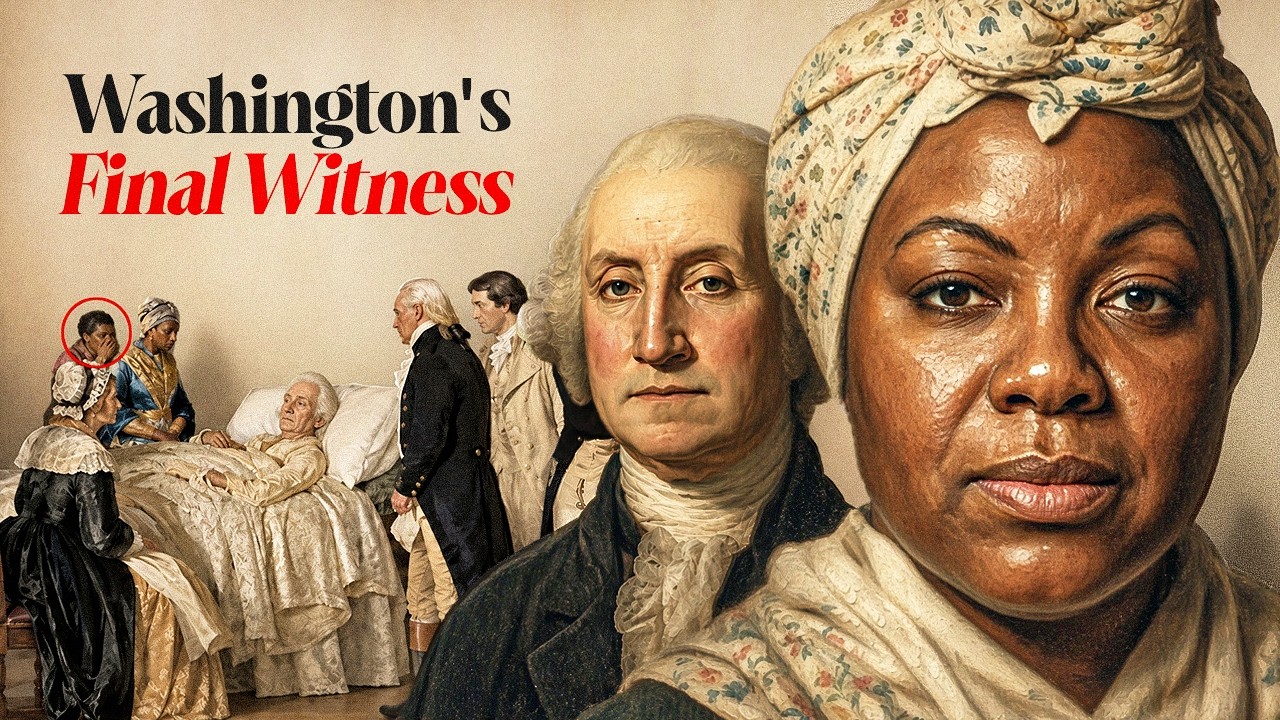
Every morning before sunrise, Caroline entered George Washington’s bedroom to light his fire. On December 14, 1799, she did it for the last time, and the first president of the United States never woke up. She was the enslaved woman who stood at his deathbed. His will freed 123 people.
She was not one of them. This is the story of what she did instead, and how, 25 years later, a stranger came to her cabin with a promise that would save only one child. Not her. Among George Washington’s surviving papers is a short household order in his handwriting.
It names only one servant: a woman trusted to guard his private rooms, with strict instructions that no one should enter without his permission or his wife’s. Her name was Caroline Branham. For more than three decades, she was the first person awake at Mount Vernon every morning. On a December day in 1799, she was the first to realize something was terribly wrong.
Before sunrise, before the household stirred, Caroline Branham was already up. She crossed the dark yard from the servants’ hall, climbed the back stairs of the mansion, and lit the fire in the room where George and Martha Washington slept. Kindling first, then the spark, then the low flames warming the chamber before either of them opened their eyes. This was not one morning.
This was every morning for more than 30 years. The house Caroline served was enormous by the standards of the time: 21 rooms, 10 of them bedrooms, filled with visitors most of the year. Washington himself described Mount Vernon as operating like a well-frequented tavern. Every visitor needed clean linens, hot water, and a burning fire against the Virginia cold.
Caroline was one of the women who made that hospitality possible, invisibly, before anyone in the parlor below noticed she had been there at all. Lighting the fire was only the beginning of her day. She emptied chamber pots, carried water for washing, made beds, changed linens, and dusted room after room. She was also a seamstress, sewing shirts and clothing for the enslaved workers on Washington’s five farms in whatever hours remained after her household duties.
Washington expected the women who cleaned his home to remain productive even when not doing housework. There was no such thing as a day off for Caroline. One story about her survives through sheer chance. A young girl named Hannah Taylor, age seven, once fell asleep in the Washington family carriage and woke up to find herself at Mount Vernon on a stormy night, far from home.
The family insisted she stay. Caroline carried her to a small upstairs room, warmed the blankets with a copper pan, dressed her in a borrowed nightgown, and left a candle burning until the child fell asleep. Decades later, as an old woman, Hannah Taylor still remembered the servant who did that, and remembered her name. It is one of the few descriptions of Caroline Branham in all surviving records, written by someone who did not enslave her.
Caroline was not alone in this work. Other enslaved women, Molly and Charlotte, moved through the same rooms on the same relentless schedule. Together, they built something like a family inside a system designed explicitly to deny them that. They cared for each other’s children, covered each other’s exhaustion, and shared the little news that reached Mount Vernon from the outside world.
It was not a life anyone chose. It was simply the life available. Caroline was born into this life. Her mother was enslaved by the estate of Martha’s first husband, which meant Caroline was not owned directly by George Washington but by what the law called the widow’s dower property.
In the eyes of the law, she was inventory, listed, valued, and inherited like silver or china, along with everyone else Martha inherited as a young widow decades before marrying George Washington. It was a distinction that meant nothing in the daily routine of lighting fires and making beds. But it would mean everything decades later when the question of freedom finally came. For now, there was only the work, and within it, something rarer: a family of her own.
She married Peter Hardiman, a hostler who managed George Washington’s horses. It was not a marriage recognized by law. Enslaved people could not legally marry in Virginia. Any vows Caroline and Peter exchanged existed only in the eyes of those who witnessed them.
But Washington himself took an interest in preserving the arrangement. Peter belonged on paper to a neighboring family, the Stewarts, and Washington paid 12 pounds sterling each year to keep him working and living at Mount Vernon. In a letter explaining the arrangement, Washington wrote that he hired Peter “for my jackasses, horses, and mares, etc. , and because he does not seem willing to part from his wife and children.
” It is one of the few times in all of Washington’s surviving papers that he wrote so plainly about the feelings of an enslaved man. He noticed that Peter did not want to be separated from his family. And he arranged, for his own economic reasons, that he would not have to be. This was not freedom.
It was not even close to freedom. But by 1788, Caroline and Peter had two small children, Wilson and Rachel, and for now, they were together. Over the years that followed, six more children came. Jemima, Leanthe, Polly, Peter, Austin, and Daniel.
Eight in total, born into a system that claimed each of them as property from the moment they breathed. There was no such thing as a childhood exempt from labor. Once a child could walk steadily and follow instructions, they were assigned small tasks: fetching, carrying, tending younger children. By age eleven, they were expected to work in earnest.
Caroline had grown up this way herself. Now she watched her own children grow into that reality, one by one, without any power to stop the wheel of time. Washington trusted Caroline enough to give her responsibility beyond her manual work. In the summer of 1796, while preparing the mansion for the family’s return from Philadelphia, he sent written instructions to his farm manager.
Instructions that mentioned her directly, by name, among more than 300 people he held in bondage. “Order Caroline, or whoever has charge of those rooms, not to suffer any person to sleep in them, or even to enter them, without express orders from her mistress or me. ” No one entered those rooms without her permission, or theirs. That was, in its way, a kind of trust.
It was also, in its way, a reminder that that trust could be granted or revoked entirely by two people who had never once asked what Caroline might want for herself. She raised her children in the intervals between exhausting labor. She buried nothing of herself in complaint, at least nothing the record preserved. But historians who studied the farm accounts found something else.
Caroline worked more slowly than her enslavers wished. She kept scraps of fabric that were not hers in any literal sense to keep. Washington noticed and suspected, yet he never sent her to the fields as punishment. She was too skilled to lose.
It was not rebellion that could be spoken aloud. It was smaller than that. Closer to holding one’s breath than raising a fist. But it was hers.
By her thirties, Caroline Branham had spent her entire life within the rhythm of someone else’s household. Waking before them, serving them, raising children who were not legally hers but belonged to those who owned her. She could not have known which ordinary morning would be the one that changed everything. That morning came in December 1799.
December 14, 1799. Virginia was gripped by harsh, wet cold. The kind that seeps into stone and never quite leaves. Caroline came to the bedroom before dawn as she always did, carrying kindling and a pitcher of water still cold from the well.
She knelt at the hearth. She struck the spark. This time, the man in the bed did not stir as she passed. His breathing was heavy, labored, unnatural.
Caroline did not need anyone to tell her that. Thirty years of lighting fires in that room had taught her the sound of an ordinary morning. This morning was not that. She did not wait to be told what to do.
She rushed to wake Martha, who took one look at her husband and sent Caroline running again, this time to fetch Tobias Lear, Washington’s personal secretary, sleeping two floors below. Lear sent for a doctor at once. By the time the sun was fully up, the household staff knew, without anyone saying it aloud, that the coming day would not be ordinary. Washington had gone riding the day before in freezing rain that turned to sleet, inspecting his farms as he did nearly every day of his life.
He returned late, his neck and hair wet, and sat down to dinner in damp clothes rather than keep his guests waiting. A small, stubborn habit of punctuality may have cost him dearly this time. By the next morning, he could barely speak above a whisper. Caroline did not return to her other duties that day.
She stayed close, preparing what was asked, watching a household rearrange itself entirely around one failing body. The house filled slowly through the morning. Doctors arriving on horseback through the rain. Government officials and neighbors crowding the hall below.
Servants moving in and out of the sickroom with hot compresses, cold water, and anything requested. Among them was a young man named Christopher Shields, Washington’s personal valet, who had served him at nearly every meal for years. Three months earlier, Christopher had tried to disappear. That September, he had asked Washington’s permission to marry a young enslaved woman owned by a neighboring farmer, Colonel Roger West.
Then, in secret, the two began planning to escape by sea from Alexandria. Washington intercepted a letter between them and stopped the plan before it happened. Christopher was not punished. He was simply kept, watched, and returned to work.
Now, three months later, he stood in the same room with Caroline, caring for the man who had taken away his only chance at freedom, and who would himself be gone within hours. There was something almost unbearable in it, had anyone in that house stopped to think about it. No one did that day. Three months earlier, Christopher had reached for freedom with both hands, and it had been torn from him.
Caroline had never reached for it at all. Not for herself. Over 30 years, she had learned to want smaller things. A full night’s sleep.
A warm coat for Rachel. A moment alone at the edge of the yard. It was not a challenge that could be spoken aloud. With the same held breath she had always carried, she now stood in the same doorway, watching the same man who had owned them both stop breathing.
Through the long hours of that day, Caroline moved between the sickroom and the kitchen, carrying basins of water up the back stairs and returning with them, fetching whatever the doctors asked. She caught fragments of conversations she was not meant to hear. Words like “blisters” and “bleeding. ” Numbers the doctors whispered about how many ounces of blood had already been drawn.
She said nothing. She kept working. That was, in her way, the only thing she knew how to do with fear. The day stretched long and bleak.
Washington underwent repeated bleeding by three different doctors using the medical practices of the age, treatments that, by modern medical understanding, likely harmed him more than helped. Nothing helped. By the afternoon, he understood, before any of the doctors said it aloud, that he was dying. He thanked each doctor for his efforts and asked them, plainly, to stop trying.
Evening fell. The room became crowded and quiet at once. Martha seated at the foot of the bed, Tobias Lear beside him, the doctors drawing back now that medicine had nothing left to offer. Caroline stood near the door with three other enslaved people: Christopher Shields and two servants, Charlotte and Molly.
Four people who were, by Virginia law, mere property. They stood as witnesses to the death of the man who legally owned them because there was no one else left in the house who had not already been summoned to the room. No one asked whether they wished to be there. There was no need.
Near ten o’clock, Washington spoke for the last time. He asked Lear to make sure his body was not put into the vault too soon after death, a common fear in that age of being buried alive. “Do you understand me? ” he asked.
Lear said he did. Washington said, “‘Tis well. ” He never spoke again. Sometime between ten and eleven that night, his breathing slowed and then stopped.
For a moment, no one in the room moved. Caroline had been lighting his fire every morning for more than a decade. Now she was one of four enslaved people standing in a quiet room watching the most powerful man in America take his last breath. None of them yet knew what his death would or would not mean for their lives.
What his death meant, and did not mean, became clear within days. On December 18, four days after Washington’s death, a massive funeral procession moved slowly across the grounds of Mount Vernon. Wilson, Caroline’s eldest son, age 14, led a riderless horse behind the coffin, with boots reversed in the stirrups, a tradition reserved for a fallen leader. Caroline did not walk in that procession.
She stood at the back with the rest of the enslaved household and watched it pass, just as she had watched nearly everything in that house for more than 30 years: present at its heart, invisible at the same time. Two weeks later, Washington’s will was read aloud. By the standards of that time, it was an extraordinary document. George Washington owned Mount Vernon outright, along with nearly 123 of the more than 300 enslaved people who lived and worked there.
In his will, he ordered them all freed, not at his death, but at Martha’s death, so that families would not be torn apart by an immediate sale. It was one of the few times in American history that a Founding Father freed the people he enslaved, by name, in writing, permanently. For the people gathered to hear it, the will fell unevenly. Some in that room, cooks and carpenters and blacksmiths who had spent their entire lives under Washington’s direct ownership, heard their names and realized for the first time that there was a date attached to the end of their bondage.
Others heard nothing that applied to them at all. Caroline stood in the second group. She had scrubbed those floors, dressed that family, warmed that bed for 35 years, and the document that made national headlines for its generosity contained not one word about her. Caroline’s name was not among them.
Nor her husband’s. Nor any of her children’s. The reason was not about loyalty or service or the decades she had spent inside that house. It was a matter of law.
When Martha Washington’s first husband, Daniel Parke Custis, died in 1757, more than half of the enslaved people who later lived at Mount Vernon came into the marriage as part of Martha’s inheritance, legally known as dower slaves. George Washington managed their affairs, put them to work, and lived alongside them for 40 years, but he never owned them. Under Virginia law, dower property belonged on paper to the Custis estate and was meant to pass eventually to Martha’s descendants. Even if Washington had wanted to free every person at Mount Vernon, the law would not have allowed him to touch that half of them.
Caroline was one of nearly 200 people trapped on that side of the line. So the answer to why Caroline was never free is, in the end, a simple one. Freedom was not his to give her in the first place. But that answer closes only one door.
On January 1, 1801, Martha, said to be distressed by owning people who now had every reason to wish her dead sooner rather than later, freed Washington’s 123 enslaved people with her own signature, a full year before the will stipulated. Caroline watched the household around her thin out, watched neighbors and relatives and old friends walk free through the same gate she had swept every morning for two decades. Then she returned to her work. What would happen to her next would not come from a will or a law or a president.
It would be the product of another death first, then, decades later, the result of a choice no one had ever offered her before. That death came less than two years later. In 1802, Martha Washington’s health began to fail. She was in her seventies, worn down by the grief she had carried since December 1799 and never fully set down.
Caroline was there again, not beside the bed of the man whose fire she had lit every morning, but this time beside the woman who had run that house for four decades. It was, in a sense, the same room she had stood in before: the same quiet, the same waiting, the same certainty hanging over everyone gathered that death was near and there was nothing left to do but watch it come. Martha did not live out the year, and this time there was no will to be read that would change anything for Caroline. Under Virginia slave law, she, her children, and her husband did not gain their freedom and did not remain at Mount Vernon.
They became the legal property of Martha’s grandson, 20-year-old George Washington Parke Custis, divided along with nearly 200 others the way land or livestock was divided among heirs. Within months, Caroline and her family were moved 11 miles north to a new estate the young Custis was building on a hill overlooking the Potomac River. He called it Arlington House. George Washington Parke Custis was 20 years old, having spent his entire childhood under the care of the man who was technically his step-grandfather, George Washington himself, who treated Martha’s grandchildren as his own sons after their father’s early death.
Custis revered Washington’s memory almost obsessively. He devoted the rest of his life to turning Arlington House into something like a shrine filled with Washington’s furniture, books, portraits, and legend. Caroline arrived there in 1802 as part of the furnishings of that legend too. A woman who had personally witnessed the death of that great man, now living and working and raising her children inside a monument built to celebrate him.
What awaited her at Arlington was not the freedom Washington’s will had promised 123 others. It was something entirely different. When Caroline arrived at Arlington House in 1802, the place was still mostly a construction site, a half-finished mansion on a hill overlooking the emerging city of Washington, its unfinished columns rising from Virginia clay. George Washington Parke Custis had inherited a fortune in land and enslaved people from his grandmother and was spending much of it building a house to be, in his own words and in the eyes of all who visited, a living memorial to the first president.
Portraits of Washington were hung before the plaster on the walls had even dried. Relics from Mount Vernon, furniture, china, and a tent Washington had used during the Revolutionary War, arrived by wagon and were arranged as exhibits. Caroline had spent her entire life inside George Washington’s real house. Now she would spend the rest of her life inside a monument to his memory, built by a man who had never known him well enough to separate the legend from the person.
For Caroline, the work itself did not change much. The house needed its fires lit, its linens maintained, its family fed and clothed, whether the house belonged to George Washington or his step-grandson. What changed was everything surrounding that work. A new house, new rooms to learn in the dark, her children now old enough to help her carry water and wood, and a new owner who had not yet turned 30, raised to revere a man Caroline had known intimately, day after day, in his most human states.
Exhausted, aching with cold, and on the edge of death. It is not entirely clear in the historical records whether her husband, Peter Hardiman, moved with her on that journey. Even Mount Vernon’s archivists note this ambiguity. What is documented is that Peter died sometime around 1811 or 1812 at Arlington House, ending a marriage that Virginia law never recognized but that lasted, by any honest measure, more than two decades.
Caroline was left in her late forties, a widow with children ranging from young adults to infants, still legally the property of a man she had known since he was a boy. Sometime around 1806, while still building a life at Arlington, Caroline gave birth to her ninth and final child. She named her Lucy. Here the records become uncomfortable, and this story will not soften that.
According to a nineteenth-century account and research compiled for the “Lives Bound Together” exhibition, there was a widespread belief within the household, based on physical resemblance rather than any confession or documented record, that Lucy’s father was not Peter Hardiman but George Washington Parke Custis himself, the man who legally owned Caroline. There is no letter, diary, or legal document that confirms this directly. It survives only as a belief held among those who lived at Arlington and passed down as oral history. What can be said with certainty is simpler, and in its own way, sufficient.
Caroline was an enslaved woman with no legal power to refuse anyone who owned her, and the child in question grew up inside a house where that truth was never spoken aloud, and there was no need to. Meanwhile, Custis built his public reputation as the last living link to George Washington, giving speeches, writing memoirs of his step-grandfather, and receiving visitors eager to see Washington’s real possessions arranged inside his home. History would remember him for more than a century, mostly for that devotion. The house that worked quietly behind those speeches, and the enslaved women and men who kept that shrine clean, fed, and functional, rarely appeared in any of it.
Caroline raised Lucy as she had raised her other eight children, inside a system where she could not protect anything about their future, including, apparently, the circumstances of their birth. It would be easy for any storyteller to turn this into a scandal involving the grandson of a Founding Father. Caroline did not have that luxury. For her, it was simply another burden to carry.
Another child to feed, teach, and worry about, born into bondage regardless of whose blood ran in her veins. There is another part of Caroline’s story worth telling here, though it comes with a particular caveat. Historical interpreters at Mount Vernon, staff members who study the lives of the enslaved people who worked there and present their stories through educational programs, describe a hope that was common among women like Caroline: that if their children ever had the chance, they would not escape south toward more slavery, but north to a city like Philadelphia, where free Black Americans could be seen walking the streets openly, owned by no one. This is not a quote from Caroline herself.
No letter or document proves she said anything like this. But historians who study lives like hers describe it as a hope that would have been almost impossible for a mother in her position not to carry. Not freedom for herself, which she may have stopped imagining entirely by that point, but the smallest possible version of it passed down to the next generation. By the late 1820s, Caroline was in her sixties, still living at Arlington, still enslaved, having buried a husband and raised nine children while the control over her life passed from George Washington’s management to Martha Washington’s property, and finally to their grandson’s.
She had watched the man whose fire she once lit become a national legend. She had watched his will free 123 people who were not her. She had watched her children grow up owned by his grandson. What she had never had in more than 60 years was a choice.
A real choice with something worth choosing, that was hers to make. That was about to change. Sometime in the late 1820s, a stranger came to Arlington House with a notebook and a specific purpose. His name was Jared Sparks, a historian, editor, and future president of Harvard University, who had taken on the task of writing what would become one of the first serious biographies of George Washington.
Sparks realized that the most valuable witnesses to Washington’s life were not in any archive. They were the handful of people still alive who had actually been in the room when he died. Through George Washington Parke Custis, Sparks arranged to speak with several of them. One was Caroline.
By this point, Caroline was in her sixties. She was one of the last living people, free or enslaved, who could describe the final hours of the first president of the United States from direct memory. What he said, who was in the room, how the doctors moved around him, and the moment his breathing stopped. That memory, carried silently for nearly 30 years, was the most valuable thing she owned.
It was also, in a strange and bitter way, the only thing she had ever owned that someone with real power wanted. By the late 1820s, Washington’s death had become close to an American sacred text, told endlessly, revised constantly, drifting further from the reality of what happened in that room with every new writer’s additions. Sparks wanted something rarer than legend. He wanted the truth from someone who had actually been there.
Of the four enslaved witnesses who stood in that room in 1799, Caroline, Christopher Shields, Charlotte, and Molly, history recorded nothing of what became of the other three. Caroline was the only one whose memory survived because a historian came looking for her, and because she possessed something a powerful man wanted badly enough to bargain for. The interview, according to accounts passed down through generations, took place in a small cabin on the Arlington estate. Nearby, one of Caroline’s young grandchildren, a boy named Robert H.
Robinson, only a few years old, played at her feet as children do while adults talk. Somewhere in that conversation, an offer was made. If Caroline told her story clearly and completely, with the details a historian could actually use, young Robert would be freed. Think about what that meant.
In 60 years of enslavement, no one had ever asked Caroline what she wanted, or offered her anything in exchange for anything. She had received orders, not choices. Now, for the first time in her life, someone was placing something of real value on the table: not her own freedom, which was not a realistic prospect for an elderly woman by then, but the freedom of her grandson. She said yes.
Every other moment in this story showed Caroline enduring: lighting fires before dawn for 30 years, working through a president’s death without any say in what followed, watching a will free 123 people who were not her, raising nine children under three different degrees of ownership without ever being asked what she wanted. This moment was different. For the first time in her entire life, Caroline was not simply accepting what was done to her. She was bargaining.
She had something someone wanted, and she used it carefully, deliberately, for the one form of freedom that was actually within her reach: not for herself, but for her grandson. And so Caroline spoke. She described, in words of which only transmitted accounts now remain, the sound of Washington’s breathing on the morning of December 14, the bleeding treatments that continued through that day, the room filling with people that evening, Martha at the foot of the bed, Tobias Lear beside him, and herself standing near the door with the others who had no choice in being there. The last words: “Do you understand me?
” “‘Tis well. ”
She gave Jared Sparks the most complete and human account of that night, one that existed nowhere else outside the pages written by Tobias Lear himself, and Sparks used it. Decades of scholarship on Washington’s death trace back in part to a conversation in a cabin at Arlington House with an enslaved woman whose name barely survived in the margins. The Washington biography Sparks wrote, published shortly afterward, became one of the standard accounts read by American schoolchildren and scholars for much of the nineteenth century.
Her description of Washington’s final hours, calm, coherent, and resigned to death, helped cement the image of Washington that Americans still hold today. Caroline’s name appears nowhere in it. But her memory is there. The promise was kept, in the end.
Robert H. Robinson was freed in 1846 at the age of 21, exactly as arranged in that cabin two decades earlier. He later became a minister. A library in Arlington bears his name today.
It is, by any honest measure, one of the only moments in this entire story where a promise made to an enslaved person by someone who owned her was fully kept: a promise purchased not with money but with a memory Caroline had carried silently for nearly 30 years. Caroline herself gained nothing from this bargain. No freedom, no property, no name in Sparks’s published biography beyond a passing mention. What she gained was smaller, and in her own way, greater.
The certainty for the rest of her life that someone she loved would walk free because of something she, and no one else in that entire household, could provide. That turned out to be the last great work of her life. But that was not quite the end of her story. Caroline did not live to see her grandson walk free.
She died on March 13, 1843, three years before Robert H. Robinson reached 21 and received the freedom she had bargained for in that small cabin at Arlington House. Whatever reassurance she carried in her final years, a promise from a man who had kept his word, for once, to an enslaved woman, she carried without seeing it fulfilled. She simply had to trust that it would be.
What we know of her final years is very little. She remained at Arlington House, enslaved even into her seventies. An old woman by the standards of her age, she outlived her husband and watched most of her children reach adulthood while remaining the property of the same family. Did she live to see Robert as a boy of six or seventeen, at an age to understand what had been promised?
No surviving record tells us. What the record does tell us is simpler, and perhaps more important. She kept her side of the agreement years before anyone kept their promise to her. She was buried at Christ Church in Alexandria, the same church where the Washington family once had a pew.
In the burial register, the clerk recorded her death under a simple heading: “Burials of Negroes. ” No eulogy. No headstone was ever raised to mark her place. Not from the Custis family she had served for 41 years, nor from descendants who could afford it, nor from the nation that watched its first president take his last breath before her eyes.
Today, no one can identify the spot where Caroline Branham rests. It is almost impossible to exaggerate the contrast. George Washington’s face appears on the one-dollar bill millions of Americans carry today. His home at Mount Vernon welcomes nearly a million visitors a year.
His birthday is a federal holiday. His will freeing 123 people is taught in classrooms as a historic act of conscience. Caroline Branham, who lit his fire every morning for a decade, whose name was written in his hand, who stood four feet from him when he died, and who later gave the most valuable thing she owned, her memory, to a Harvard historian in exchange for a child’s freedom, has no marked grave, no portrait, no monument. History remembers the man she served in extraordinary, comprehensive detail.
It nearly forgot her entirely. Yet not entirely. In Arlington, Virginia today, there is a public library bearing the name Robert H. Robinson, created in part to remember the boy who was freed as a small child and grew up to become a minister, a free man, and a full citizen of the country his grandmother served while in bondage.
His freedom exists today, documented, remembered, and honored by his name on a building. It exists because of an agreement made in a cabin nearly 200 years ago, when an elderly enslaved woman decided that the only thing she still owned, her memory, was worth more to her than silence. Caroline Branham lit fires for others for more than 60 years. She was never once allowed to light a flame for herself.
But in the last real decision of her life, she found a small, precise place to spend the only power she had ever been permitted to possess. And it worked. This is not justice. Justice would have meant her name in Washington’s will, her freedom decades before her death, and her headstone standing today at Christ Church beside the others that remain there.
What Caroline got instead was less than justice. But it was not nothing. It was one free grandson with his name on a library door.
And a woman history nearly erased, who is now remembered because someone finally chose to tell her story to the end.