Steven Sasson was 24 years old in 1975 when he built an object that had no name because nothing like it existed. It weighed about eight pounds, used a lens stripped from a home movie camera, and captured an image as numbers rather than as chemistry. When he demonstrated it to executives at Eastman Kodak, the company he worked for, he was not told to stop. He was asked not to talk about it outside the company.
He did not. More than 20 years later, Kodak was worth roughly $31 billion. About 15 years after that, it filed for bankruptcy protection owing close to $7 billion. The popular story is that Kodak invented the digital camera, refused to sell it, and was destroyed by its own invention.
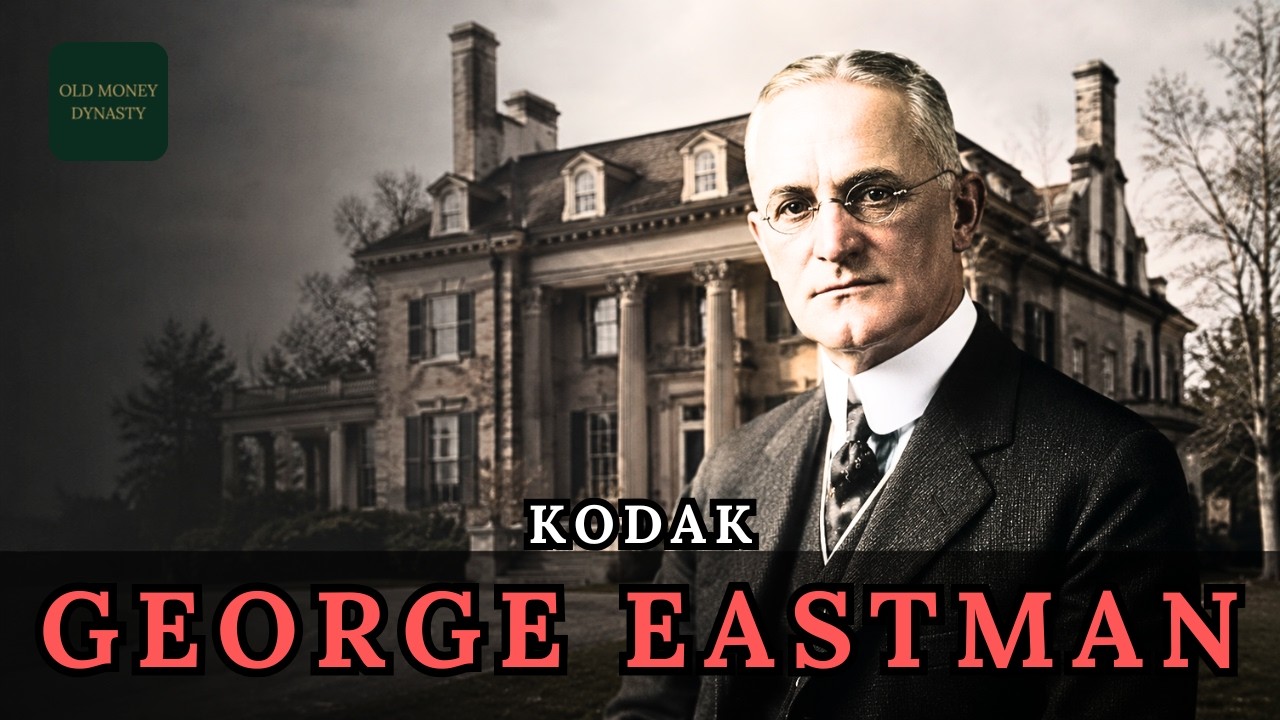
That account is tidy, which is why it has lasted. It is also incomplete. The company that made photography a part of ordinary life was also the company that kept its own calendar, knew where the first atomic bomb test’s fallout had traveled before the public did, and processed the film brought back from spy planes over the Soviet Union. The larger history is tied to its founder, George Eastman, a man who left school before he was 15, never married, gave away most of a very large fortune while he was alive, and operated on one principle.
Whatever his company was selling, he was already building the thing that would make it worthless. His successors inherited the factories. The habit of mind did not come with them. Sasson joined Kodak in 1973, straight out of graduate school.
He was an electrical engineer at a company that hired chemists and mechanical engineers. In 1974, his supervisor gave him a question rather than a project. A company called Fairchild had produced a new component that turned light into an electrical signal. Could one of those be used to capture a picture?
By December 1975, it worked, after a fashion. On the 12th of that month, he asked a lab technician named Joy Marshall to sit for him. The machine needed about 23 seconds to write the picture onto a cassette tape. The image measured 100 pixels across and 100 down, roughly one hundredth of a megapixel.
It was black and white, barely a face. But no chemistry had gone near it. The image existed as numbers. Over the following month, Sasson demonstrated the machine to groups of Kodak executives.
He later described the reaction as curiosity mixed with unease. The questions he remembered were practical. When would it be ready? Why would anyone want to look at photographs on a television set?
Who exactly was asking for this? In 1975, those were not absurd questions. Kodak did not make its money from cameras. It made its money from what cameras used up.
A camera sold once. Film sold forever. In 1976, the company held around 90% of film sales in the United States and about 85% of camera sales. Sasson had built a camera that used nothing up.
Nobody told him to stop. He was allowed to carry on, and he did carry on for years. What he was asked was smaller and more corrosive than a ban. He was asked not to talk about it outside the company.
The most consequential object Kodak produced in the second half of the century sat inside its own laboratories. The patent came through in 1978. It described a filmless camera in plain language and belonged entirely to Eastman Kodak. It expired in 1995, at almost exactly the moment the rest of the world worked out what it was for.
The company that created this was an industrial giant unlike anything seen before. Kodak Park sat on the northern edge of Rochester, New York, covering well over a thousand acres. More than 150 manufacturing buildings stood on the site, connected by 30 miles of paved road and miles of private track. The company generated its own electricity and steam, handled its own water and sewage, and ran its own fire brigade.
The buildings were not named. They were numbered. At its height, the site employed more than 15,000 people. From 1928, all of it kept time by a calendar that existed nowhere else in the country.
The idea belonged to a British accountant named Moses Cotsworth, who had grown irritated by comparing unequal months. His answer was to make them equal. Thirteen months in the year, 28 days in each, every month beginning on a Sunday and ending on a Saturday. The 13th sat between June and July and was called Sol.
That left the year a day short, so one was added at the end and belonged to no month at all. Eastman adopted it and put the entire company on it. Payroll went onto the new months, and so did the accounts. Every internal report Kodak produced carried a date that meant nothing to anyone outside the gates.
Eastman died in 1932. The calendar outlasted him by 57 years. It was still in use in 1989, by which time Kodak was competing against Japanese manufacturers and losing. The company’s most sensitive knowledge was held close.
In the late summer of 1945, unexposed X-ray film at the Rochester plant was developing patterns when it should have shown nothing. The fault was traced to the cardboard packaging, which had been made from strawboard from a mill in Vincennes, Indiana. The mill drew its water from a river. Something upstream had gone into that water.
A company scientist identified in the board a fission product that does not occur in nature and that no industrial process makes. In 1945, there was exactly one way for it to exist. The contamination had come from the atomic test carried out in New Mexico in July of 1945. Fallout from Trinity had crossed most of a continent and entered the water supply of an Indiana paper mill.
Kodak fitted air samplers to its ventilation intakes and said nothing publicly for four years. When testing moved to Nevada, the company took its findings directly to the Atomic Energy Commission. The commission agreed to help, not by stopping and not by telling the country. What it offered was advanced notice to the photographic industry covering when tests would happen and where the fallout was likely to drift.
Manufacturers could move stock and shield their packaging accordingly. The people living under the drift were told nothing. By then, Kodak was doing work for the government that went considerably further. In the spring of 1956, it set up a covert processing center for film from the U-2 aircraft photographing the Soviet Union from 60,000 feet.
The operation later moved to Kodak’s Hawkeye plant, where it was called Bridge Head inside the intelligence community. Something like 1,400 people worked there at its height. When the satellites came, the film came north, too. Kodak also built the cameras for Gambit, the high-resolution system that photographed Soviet missile sites.
Then in 1974, the company installed something beneath one of its buildings. It was a device no bigger than a refrigerator, producing a beam of neutrons. To multiply those neutrons, it used a lattice of highly enriched uranium, about three and a half pounds of it, the same material in the same form that goes into weapons. It sat under building 82 in a purpose-built labyrinth behind two feet of reinforced concrete.
The device was licensed and it never leaked. The uranium went back to the federal government in 2007. The city found out in 2012 when a former employee mentioned it to the local newspaper. The police had not known.
The fire service had not known. Kodak’s own spokesman said afterwards that he could find no record of the company ever announcing it. Long before any of that, the company had nearly died in its infancy. By the spring of 1882, the money was gone, and George Eastman had spent it undoing his own work.
His company was less than two years old. It made photographic plates, and the plates had stopped working. Instead of arguing that dealers stored them badly, he took every bad plate back and replaced it at his own cost. It emptied the business.
Eastman said afterwards that the replacements had taken the last dollar the company had and that he considered it a fair exchange because what he still owned was a reputation. Through that winter he ran experiment after experiment on the emulsion. The number usually given is 469 failed attempts. In March, he and his partner Henry Strong boarded a steamer for England, where the raw material came from.
They found the supplier had changed where it sourced its gelatin. The behavior of the gelatin depended on what the cattle had been eating. He had nearly lost everything over what some cows in England were fed. Five years earlier, none of it had existed.
In 1877, Eastman was a clerk at the Rochester Savings Bank. That year, he planned a trip to Santo Domingo to look at land, and a colleague suggested he photograph what he found. Photography in 1877 did not fit in a bag. The camera was the size of a small piece of furniture and needed a tripod built to carry it.
A tent came too because the plate had to be coated with chemicals, exposed and developed before it dried. Eastman paid just under $50 for it. He never made the trip. What he did instead was subscribe to a British photographic journal, where he read about a new process.
Plates could be coated in advance with an emulsion set in gelatin and then stored dry. For three years he worked at the bank by day and on emulsions at night in his mother’s kitchen. In 1880, he patented not just a formula, but a machine that coated plates evenly in numbers. He rented a room above a music shop on State Street and began producing.
A local businessman named Henry Strong, who had made his money manufacturing buggy whips, put money into it. They formed a partnership on the 1st of January 1881. Eastman held onto the bank job for most of that year in case. Fourteen months later, the plates failed.
What he built next changed the world. The Kodak camera, introduced in 1888, was a wooden box about the size of a shoebox. There was no viewfinder. You pointed it in approximately the right direction and pressed a button.
Inside sat a roll of film long enough for 100 exposures, already loaded. It cost $25, which was serious money. When the hundred pictures were used up, the owner did not open the camera. What you did instead was wrap up the whole camera and post it away.
Some weeks later, a parcel arrived containing your photographs, your negatives, and your camera loaded and ready to go again. Eastman wrote the advertising himself. The line he built the campaign on told the customer that they pressed the button, and the company handled everything. The word Kodak did not exist before 1888.
Eastman built it from nothing. He liked the letter K and said it struck him as a strong and incisive sort of letter. Working through combinations that began and ended with it, he tested each against four conditions. It had to be short.
Nobody could mispronounce it. It should resemble no other word in use. And it should mean absolutely nothing in any language on earth. He registered it as a trademark that year and chose the yellow to go with it.
In 1892, the business took the name of its own product and became the Eastman Kodak Company. Then came the dollar. The Brownie camera reached shops in 1900 at a price of one dollar. A roll of film cost 15 cents.
Reportedly more than 100,000 went in the first year. At a dollar, it sat inside the reach of a working family. What he had manufactured in 1888 was not a camera. It was a word that meant nothing, and he then spent 12 years filling it.
The patent on the film that made Kodak possible was not issued in Eastman’s name. It went to a chemist called Henry Reichenbach in December of 1889. Reichenbach had found a transparent, flexible, tough base in celluloid. It would turn out to be the material motion pictures were made from for the next hundred years.
Then at the end of 1891, Eastman discovered that Reichenbach and two other employees were preparing to leave and set up in competition. He dismissed all three. The man who had built the film base for the largest photographic company in the world spent the rest of his career in obscurity. Eastman would not tolerate somebody becoming necessary and then becoming independent.
For most of the 20th century, every moving picture the world watched was printed on material made by one company in New York State. In 1891, working for Thomas Edison, a man named William Dickson designed a camera that could take photographs in rapid sequence. By March of 1892, Eastman was supplying Edison directly. The width Dickson settled on was 35 mm, because that was what you got when you took Kodak stock and cut it down the middle.
That measurement became the shape of cinema and it never changed. Digital cameras today still frame their images to match. A manufacturing convenience at one factory decided the physical proportions of an art form. The material had one further problem, and it was lethal.
Nitro cellulose burns ferociously, and it carries its own oxidizer. Projection booths through the nitrate era were built as containment rather than as rooms. Kodak had a safer base almost from the start, but the industry would not take it. It took until 1948 for Kodak to produce a safety base that Hollywood would finally accept.
By the company’s own count, more than 80 films that won the Academy Award for best picture were shot on Kodak stock. Kodak also holds nine Academy Awards of its own, given for scientific and technical work. Eastman’s personal life was as disciplined as his factories. He had his house cut in half in 1919.
The entire rear section was lifted onto jacks and rolled backwards about nine feet. The reason was a room. The conservatory sat at the center of the house, and it was where he took breakfast. Eastman decided a square room was acoustically wrong, that it wanted to be longer than it was wide.
The work took three months and reportedly cost more than twice what the whole estate had cost to build. He moved in with his mother, who lived there until she died in 1907. After that he was alone in the house for 25 years. The place was busy.
He gave dinners constantly and kept a wide circle around him. But there was no heir. Eastman never married and had no children. The house is still standing.
Nobody inherited it. In 1949, it opened to the public as a museum of photography. His generosity was enormous and often secret. In 1912, the Massachusetts Institute of Technology was planning to move across the river from Boston to Cambridge, and it did not have the money to build the new campus.
Then a donation arrived that made the move possible. Two and a half million dollars on one condition. The donor’s name was never to be used. In the records, the money came from a man called Smith.
Not even the members of the governing corporation were told. For years, the only people who knew were the president of MIT, his wife, and his secretary. In 1920, Eastman finally gave permission to say who he was. Over his lifetime, Eastman gave away something in the region of $100 million, which put him among the largest American donors of the era.
The largest single beneficiary was the University of Rochester. A school of music went up there, then a theater, then a medical school and a school of dentistry. He also funded dental clinics for children and gave substantial sums to Tuskegee and to Hampton, two colleges educating Black students in the American South at a time when very few northern industrialists were doing so. In 1919, he released 10,000 shares of his own stock, roughly a third of everything he personally held.
Kodak employees could buy it at about 17% of its market value. By the late 1920s, something was wrong with his spine. The pain was constant and it worsened. A doctor today would probably call it lumbar spinal stenosis.
There was nothing available in 1930 that would have helped. On the 14th of March 1932, Eastman asked a small group of friends to come to the house. He had rewritten his will and needed witnesses. They signed.
There was conversation afterwards, and some of it was cheerful. Then he asked them to leave because he wanted to write a note. George Eastman took his own life that afternoon. He was 77.
His ashes were placed at Kodak Park under a monument on the industrial site he had spent 40 years building. After his death, the company made one last genuinely unreasonable bet. Two men stood in a completely dark room whistling Brahms, timing their work because they could not see a clock. Leopold Mannes was a pianist.
Leopold Godowsky was a violinist. Neither of them was a chemist. They had met at school in New York, and in 1916 they went to a cinema together to see a film advertised as being in color. The tints were approximations, and the two teenagers came out annoyed enough to believe they could do better.
They spent the next 19 years on it. In 1930, the head of Kodak’s research laboratories put them on the payroll. What they built with a team of Kodak chemists around them was one strip of film carrying three layers of emulsion. The color was not in the film at all.
It was created during development chemically, layer by layer. Kodachrome was announced on the 15th of April 1935. Color stopped being a specialist process, and within a few years, ordinary people were photographing their own lives in it. Kodachrome remained in production for 74 years.
Kodak stopped making it in 2009, and the last laboratory still able to process it closed the year after. The decline that followed came in three defeats. In 1954, the Justice Department called Kodak’s practice of selling color film with developing included an illegal tie, and the company signed a consent decree agreeing to stop. It opened a market for independent laboratories.
In 1976, Kodak launched an instant camera of its own, challenging Polaroid. Polaroid sued within weeks. In 1985, the court found seven Polaroid patents infringed, and the following year, Kodak was ordered out of the business. The refunds and exchanges for the 16.
5 million cameras already sold reportedly ran to hundreds of millions of dollars, and the judgment came to close to a billion. The third defeat was the cheapest. In the early 1980s, Peter Ueberroth flew to Rochester to sell Kodak the sponsorship of the Los Angeles Olympics. He had set a floor of $4 million.
Kodak would not go to one. Ueberroth went to Fuji, which agreed immediately. Within 30 months of the campaign starting, Fuji was selling 30% more film to Americans than before. Kodak joined the worldwide Olympic program in 1986 and paid for the privilege every four years until 2008.
The sponsorship it had refused at $4 million was never available at that price again. Kodak had been warned about digital in writing. In 1981, a man named Vince Barabba wrote a report. Barabba was Kodak’s head of market intelligence.
He ran a serious study of digital photography. The report came back with two findings. The first was that digital photography was capable of replacing the film business completely, not supplementing it. The second was that it would take about 10 years.
In 1986, Kodak’s laboratories built the first megapixel sensor. Three years later, two Kodak engineers, Steven Sasson and Robert Hills, built the first self-contained digital single-lens reflex camera. It worked. Kodak declined to sell it because selling it would have damaged film.
In 1996, with the decade gone, Kodak launched a film format called the Advanced Photo System. It was a digital camera engineered to sell film. The stock reached its all-time high in early 1997 at just under $95. Then Kodak did the thing everybody says it failed to do.
It went into digital properly. By 2005, it was the largest seller of digital cameras in America, with digital revenue of $5. 7 billion. That same year, the company lost $1.
3 billion. Digital cameras were a bad business. By 2001, Kodak was losing about $60 on every digital camera it sold. Film had been protected by chemistry, and the margins reflected the difficulty.
A digital camera needed a sensor and a processor and a lens, and all of them could be bought from somebody else. Anybody could assemble one. Dozens of companies did. In 2011, Kodak’s film business made $34 million in operating income.
The digital camera division lost $349 million. Then the company began selling patents. A consortium including Apple, Google, Microsoft, Facebook, and Samsung eventually paid around $525 million for the digital imaging portfolio. On the 19th of January 2012, Eastman Kodak filed for bankruptcy protection.
The film, against all odds, survived. The film coating machines in Rochester run around the clock now. For most of this century, they ran a single shift because a single shift was more than enough. Then demand for film started going up, not slightly.
Kodak executives have said consumer demand roughly doubled across five years, and the company has expanded capacity more than once to keep pace. $60 million went into upgrading the coating operation. Around half the manufacturing workforce was hired within the last few years. Retailers report they cannot keep the stock on the shelves.
The buyers are mostly young. People who have never known a world without a camera in their pocket are paying money for 36 exposures and a week of waiting. They are choosing that on purpose. Hollywood came back, too.
Several of the films that took Academy Awards this year were photographed on Kodak film, and a new motion picture stock went into production in the spring. None of that makes this a comeback story. In 2025, Kodak told regulators it did not have committed financing to cover roughly $500 million of debt falling due. That, the filing said, raised substantial doubt about its ability to continue as a going concern.
What saved it was a pension fund. Kodak terminated its American retirement plan, paid out what it owed to every participant, and took the surplus, which came to something like $767 million. Most of the debt went with it. The balance sheet is healthier than it has been in years, and the largest division, commercial printing, is still shrinking.
Both of those are true at once. The company Eastman built stopped existing in the legal sense. What came out the other side carries his name and not much else of him. The film survived.
The calendar is in a display case now. The monopoly is gone. The masonry and the museum remain, along with the school of music, the medical school, and the dental clinics that treat children who could not otherwise afford it. All of it was paid for by a man who wanted to watch the money being spent while he was alive to see it.
Somebody in Rochester is coating film tonight in the dark. The chemistry goes back to a bank clerk working at his mother’s kitchen table 140-odd years ago.