In spring 1979, Coca-Cola made a quiet announcement that should have reshaped the American soda market. The company had developed a new citrus drink in a yellow can, engineered with one specific objective: kill Mountain Dew. Not compete with it. Not split the category with it.
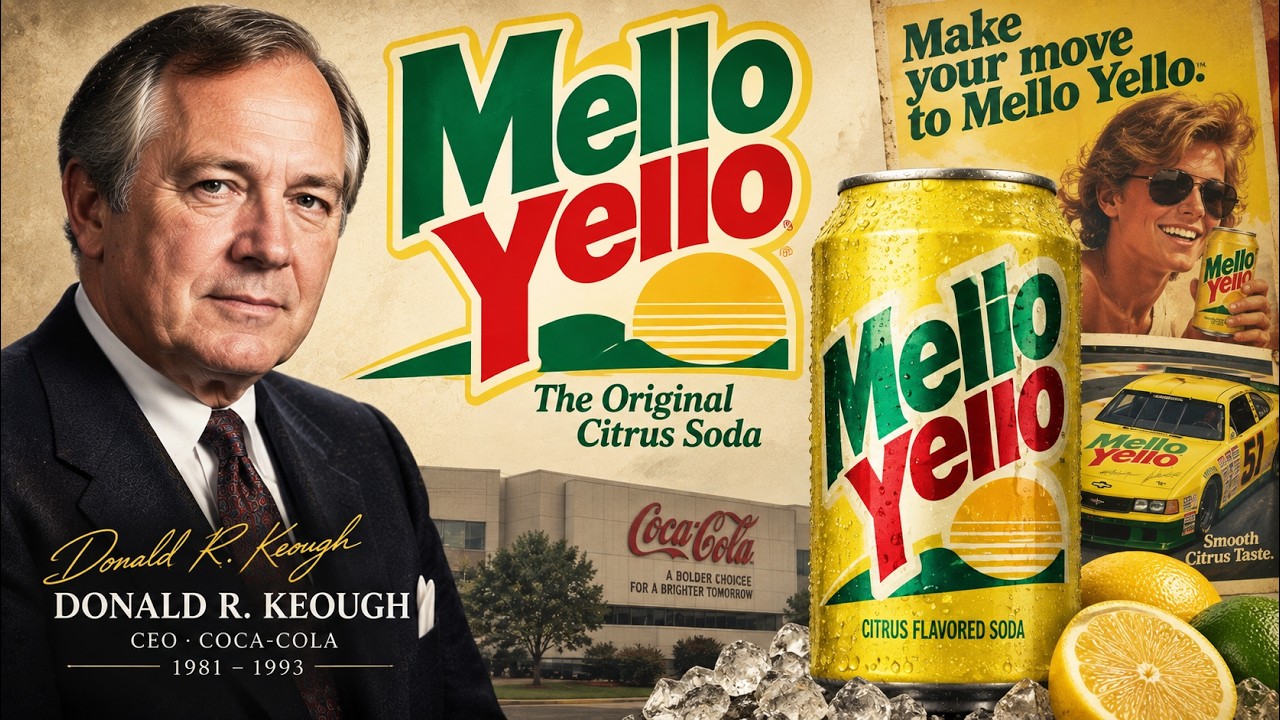
Kill it. The weapon was called Mello Yello, and behind it stood the most powerful distribution network in the history of American consumer goods. Coca-Cola deployed eight decades of bottler relationships, hundreds of thousands of retail accounts, and vending machines in airports, stadiums, and school cafeterias across the country. The company that had supplied American soldiers in World War II and planted its red logo in 140 countries turned that entire apparatus against a single regional soda from the mountains of Tennessee.
Within 18 months of launch, Mello Yello was available in 42 states. No new soda in Coca-Cola’s history had moved that fast. Ten years later, Mountain Dew was still growing, not despite Mello Yello but around it. By 1990, the gap between the two brands had become a canyon.
Coca-Cola responded by launching Surge in 1996, a louder, more aggressive citrus soda aimed at the same target. It failed. The company tried again with Vault in 2005. Vault also failed.
Through it all, Mello Yello quietly disappeared from shelf after shelf, state after state, until it survived mostly as a memory in the back of a gas station cooler in South Carolina. The real story of Mello Yello is not the story of a product that failed. It is the story of what happens when the most powerful company in American beverage history tries to manufacture the one thing that cannot be manufactured: the feeling in a drinker’s hand that a soda belongs to them. The story begins not in Atlanta, where Coca-Cola lived, but in the hills of Tennessee, where the enemy was already winning.
Mountain Dew was not born in a laboratory or conceived in a boardroom. It came from two brothers, Barney and Ally Hartman, working out of Johnson City, Tennessee, in 1940, in a region where the economy ran on tobacco, coal, and whatever a man could make with his hands. The name was not accidental. “Mello Yello” was Appalachian slang for moonshine, the homemade whiskey that moved through those mountains outside the reach of federal tax collectors.
The Hartmans were speaking directly to their neighbors. The original bottle label showed a barefoot hillbilly, a jug of corn liquor, and an outhouse in the background. It was deliberately rough and deliberately local. It did not want to appeal to everyone.
That was the entire point from the beginning. The Hartmans sold the brand to Tip Corporation of Marion, Virginia, in 1964. That same year, PepsiCo acquired it. The new owners cleaned up the label slightly, expanded distribution beyond the Southeast, and began the slow work of turning a regional curiosity into a national product.
Growth came gradually at first, then faster than anyone at PepsiCo’s headquarters had modeled. By the mid-1970s, Mountain Dew had become PepsiCo’s second-best-selling soft drink, behind only Pepsi itself. In a portfolio that included some of the most recognized brands in American food and beverage, a soda that had started as a mixer for bootleg whiskey in Appalachian Tennessee was outselling everything else the company made except its flagship. In Atlanta, someone at Coca-Cola was paying very close attention.
The Coca-Cola Company in 1977 was not an organization built for modesty. It had spent 90 years becoming the most recognized brand on Earth. Its secret formula, locked in a vault at the Trust Company of Georgia, had never been replicated by a competitor. Its distribution network touched more countries than most governments.
It employed tens of thousands of people whose professional lives were organized around a single proposition: Coca-Cola does not lose. Yet in one specific corner of the American soda aisle, Coca-Cola had nothing. Sprite existed, positioned squarely against 7UP, not designed for the drinker Mountain Dew had claimed. Fresca existed, grapefruit-flavored and diet-forward.
Tab existed for diet drinkers. Mr. Pibb existed for Dr. Pepper territory.
But the gap Mountain Dew occupied, caffeinated, aggressively citrus, working-class in its identity, coded for the outdoors and physical labor, was entirely unclaimed in Coca-Cola’s portfolio. A product development team inside Coca-Cola’s Atlanta headquarters began work in 1977. Their offices sat three blocks from the original soda fountain where John Pemberton had first mixed Coca-Cola syrup with carbonated water in 1886. The brief was precise: develop a citrus soft drink caffeinated at a level competitive with Mountain Dew, price it identically at retail, put it in a yellow can, and use Coca-Cola’s existing bottler network for distribution.
By late 1978, the formula was finalized. First production runs were completed at the Atlanta syrup plant in early 1979. The launch price was set at 35 cents for a 12-ounce can, matching Mountain Dew exactly, penny for penny. Initial test markets were selected in the Southeast, the states where Coca-Cola’s bottler relationships were oldest and deepest.
The rollout began in spring 1979. Within six months, Mello Yello was in every Coca-Cola bottler territory across the southeastern United States. Within 18 months, it had reached 42 states. On paper, the war was already over before it started.
Coca-Cola had the formula, the distribution, the shelf space, and the budget. Mountain Dew had a barefoot hillbilly on its old label and a head start that by every rational measure should not have been enough. The yellow can arrived on shelves in spring 1979, and by every measurable standard, it was a serious product. Coca-Cola’s flavor chemists had designed Mello Yello’s profile with a specific objective: take everything Mountain Dew did and do it cleaner.
Where Mountain Dew carried a sweetness that hit immediately and lingered, Mello Yello was calibrated for a faster resolution. The citrus notes arrived sharp, then fell away cleanly on the finish. The carbonation was the centerpiece of the launch. Coca-Cola’s engineers had achieved a finer, tighter, more uniform bubble structure than standard carbonation levels of the era.
The launch materials described Mello Yello as the fastest carbonated soft drink in the world, a technical claim grounded in the physics of dissolved carbon dioxide. Caffeine content was set at 52 milligrams per 12-ounce serving, within two milligrams of Mountain Dew’s 54. In blind taste tests conducted across multiple consumer panels in 1978 and early 1979, Mello Yello consistently scored at or above Mountain Dew. In several demographic panels, particularly among consumers who had not grown up drinking Mountain Dew, it rated higher.
The packaging was the second disruption. In 1979, the American soda aisle was a landscape of blues and reds. Mello Yello arrived in electric yellow, a sharp, high-visibility color that a consumer could identify from 40 feet away inside a convenience store cooler. On a shelf next to every other product in the aisle, it was the only thing that looked like sunlight.
The price point was calibrated with precision. Thirty-five cents per 12-ounce can at launch. A six-pack retailed for $1. 89 in the southeastern test markets.
Mountain Dew was priced identically. Coca-Cola made a deliberate decision not to undercut. The objective was not to win on value but to win on equivalence, then superiority. The go-to-market execution was where Coca-Cola’s structural advantage became overwhelming.
The Coca-Cola bottler network in 1979 was not merely a distribution system. It was infrastructure built, negotiated, and refined over 80 years into something closer to a national utility for soft drinks. Independent bottlers owned the trucks, the cold storage facilities, the vending machine routes, and the fountain equipment in diners and stadiums across the country. In Georgia, Mello Yello reached full retail penetration within 60 days of launch.
By the end of 1980, 42 states had Mello Yello on the shelf. By mid-1981, distribution was effectively national. No new soft drink in Coca-Cola’s history had achieved that reach that quickly. The early 1980s were good years for Mello Yello.
Not transformative years, but solid, measurable years in which a product found an audience and held it. The soda sold well in the South and the Midwest. In Georgia and Alabama, Mello Yello had a natural home. Gas stations stocked it beside the register.
High school cafeterias carried it in vending machines. For a certain kind of American teenager in 1982, Mello Yello was simply what was available. The advertising in those first years was competent by Coca-Cola standards. The 1982 campaign, developed through McCann-Erickson, pushed the speed platform.
One television spot featured a stock car circling a track at full speed, intercut with slow-motion footage of a Mello Yello can being opened and poured. The tagline was four words: “The one that moves. ”
In 1983, Mello Yello became the presenting sponsor of a racing event at Charlotte Motor Speedway in North Carolina. The deal placed the yellow can in front of exactly the audience that drank it: Southern, predominantly male, working-class, and loyal to brands.
The NASCAR presence expanded through the mid-1980s. Kyle Petty, son of Richard Petty, drove a car carrying the Mello Yello livery. The car was yellow. The can was yellow.
For a viewer in rural Georgia, the connection required no explanation. For Mello Yello through the first half of the 1980s, it was working. But 1985 changed everything, and not because of Mountain Dew. On April 23, 1985, Coca-Cola announced that it was changing its formula.
The original Coca-Cola, the drink that had been mixed the same way since 1886, was being replaced with a sweeter version that had tested better in blind panels. The public reaction was unlike anything the American consumer industry had seen since Prohibition. Letters arrived by the tens of thousands. Consumers in Seattle paid $25 for cases of original Coca-Cola.
A retired real estate developer in Los Angeles founded the Society for the Preservation of the Real Thing. Within 79 days, Coca-Cola reversed the decision and brought back the original formula under the name Coca-Cola Classic. What is less remembered is what the crisis cost every other product in Coca-Cola’s portfolio during those 79 days. Every senior executive was consumed by the reversal.
Every marketing dollar and public relations resource was subordinated to one objective: fix Coke. The rest of the portfolio, including Mello Yello, was left to run on momentum alone. And 1985 was the precise year that PepsiCo chose to accelerate Mountain Dew. It was not a coincidence.
PepsiCo’s strategists watched the New Coke implosion in real time and understood what it meant. Coca-Cola’s attention was elsewhere. Mountain Dew’s advertising budget increased. Its distribution push intensified.
The groundwork was being laid for a campaign that would within a decade redefine what a citrus soda could mean to an entire generation of consumers. Mello Yello in 1985 had no one minding it. In the working-class gas stations and county fairgrounds of the Southeast, it remained a genuine presence through the second half of the 1980s. In Georgia, Alabama, Tennessee, and the Carolinas, ordering a Mello Yello at a truck stop was not a considered brand decision.
It was a reflex. That kind of habitual loyalty is real. It is also, as Mello Yello would eventually discover, the most fragile kind. It does not survive distribution gaps.
It does not transfer to a new generation of consumers on its own. And it offers no defense against a competitor who has decided to replace your drinkers with their own. By the late 1980s, Mello Yello’s peak metrics told a story the brand could not afford to examine too closely. At its highest point, roughly 1985 to 1987, Mello Yello held an estimated 2 to 3 percent of the American soft drink market.
Mountain Dew, in the same period, held 6 percent and was climbing. Coca-Cola had deployed the full weight of the most powerful beverage company on Earth against a soda invented as a whiskey mixer in Appalachian Tennessee. The gap between them had widened every single year. The decline of Mello Yello did not begin with a single decision.
It began with a question that Coca-Cola asked too late and answered too slowly: What exactly was Mountain Dew selling? The answer was not citrus flavor, not caffeine content, not price or packaging or distribution reach, all areas where Mello Yello was competitive and in some cases superior. Mountain Dew was selling identity. To drink Mountain Dew in 1979 was to signal something about who you were, where you were from, and what you valued.
That signal had been present since the Hartman brothers put a barefoot hillbilly on the label in 1940. PepsiCo had not created it. They had recognized it, preserved it, and when the moment was right, amplified it. Mello Yello had no equivalent signal.
It had been engineered in an Atlanta office building by a team working from a competitive brief. It was, at its core, a corporate response to a cultural phenomenon. American consumers, without being able to articulate it, could feel the difference. Through the late 1980s, the warning signs accumulated quietly.
In markets north of the Mason-Dixon line, Mello Yello had never fully established itself. Even in the Southeast, shelf presence began to erode in larger grocery chains as category managers prioritized brands with the highest velocity. Coca-Cola’s response was measured and, in retrospect, insufficient. Packaging was refreshed.
Minor formula adjustments were made. None of it was accompanied by a national advertising campaign of the scale that had launched the brand in 1979. Then, in 1992, PepsiCo made the move that would define the next 20 years of the citrus soda category. The campaign was called “Do the Dew.
” It featured skateboarders launching off half-pipes into the Utah desert, mountain bikers descending unnamed trails, young men doing things that had no established market category. Mountain Dew did not follow that culture. It helped build it. Mello Yello was not in that conversation.
It had no skateboarding, no cultural ambassador who could speak to a 19-year-old in 1992 the way Kyle Petty had spoken to a 35-year-old in 1985. The NASCAR drinker was aging. His children were watching “Do the Dew” and reaching for the green can. In 1996, Coca-Cola made a decision that said more than any press release could.
They launched Surge. The can was green, not yellow. Green, because green was Mountain Dew’s color and Coca-Cola was no longer pretending otherwise. The tagline was “Feed the Rush.
” Surge was not a complement to Mello Yello. It was a replacement for it. Mello Yello’s national advertising budget, already diminished through the early 1990s, effectively ceased with Surge’s arrival. The yellow can remained in production, particularly in the Southeast, but it received no support, no campaign, no shelf negotiation priority, no executive champion inside Atlanta willing to argue for its future.
It was present. It was simply no longer seen. Surge lasted six years in national distribution before Coca-Cola quietly discontinued it in 2002. It had acquired a devoted cult following, but it had not moved Mountain Dew’s market share in any measurable direction.
In 2005, Coca-Cola tried one final time with Vault, a citrus soda positioned as a hybrid between a soft drink and an energy drink. Vault was discontinued in 2011. Through it all, Mello Yello continued its quiet diminishment. Bottlers in the Northeast stopped prioritizing it in the mid-1990s.
Bottlers in the Pacific Northwest followed. Major grocery chains outside the Southeast reduced shelf allocation. Vending machine contracts expired and were not renewed. One machine at a time, one account at a time.
By the early 2000s, Mello Yello existed in meaningful distribution in fewer than 20 states. No announcement was made. No discontinuation date was set. It simply became harder to find, then harder still, then in most of the country, impossible.
In 2012, Coca-Cola quietly reintroduced it. Not with a national campaign, not with a press conference or a celebrity endorsement. It came back the way it had always operated best, through the bottler network, market by market, starting in the Southeast where the brand’s oldest consumers still remembered it. The formula remained close to the original.
The yellow can returned largely unchanged. It simply reappeared on the shelf. Today, Mello Yello is available in approximately 30 states. It is not growing.
It is not declining dramatically. It occupies a specific narrow place in the American soda market, the place reserved for brands that have outlasted their cultural moment but retained enough consumer loyalty to justify continued production. In the unsentimental language of beverage industry analysts, it is a maintenance brand. But in the secondary market, Mello Yello tells a different story.
Original pull-tab cans from the 1979 and 1980 launch years sell for $15 to $40 each on eBay. Mello Yello neon bar signs from the mid-1980s, the kind that hung in gas stations and rural southern taverns, sell for $200 to $500 in working condition. They move within days of listing. The buyers are not investors.
They are men in their 60s who know exactly where they first saw one of those signs and what they were drinking when they saw it. Facebook communities dedicated to Mello Yello memorabilia number in the thousands of members. The posts are specific. A man in Georgia posts a photograph of a Mello Yello can he found in his father’s garage, still sealed from 1983.
The comments fill with people who remember that exact can, the weight of it, the specific resistance of the pull tab, the sound it made when the carbonation released. There is one final detail that reframes the entire story. The name Mello Yello was not invented by Coca-Cola’s marketing team. It was borrowed from a song: “Mellow Yellow,” recorded by Scottish folk singer Donovan Leech and released in October 1966.
The song reached number two on the American Billboard chart and became one of the most recognizable singles of the psychedelic era. It was famously rumored to be about smoking dried banana peels to achieve a hallucinogenic effect, a rumor that Donovan neither confirmed nor effectively denied for years. A psychedelic folk song from London, built on a drug rumor that was never true, gave its name to a corporate weapon built in Atlanta to fight a moonshine mixer from Tennessee. What Mello Yello ultimately represents is not a failure of product development, distribution strategy, or advertising execution.
On all three of those dimensions, Coca-Cola performed at the highest level the industry could offer. What it represents is the limit of what corporate power can accomplish when it is deployed against something that was never fully corporate to begin with. Mountain Dew had an origin that Coca-Cola could not purchase, could not replicate, and could not make irrelevant. It came from a specific place, spoken in a specific accent, and handed down to drinkers who recognized it as their own before PepsiCo ever put it in a national distribution truck.
Mello Yello was built to win a war. It was a better engineered product, a more precisely priced product, a more efficiently distributed product. It simply could not answer the one question that Mountain Dew’s drinkers never needed to ask: Whose side is this on?
In the American market in the long run, that question is the only one that matters.