The animosity between Diana, Princess of Wales, and her stepmother, Raine Spencer, was one of the most bitter family feuds in modern British aristocratic history. It was a conflict defined by a dramatic expulsion, a physical assault on a staircase, and a final, unexpected reconciliation.
The story reached its brutal climax on March 31, 1992, just two days after the death of the 8th Earl Spencer from a heart attack. The Earl’s will had requested that his children allow his widow six months to arrange her affairs and leave the family estate at Althorp. Instead, she was given 48 hours.
A maid named Pauline Shaw was tasked with packing the Countess’s belongings into four open Louis Vuitton cases. Diana stood guard at the door. When Diana noticed the prominent “S” on the locks, she decided the luggage itself belonged to the Spencer family and could not leave the house.
The clothes were removed and replaced with black plastic garbage bags. The new 9th Earl, Diana’s younger brother Charles, then gathered the bags and kicked them down the grand staircase. It was the same staircase where Diana had pushed the same woman three years earlier, watching her fall.
The woman at the bottom of the stairs was not destitute. She had a home in Mayfair and a legacy of roughly £4 million from her late husband. She would later marry a French count and serve on the board of Harrods. She would outlive her stepdaughter by 19 years.
By most accounts, Raine was the person who had saved the very house she was being expelled from. She had nursed the Earl through a coma that doctors did not expect him to survive. She had opened the palace to the public, managed the accounts, and funded roof repairs. She bore the blame for every painting removed from the walls to pay the bills. Her reward was the garbage bags.
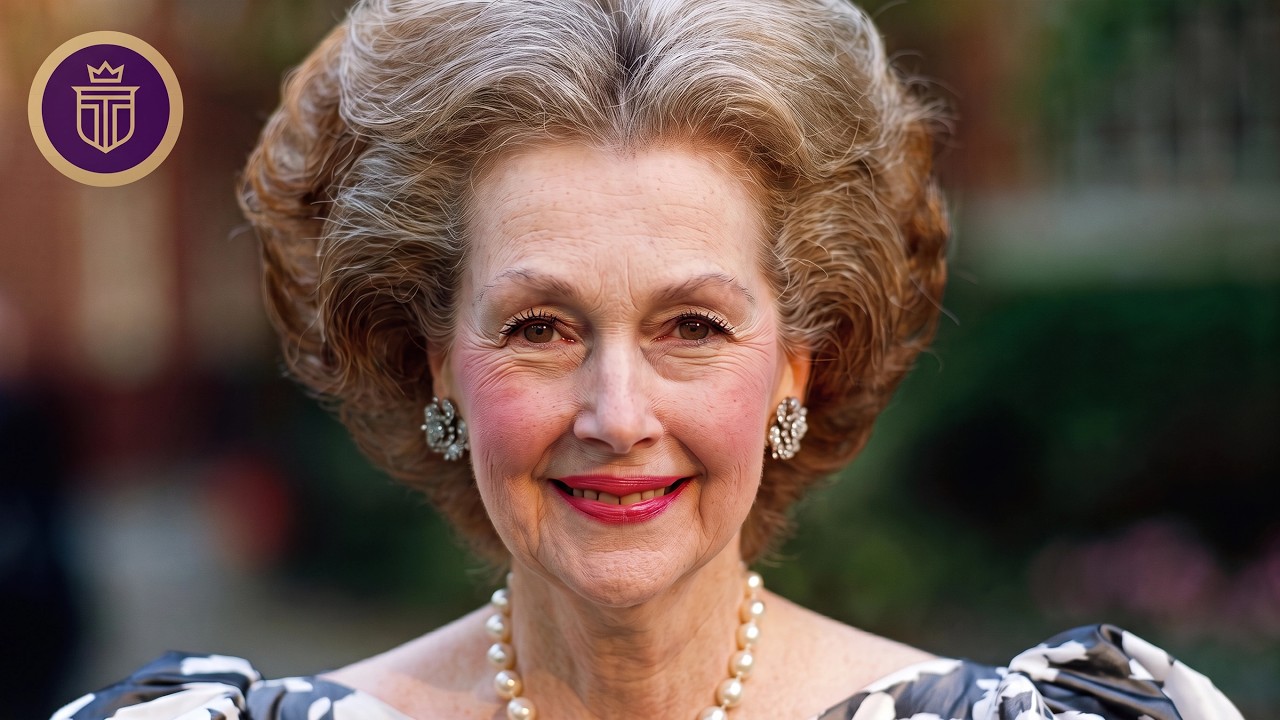
Raine Spencer was born Raine McCorquodale in 1929, the only daughter of romance novelist Barbara Cartland. For nearly 17 years, she was the most hated stepmother in England. The children nicknamed her “Acid Rain.” They sang a children’s song to her but never finished it.
In one of the strangest reversals in the Spencer family story, the daughter who hated her most would eventually describe her as the mother she never had.
Raine was born into privilege in Mayfair. Her parents divorced when she was a small child amidst mutual accusations of infidelity that spread through the newspapers. By age seven, she was already a victim of a scandal she did not cause.
Her mother, Barbara Cartland, had wanted a son. She admitted as much to the BBC in 1991, saying she was disappointed to have a daughter and would have preferred twelve boys. Cartland decided to shape her daughter into what she wanted. She published 723 novels, dictating them to secretaries at a furious pace. She treated Raine’s upbringing as another manuscript to be revised into perfection.
Cartland admitted to a biographer that she decided her daughter had perfect features and a beautiful figure, so she set out to make her a beauty. She used bullying as a tool, saying it worked. When young Raine came home at the top of her class, her mother’s response was not congratulations but a comment about a gravy stain on her shirt.
In 1947, at age 18, Raine was presented at court and named “Debutante of the Year.” It was the ultimate public confirmation of her mother’s project. The following year, she married Gerald Legge, an accountant and heir to the Earldom of Dartmouth. The marriage produced four children over 20 years.
Raine was not just a decorative socialite. In 1954, at age 23, she became the youngest woman elected to the Westminster City Council. She ran as a Conservative, refusing to pretend to be anything she was not. She campaigned wearing her furs and jewels, saying everyone knew she owned them anyway.
She spent nearly 17 years in local government. Her greatest enduring achievement was chairing the Covent Garden development committee in the early 1970s. London was in the grip of a demolition wave, with serious plans to flatten Covent Garden for modern offices and roads. Raine resisted, playing a significant role in preventing the destructive redevelopment of one of the city’s oldest neighborhoods.
Prince Philip reportedly summarized her character by saying that if you wanted something done, you got Raine. She was described as a woman who did not know how to compromise and did not accept “no” for an answer.
In 1973, she met John Spencer, the Earl of Althorp, described at the time as the unhappiest man in London. His first marriage to Frances Roche had ended in one of the ugliest aristocratic divorces of the era. Frances had fallen in love with Peter Shand Kydd in 1966. The ensuing custody battle was devastating for the children, including young Diana and Charles.
The children were not welcoming to a glamorous replacement. Diana later told Andrew Morton that her mother’s departure was the biggest shock of her childhood. The children compared Raine not to a real rival but to a perfect absence, the mother who had been driven from the home.
Raine married John Spencer in a quiet civil ceremony in July 1976. The wedding was so secretive it was an act of war against the family she was joining. John’s children were not informed and were excluded from the guest list. They learned of their father’s remarriage by reading the newspapers the next day.
Diana was 15. She later said she slapped her father across the face, telling him that was for all of them because he had hurt them. The four children all shared the same immediate judgment, and the position never softened.
Raine arrived at Althorp, the Spencer family seat since 1508, and reportedly took one look at its quiet gloom and called it “the city of melancholy.” She set about a dramatic transformation. She covered worn furniture with bright new fabric, replaced old Victorian lampshades with pink ones, and spent an estimated £2 million over the following years redesigning the interiors.

The family saw vandalism. Sarah, Diana’s older sister, said she would rather embrace Lenin’s corpse in his mausoleum for warmth than accept Raine as a stepmother. Charles Spencer later wrote that the south drawing room had become a riot of clashing pinks, comparing his stepmother’s taste to a wedding cake in a five-star Monaco hotel.
There was another reading of the renovation. The house required nearly half a million pounds a year to maintain. Raine cut the staff, opened the stately home to visitors, and filled the annual calendar with car launches, open days, dinners, and concerts to make the estate self-financing. John supported it all fully.
Between 1976 and 1992, artworks and heirlooms quietly left Althorp through a network of Bond Street dealers. According to Charles Spencer’s later estimate, nearly a fifth of the house’s contents were sold in those years, more than 200 pieces valued at over £15 million. The list included 11 Van Dycks, four portraits of the apostles, and works by Reynolds and others.
Charles’s real complaint was not just that the sales happened but how they happened. He claimed items were sent to London dealers in laundry baskets through the back door to ensure secrecy, meaning the family did not get full market value. A Salvatore Rosa painting sold for $87,500 in 1982 and was resold two years later for $612,500.
There is a complication the family rarely acknowledged. The desire to sell may have been John’s as much as Raine’s. Charles himself hinted that his father sold the collection partly as a form of revenge against his own inheritance. If so, Raine was the executor of a grievance that predated her arrival.
In 1978, just two years into the marriage, John Spencer collapsed at Althorp from a severe brain hemorrhage. He fell into a coma, with doctors giving him a 10% chance of survival. Raine mounted a vigil by his bedside. She was fiercely protective of his care, reportedly deciding that the children should not be around, that he needed peace and quiet without disturbance.
That decision became another item on the family’s indictment. The Spencer children were prevented from being at their father’s bedside during the weeks they feared he would die. Raine also obtained an experimental drug from Germany that was not licensed in the UK and pressed the hospital to administer it.
Against expectations, John recovered. He was never the same, with affected speech and limited movement, but he lived for another 14 years. Even his most hostile family members had to admit Raine’s care was the reason. For a brief period, the gratitude was real. It did not last.
At Diana’s wedding to the Prince of Wales in July 1981, the seating arrangements told the family story without a word. Raine attended but did not sit with her husband. While the Earl, Frances Shand Kydd, and the Spencer children sat opposite the royal family, Raine was placed among the general congregation. She did not appear on the Buckingham Palace balcony with the rest of the family.
It was a deliberate insult staged before the world. Raine’s mother, Barbara Cartland, was also given a poor seat behind a pillar. She chose to stay home and watch on television instead.

In September 1989, at the wedding of Diana’s younger brother Charles, the long cold war turned physical. Diana became convinced Raine was not showing enough attention or respect to her mother Frances, who had come from Scotland. Diana pushed Raine, who fell down the stairs.
Raine’s personal assistant described the act as cruel and merciless. Diana never expressed regret. In a recorded conversation with her voice coach in 1992, she said pushing Raine down the stairs gave her an enormous sense of satisfaction. She said she wanted to choke the stepmother who had brought her so much sorrow.
John Spencer died on March 29, 1992, of a heart attack. He had left instructions in his will asking his children to allow Raine six months at Althorp to arrange her affairs. His heirs chose to ignore this wish. Within two days, Charles and Diana had expelled her.
Raine was not allowed to remove anything unless she could prove she owned it personally. Her staff were dismissed without notice. Diana stood watching in the bedroom as the maid packed the Countess’s wardrobe into Louis Vuitton cases. Seeing the “S” on the cases, Diana decided the luggage belonged to the Spencer family. The clothes were repacked into black garbage bags. Charles kicked the bags down the grand staircase.
Diana’s verdict on her stepmother at that moment was final. She said the woman was no longer her stepmother but simply an “ex.” The furs, haute couture, and evening gowns went out the back door in plastic bags.
The reconciliation began around 1993, as Diana’s own marriage was collapsing in public scandal. Diana reached out to Raine, telling her she knew Raine had loved her father deeply and was grateful for the years of happiness she had given him. The two women who had fought over John’s house wept and embraced.
They began meeting regularly for lunch and speaking on the phone almost daily. Diana’s butler, Paul Burrell, summarized the logic simply. Diana was an outcast, and Raine was an outcast. So they became close friends. Diana’s own relationship with her mother Frances had deteriorated, and into that void stepped the woman Diana had once tried to choke.
Diana said she would rather talk to Raine than to her own mother, describing Raine as the mother she never had. It was the most complete reversal imaginable, spoken by the child who had nicknamed her “Acid Rain.”
Diana died in Paris on August 31, 1997. Raine, then close to the Al-Fayed family, was among the first people in the world to be told that her stepdaughter had died. Barbara Cartland died in her sleep in 2000 at age 98.
Raine joined the board of Harrods after Mohamed Al-Fayed followed through on a joke Diana had made about appointing her. She took it as seriously as she took everything. She worked on the shop floor, traveled to 16 countries for the business, and did night shifts at the distribution center wearing a packing apron into her 80s.
Charles Spencer never apologized. In a 2010 Vanity Fair article, he softened his tone, admitting his stepmother was a strong and effective character in her own way, but he did not express regret for the garbage bags or the years of war.
Raine Spencer died on October 21, 2016, at age 87, from cancer she had hidden until the end. She left an estate estimated at £5.88 million. She left nothing to any member of the Spencer family. None of them attended her funeral. The stepdaughter who learned to call her “Mum” was already gone. The rest never learned to do so.