Kathleen “Kick” Kennedy was the favorite sister of John F. Kennedy—vibrant, rebellious, and fiercely independent. But instead of protecting her, her family deliberately erased her from history. She dared to defy her ruthless father and mock her mother’s rigid rules, choosing love over political power.
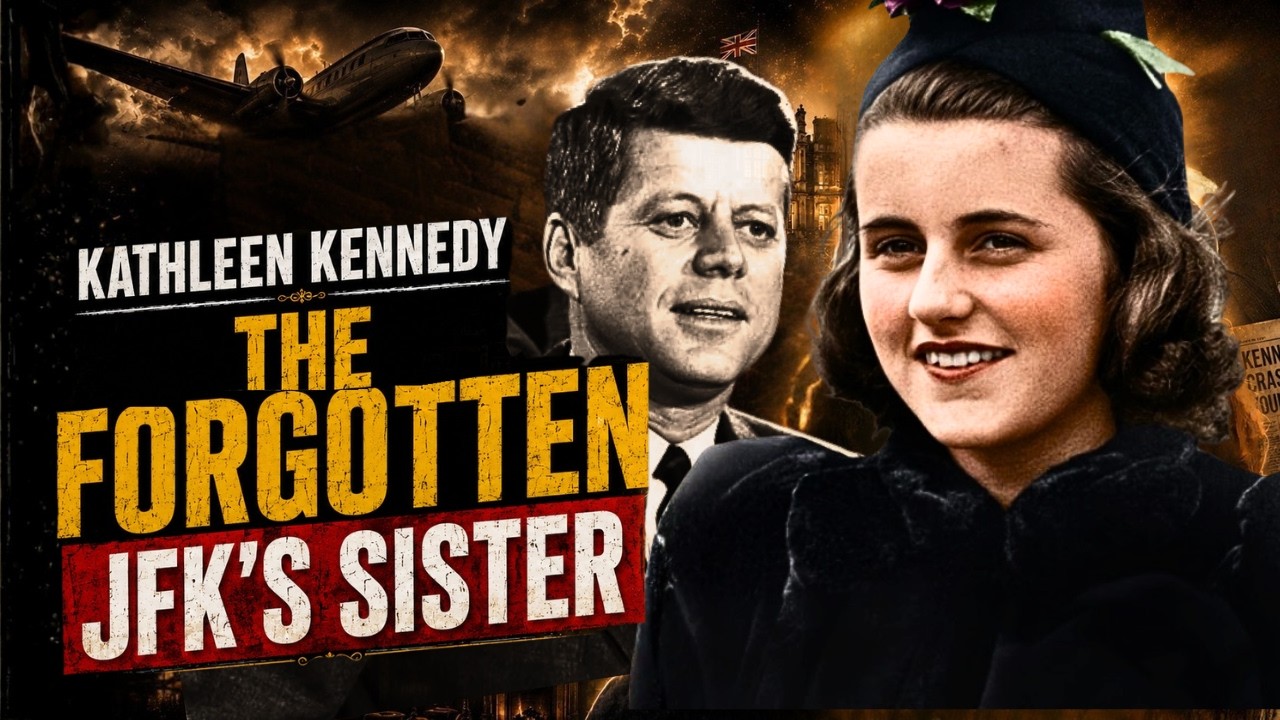
For that, she was brutally exiled. Widowed by war at 24 and killed in a plane crash at 28, she suffered the ultimate injustice. Even as she lay in her coffin, the cruelty continued. Her mother claimed illness to avoid attending the funeral, leaving strangers to bury her in foreign soil.
Born Kathleen Agnes Kennedy on February 20, 1920, in Brookline, Massachusetts, she was the fourth daughter and second child of Joseph P. Kennedy Sr. and Rose Fitzgerald. Her parents did not run an ordinary household.
They operated a political and social training camp. Their goal was to establish a powerful American dynasty, and every child was expected to serve that purpose. Joseph Sr. and Rose demanded strict obedience and high performance.
Rose managed the family with meticulous precision, keeping a card index box on her desk. Each child had a card detailing weight, medical history, dental appointments, and shoe size. Rules were enforced harshly. If a child was late for a meal, they were not allowed to eat with the family.
Dinner conversations were highly structured, with Joseph Sr. quizzing his children on politics, history, and current events. Weak answers drew public criticism. The cardinal rule was that a Kennedy never lost and never showed weakness.
Kathleen did not fit the expected image of a debutante daughter. Her parents wanted girls who were quiet, refined, and ready for advantageous marriages. Kathleen was loud, hyperactive, and impulsive, preferring rough backyard football with her older brothers over indoor activities. Her athletic, physical play style earned her the permanent nickname “Kick.
” Among her siblings, Kick was closest to her older brother Jack, who suffered from chronic health issues that left him bedridden. They shared a skeptical view of their parents’ intense ambitions, using dark humor to secretly mock the rigid expectations placed upon them. The Kennedy household was also unsafe for young women. As a teenager, Kick and her friends learned to avoid certain areas of the house.
The family had a private cinema in the basement, which Joseph Sr. used to lure young women brought home by his daughters for harassment. Kick’s friends explicitly warned each other never to go near the basement or be alone with Joseph Sr. Witnessing her father act as a predator without consequences permanently changed Kick’s worldview, destroying her trust in the religious and moral lectures her parents delivered.
Rose Kennedy’s response to her husband’s behavior was complete detachment from reality. She obsessed over Catholic rituals, attending Mass daily and imposing strict religious study on her children. When the pressure became too much, she would leave the family for weeks to travel to Paris. She provided no emotional support.
Jack Kennedy later remarked that he never heard his mother say “I love you. ”
The cruelest example of the family’s priorities was the treatment of Rosemary, Kick’s older sister. Born in 1918, Rosemary suffered oxygen deprivation during birth due to a nurse forcing Rose to keep her legs closed until the doctor arrived, resulting in permanent intellectual disabilities. In November 1941, when Rosemary was 23, Joseph Sr.
secretly subjected her to experimental lobotomy surgery without informing his wife. The procedure was a catastrophic failure, permanently destroying Rosemary’s cognitive abilities. She lost the ability to walk independently, her speech became unintelligible, and her mental capacities regressed to that of a two-year-old. Joseph Sr.
had her institutionalized at St. Coletta in Wisconsin, where she was hidden from public view for decades. He ordered the rest of the family to stop speaking about her. For Kick, this was the defining moment of her early life—she saw clearly what happened to any Kennedy who became an inconvenience.
In the 1930s, upper-class American society demanded physical beauty and passive compliance from women. The Kennedys amplified these expectations into an institutional standard. Kathleen failed to meet the physical standard entirely. By her teenage years, she was described as plain-looking, standing at 5 feet 3 inches with a sturdy build, thick neck, and round face.
Her naturally curly hair was hard to style, contrasting sharply with her sisters’ perfect hairdos. She had no interest in fashion, often wearing her brother’s oversized jackets, worn-out flat shoes, and rough skirts. Rose Kennedy constantly criticized Kick’s appearance. But Kick developed a sophisticated psychological strategy: instead of retreating, she bypassed the physical competition entirely, using her personality as a weapon.
She possessed exceptional emotional intelligence and razor-sharp humor. In the formal, stuffy gatherings of East Coast elites, Kick was a change-maker. She laughed loudly, spoke her mind directly, and refused to act shy or submissive. This style produced unexpected results—she became immensely popular among young men from prominent families who were used to compliant debutantes.
She treated them as equals, challenging their ideas and playing sports with them. Her lack of vanity was incredibly attractive. This sudden popularity with men triggered an immediate and harsh reaction from Rose. For Rose, an independent daughter attracting male attention represented a threat to family stability.
Her solution was physical isolation. In 1933, when Kick was 13, Rose sent her to the Convent of the Sacred Heart in Noroton, Connecticut—an institution designed to break the will of young women and mold them into obedient Catholics. The environment was harsh: strict silence rules, censored reading material, and all letters monitored. The primary goal was to suppress individuality and enforce absolute submission.
This strategy failed. Kick was not broken by convent discipline. Instead, she adapted, maintaining her humor and quietly challenging the nuns’ expectations without committing expulsion-worthy offenses. She became a beloved central figure among the other girls, building networks of loyal friendships while outwardly obeying the rules without internalizing the demand for subservience.
Recognizing that Noroton had not succeeded, Rose escalated in 1937 by sending Kick abroad entirely to a convent in France. The French convent was even more isolated, separating Kick from her beloved brother Jack, her friends, and familiar American culture. But the European exile sharpened Kick’s intellect and provoked a more direct form of rebellion. She engaged in heated debates with the nuns, demanding logical explanations for church teachings instead of blind acceptance.
The French nuns, accustomed to absolute submission, did not know how to handle her. They officially classified her as a troublemaker, permanently nicknaming her “Mademoiselle Pourquoi” (Miss Why). For Kick, it was a badge of honor proving her mind remained her own. When Kick finally returned to the United States, she tested boundaries immediately.
She began openly dating Peter Grace, heir to a chemical and shipping fortune—a man known for being rough, loud, and entirely lacking the polished political image the Kennedys required for their partners. It was a calculated display of defiance, sending an unmistakable message to Rose that years of isolation and geographic exile had failed. In late 1937, President Franklin Roosevelt appointed Joseph P. Kennedy Sr.
as U. S. Ambassador to the United Kingdom. For Joseph Sr.
, this was the ultimate triumph—the first Irish Catholic to hold the position. In early 1938, the Kennedy family moved to London. For 18-year-old Kick, the move was a massive psychological shift. London’s 1938 social season, designed to present aristocratic daughters to potential husbands, was governed by strict rules.
Girls were expected to be shy, polite, quiet, and completely submissive to the established hierarchy. Kick’s arrival was a shockwave. She ignored the usual rules entirely. She was overly friendly, approaching dukes and earls with firm handshakes and calling them by first names—a violation of British etiquette.
She chewed gum. She removed her heels at formal parties when her feet hurt. She laughed loudly and challenged young British aristocrats in debates. By all traditional measures, she should have been socially ostracized.
Instead, she became the sensation of the season. The British upper class was charmed by her spontaneity and lack of pretense. Her triumph was formally recognized when the British press and aristocratic society named her “Debutante of the Year 1938. ”
London gave Kick the recognition she had desperately lacked in Massachusetts.
During this intense social season, she was introduced to William Cavendish, Marquess of Hartington, known to everyone as Billy. Billy was the heir to the 10th Duke of Devonshire, meaning he would inherit one of the largest fortunes and highest titles in the United Kingdom. Unlike Kick, Billy was deeply rooted in the traditional British mold: quiet, serious, slightly awkward, and heavily burdened by the responsibilities of his future title. Despite their contrasting temperaments, a bond formed.
Billy was drawn to Kick’s booming energy; Kick found in Billy genuine stability and kindness. However, the triumphs of 1938 were occurring against the backdrop of impending global catastrophe. Joseph Kennedy Sr. was an isolationist and strong supporter of appeasement, believing Britain could not win a war against Germany.
The Munich Agreement in September 1938 delayed conflict, but anxiety in London was palpable. On September 1, 1939, Germany invaded Poland. Two days later, Britain and France declared war. Kick found herself trapped in France, finally managing a difficult journey back to a London transformed overnight into a darkened city preparing for aerial bombardment.
Kick wanted to stay. She felt genuine loyalty to the British people who had embraced her and wanted to volunteer for the war effort. Joseph Sr. refused absolutely.
He ordered his wife and children to evacuate immediately. Kick fought, pleaded, and cried, begging to stay. But Joseph Sr. exercised absolute paternal authority.
In late September 1939, Kick was forced onto a passenger ship bound for New York. She was devastated—everything she had built over the past year and a half was being ripped away. After returning to the United States, Kick sank into deep depression. The contrast between her London life and American reality was unbearable.
She briefly attended Finch College in New York, found it trivial, and left. She drifted aimlessly while her brothers’ careers advanced. To combat her despair, she took a job in Washington, D. C.
, in 1941, working at the Washington Times-Herald, eventually writing a column called “Did You Happen to See? ” involving theater reviews and celebrity interviews. But internally, she was miserable, feeling her reporting on Washington cocktail parties was trivial while her friends in London were surviving the Blitz. By summer 1943, Kick had reached her breaking point.
She had spent three years trapped in America while the defining conflict of the century tore Europe apart. She found her escape in the American Red Cross, one of the few socially acceptable ways for a woman of her standing to enter a war zone. Her father could not publicly prevent his daughter from serving the war effort without appearing unpatriotic—a critical concern for a man desperately trying to salvage his political reputation. In summer 1943, she boarded the RMS Queen Mary, converted into a troopship sailing through U-boat-infested waters.
She was trading absolute safety and luxury for a city being bombed by the German Air Force. For Kick, the physical danger of London during the Blitz was preferable to the psychological prison her family imposed. When Kick arrived in London, the city was completely changed. She was assigned to the Hans Crescent Club, a massive Red Cross facility serving thousands of American soldiers.
She was no longer the ambassador’s daughter—she was simply a worker, wearing a uniform, cycling through bombed streets, cleaning tables, organizing dances, and serving coffee. She excelled at the work. In this high-risk environment, she reconnected with Billy Cavendish. Now an officer in the Coldstream Guards, Billy faced imminent deployment to the front lines, where infantry officer survival rates were brutally low.
Their friendship rapidly deepened into a desperate wartime love story. When Billy proposed marriage, they hit an immovable theological wall. The Kennedy family was devoutly Irish Catholic. In the 1940s, the Catholic Church operated under the strict Ne Temere decree: for a Catholic to marry a non-Catholic, the non-Catholic had to agree in writing to raise all children as Catholics.
Billy, an Anglican, could not make that promise. As heir to the Duke of Devonshire, his title, estates, and legacy required an Anglican heir. There was no room for compromise. When Kick informed her parents of her intention to marry Billy, the reaction was explosive.
Rose launched a psychological war campaign. She bombarded Kick with telegrams, letters, and phone calls. She bypassed Kick entirely, contacting the Archbishop of New York and senior Catholic officials, demanding they intervene. She used guilt as a weapon, telling Kick the marriage would destroy the family, ruin her father’s political standing, and disgrace her brothers.
She threatened disinheritance and permanent exile. Joseph Sr. , ever the pragmatist, was torn. He admired Billy and understood the immense social value of an alliance with the Devonshires, but he also knew alienating the Catholic base was political suicide.
He ultimately sided with Rose, explicitly forbidding the marriage. Kick was completely isolated, sitting in a war-torn city, facing the possibility of losing the man she loved to German bullets while simultaneously fighting a vicious battle against her mother. She consulted priests in London, desperately seeking a loophole in canon law. There was none.
She had two choices: return to America, submit to her mother, and accept a life of compliance—or cut ties, marry the man she loved, and accept permanent exile. She chose Billy. She chose herself. On May 6, 1944, Kathleen Kennedy and William Cavendish were married.
Because Kick was marrying outside the Catholic Church, she was denied a religious ceremony. The wedding took place at Caxton Hall, a government registry office in London—a purely civil procedure lasting just 10 minutes. Kick wore a short, simple pink dress with a matching hat; Billy wore his military uniform. The Devonshire family, despite their fundamental differences with Kick’s Catholicism, chose to support their son.
The Kennedy family boycotted the wedding entirely. Joseph Sr. and Rose refused to travel to London, refused to send any representative, and refused to issue any public statement of congratulations. In Massachusetts, Rose checked herself into the hospital for routine examinations on the wedding day—a calculated move to avoid the press and express her disgust.
Only one Kennedy broke the ban: Joe Jr. , Kick’s eldest brother, stationed in England as a Navy pilot. Ignoring his parents’ explicit orders, Joe Jr. arrived at Caxton Hall in full dress uniform, took his sister’s arm, and walked her down the short aisle of the registry office.
When Kick signed the marriage register, she became officially the Marchioness of Hartington. But in doing so, she relinquished her place in the Kennedy family. Kick and Billy were given only five weeks together as husband and wife. Those 35 days were spent under a charged, painful atmosphere in pre-invasion England.
In mid-June 1944, days after the Allies stormed the Normandy beaches, Billy’s battalion received its orders. He packed, kissed his wife goodbye, and departed for France. Kick remained in London, completely cut off from her family in America and now separated from the man who was her anchor in England. London in summer 1944 was terrorized by Hitler’s V1 flying bombs.
Kick lived in a state of hypervigilance, listening for engines to stop, waiting for the inevitable telegram from the War Office regarding Billy’s unit. The first catastrophic blow came not from the trenches of France but from the skies over England. In August 1944, Joe Jr. , driven to desperate recklessness by Jack’s growing hero status, volunteered for Operation Aphrodite—a top-secret, incredibly dangerous mission involving flying a B-24 loaded with explosives as a giant bomb toward German weapon sites in France.
On the evening of August 12, 1944, a massive electrical malfunction caused the explosives to detonate prematurely over the English coast. The explosion was so violent it shattered windows in towns miles away. Joe Jr. simply vanished; no wreckage was ever found.
When news reached Kick in London, it was devastating. Joe Jr. was her protector, the only family member who had defied their parents to attend her wedding, the bridge to reconciliation with her father. With his death, her family safety net collapsed.
On September 9, 1944, less than a month after Joe Jr. vanished, Billy’s unit was ordered to secure the small Belgian town of Heppen. German snipers had been left behind to disrupt Allied advances. Billy was leading his men on foot when a German sniper’s bullet struck him directly in the heart.
He was killed instantly. In London, it took several days for the official notice to arrive. Kick was 24 years old. She had been married for four months and had spent a total of five weeks with her husband.
Because Allied forces were moving so quickly and casualties were so heavy, the British military did not repatriate bodies. Billy was buried in a temporary military cemetery in Belgium under a simple wooden cross. Kick was denied the chance to see her husband’s body and denied traditional aristocratic mourning rites. She was simply a widow in a strange city still under bombardment.
With the fall of 1944, Kick returned to Hyannis Port, hoping to find sanctuary. Instead, she found a family entirely unequipped to deal with grief. Joseph Sr. , the patriarch who designed his family to be invincible, was shattered by the loss of his eldest son.
Rose continued her lifelong pattern of complete emotional suppression, refusing to discuss Joe Jr. ’s death or Kick’s mourning, imposing an atmosphere of forced normalcy. Kick realized she was a stranger in her own home. The family understood only the language of victory and moving forward.
She packed her bags and returned to London. Back in post-war Britain, the Cavendish family embraced her fully, providing her a house in Westminster and maintaining her place within the highest ranks of the aristocracy. But Kick did not use this position to retreat into quiet mourning. Instead, she threw herself into London society with feverish, almost aggressive energy.
She drank heavily, danced until dawn, and surrounded herself with politicians, artists, and aristocrats. Psychologically, she was using overactivity to escape her grief. Furthermore, the double trauma of 1944 had fundamentally altered her moral compass. She abandoned her remaining moral restraints, adopting a reckless, nihilistic approach to her own life.
In 1946, Kick met Peter Wentworth-Fitzwilliam, the 8th Earl Fitzwilliam. If Billy Hartington embodied quiet, responsible British duty, Peter Fitzwilliam was his exact dark opposite. Peter was fabulously wealthy, owning Wentworth Woodhouse, a mansion so vast it was considered the largest private residence in the United Kingdom. But his immense wealth paled against his toxic reputation.
He was a notorious womanizer, heavy drinker, and compulsive gambler. He was also a married man. By all objective measures, Peter was a disaster—precisely the type of man a grieving, fragile widow should avoid. Kick herself nicknamed him “Rhett Butler,” acknowledging his cynical, selfish character.
But Peter’s chaotic energy matched her internal chaos. With Peter, there were no expectations of Catholic purity or political perfection—just adrenaline, money, and scandal. The toxic relationship provided the perfect high-impact distraction. Their affair escalated rapidly and publicly.
The British aristocracy began closing doors on Kick, as the affair with a married man was considered a crass American violation of protocol. The rumors eventually crossed the ocean to Rose Kennedy’s desk. Rose sent ultimatums, not maternal concerns. She threatened to cut off Kick’s trust fund, ban her from all family properties, erase her from public history, and treat her as dead.
Kick read the ultimatums without flinching. After burying her favorite brother and her husband, the threat of estrangement from a mother who had never shown genuine affection was not a deterrent—it was almost a relief. Instead of retreating, Kick accelerated her timeline. In early 1948, Peter’s wife finally agreed to a divorce settlement.
Kick and Peter decided to marry as soon as the legal paperwork was complete. Kick devised a strategic plan: intercept her father, Joseph Sr. , during his business trip in Europe, and force him to accept the marriage face-to-face. In May 1948, Kick learned her father was staying at the Hotel George V in Paris.
She and Peter planned to fly to Paris, intercept him, and extract his blessing. On May 13, 1948, Kick and Peter arrived at an airfield in southern London. Peter had chartered a De Havilland Dove, a small twin-engine airplane. The pilot was Peter Townsend, a highly experienced RAF pilot, with navigator Arthur Freeman.
The flight plan was straightforward: a short refueling stop in Paris, then a direct flight to the French Riviera where they intended to meet Joseph Sr. in Cannes. The first leg to Paris was uneventful. But while the plane was refueling at Le Bourget airport, weather reports indicated a violent storm brewing over the Rhône Valley, directly between Paris and the Riviera.
Pilot Townsend advised strongly against taking off, recommending they wait in Paris until the weather system cleared. Six other passengers who had accompanied them from London heeded the advice, collected their luggage, and left the plane. Peter Fitzwilliam refused. It was a fatal embodiment of aristocratic arrogance—a man entirely unaccustomed to being told “no,” who believed rules and even natural laws could be circumvented with enough money and power.
He ignored the pilot’s warnings, impatient to reach the Riviera, and ordered Townsend to take off. Kick, who had survived the Blitz and lost her husband by adopting a reckless, fatalistic outlook on life, did not stop him. She boarded the plane. The aircraft departed Paris and headed south.
Within an hour, they flew directly into the heart of the storm. The sky turned black, torrential rain engulfed the Dove, visibility vanished completely, and severe pressure fluctuations wreaked havoc. The radio system failed entirely, cutting them off from ground support. For 20 agonizing minutes, the small plane was battered by extreme turbulence—violent updrafts and downdrafts causing it to yaw, spin, and drop thousands of feet in seconds.
As the aircraft broke through the lower layer of storm clouds near the town of Saint-Bauzile, the pilot found himself in a deadly situation: the plane was in an uncontrollable steep descent, heading directly toward a rocky mountain range. In a final desperate attempt to save the aircraft, Townsend pulled hard on the controls, trying to raise the nose and pull away from the terrain. The maneuver exceeded the structural limits of the light aircraft. The combination of severe wind shear, high descent speed, and the sudden sharp change of direction created aerodynamic stress the Dove could not withstand.
The plane literally tore apart mid-air. The right wing was ripped from the fuselage. Both engines separated from their mounts. The tail section broke off.
The main fuselage, essentially a metal tube filled with aviation fuel, fell to the ground, crashing against the side of a plateau near Saint-Bauzile in the Ardèche region of France. Kathleen “Kick” Kennedy, Peter Fitzwilliam, pilot Peter Townsend, and navigator Arthur Freeman were all killed instantly. Kick was 28 years old. Local French farmers discovered the wreckage hours later.
Joseph Sr. , already in France, traveled to the crash site. The father who had planned his family to conquer the world was forced to enter a small French country morgue and visually identify the shattered remains of his most vibrant daughter. Across the Atlantic, Rose Kennedy’s reaction exceeded all normal human expectations.
When she received news of her daughter’s death in a plane crash in the company of a married Protestant man, she did not grieve. She began calculating. Rose viewed Kick’s death not as a family tragedy but as a final betrayal of her Catholic faith and a massive political liability. Jack Kennedy was in the middle of a critical congressional campaign; if the press focused on the scandalous nature of Kick’s death, it could severely damage his standing among conservative Catholic voters.
Rose executed a ruthless, cold public relations maneuver. She refused to travel to England for the funeral. She refused to allow Kick’s body to be returned to the United States. To ensure she did not have to answer press questions or face the public, she fabricated a medical emergency.
On the day of Kick’s funeral, Rose Kennedy checked herself into New England Baptist Hospital in Boston for routine medical examinations—hiding in a hospital bed, safely isolated from reporters. Rose’s frostiness dictated the behavior of the rest of the family. Because the mother refused to attend, and because political considerations were deemed too severe, none of Kick’s siblings—not Eunice, not Pat, not Jean, not even Jack—traveled to England for the burial. The only Kennedy who attended was Joseph Sr.
, standing entirely alone in England, surrounded by the British aristocracy instead of his own family. Because the Kennedy family had disowned her, the Cavendish family stepped in to claim her. Although Billy had died four years earlier and Kick had been in a controversial relationship with another man when she died, the Devonshires recognized her deep loyalty to Billy during the war. They treated her with the kindness and dignity her own mother had denied her.
Kathleen Kennedy was not buried in the Kennedy family plot in Brookline. She was buried in the traditional resting place of the Dukes of Devonshire, in the churchyard of St. Peter’s Church in the small village of Edensor, within the grounds of the vast Chatsworth estate. On the day of the burial, Joseph Sr.
stood beside the Duke of Devonshire and watched his daughter’s coffin lowered into English soil. The family into which she was born had disowned her. The family she joined by marriage gave her a permanent home. The Cavendish family ordered a simple, elegant headstone.
The inscription they chose made no mention of the Kennedy family, the scandals, or the tragedy of her early death. It captured the essence of the woman who had conquered London and fought fiercely against the darkness of her upbringing. The inscription reads: “Joyous, she gave joy and found it. ”
After her death, the Kennedy family executed a systematic erasure of Kathleen’s legacy.
In the decades that followed, as the Kennedy name became synonymous with American royalty, Kick was marginalized to a mere footnote. When the family published authorized biographies or produced documentaries, her name was barely mentioned. Rose rarely spoke of her. It was as if the wild, rebellious daughter had never existed.
The family attained the pinnacle of American political power—Jack became president, Bobby became attorney general, Ted became one of the most powerful senators in history. But the machine that made them was a meat grinder, leaving behind sisters subjected to lobotomies, assassinated brothers, and broken wives. Kathleen “Kick” Kennedy remains the most vibrant and remarkable exception in the family’s history. She was the only one who saw the machine for what it was, recognizing early on that the wealth, power, and polished Catholic image were built on a foundation of emotional abuse, hypocrisy, and controlling cruelty.
While her siblings surrendered their independence to serve their father’s grand plan, Kick demanded the right to own her life. She used her humor as a weapon, her charm as a shield, and her fierce stubbornness to escape her gilded cage. She forced the British elite to accept her on her own terms, defied the constraints of her religion to marry the man she loved, and when war tore that love apart, she refused to crawl back to the safety of a family that valued her only as a political tool. Her life was short and terrifying, but it was entirely her own.
She was not a victim of the Kennedy curse. She was a casualty of her fierce, uncompromising demand for freedom. In refusing to be an obedient cog in the Kennedy machine, she guaranteed her exile.
But in that exile, far across the ocean from the family that erased her, she achieved the one thing no other member of her generation in the Kennedy family truly possessed: complete independence.