In 1960, only two breweries in America sold more beer than Falstaff. Not Miller, not Coors. It was a name most Americans today have never heard of, borrowed from a Shakespeare character and brewed in St. Louis, Missouri.
For years, it outsold Budweiser in Budweiser’s own hometown, and its beer reached kitchens across a stretch of the American South where no major league baseball team existed. It traveled there not by trucks, but by a voice on the radio. The name had already changed hands once by then, and it would change hands three more times before the century was out. The beer survived Prohibition.
The man who gave it its name did not. But the real story of Falstaff is not the story of Prohibition or a bad batch or a market that stopped caring. It is the story of who owned the name, and how one buyout artist turned a hundred years of brewing into a line on a spreadsheet, one plant closure at a time. The story begins in St.
Louis, Missouri, in 1840. A 19-year-old immigrant named Adam Lemp stood on a dock looking at a city he could not yet pronounce. He had come from Germany with a trade—brewing—and a recipe that worked back home, with no guarantee it would work here. St.
Louis in the 1830s was a river town growing fast, filling with German and Irish immigrants who wanted something the local water could not give them: a cold, clean beer. Lemp had an answer: lager. It was a colder, slower-fermented style that needed something St. Louis happened to have in abundance and almost nobody else was using yet—natural limestone caves cut into the bluffs along the river, holding a steady, cool temperature year round.
In 1840, Lemp opened the Western Brewery in St. Louis. It was small, one man, a handful of barrels, and a gamble that St. Louis wanted lager more than the thinner ales already on the market.
It did. What Adam Lemp could not have known was that his small brewery would grow into one of the largest brewing empires in the American Midwest—and that the name it would one day be remembered for was not even a name the Lemp family invented. That name came later, and it came from his grandson. By the early 1900s, the Lemp family had turned the Western Brewery into a genuine empire, with plants, warehouses, a private rail spur, and its own ice house.
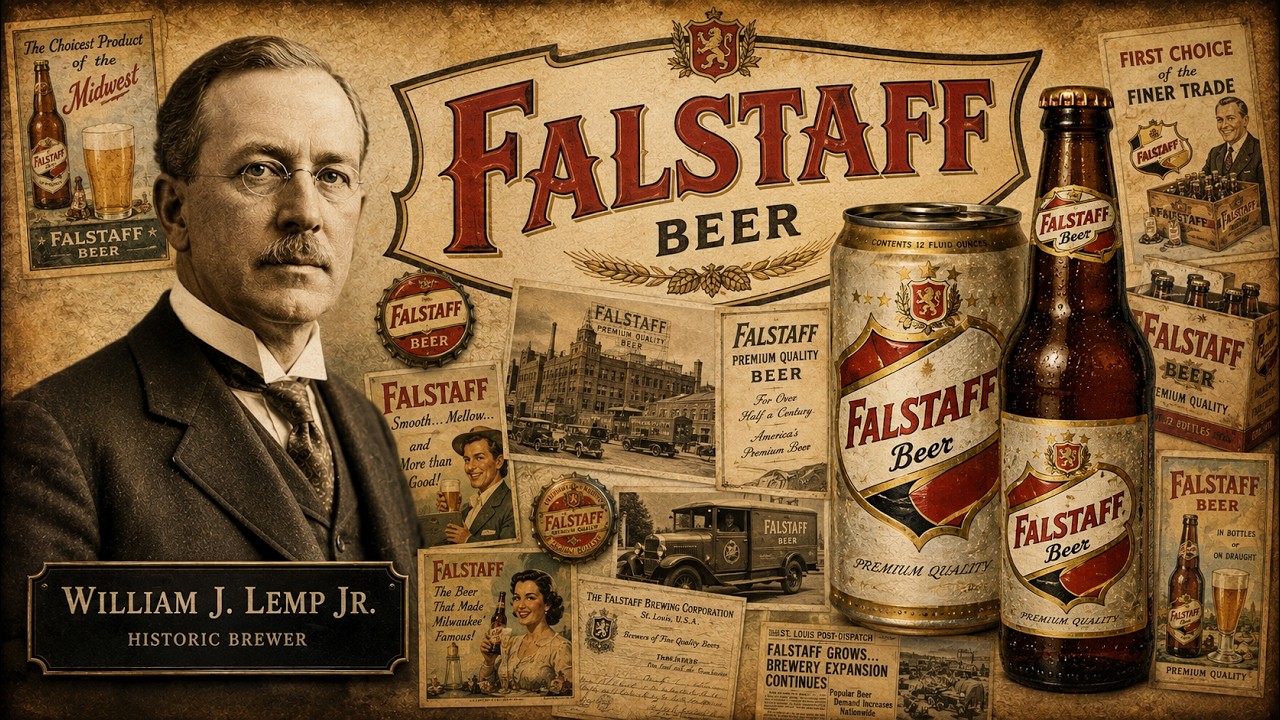
William J. Lemp Jr. ran it, grooming his own son, Frederick, to take the reins. In 1903, looking for a flagship name, the Lemps landed on something unusual for a beer label: a Shakespearean character.
Sir John Falstaff, the loud, unrepentant knight from Shakespeare’s history plays, was a symbol of drinking as pleasure, wit, and good company. William Lemp named his best beer after him. Then, within a single year, the foundation cracked. Frederick Lemp, the son being groomed to inherit everything, died of heart failure.
He was 33 years old. William Lemp Jr. never fully recovered, and the empire he was still trying to hold together was about to face something far bigger than one family’s grief. In 1920, the United States shut down the entire legal beer industry overnight.
Prohibition did not ease breweries out of business; it switched off the tap nationwide and left them to survive on nothing. The Lemp family’s Western Brewery closed that year. Two years later, the physical brewery complex was sold off at public auction to the International Shoe Company. William Lemp Jr.
was by every account a broken man. His son was gone, his brewery was gone, and the one asset that still carried real value—the Falstaff name itself—was the only thing left worth selling. That is when Joseph Griesedieck came to see him. Griesedieck, known to nearly everyone as Papa Joe, was no stranger to St.
Louis brewing. In 1917, he had bought a smaller operation and renamed it the Griesedieck Beverage Company. When Prohibition hit, he had been forced, like every brewer in the country, to find a way to survive on legal ground. Now he sat across from William Lemp Jr.
and made an offer for the rights to the Falstaff name: $25,000. Even by 1920 standards, it was a bargain price for a family with no leverage left to negotiate. Lemp, by his son’s later account, was furious before he calmed down and finally agreed. Later that same year, in that same office where the deal had been signed, William J.
Lemp Jr. took his own life. A century-long brewing dynasty was brought down not by bad beer, but by a national law and a family that ran out of time. What Papa Joe Griesedieck did not know sitting in that room was that he had just bought the name of what would one day become the third largest brewery in the United States.
He just had to figure out how to survive Prohibition long enough to use it. Prohibition forced men who knew nothing but brewing to become salesmen of something else entirely. Griesedieck’s first attempt was a non-alcoholic drink marketed as an ancient Egyptian beer recipe. It was not a good name, not a good product, and it did not sell.
The money ran out fast. So Griesedieck turned to the one asset that still had a story behind it: the name he had just bought from a dying dynasty. He raised capital, paid off what he owed the Lemps, and renamed his company the Falstaff Brewing Corporation. There was a technical problem to solve first.
Most breweries making legal near beer during Prohibition used a shortcut called check fermentation, stopping the brewing process early before the alcohol content rose too high. It was fast, cheap, and made mediocre beer. Griesedieck refused to cut that corner. Falstaff would brew the beer all the way through the same way it always had, then strip the alcohol out afterward with a specialized dealcoholizer.
It cost more and took longer. But it meant that when Prohibition ended, Falstaff would not need to relearn how to make good beer. It had never stopped. When repeal finally came in 1933, Falstaff did not rebuild from nothing.
It had spent 13 years quietly perfecting the exact skill it would need the moment beer became legal again, and it had a federal brewing permit, one of the first issued, ready to go when the law changed. What followed was expansion by acquisition, plant by plant, city by city. Falstaff was buying the wreckage other companies had left behind and putting its name on the door. In 1936, Falstaff bought the Fred Krug Brewing Company in Omaha, Nebraska, and made it plant number three.
That same year, the company bought the National Brewing Company in New Orleans and made it plant number four. Half of America’s regional breweries had gone under during Prohibition and never come back, which meant the buildings, equipment, and local distribution routes were available and cheap for whoever moved first. Falstaff moved first, again and again. By the 1950s, the strategy had compounded into something enormous.
Falstaff was not fighting Anheuser-Busch and Schlitz for shelf space city by city; it was assembling a genuinely national footprint, with plants stretching from St. Louis to Omaha to New Orleans to San Francisco. By 1957, that strategy put Falstaff in third place nationally, behind only Anheuser-Busch and Schlitz, a position it would hold for several years. Behind names people still remember today sat a company from St.
Louis that most Americans under 50 have never heard of, quietly outproducing nearly all of them. The growth kept climbing until Falstaff reached a number that would turn out to be the high water mark of the entire company’s history: over 7 million barrels brewed in a single year. It was three decades of buying distressed breweries other companies had walked away from, running them harder than anyone thought possible, and putting one name—a name that had not even belonged to the man who built the company—on every bottle that came off the line. Falstaff did not just build breweries; it built an audience through a radio signal that traveled farther than any truck route ever could.
In the middle of the 20th century, KMOX out of St. Louis carried broadcasts of the St. Louis Cardinals across an enormous stretch of the American South and lower Midwest, territory that had no major league baseball team of its own. For millions of listeners in those states, the Cardinals were the only major league team many of them had ever really had.
And for years, the voice calling those games belonged to broadcaster Harry Caray, who also happened to be Falstaff’s pitchman. Caray did not just read a scripted ad between innings. He drank the beer on air, glass in hand, mid-broadcast, presenting Falstaff as something he was actually enjoying while calling the game. It was the kind of endorsement modern advertising spends millions trying to fake, and Falstaff had it night after night for an entire baseball season, year after year.
That is how Falstaff became, in a very real sense, a southern beer—not because it was brewed in the South, but because its name traveled into southern homes on the same signal that carried baseball itself. Falstaff also wove itself into the unremarkable rituals of working people: a cold bottle at the end of a shift, a case picked up on a Friday at a price a factory wage could cover. The brand turned up decades later in song lyrics from artists with no connection to St. Louis at all.
And on New Year’s Day 1953, Falstaff became attached to one of American music’s most somber footnotes: country singer Hank Williams was found dead in the back of his car that morning, and among the details historians have long noted from that night was a Falstaff can in the car with him. By the time the 1960s were in full swing, Falstaff was the third largest brewer in the country by volume and, for a huge stretch of the American South, the beer carried there by a broadcaster’s voice. That kind of cultural embedding is exactly what makes a brand feel permanent. It is also exactly the kind of loyalty a company can spend recklessly without noticing the account is running low.
Every brewery that survived into the second half of the 20th century had already survived something that killed almost everyone else in its industry. Before Prohibition began in 1920, St. Louis alone was home to roughly 20 breweries. When Prohibition finally ended in 1933, only a fraction of them reopened.
Falstaff was one of the survivors, and it survived because Papa Joe Griesedieck made a decision that looked expensive and pointless at the time: brewing real beer all the way through, then stripping the alcohol out afterward, instead of taking the cheap shortcut nearly everyone else was using. The Second World War brought another kind of test. Grain rationing, manpower shortages, and wartime supply priorities squeezed every brewer in the country. Falstaff adapted, supplying beer under wartime allocation rules and keeping production running at reduced capacity rather than shutting down.
By the time peacetime returned in the second half of the 1940s, Falstaff was positioned with plants already running in St. Louis, Omaha, and New Orleans to expand harder and faster than brewers who had spent the war years standing still. Two national crises cut the American brewing industry down to a fraction of its former size, and in both of them, Falstaff came out stronger relative to its competitors. That kind of resilience builds a company’s confidence.
It also eventually builds a company’s blind spot. Falstaff had proven it could survive anything the country threw at it from the outside. It had not yet been tested by a threat from the inside. In 1965, Falstaff reached its absolute high point: over 7 million barrels brewed in a single year.
At that exact moment, the company made a decision that looked on paper like more of the same successful playbook. That year, Falstaff acquired the Narragansett Brewing Company of Rhode Island. It was not the first distressed brewery Falstaff had swallowed; it was the 14th or 15th. The formula had worked every single time before.
This time, it did not move on cleanly. The state of Rhode Island’s government took notice of the deal and did not like what it saw. A national brewer buying up one of the last remaining independent regional brands in New England looked to state regulators less like ordinary business and more like the kind of market consolidation antitrust law existed to stop. The case climbed all the way to the United States Supreme Court.
In 1973, the Supreme Court finally ruled Falstaff won. It should have been a moment of vindication. Instead, it landed almost too late to matter. While Falstaff’s leadership had spent the better part of a decade defending an acquisition in federal court, the rest of the American beer industry had not stood still.
Anheuser-Busch and Miller were pouring money into advertising and modernized brewing capacity at a scale Falstaff, distracted and cash-strained by years of legal costs, simply could not match. The court victory confirmed Falstaff had done nothing illegal. It did nothing to fix the fact that Falstaff had spent nearly a decade looking backward at a lawsuit instead of forward at a beer market consolidating faster than ever. The acquisition that was supposed to be just one more brick in a 30-year winning formula had become the moment the formula stopped working.
By the early 1970s, Falstaff was still one of the biggest names in American beer. It was also quietly running out of money. In 1972, it made a bold move: it bought the Ballantine beer brands. Ballantine had once been a major name in the Northeast, and on paper, folding it into the Falstaff portfolio looked like the kind of acquisition that had built the company for 30 years.
This time, the math did not work. Ballantine’s own business was already declining, and integrating a struggling brand costs money whether or not it is bringing in revenue. The purchase stretched Falstaff’s finances at the exact moment it could least afford to be stretched. By 1974, the company needed cash so badly it did something it had never done before: it sold one of its own plants, in San Francisco, to raise money and keep the rest of the company running.
By early 1975, Falstaff was losing an estimated $3. 5 million a year, and its national ranking had slipped from third place down to somewhere between sixth and eleventh. That is when Paul Kalmanovitz came calling. Kalmanovitz was not a brewer; he was a corporate raider who had built a fortune buying distressed companies, stripping their costs, and running them for cash flow rather than growth.
He already controlled General Brewing Company, whose portfolio included names like Lucky Lager. Falstaff, desperate for capital, offered him $20 million in exchange for preferred stock and, crucially, voting control of the company. On April 28, 1975, Kalmanovitz took it. What happened next followed a pattern Kalmanovitz had used before and would use again on nearly every brewery he acquired.
Within months, he dismissed dozens of Falstaff’s corporate managers. He moved company headquarters out of St. Louis entirely to San Francisco. He halted plant maintenance.
He cut quality control. He was not interested in brewing a better beer or building a stronger brand; he was interested in extracting value from a company that already had decades of built-up loyalty and infrastructure, at the lowest possible ongoing cost. The original St. Louis operations stopped active production not long after Kalmanovitz took over, with the historic Gravois Avenue site fully shuttered by 1977.
New Orleans closed in 1979. Cranston, Rhode Island—the very plant Falstaff had fought the Supreme Court over less than a decade earlier—and Galveston, Texas, both closed in 1981. Omaha, one of Falstaff’s original post-Prohibition acquisitions from 1936, closed in 1987. Each closure followed the same quiet pattern: no press conference, no farewell campaign, just fewer trucks on the road in one more city where Falstaff quietly stopped being made.
Then in 1983, Kalmanovitz acquired Pabst Brewing Company outright, and Falstaff, once the third largest independent brewer in America, became just one more name inside the same portfolio as Pabst, Stroh’s, Pearl, and Olympia. It was no longer competing as itself. It was a brand among brands, owned by a man whose business model had never been about beer at all. By the time the 1980s were closing out, only one Falstaff plant in the entire country was still running.
It was in Fort Wayne, Indiana, a plant Falstaff had bought in 1954 from the old Berghoff Brewing Corporation. For 36 years, it had kept running, long after the original St. Louis operation went quiet, long after New Orleans, Galveston, and Omaha had all shut their gates. There was no ceremony when it finally closed in 1990, no press conference, no farewell run of commemorative cans.
The workforce told its own story: in the 1960s, Falstaff employed thousands across a dozen plants; by the late 1980s, that number had fallen to under 500. When the Fort Wayne plant closed, Falstaff stopped being a company that brewed beer. It became a license—a name Pabst owned the rights to, printed on cans that were brewed somewhere else by someone else for a shrinking handful of customers who still remembered what the name used to mean. For 15 years after Fort Wayne closed, Falstaff did not disappear; it just stopped being anything more than a name on a license.
Pabst kept the brand alive through contract brewing arrangements, producing small, shrinking runs for the handful of loyal customers who still asked for it by name. The numbers made the ending obvious before anyone announced it. In 2004, Falstaff sold only 1,468 barrels nationwide, a fraction of what a single midsize plant used to produce in a single week during the brand’s peak. In May of 2005, Pabst shipped the last cases of Falstaff beer to wholesalers and quietly discontinued the label.
For the first time since 1920, there was no Falstaff beer being brewed anywhere in the United States. Falstaff did not cease to exist. The trademark did not vanish. Pabst Brewing Company still owns the rights to the Falstaff name today, filed and protected, sitting dormant in a corporate portfolio.
Nobody has revived it. But a corporation can only buy the parts of a brand that live on paper. It cannot buy the parts that live in people. The Beer Can Collectors of America, founded in St.
Louis in 1970, grew into the Brewery Collectibles Club of America and still maintains its headquarters in Fenton, Missouri, not far from where Falstaff was born. Falstaff’s old plant number 10 in St. Louis’s Benton Park neighborhood is still standing, a massive brick monument to a business that stopped running inside it decades ago. Descendants of the Griesedieck family have even gone back into brewing in St.
Louis in recent years, producing beer under the old GB shield the family used before Falstaff ever existed. So what actually killed Falstaff? It was not the beer. Nobody who worked the line or drank it on a summer porch listening to Harry Caray call a Cardinals game ever claimed Falstaff tasted worse than Budweiser or Schlitz.
For a stretch of years in its own hometown, it outsold both of them. It was not a single bad year, a single scandal, or a single failed ad campaign. This was a company that survived Prohibition with its integrity intact, survived a world war, and won at the United States Supreme Court. What Falstaff was never built to survive was a man who had no interest in beer at all, only in what a company with decades of loyalty and undervalued assets could be worth stripped down piece by piece.
Paul Kalmanovitz did not buy Falstaff to make it better. He bought voting control because a company in crisis was cheap, and a company with Falstaff’s history still had value left to extract. That is the real story of the Falstaff Brewing Corporation—not a story of a southern favorite that lost its way, but a story of who owned the capital and what that owner decided the name was for. It is the same story that played out across dozens of regional American breweries in the second half of the 20th century: small, proud companies built by men who knew how to brew, sold to men who only knew how to buy.
The beer never lost the argument. The balance sheet did.