The fog that swallowed Captain William Dwight’s jeep on the morning of September 19, 1944, did not simply obscure the road ahead—it concealed the full fury of Adolf Hitler’s personal vendetta against George S. Patton. As Dwight rolled to a halt directly into the rear of a 42-tank column of German Panthers, the Third Army’s spearhead was already deep inside enemy territory, racing for the Rhine.
What followed over the next ten days would become the largest tank-versus-tank engagement the United States Army fought in Western Europe before the Battle of the Bulge, a brutal slugging match in the mud and mist of Lorraine that tested Patton’s nerve, his judgment, and his defiance in ways no speech ever could.
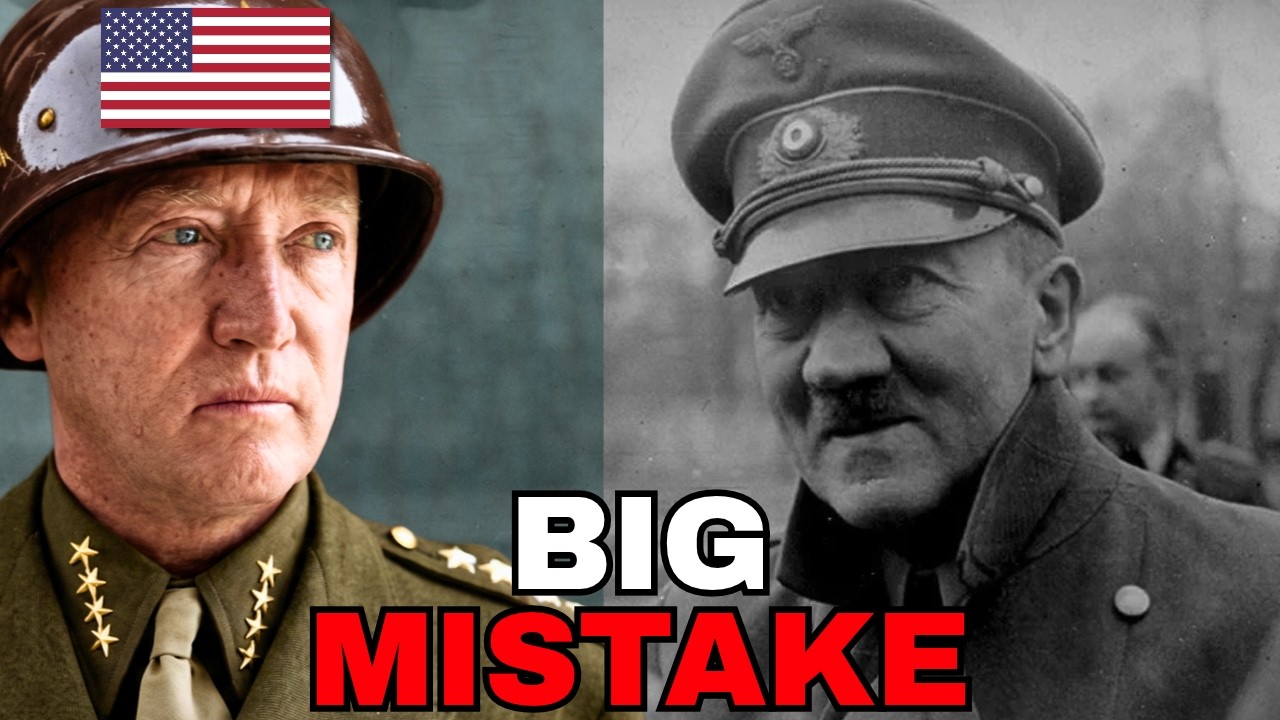 Dwight, a liaison officer, did not panic. He slipped away unseen, the fog swallowing his vehicle as completely as it had hidden the German armor, and he radioed his battalion commander, Lieutenant Colonel Creighton Abrams. The message was stark: Panthers were moving in force, and behind them stood an entire Panzer army assembled for one purpose—to stop Patton dead in his tracks.
The clanking of tracks had been heard just before midnight near the village of Laisy, where American outposts had called for artillery fire. The Germans had gone quiet, waiting. Now, at dawn, they were rolling.
Patton had planned for speed, not for this. On September 12, his superior, Omar Bradley, had imposed a hard deadline: if the Third Army could not cross the Moselle River in strength by the evening of the 14th, it would be forced onto the defensive. Patton had crossed, and by the 16th he was handing out objectives that assumed the Germans in front of him were broken, their reserves exhausted, their defenses hollow.
He ordered his 12th Corps to drive rapidly toward Darmstadt and seize a bridgehead over the Rhine, with the Fourth Armored Division as the spearhead, already deep in German territory around Arracourt. The target date for the full armored punch was September 18.
But Hitler was not finished. The Fifth Panzer Army, assembled under the personal command of General Hasso von Manteuffel, a veteran of the Russian front, was ordered to attack on the exact same day. Manteuffel had protested that his force was too weak, that his Panzer brigades had been savaged by Allied air attacks before they even reached the front, that he had no artillery and no air support.
Hitler’s response was fixed: attack on the 18th, retake Lunéville, and smash the American bridgehead. Two plans, both set for the same morning, were about to collide on the same patch of French countryside.
The opening blows came early on the 18th, when German Panthers hit American cavalry south of Lunéville. The American assault guns fired, but their shells bounced harmlessly off the sloped German armor, and three of the six were destroyed in minutes. The squadron commander, Major J.
H. Pittman, was killed. Colonel Reed, the cavalry commander, was severely wounded.
The tanks that had been reported unloading near Saint-Dié, which Patton’s intelligence had assumed were heading for the Seventh Army further south, were here, in his face. Yet the official history records that Patton and his corps commander were not greatly concerned. The attack toward the Rhine stayed on the books for the next morning.
That night, Combat Command A of the Fourth Armored Division, under Colonel Bruce Clark, was spread thin around Arracourt. At Lezey, a single tank company under Captain Richard Lamason held the forward outpost. At midnight, Manteuffel phoned his corps commander with orders to attack at dawn, threatening severe punishment for any deviation.
 The column Dwight had stumbled into was the 113th Panzer Brigade, 42 Panthers moving through thick fog after a night march. The fog was a double-edged sword: it hid the Germans from American aircraft, but it also forced them to fight at close quarters, where the Panther’s legendary long-range gun was useless.
The first contact was brutal and brief. South of Lezey, two Sherman tanks sat in an outpost position. A Panther emerged from the mist barely 75 yards away.
In seconds, that Panther and two others were burning wrecks. Dwight was sent back out with four tank destroyers, which spotted German tanks in the fog, dropped into a shallow dip, and opened fire at 150 yards. Three of the four American vehicles were knocked out, but they destroyed seven German tanks before they died.
Lamason, meanwhile, took four Shermans and raced 3,000 yards to a ridge, arriving just three minutes before eight Panthers appeared below. His gunners knocked out four before the Germans could even traverse their turrets, then backed over the crest, moved south, and finished the remaining four from a new position.
The second German brigade never arrived that morning. A patriotic French farmer had deliberately sent it down the wrong road, buying the Americans precious hours. In the afternoon, two companies of the 37th Tank Battalion swung through Rechicourt, hit the Germans in the flank, and destroyed nine Panthers for the loss of three Shermans.
By nightfall, the Americans counted 43 German tanks destroyed in a single day, against six men killed. The village of Laisy was lit by the glow of burning German armor.
That evening, Patton drove down from his headquarters at Étain and sat down with Major General John Wood, commander of the Fourth Armored. Any other commander might have ordered a defensive posture, dug in, and waited for reinforcements. Patton did the opposite.
He and Wood agreed that Combat Command A would resume its push east toward Sarreguemines the next morning. Patton’s logic was simple: the German attack had failed to break his line, and he still believed the road to the Rhine was open. He was not going to let a single Panzer army, even one personally assembled by Hitler, dictate his timetable.
The next morning, his columns were already driving northeast when the Germans hit Arracourt again. Colonel Clark had to turn his entire command around to clear the area once and for all. On the German side, Manteuffel begged to call off the attack, citing his losses and the impossibility of fighting in the fog.
 He was reprimanded for lacking offensive spirit. On September 21, Hitler used the failure as an excuse to fire the army group commander, General Johannes Blaskowitz. The pressure to produce a victory was mounting, and the Germans were running out of options.
On September 22, the fog returned, and the Germans tried a new tactic. Patrols had laid white tape right up to the American cavalry lines, and their tanks followed it in, some getting within 75 yards before being spotted. But then the sun came out.
American P-47 Thunderbolts flew in, and Abrams counterattacked from a hill overlooking the valley, his tanks and artillery destroying 14 German tanks. The German brigade commander, Colonel Heinrich Bronsart von Schellendorf, was mortally wounded. Manteuffel begged the Luftwaffe for air support, but nobody answered.
By nightfall, the 111th Panzer Brigade, the unit that had opened the battle at Lunéville, had just seven tanks and 80 men left.
The battle was effectively over, but the orders were still coming. On September 23, the defensive order Patton had been sure he would never need arrived. Bradley told him the Third Army was going on the defensive because supplies were being diverted north to support the Allied push into Holland.
Patton called it one of the bad days of his military career. He obeyed, pulling his forward units back to a line they could hold. But the Germans kept coming for another week because Hitler refused to cancel the attack, even as his army was being bled white.
On September 26, when the Fourth Armored pulled its line back slightly under the defensive order, Manteuffel reported his troops’ uncontested entry into two empty villages as victories. The last significant fight came on Hill 318, where German infantry crept up through old trenches from the First World War. By September 29, they pulled back for good.
The Fifth Panzer Army was finished as an attacking force.
The question of German tank losses at Arracourt remains contested. Online sources cite figures ranging from 285 to approximately 200, with some timelines claiming 86 destroyed and 114 damaged. The official US Army history is more careful, stating that German losses cannot be accurately determined.
 What it can say is that two Panzer brigades were wrecked as fighting units, and the Fifth Panzer Army never got any closer to the Moselle. Sometimes the most honest number is the one nobody can give you.
So what did George Patton do when Hitler sent a Panzer Army after him? On the first day, he barely noticed. After the fog battle, he ordered his spearhead to keep going east.
When his own side ordered him to stop, he called it a bad day and pulled back. He had believed on September 12 that there were no German reserves. He was wrong.
Hitler had found a whole Panzer army. But in open country against the Fourth Armored Division, that army broke. And John Wood’s two words—no blitz—proved prophetic.
Arracourt was a slugging match in fog and rain, one hill at a time.
The last word belongs to the other side. The ground Patton gave up was not taken by German tanks. He gave it up because his own side sent the supplies north.
And the German general who lost the battle called it a victory. Three months later, Manteuffel and the Fourth Armored Division would meet again in the Ardennes, in different fog, with the same two opponents. That battle would become famous.
Arracourt, the fight that broke Hitler’s personal Panzer army, would be forgotten by most—but not by the men who were there, and not by the documents that record what they did.