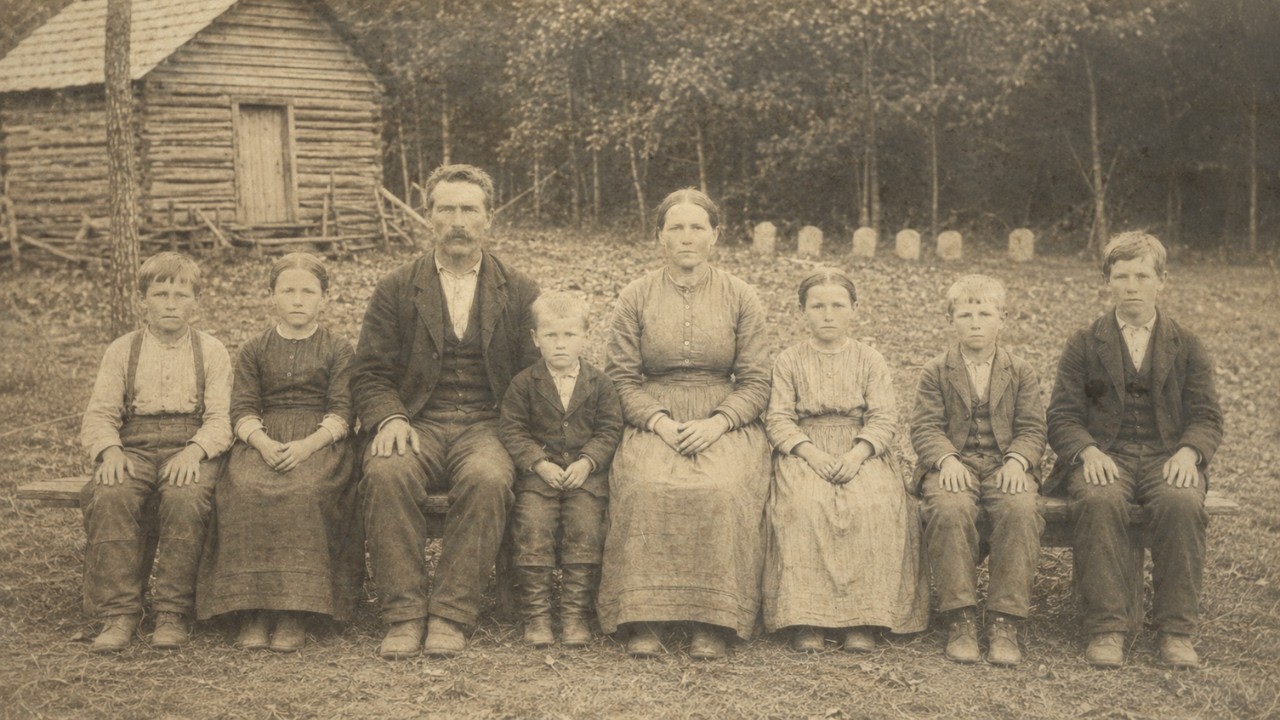
The Halstead family arrived at a 160-acre parcel of bottomland in the hill country of Independence County, Arkansas, in October of 1867. Elias Halstead was a 39-year-old Civil War veteran with a limp from a ball that never fully worked its way out of his leg. His wife, Sarah, was a 28-year-old widow who had lost her first husband to typhoid fever and brought an infant daughter, Ruth, into the marriage.
The land was cheap because it was poor. The bottomland flooded most springs, and the soil ran thin over limestone. It had belonged to Sarah’s late father, and a widow with a child needed somewhere to stand that nobody could take from her. The property sat in a bend along a creek locals called Sinking Fork, named for the way it vanished into the limestone in dry months and reappeared a half mile downstream.
For nine years, nothing especially unusual was recorded about the Halsteads. They were an ordinary subsistence farm family in the hard years after the war. Elias and Sarah had five more children together: Amos, born in 1868, Naomi in 1870, twin boys Caleb and Micah in 1872, and a youngest daughter, Eliza, in the spring of 1875.
The nearest neighbor, a farmer and part-time circuit preacher named Obadiah Karns, described them as a family that kept to themselves. They had already buried enough for one lifetime and did not wish to invite the world in close. They had come to the bend not because it was good farmland, but because it was cheap and because it was Sarah’s father’s land.
Then, in the summer of 1877, something in that hollow changed. Or, as an old woman who eventually explained the local folklore to investigators insisted, something in that hollow had always been the way it was, and it was the Halsteads who changed by staying in one place on one particular parcel of ground for nine consecutive years.
There was a rule in the folklore of that stretch of the Ozark foothills, one that predated the Halsteads by at least two generations. Some ground is thick, the saying went, and most ground is thick enough that whatever’s underneath stays underneath the way it should. But there are places where the thick ground goes thin. If a family sits still on thin ground too many years running, the thin place starts to notice the family, the way a family might notice a stray dog that slept on the porch too many nights to still call itself a stray.
The first piece of the story was a coffin found empty in a family plot behind the house, a full six weeks before anyone in that family had actually died. The second piece was a journal, hidden in a root cellar, written by a woman named Rachel Cer who had lived on that same land two decades earlier.
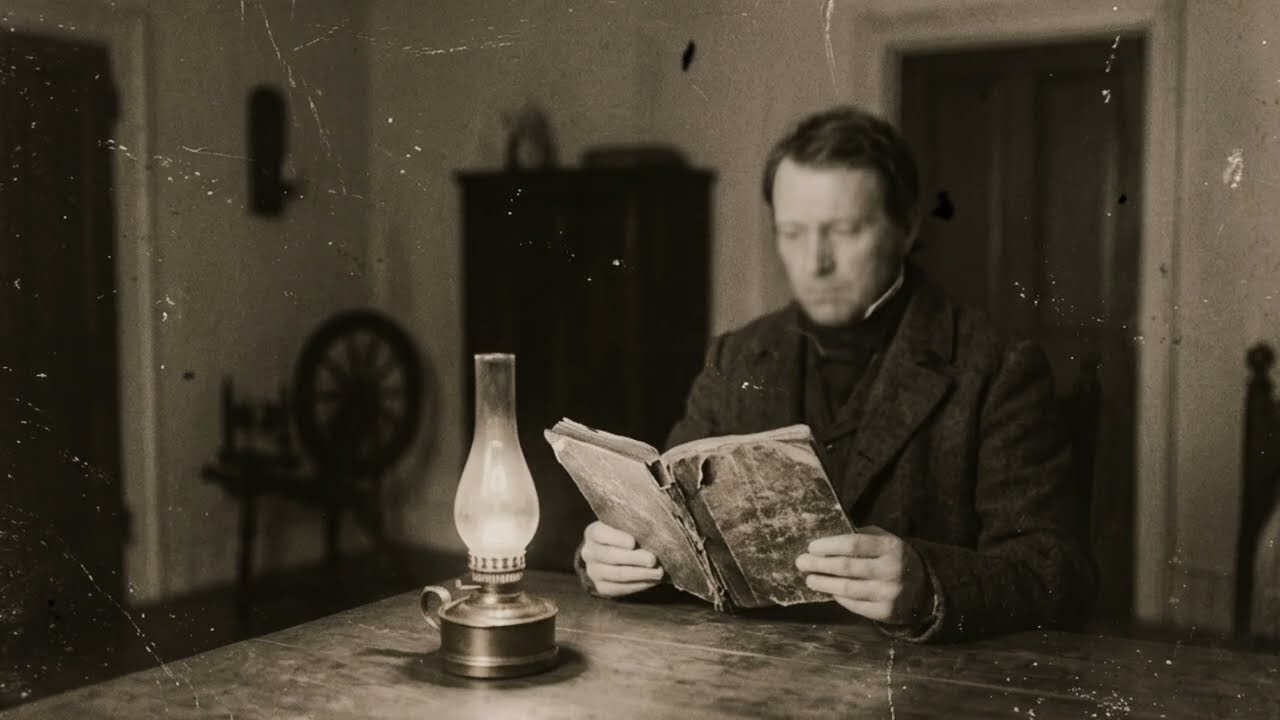
Rachel Cer’s journal began in 1851 in the ordinary way of a farm wife’s private record. Weather, planting, a running account of a difficult second pregnancy. But within its pages were entries that matched Sarah Halstead’s own experience almost word for word, even though Sarah had never read a word of Rachel’s writing. The dogs that would not cross the creek bend. The birds going quiet at 4 in the afternoon. A child’s laughter from an empty yard.
In October of 1852, Rachel recorded a visit from an old woman who identified herself only as Yaro. The woman told her that the ground in that hollow did not forget a debt. If you buried what was owed to it inside its own boundary, it would hold that child close, and it would send something wearing that child’s face to come and collect the rest of what it believed it was owed.
Rachel Cer buried her daughter Mary Ellen on the property in January of 1855. The girl had died of fever, but Rachel, sitting with the body through the night, thought she saw the girl’s breast rise. She could not make herself carry a child who might yet be breathing eight miles into a frozen churchyard. She buried her close, meaning to move her come spring. She never did.
Something began to walk the tree line wearing Mary Ellen’s voice. It began with her laugh echoing from the yard when no child was there. It progressed to her voice calling for her mother from just past the tree line at dusk. In March of 1856, Rachel wrote that she saw her daughter standing at the tree line in the last of the light, wearing the blue dress they buried her in, her hair combed the way she used to comb it of a Sunday. The girl raised one hand and beckoned slow. Rachel understood that she was not asking her to come. She was showing her that she could still.
The journal ended mid-sentence. There were over a hundred blank pages remaining in the book.
Josiah Halstead found the journal in February of 1874, wedged into a niche in the root cellar wall, packed over with clay. He did not tell Sarah about it for 11 days. When he finally showed it to her, she read it through twice and understood at last what had been walking their tree line for the past 11 months.
Sarah made the trip alone to find the woman named in Rachel Cer’s journal. Granny Yaro, the granddaughter of the woman who had warned Rachel, received her without surprise. She gave Sarah three refined rules. Any child who died on that land must be watched over unburied for a full seven days before interment, and buried nowhere within the hollow’s boundary under any circumstance. If the family heard a child’s voice that did not belong to one of their own living children, they were to light every lamp and candle in the cabin, gather in the strongest room, and count aloud together from one to one thousand without stopping, without answering any voice from outside. And under no circumstance, for any reason, no matter how desperate the family became, should they ever attempt to bury a living child, even briefly, even with the intention of retrieving them.
Whatever thought crosses your mind in a bad enough hour, Granny Yaro told her, that seems clever, put it out of your head the moment it arrives. That ground does not honor cleverness. It only ever honors what actually goes into it.
For a time, the family’s fortune seemed to hold. The small wrongnesses continued. The birds still went quiet. The dog still avoided the creek bend. But no voice called that did not belong to a living child, and no crisis arose that tested the third and most terrible rule.
In April of 1876, Eli Halstead, then 13 years old, found a second set of markers deeper in the tree line. Not five stones this time, but 11, arranged in a deliberate circle, each bearing a shallow hand-carved mark. The same mark was faintly scratched into the foundation stone of the springhouse cellar. At the center of the circle was a partially collapsed structure, low, stone-walled, roofless, no more than four feet across. Josiah came to believe the stones marked not children who were buried and lost, but children who were buried and returned. He believed there was a way to satisfy the ground’s reckoning without a true loss.
Sarah opposed the idea firmly every time it came up, invoking Granny Yaro’s third rule by name. The idea remained through that whole summer and into the fall, a dangerous thought held at bay by a mother’s plain good sense.
It took a fever to break that restraint. Thomas Halstead, six years old, took sick in the last week of January 1877. By the fourth day, he was limp, unresponsive, and by every outward sign either parent had ever been taught to look for, dying. Dr. Anson, the same circuit doctor who had attended the Cer family 22 years earlier, examined the boy and told them plainly that he was not likely to survive the night.
Sometime close to midnight, Sarah, holding Thomas against her chest, became convinced the boy had stopped breathing entirely. Josiah proposed that they carry Thomas’s body to the old clearing, to the structure at its center, and bury him there, deliberately, as an offering, and then before dawn, dig him back up. His reasoning was that the ground’s reckoning operated on completion, not intention. If the family could offer the debt and then reclaim it quickly, they might satisfy the ground’s hunger without actually surrendering their son.
Sarah’s objection was immediate, framed in Granny Yaro’s own words. Josiah’s counter was that Thomas was for all practical purposes already gone. The only true choice was whether to lose him for nothing, or to risk everything on the one theory that offered even the possibility of getting him back.
A little before 2 in the morning on the 30th of January 1877, Josiah carried his son’s body out through the tree line, past the original five stones, deeper into the woods to the clearing. Sarah followed with a lantern. They buried Thomas shallowly, deliberately, at the center of that ring of 11 marked stones. They meant to dig him back up before dawn.

They waited a little under four hours, standing at the edge of that clearing inside the ring of stones. In those four hours, they heard from the tree line on every side the sound of a great many children of every age calling out at once, not in distress, not menacing, but in what Josiah could only describe as celebration, as though something long starved had finally been offered a proper meal.
At 6:00, with the sky lightening, Josiah dug his son back up. Thomas was breathing.
For 11 days, Thomas Halstead lived. He ate sparingly. He spoke rarely, and when he did, in a voice that retained the shape and cadence of his own, but carried underneath it a second voice, very faint, running just beneath his own. He did not go back to the tree line. He simply sat mostly near the hearth, watching the door. His sister Naomi told her mother that Thomas was waiting for the rest of them to come get their turn.
On the 12th day, the 11th of February 1877, Thomas Halstead died again. This time by every account permanently, of entirely natural causes consistent with the fever having simply run its full course at last, 11 days later than it should have.
Having believed for 11 days that they had found a way to cheat the hollow’s reckoning entirely, and having then watched that belief collapse, Josiah and Sarah did not abandon the idea. They concluded that they had simply performed the ritual incorrectly. That some detail of the stones, the timing, the depth, the direction Thomas’s small body had faced, had been gotten wrong.
Ruth Halstead died on the night of March the 6th, 1877. She was 10 years old. Naomi Holstead, not yet six, died four nights later on March the 10th. Eli testified that he watched his own parents carry both of his sisters, one after the other, out through the tree line toward the clearing in the deep hours of the night, and that he did not see either of them carried back.
Eli left the hollow on foot alone in the pre-dawn hours of March the 11th, 1877, and walked the 11 miles to Amos Deal’s store in a little under four hours. He was half frozen, his feet bleeding through what remained of his boots. He said only that his sisters were gone into the ground, and his mother and father meant to bring them back the same way they had brought Thomas back, and that he could not stay to watch it a second and third time.
The sheriff and two deputies reached the hollow on the afternoon of March the 13th. The cabin stood empty, the hearth fire long dead. They followed the worn path through the tree line, past the five original stones, and on deeper into the woods to the second clearing. The ring of stones, which Eli had counted at 11 the previous April, now numbered 14. Three new stones, unweathered, clearly recent, had been added to the circle.
Within the low stone structure at the clearing center, the search party found freshly disturbed earth consistent with at least two and possibly three separate burials and exhumations. The ground showed no bodies present at all. Ruth’s and Naomi’s bodies were never recovered. Neither ultimately were Josiah’s or Sarah’s.
The formal county inquest convened in Yelville over the course of several sessions between April and July of 1877. Its formal finding was deliberately, almost defiantly vague: a finding of death or disappearance by causes the jury is unable to determine with sufficient certainty to assign specific culpability.
The parcel was never leased again. Elias Carver’s heirs eventually deeded it to the county in 1891 as unimprovable timberland. It remains to this day uninhabited.
Eli Halstead grew up in Calico Rock under a cousin’s roof. He apprenticed to a harness maker at 16, married a local woman at 22, and ran his own small harness and leather goods shop for the better part of four decades, raising three children of his own.
His children and later his grandchildren noticed things. Eli never once in his adult life allowed a fire or a lamp to go entirely out in his home between the hours of dusk and dawn in any season for any reason. He could not tolerate hearing a child’s voice call from any distance without immediately, visibly counting the children present in a room. And every evening at dusk, he sat on his own front porch, door barred behind him, and counted aloud slowly, deliberately, from one to somewhere well past 500, sometimes closer to a thousand, every single night, rain or clear.
On the evening of October the 9th, 1928, his daughter-in-law heard the sound of a young girl’s laughter coming from the tree line behind Eli’s small house. She noticed that Eli’s counting had abruptly stopped mid-number, and that he had risen from his chair, and was standing very still, facing the tree line. She heard him speak, low and even, and entirely without fear.
Not this one, he said. Not any of them. You had your due 51 years ago and I am still paying against it every single night of my life and that will have to be enough because it is all you are ever going to get from this family again.
The laughter stopped. Eli sat back down, resumed his counting from very near the exact number he had left off at, and never mentioned the incident to anyone for the remaining 11 years of his life.
Eli Halstead died on the 4th of February 1939 at the age of 75 of what his death certificate records simply as heart failure. Among his effects was a single flat unmarked stone, roughly the size and shape of the fieldstones described throughout this case, wrapped carefully in cloth, at the bottom of a small cedar box, alongside a folded scrap of paper in Eli’s own hand, undated, bearing only a short list of five names: Josiah, Sarah, Ruth, Naomi, Thomas. Beneath them, in the same careful hand, three words: still counting for.
The papers were donated to the Arkansas History Commission in 1961 by a great granddaughter who did not wish to be the one holding on to them when her own time came. The file was sealed from public access for seven years until a graduate researcher’s persistent inquiry finally saw it reopened in 1968.
That researcher, Constance Whitfield, spent the following three years cross-referencing the sealed inquest transcript against Sarah Halstead’s diary, Rachel Cer’s journal, and a series of her own follow-up interviews with surviving family members. It was her work that first assembled the complete narrative of the case.
Whitfield described a visit she made to the old hollow site in the autumn of 1970, midway through her original research. In the last hour of daylight, one of her colleagues found a sixth stone, separate from the original five, set slightly apart, unweathered in a way that struck all three of them as deeply and specifically wrong. Cut into the stone, in the same shallow, deliberate style as the mark on the 11 stones deeper in the woods, was a single word. It was not a name. The word was: next.
Whitfield died in 2003. The hollow itself remains exactly what it became in the 1920s, an unlabeled 160 acres of Marion County timberland, closed to public recreational access for reasons of habitat preservation and unstable terrain. The county’s own land management policy has recommended that no further solo surveys of the parcel be scheduled without a second technician present.
In 2019, a regional history podcast tracked down and interviewed a great-great-granddaughter of Eli’s, a woman in her 60s living in northern Arkansas, who asked to be identified only by her first name, Deborah. She described growing up in a family that had largely lost the specific details of the 1877 case, even as certain practical habits persisted stubbornly onward. No calling children in from outside after dark by shouting their names. A lamp or a nightlight left burning somewhere in the house at all times. A soft private habit of quietly counting under her breath whenever a knock came at the door after dusk.
Deborah said she cried for about two days straight when she finally read the whole thing through. Not just for Thomas and Ruth and Naomi, though God knows that alone would be enough. She cried because she finally understood her own grandmother in a way she never once managed to while she was alive. All those little habits she used to roll her eyes at growing up. The light left on. Never hollering a name into the yard. She was still paying it forward. This thing that happened three generations before she was even born, still keeping her own little corner of the debt paid down without ever once explaining to any of us why.
Deborah said she has since adopted several of the same small habits herself. Not out of any genuine belief that a hollow she has never visited and hopes never to visit continues to hold any claim on her own family nearly a century and a half later. But out of something closer to a kind of respect for what it cost the people before her to get the rest of the family safely all the way down to where she is standing now.
It doesn’t cost me anything to leave a light on, she said. It cost my great-great-grandfather everything he had twice over to learn that it mattered. Least I can do is keep doing the easy part of what he started.