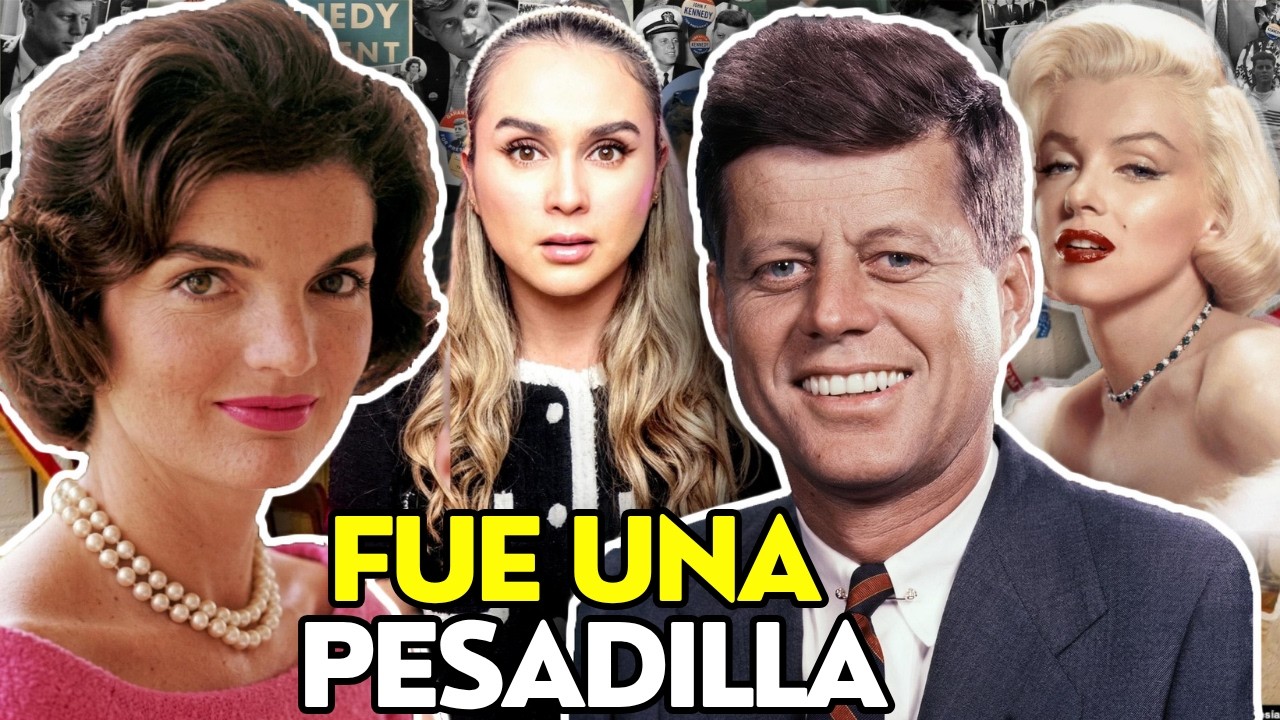
Before the era of power couples and media-savvy political dynasties, there was John F. Kennedy and Jacqueline Bouvier. He was the young, handsome, and intelligent president. She was the feminine, sophisticated, and elegant first lady. After the tragedy of 1963, they became symbols of patriotism, beauty, and American pride.
Over time, that image of perfection began to crack. Behind the myth was a story of pain, numerous infidelities, and an overwhelming need to maintain appearances. Revisiting this marriage today reveals how power, marriage, and the role of women functioned in the 1950s and 1960s.
John F. Kennedy was born into one of the wealthiest and most influential families in the United States. In that household, it was not enough to have privilege; you had to prove you were the best. His father, Joe Kennedy Sr., had built a massive fortune and wanted to place his family name in the White House.
Joe Jr. was the eldest son and the original heir to this political dream. John was the second son, plagued by serious health issues from a young age. Doctors told him more than once that he had only months to live due to digestive problems and severe back pain.
Despite his frailty, the competitive family environment pushed him to develop resilience. He and his brother competed constantly, though John usually lost. When World War II broke out, John joined the military and became a hero after his boat sank in battle and he led his crew to safety.
His brother Joe Jr., wanting to prove he was better, risked his life in a dangerous mission and died. Devastated, Joe Kennedy Sr. transferred his political ambitions to John. John entered Congress in 1946 and later set his sights on the Senate.
At a dinner shortly after his Senate win, he met a beautiful 22-year-old reporter for the Washington Times-Herald, Jacqueline Bouvier. At the time, nothing happened between them. John was a declared womanizer, unable to stay with a single woman.
Jackie was cultured, sophisticated, and spoke French, Spanish, and Italian. She came from a good family and had a refinement uncommon for her age. John saw her as elegant and mysterious, a suitable companion for his political aspirations.
Jackie had grown up in a broken home. Her parents divorced when she was seven, and the rupture was deeply painful. Her mother, Janet, was ambitious and strict, while her father, Blackjack, was a charming but unstable womanizer and alcoholic.
Jackie learned to keep her feelings to herself, retreating into her inner world. This would become the same defense mechanism she used later in her marriage. Her mother remarried a much richer man, which gave Jackie access to travel and elite education.
Despite her independence, Jackie feared remaining single. Her mother pushed her to marry a wealthy man. When Jackie was briefly engaged to a stockbroker, her mother pressured her to break it off, saying he did not earn enough.
When John F. Kennedy came along, Jackie was attracted to him but admitted she felt he would make her suffer. She knew about his past as a womanizer but took it as a challenge. She believed that with her, he would change.
They became engaged in the summer of 1953. Jackie left her job to plan the wedding. John was 36, and Jackie was 24. The wedding was one of the most talked-about social events of the year.
From the beginning, the marriage was strained. John focused entirely on advancing his political career. He was rarely home, traveling constantly and seeing other women. Jackie stayed by his side, caring for him during his health crises, hoping her love would make him see she was the only woman who mattered.
In August 1956, Jackie suffered a devastating loss. Her baby died shortly after birth. John was not there to comfort her. He was sailing in the Mediterranean with friends and women. Some biographers speculate that Jackie’s miscarriages and premature births may have been caused by diseases John transmitted from his affairs.
Jackie wanted a divorce, but her mother and sister persuaded her to stay. Her sister told her the infidelities were worth it when you were with a powerful man. Her mother said it was the price you paid to have a man like that by your side.
Their daughter Caroline was born in November 1957. Jackie continued to support John’s ambitions, correcting speeches and appearing at political events. They built the image of a powerful, charismatic family that fascinated the American public.
When John ran for president, Jackie was pregnant again and could not campaign with him. She wrote a weekly column for women voters instead. The race was difficult. John was young and Catholic, and his opponent Richard Nixon exposed his health issues.

John made a risky move by supporting the release of activist Martin Luther King Jr. while Nixon stayed on the sidelines. He balanced this by choosing Lyndon B. Johnson as his running mate, appealing to southern white voters. He won the election by a razor-thin margin.
The family moved into the White House in January 1961. Jackie took charge of restoring the building, gathering antiques and artwork. Her televised tour of the White House in 1962 was watched by millions and made her enormously popular.
From the outside, the family seemed perfect. Jackie was named the most glamorous woman in the world. During a trip to France, she outshone her husband with her fluent French, and John joked that he was the one accompanying her.
But John’s infidelities never stopped. He had affairs with a stripper, a socialite, and even his wife’s own secretary. One intern at the White House, only 19 years old, later wrote a book describing her affair with the president.
The Secret Service reportedly helped cover up these activities. Agents were expected to arrange access to women and pay off witnesses and the press. John once told an agent he had not found him a girl in two weeks.
Jackie knew about the affairs and fell into a deep depression. She developed tics and even required electroshock treatment. But in public, she had to pretend everything was perfect.
Eventually, she stopped seeing the mistresses as a threat. She felt secure in her role as wife and focused on enjoying her position as first lady. She traveled with her children and did not ask for a divorce, knowing it would not be politically convenient.
It was around this time that Marilyn Monroe entered the picture. On May 19, 1962, Marilyn sang a famously sensual version of Happy Birthday to the president at his 45th birthday celebration. Jackie refused to attend.
It is confirmed that Marilyn and the president had met in person before. Rumors of an affair were widespread. Marilyn reportedly called the White House repeatedly looking for John.
One journalist claimed that Marilyn once called and spoke to Jackie directly, saying John would leave her for Marilyn. Jackie reportedly replied coldly, telling Marilyn to marry Jack and take on all the problems of being first lady.
Marilyn was deeply attracted to powerful men, likely due to her own troubled childhood. Both Kennedy brothers contributed to her emotional decline, using her as a trophy before ignoring her completely. The relationship with the Kennedys was one of the final blows in Marilyn’s life.
The final stage of the Kennedy presidency was brutally difficult. The Bay of Pigs invasion was a humiliating disaster. The Berlin Wall was built. Then came the Cuban Missile Crisis, the closest the world has ever come to nuclear war.
During those tense days, John could not focus on his affairs. Ironically, this was when the marriage seemed to unite. Jackie refused to leave Washington with their children, saying that if they were going to die, they would die together.
Kennedy successfully negotiated with Soviet leader Nikita Khrushchev, and the crisis was resolved. But his physical pain worsened. He depended on strong medications and admitted he would take anything to stop the pain.
Jackie became pregnant again, but the baby was born prematurely and died after two days in August 1963. This time, the loss united them. Kennedy cried over the death of his son Patrick, and Jackie finally felt she could count on her husband.
With the 1964 elections approaching, Kennedy needed to campaign in Texas. He asked Jackie to accompany him, knowing she would help bring in votes. On November 22, 1963, they were in Dallas.
They rode in an open car, moving slowly through the crowds. Suddenly, shots rang out. The president was hit and died shortly after.
Jackie’s pink Chanel suit was soaked in blood. She refused to change clothes, saying she wanted people to see what had been done to her husband. Lyndon B. Johnson was sworn in as president that same day on the presidential plane.
The official version is that Lee Harvey Oswald acted alone, but the reasons remain unclear. Jackie organized the funeral, inspired by the funeral of Abraham Lincoln. She walked behind the coffin through the streets of Washington.
From that day on, she never said a single negative word about John. She continued to sell the story of a perfect husband and a perfect family. She did the opposite of what her mother had done, turning John F. Kennedy and the entire family into a legend.
The most enduring image of the funeral is that of young John F. Kennedy Jr. saluting his father’s coffin. That moment marked the beginning of another story, the short and fascinating life of the son who carried one of the heaviest names in the world.