In the autumn of 1884, a letter arrived at the offices of the *Lancashire Evening Post*. It carried no return address. The handwriting was agitated, and the ink was smudged in places, as if the writer had been trembling.
The letter described a family living on the edge of a village called Barrowford, north of Pendle Hill in Lancashire, England. The family was named Stannock. The letter claimed the children of this family were "wrong"—not sick, not deformed, but wrong. It said their eyes were entirely black, with no whites, no irises, just pure, featureless darkness from lid to lid. It also claimed that anyone who spent time near the children began to change.
The editor who received it filed it away, assuming it was the delusion of a drunkard or a prankster. But over the following weeks, two more letters arrived, in different handwriting and with different postmarks, carrying the same claim. The Stannock children had black eyes, and Barrowford was afraid.
What followed over the next eighteen months became one of the strangest and most disturbing cases in Victorian England. A case that was never solved, that local authorities tried hard to bury, and that, once fully heard, is not easily forgotten.
## The Village
To understand what happened with the Stannocks, you must understand where it took place. Barrowford in 1884 was not a large village. A few hundred people lived there, mostly working in the cotton mills that lined the River Pendle Water. The village sat in a low-lying area, surrounded by steep hills covered in coarse grass and heather.
In winter, fog settled into the valley and stayed for days, turning the streets into gray tunnels where you could barely see twenty feet ahead. Even in summer, the hills blocked sunlight for most of the day. It was a place that felt enclosed, watched, and trapped.
It also sat in the shadow of Pendle Hill, which told you a great deal if you knew English history. Pendle Hill is where the Pendle witch trials took place in 1612. Twelve people were accused of witchcraft in those valleys. Ten were hanged at Lancaster Castle after a trial that relied almost entirely on the testimony of a nine-year-old girl. The case became one of the most famous witch trials in English history and tainted the reputation of every village in the Pendle area for centuries.
Two hundred and seventy years later, the people of Barrowford still whispered about curses. They still avoided certain paths after dark. Old women still hung ash branches over their doors to ward off ill intentions. Children were told not to wander the moors alone, especially near the stone circles and cairns that dotted the high ground.
## The Family
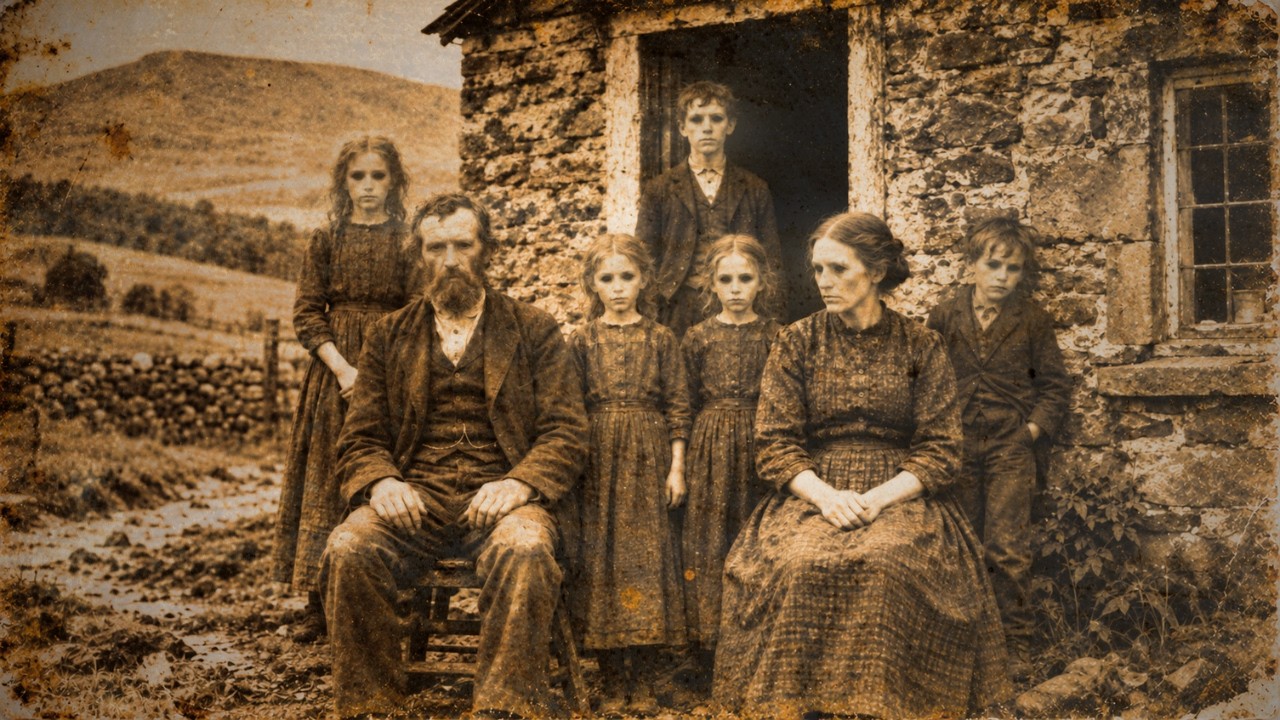
The Stannocks had lived in the area for at least three generations. The father, known in records only as Edwin Stannock, worked as a technician in a local mill, maintaining looms and operating machinery. His wife, referred to in most accounts as Martha, came from a neighboring village called Roughlee. They married in 1871 and settled in a small stone cottage on the edge of Barrowford, about a quarter of a mile of muddy road from the main cluster of houses.
By all accounts, the Stannocks were ordinary people. Edwin was known as a competent worker but not sociable. Martha attended church intermittently. They tended toward a noticeable reclusiveness, though that was not uncommon in the rural Lancashire of the 1880s.
Their first child, a boy, was born in 1873. Parish records list his name as Thomas. Their second child, a girl named Ada, came in 1876. A third child, another boy named William, arrived in 1879. Then in 1882, Martha gave birth to twins, a boy and a girl. The boy was named Harold, and the girl was named Cecily. Five children in total.
According to every surviving account, all five had the same condition. Their eyes were black.
## First Reports
The first mention of the children's eyes in any written record comes from a letter dated March 1883. A woman named Edith Greenhow, who lived in Barrowford and worked alongside Edwin at the mill, wrote to her sister in Burnley. The letter survived because the sister's descendants donated a collection of family correspondence to a local history archive in the 1970s.
In it, Edith wrote:
> "I saw the Stannock boy at the well on Tuesday morning. The eldest one, Thomas. He looked straight at me and I felt such a chill. His eyes are not natural, Mary. They are black entirely. Like looking into a well with no bottom. I crossed the road to avoid him, and he watched me the whole way. He never blinked."
That phrase—*never blinked*—appears again and again in accounts of the Stannock children. Multiple witnesses over the years described the same thing. The children stared. They held eye contact far longer than was naturalhol, and they did not blink.
A modern reader might immediately think of a medical explanation. There are conditions that can make eyes appear completely dark. Aniridia, the absence of the iris, can make the pupil appear to fill the entire eye, though this usually appears as a very large dark pupil rather than a fully black eye. Certain types of ocular melanosis can cause heavy pigmentation across the sclera and iris. Coloboma can create unusual eye shapes and colors. Uveal melanoma can darken parts of the eye. Severe uveitis can alter the appearance of the iris itself.
But none of these conditions alone or in combination would produce the effect witnesses described: a solid, uniform blackness across the entire visible surface of the eye, including the whites. Not dark. Not heavily pigmented. Black, as if ink had been poured into the socket and left to dry. Every witness who described the children's eyes used the same word. They were black.
More importantly, none of these conditions explain what witnesses claimed happened around the children. Medical conditions do not make dogs refuse to pass your house. Medical conditions do not give other people nightmares. Medical conditions do not cause sheep to die in the neighboring field.
## The Effect on People
The Greenhow letter is the earliest written account, but when researchers later interviewed elderly Barrowford residents in the 1930s and 1940s, many claimed talk of the Stannock children had been circulating for years before that. One woman interviewed in 1938 at age seventy-two said she remembered her mother refusing to let her pass the Stannock cottage as early as 1880. She said her mother told her the children were possessed, and that if you looked at them too long, you would begin to dream their dreams.
*Dream their dreams.* That phrase would return later.
The Stannock children did not attend the local school. This was not as unusual as it might seem. Compulsory education was only introduced in England in 1880, and enforcement in rural areas was limited at best. Many families kept children at home for work, but the Stannocks did not keep their children home for work. According to neighbors, the children were rarely seen doing chores or any visible household labor. They simply existed, standing at the doorway, sitting on the stone wall surrounding the house, or walking the lane in the early morning or late evening, always together, always silent.
A man named George Hartley, a carter who made regular deliveries through Barrowford, gave an account to a local paper in 1885. He described encountering the Stannock children in the lane one autumn evening:
> "There were four of them standing in the road, not playing, not talking, just standing. I called out for them to let the cart through, but they did not move. I came closer and saw their faces in the lamplight. Their eyes were black as tar, every one of them. The littlest girl, she could not have been more than three, she looked at me with those eyes, and I felt something pressing on the inside of my head, like a hand pushing from inside my skull towards the outside. I whipped the horse and went around them through the ditch. I did not look back."
The detail of pressure inside the head is significant because it appears in many independent accounts. Edith Greenhow described a feeling of cold. George Hartley described a feeling of pressure. A third witness, a woman who claimed she visited the Stannock cottage to deliver a basket of provisions from the church, described a sudden and overwhelming feeling of deep sadness that came over her completely while she stood at the front door—as if she had remembered a grief she had never lived.
There was something in these children that provoked a physical or emotional response in those who encountered them. Whether you interpret that as supernatural, as a psychosomatic reaction driven by fear and expectation, or as something else entirely, the consistency of these reports warrants attention. These were not people who had read each other's stories. They described the same sensations independently over years.
## The Animals
Then there was the matter of the animals. Many Barrowford residents noticed that animals behaved strangely near the Stannock property. Dogs refused to pass the cottage. They would plant their feet, flatten their ears, and whine. No amount of tugging on the lead could move them. Some dogs growled; others simply lay down on the ground and refused to move, trembling until their owners gave up and took another route.
A farmer named Holgate reported that his sheepdog, a border collie he had owned for seven years and described as the bravest animal he had ever known, fled from him one evening when they passed within a hundred yards of the Stannock property. The dog ran all the way home and hid under the kitchen table. It did not come out for two days.
Horses became agitated and difficult to control. Carters quickly learned to avoid the road past the cottage because their horses would rear, kick, and try to turn around.
A sheep farmer named Whitaker, who kept a flock of forty or more ewes in a field adjoining Stannock land, reported that his flock would gather at the far fence, as far from the property boundary as possible, and that lambs born in the field closest to the cottage were often stillborn. Whitaker eventually moved his entire flock. He told his neighbors he would rather lose the grazing land than keep losing lambs. When asked directly whether he believed the Stannocks were responsible, he was said to have replied: "I do not know what they are, but my sheep know, and that is enough for me."
It is difficult reading these accounts from a distance of more than a century to separate genuine observation from superstition and gossip. Rural Victorian communities were fertile ground for folk tales and collective panic. A reclusive family with an unusual appearance would naturally attract whispered explanations drawn from local tradition, and Pendle Hill's association with witchcraft provided a ready vocabulary for those whispers.
But the sheer volume of these accounts is hard to ignore. This was not one person telling ghost stories. This was an entire community over years describing the same phenomena in the same detail.
## The Summer of 1884
In the summer of 1884, things got worse. It was unusually hot in Lancashire. Mills worked shorter hours because the cotton dried out and became difficult to handle. People spent more time outdoors, in their gardens, in the lanes, at the wells, and that meant more contact with the Stannock children.
In June of that year, a girl named Polly Nutter, aged eleven, told her parents that the youngest Stannock girl, Cecily, had spoken to her at the well. According to Polly, Cecily approached her while she was drawing water and stood very close, closer than was comfortable. Polly said Cecily's eyes were entirely black and that she spoke in a flat, quiet voice.
Polly told her mother: "She asked me if I wanted to come and play. She said they had toys in their house that no one else knew about. She said if I came, I would learn how to see in the dark."
Polly's mother, understandably horrified, forbade her daughter from going near the Stannock property. But what happened in the following weeks worried the family far more than the initial encounter. Polly began having nightmares. Every night, without exception, she would wake screaming at roughly the same time, around two in the morning, and her parents would need half an hour to calm her.
She told her parents the dreams were always the same, exactly the same, down to the smallest detail. She was standing in a dark room, not a room she knew, not a room in any house she had ever visited. A room with no windows and no doors, stone floor, stone walls, and no source of light at all. Yet somehow she could see. The Stannock children were there, sitting in a circle on the floor, looking at her with their black eyes. All five of them. Completely still. Completely silent.
Their mouths were closed, they were not speaking, but Polly could hear them inside her head. Where her thoughts usually lived, she could hear them talking. Not to each other, but to her. They were telling her things—things about the dark, things about what lives in the spaces between walls, in the gaps behind plaster, in the cavities under floorboards. Things about what happens to people after the candles are blown out and the fire dies down, when the dark closes in completely. Things she could never quite remember after waking, but which left her shaking with a nausea born of a terror she could not name.
Polly's parents brought in the local vicar, a man named Reverend James Holden, who prayed over the girl and told the parents it was likely nothing more than an overactive child's imagination. But Polly's nightmares continued.
Then other children in the village began talking about the same dreams. Within a month, at least four other children in Barrowford claimed to have the identical nightmare. A dark room. The Stannock children sitting in a circle. Silent communication. And things said about the dark.
One child, an eight-year-old boy named Robert Foulds, added a detail no one else mentioned. He said that in his dream, the Stannock children asked him to open his eyes as wide as he could, and when he did, in the dream, his own eyes turned black as well. Robert's parents pulled him out of school and sent him to stay with relatives in Colne. His nightmares reportedly stopped within a week of his leaving Barrowford.
## The Vicar's Visit
Fear in the village was now acute. Parents warned their children to avoid the Stannocks entirely. Some families began locking their doors at night, unusual in a community where most people had never owned a lock. Reverend Holden preached a sermon about the dangers of superstition, urging the congregation not to persecute a family on the basis of rumor and fear.
But in private, according to letters he wrote to the Bishop of Manchester, Holden was deeply disturbed. In one letter dated August 1884, Holden wrote:
> "I visited the Stannock home yesterday at the invitation of Mrs. Stannock, who wished me to see that her children were normal and well. I confess I went with some reluctance. The house was clean and orderly. The children were polite and quiet. But their eyes, my Lord Bishop, are as the villagers describe them, black entirely, with no white or visible color. I have seen many physical conditions during my years of ministry, but I have never seen this. When the youngest child looked at me, I felt a sensation I can only describe as being exposed. As if the child were not seeing my face, but my thoughts. I left after twenty minutes. I did not sleep that night, and when I finally did, I dreamed of a dark room. I should not return to that cottage."
A clergyman, a man of learning and religious authority, describing exactly the same sensations and the same dream reported by the children of Barrowford. The dream of the dark room was spreading.
## The Doctor's Examination
By the autumn of 1884, reports had reached beyond Barrowford. Letters arrived at the *Lancashire Evening Post* in October and November of that year. A reporter for the *Manchester Guardian* allegedly visited Barrowford in late November but never published a story. Decades later, a researcher claimed to have found notes from the reporter's visit in the Guardian's archives, though the notes themselves have never been made public. What the researcher shared was a single line: *"I have been instructed by my editor not to proceed with the Stannock article. He says it will cause panic and that the matter should be left to the local authorities."*
Left to the local authorities. But the local authorities were not equipped to deal with what was happening. Barrowford had no police station of its own. The nearest constable was based in Nelson, a few miles away, and his jurisdiction covered a wide area. Medical professionals were similarly scarce. The nearest doctor, a man named Dr. Earnshaw, practiced from Colne and visited Barrowford only once a week on market day.
Dr. Earnshaw was eventually persuaded to examine the Stannock children. The examination took place in December 1884, and the doctor's notes partially survive through copies made by a local historian in the early twentieth century. Earnshaw's notes described the children as physically healthy, with height and weight appropriate for their ages, no signs of malnutrition or disease, normal hearing and reflexes.
But his notes on their eyes were extensive and clearly troubled:
> "The sclera, which should appear white, is entirely lacking in any visible coloration. The iris and pupil are indistinguishable from each other or from the surrounding tissue. The entire visible surface of the eye appears uniformly dark, so entirely black that I could not determine where the pupil ended and the surrounding structures began. I attempted examination with a light source, but the eyes did not respond to light in the expected manner. The pupils did not constrict. The children showed no discomfort from direct lamplight, did not blink, and did not look away. I have consulted my reference texts and can find no condition that matches this presentation. I recommend examination by an ophthalmologist in Manchester, though I doubt the family will agree to the journey."
Earnshaw also noted something else. He wrote that during the examination, he experienced what he called an unusual mental impression, which he described as a vivid image of a dark passageway appearing in his mind unbidden and lingering for several minutes after he left the cottage. He added, with a scientist's caution, that he attributed it to the suggestive atmosphere created by village superstition rather than to any cause related to the children themselves.
But he never returned to examine them again. When a colleague at the Colne Medical Society asked him about the case months later, Earnshaw was said to have replied: "I would rather we not discuss the Stannock children. I have not slept well since that visit."
*The dark room.* Again.
## The Disappearance of Agnes Pickles
In January 1885, a girl went missing. The fear that had been building in Barrowford for months finally broke through whatever restraints the community had been holding.
Her name was Agnes Pickles. She was nine years old, the youngest of four children. Her father worked in the mill, and her mother took in laundry. They were a well-liked family, regular churchgoers, known to their neighbors for their decency and hard work. Agnes was described as a cheerful girl with red hair who loved singing hymns while doing her chores.
She was last seen on the afternoon of January 14, walking toward the well at the edge of the village. She was carrying a wooden bucket. She was alone. She did not come home.
Her parents raised the alarm that evening. A search party was organized, led by a constable from Nelson named Sergeant Howarth, who had to walk two miles through freezing rain to reach Barrowford. The search party, which grew to include nearly every able-bodied man in the village, combed the lanes, the fields, the frozen riverbank, the mill buildings, the churchyard, and every barn, cottage, and shed within a one-mile radius. They searched all night with lanterns and torches, calling Agnes's name into the darkness dash.
They found no trace of her. Not a footprint, not a thread, nothing.
The next morning, suspicion fell on the Stannocks. It must be said clearly: there was no evidence linking the Stannocks to Agnes Pickles's disappearance. No one had seen Agnes near the Stannock property. No one had seen any of the Stannock children in the area where Agnes was last seen. The suspicion was based entirely on the community's pre-existing fear of the family.
A group of village men, numbering about a dozen, went to the Stannock cottage on the morning of January 15. They demanded to search the premises. Reports say Edwin Stannock stood in the doorway and refused them entry. He did not say much. He simply stood there, blocking the door until frustration got the better of the men and they began shouting.
What happened next is told differently depending on the source. Some accounts say Martha Stannock appeared behind Edwin and told the men they were welcome to search the cottage. Other accounts say the eldest son, Thomas, then about twelve years old, came out and stood beside his father, and that the men, when they looked into the boy's black eyes, lost their nerve and backed away.
The constable arrived later that day and conducted a search of the property. He found nothing relating to Agnes Pickles. The cottage contained the usual furniture for a family of seven. Beds, a table, chairs, a stove, cooking utensils. Nothing unusual, nothing hidden, nothing suspicious.
Agnes Pickles was found three days later, alive but disoriented, in a barn about two miles from Barrowford. She was cold and hungry but physically unharmed. When her parents asked where she had been, she said she could not remember. She said the last thing she remembered was being at the well, and then she found herself in the barn and did not know how she got there.
But when a neighbor asked Agnes whether she had seen the Stannock children, Agnes became extremely distressed. She began crying and refused to answer. Her parents ended the conversation and put Agnes to bed. Over the following weeks, Agnes reportedly refused to leave the house. She would not pass by windows after dark and began sleeping with a candle burning beside her bed, something she had never done before.
Her parents asked her again, gently, weeks later, what had happened. Agnes told them only one thing: *"I was in the room. The dark room. They showed me things."* She would not say what those things were.
Within a month, the Pickles family left Barrowford entirely. They moved to Blackburn and, as far as records show, never returned.
## The Night Visitors
Agnes's disappearance, though it ended without physical harm, turned the situation in Barrowford from concern into open hostility toward the Stannocks. The fact that Agnes was found alive should have eased tensions. Instead, her behavior afterward, particularly her mention of the dark room, intensified them.
People began refusing to do business with Edwin Stannock. His coworkers at the mill did not want to work alongside him. Martha was turned away from the village shop. The children, already isolated, became all but invisible. No one saw them for weeks at a time.
Then the incidents in other homes began. In February 1885, a woman named Sarah Hunsdale reported waking in the middle of the night to find one of the Stannock children standing in her bedroom. She said the child, a boy, was standing at the foot of her bed, completely still, watching her with those black eyes. She screamed, and when her husband lit a candle, the room was empty. The bedroom door was still locked from the inside.
Sarah's account was the first of what would become a recurring phenomenon. Over the following months, eight Barrowford residents reported seeing Stannock children inside their homes at night, always standing still, always watching, always disappearing when a light was brought into the room. Doors and windows remained closed.
The night visitors followed a consistent pattern. They appeared between midnight and three in the morning. They stood at the foot of the bed or in the corner of the room, always still, always facing the sleeper. Their posture was described as rigid but not tense, almost relaxed, as though standing motionless in a stranger's bedroom at two in the morning was the most natural thing in the world.
They did not speak. Their mouths did not move. But every witness who reported seeing them described hearing words—not with their ears, but in their minds. A thought that was not their own, planted with clarity and precision in the center of their consciousness. The words were always the same. The same request. The same patient, unhurried demand.
*"Let us in."*
Not a shout, not a whisper. Placed, as one witness described it, like a stone carefully set on a table. Every witness described the same instinctive certainty that if they responded, if they said yes, if they acknowledged the request in any way, something irreversible would happen.
This detail has drawn the most attention from modern researchers and, frankly, from the paranormal community. The phrase "let us in" is now widely associated with the phenomenon of black-eyed children, a modern urban legend that gained popularity in the late 1990s after a journalist named Brian Bethel published an account of his encounter with two black-eyed children in Abilene, Texas, in 1996. In Bethel's account, two children with completely black eyes approached his car and asked to be let in.
The Stannock case predates Bethel's account by more than a century. Whether the Stannock case influenced the modern black-eyed children legend or whether both draw from a deeper, older archetype is a question that cannot be answered definitively. But the similarities are striking. Completely black eyes. Requests for entry. An overwhelming sense of dread. The feeling that they know you, that your thoughts are being read. And the dreams.
## The Changes
Reports of night visitors continued throughout the spring of 1885, but they were accompanied by another development that Barrowford residents found equally disturbing. People began to change.
The first to show visible changes was a man named Arthur Bresswell, a weaver who lived alone in a cottage near the mill. Arthur reported seeing one of the Stannock children in his home on two occasions. He said that both times, the child stood beside his bedroom window and stared at him. Both times, the child vanished when Arthur lit his candle.
After the second visit, neighbors noticed Arthur had become withdrawn. He stopped going to the pub. He stopped talking to people at the mill. He did his work in silence and went home.

Then, in April 1885, a woman who worked alongside Arthur at the mill made a passing remark that sent a wave of fear through the entire community. She said Arthur's eyes had become darker. Not black, not yet, but darker. The whites of his eyes had taken on a grayish tint. His irises, which had been blue, now appeared so dark brown they were almost black. He had also developed a habit of staring, a long unblinking stare that reminded her, she said, of the Stannock children.
A group of his peers confronted Arthur. He denied that anything was wrong. He said his eyes were as they had always been. But the woman was not the only one who had noticed. Others confirmed it. Arthur's eye color was changing.
Over the following months, two other Barrowford residents who had reported nightly visits from the Stannock children showed similar changes. Darkening eyes. Increasing withdrawal from social contact. Long periods of silence. And, according to neighbors, a tendency to stand motionless in doorways or at windows, watching in a manner uncomfortably reminiscent of the Stannock children themselves.
The village was terrified. Not just of the Stannocks anymore, but of the contagion. Whatever the Stannock children carried, it seemed to be spreading.
Dr. Earnshaw was called in again, this time to examine Arthur Bresswell instead of the Stannock children. Earnshaw's notes on this examination were brief and clinical. He recorded that the whites of Arthur's eyes were within the normal range but acknowledged a noticeable darkening of the iris compared to what he would expect for a man of Arthur's age and build. He noted no other physical abnormalities. He advised Arthur to see a specialist in Manchester, a recommendation Arthur ignored.
But Earnshaw also included a private note, not part of the official examination record, found among his papers after his death. In it, he wrote:
> "The Bresswell case worries me, but not for the reasons the villagers fear. I believe the darkening of his irises may be attributable to natural variation, or possibly a change in diet. However, his demeanor during the examination disturbed me greatly. He sat completely still the entire time, which is unusual for any patient. He did not fidget. He did not look away. He fixed his gaze on me with an intensity I found quite unsettling. When I asked whether he had experienced any unusual symptoms, he said: 'I can see better in the dark now.' He said it without expression, as one might mention the day of the week. I did not press him with further questions. I confess I wanted to leave."
*"I can see better in the dark now."*
That phrase has haunted researchers for decades, because it echoes what Polly Nutter said Cecily Stannock told her at the well: *"If you come, you will learn to see in the dark."* It echoes what Agnes Pickles refused to elaborate on: *"They showed me things."*
Something was spreading. Whether belief, delusion, infection, or something entirely outside the categories used to understand the world, something was moving from the Stannock children to the people around them.
## The Fire
By the summer of 1885, the situation in Barrowford had become untenable. The Stannocks were effectively under siege. No one in the village would deal with them. Edwin was fired from the mill in April when the manager told him plainly that the other workers refused to be in the same room with him. Martha was turned away from every shop in Barrowford and in the neighboring villages of Nelson and Roughlee, where news of the family had spread.
Their supplies began to run out. How they survived those final months is unclear. Perhaps they foraged. Perhaps someone left food at the gate under cover of darkness. Perhaps they had other means of sustaining themselves that cannot be explained.
The children were not seen outside the cottage for months. The curtains, such as they were, remained drawn. No smoke rose from the chimney even on cold evenings. The cottage sat at the end of the lane like a closed box, silent and still, and the villagers avoided it entirely. Men passing on their way to work crossed to the other side of the road and quickened their pace. Women took a longer route to the well rather than pass within sight of the front door. Even Reverend Holden, who had initially urged compassion, now avoided that end of the village altogether.
Then, on the night of July 7, 1885, the cottage burned down.
The fire was first seen at approximately two in the morning by a farmer named John Greenwood, who was returning from tending a sick cow in his barn. Greenwood later said he saw the glow from half a mile away and knew immediately what was burning. There was only one building in that direction. The Stannock cottage.
Greenwood ran to raise the alarm, but by the time a group of village men reached the site with buckets and shovels, the fire was out of control. The roof timbers were already collapsing. The heat was so intense that the men could not approach within thirty feet of the building. They stood in the road and watched it burn.
One of the men later admitted that no one tried very hard to put it out.
When dawn broke and the ruins had cooled enough to approach, the men searched through the debris. They found an iron bed frame. They found melted and charred cooking pots. They found nails, hinges, and the remains of a wooden table.
No bodies were found in the ruins. Not one bone. Not one tooth. Not even a scrap of clothing.
This is the detail that has provoked the most debate and speculation over the years. The Stannock cottage burned to the ground, but the family was not inside. Seven people—two adults and five children—simply vanished.
The constable investigated the fire and concluded it was likely deliberately set. He noted the pattern of the fire was consistent with the use of an accelerant, possibly lamp oil, applied to the exterior of the cottage at multiple points. In other words, someone had surrounded the house with fuel and set it alight.
But if that was the case, how did the family escape? The cottage had one door and two small windows. If the fire was set at multiple points around the exterior, escape would have been nearly impossible, especially for a family with young children. The twins, Harold and Cecily, were only three years old.
Two theories emerged, and they remain to this day.
The first theory is that the Stannocks received advance warning and fled before the fire was set. Perhaps one of the few remaining sympathizers in the village alerted them. Perhaps Edwin, aware of the escalating hostility, had been preparing an escape route. Under this theory, the family simply left in the night, and the arsonists arrived to find an empty cottage and burned it anyway.
The second theory is darker. Under this account, the villagers did not set the fire. The Stannocks set it themselves. They burned their own cottage and deliberately disappeared, as if they had finished whatever they came to do.
Neither theory is entirely convincing. The first requires a level of coordination and foresight that seems unlikely for a family under siege. The second requires a motive that no one has ever been able to identify. Why would a family burn down their own home? What would be the purpose? Unless the fire was not destruction but transformation. Unless the burning was part of something, a ritual, a conclusion, a door closing behind them as they crossed over to wherever they came from.
There is a third possibility that some researchers have raised, one that a Victorian mind would have found unthinkable and a modern mind finds almost equally disturbing. What if the family was not human in the first place?
## The Missing Records
Here the story enters territory that traditional historical analysis cannot fully address. But the evidence, or rather the lack of evidence, is genuinely strange.
After the fire, investigators and interested parties attempted to trace the Stannock family. They examined parish records in surrounding villages. They wrote to registrars across Lancashire. They searched census data and found something deeply unsettling.
The Stannocks appeared in Barrowford parish records starting with the marriage of Edwin and Martha in 1871. The births of all five children were registered. Edwin appeared in mill employment records. These records existed and were consistent.
But before 1871, the Stannock family did not appear to exist. No birth record for Edwin Stannock could be found anywhere in Lancashire or anywhere else in England. No birth record for Martha. No record of either surname in any parish within fifty miles of Barrowford. No parents, no siblings, no relatives. They appeared in the historical record in 1871, fully formed, a married couple ready to start a family.
After the fire, the same pattern continued. The family disappeared as completely as they had appeared. No death records. No transfer records. No sightings. Nothing. Edwin and Martha Stannock, with their five black-eyed children, simply ceased to exist on the night of July 7, 1885.
You could explain this as a failure of record-keeping. Victorian parish records were handwritten, often incomplete, and frequently lost to fire, flood, or simple neglect. It is entirely possible that the Stannocks' early records existed at some point and were accidentally destroyed. It is possible the family fled under assumed names and built a new life elsewhere, their original records lost to time.
But the combination is difficult to ignore. The missing records before their appearance. The missing records after their disappearance. The fourteen years of existence in a village where their children had entirely black eyes, where people dreamed shared dreams, where a contagion of darkness seemed to spread through eye contact, and where the family vanished without a trace from a burning building in the middle of the night.
If you wanted to describe something that arrived, embedded itself in a community, spread its influence, and then left when its purpose was accomplished, that is what it would look like.
## Aftermath
The aftermath of the Stannock fire was in some ways as disturbing as the events that preceded it. You might expect relief. You might expect celebration, even the subdued kind tinged with guilt. The thing that had frightened the village was gone. The black-eyed children would no longer stand in the road. The nightmares would stop. Life could return to normal.
But returning to normal took longer than anyone expected. For some, it never happened.
Arthur Bresswell, the man whose eyes had begun to darken, disappeared from Barrowford three weeks after the fire. He gave no notice at the mill. He did not tell his neighbors. He simply was not there one morning. His cottage was found open, his possessions still inside. A distant relative eventually collected his belongings and noted that the cottage was tidy, but every mirror in the house had been turned to face the wall.
The other two residents who had shown signs of the eye-darkening condition also left the village within months of the fire. Their departures were less dramatic. They told people they were leaving and gave reasons—a new job, family commitments. But the timing was striking. All three affected individuals left Barrowford within four months of the Stannocks' disappearance.
And the dreams stopped. After the fire, no resident of Barrowford reported dreaming of the dark room. Not one. Polly Nutter's nightmares ceased abruptly on the night of the fire. The other affected children slept peacefully.
Reverend Holden, in a letter to the bishop written in August 1885, noted with evident relief that the disturbances had stopped entirely. He attributed this to the power of prayer and divine providence. He did not mention the fire.
In fact, the fire itself received remarkably little official attention. No one was charged with arson. No formal inquiry was held into the family's disappearance. The constable's report noted the fire, noted the absence of bodies, and noted that the family's whereabouts were unknown. That was it. No follow-up. No investigation. No press coverage.

It was as if the village, the authorities, and the press had collectively decided to forget the Stannocks.
## The Investigations
This deliberate silence is itself significant. Victorian England was not a society that shied away from sensational stories. The newspapers of the era published detailed accounts of far less dramatic events. The fact that a family of seven disappeared from a burning building without leaving bodies or a trace, and that this event received so little coverage, suggests that someone, or several someones, deliberately suppressed the story.
The most likely candidates are the local authorities and the church. Reverend Holden had clear motivation to let the matter rest. He had been deeply disturbed by his visit to the Stannock cottage and had experienced the dark room dream himself. Drawing attention to the case would mean publicly admitting that an ordained clergyman had been affected by whatever influence the Stannock children carried.
Similarly, the constable had no interest in investigating a case he could not explain and that the entire community wanted to forget.
And so the story faded. The ruins of the cottage were left to collapse. Within a few years, the stones were scavenged by local builders and the site returned to grass. By the 1890s, the Stannock case had become a local ghost story, something parents told their children to keep them away from the site of the old cottage.
By the turn of the century, many Barrowford residents denied the events had ever happened at all. But the documents remained. The letters, the medical notes, the parish records, the vicar's correspondence.
In the early twentieth century, a few researchers began to piece together the threads of the story. For decades, the Stannock case existed only in memory. Elderly residents passed the tale to younger generations, who passed it to their children. With each generation, the details faded and shifted. Some versions portrayed the family as witches. Some as demons. Others as ghosts that had never been alive at all.
The core of the story remained constant: the black eyes, the dreams of the dark room, the disappearance. But the details mutated into legend.
## The Wamsley Study
The first serious examination of the Stannock case came in 1923, when a local historian named Herbert Wamsley published a short study titled *Strange Events in Barrowford, 1882–1885*. Wamsley grew up in Nelson and heard the Stannock story in childhood from his grandmother, who had lived through the events. As an adult, he spent several years tracking down surviving documents and interviewing elderly residents who remembered the events firsthand.
Wamsley was methodical and cautious. He compared accounts against each other. He checked dates against parish records. He visited the site of the cottage, which was by then just an abandoned plot of land overgrown with weeds, with some foundation stones still visible.
Wamsley's study is careful and balanced. It presents the evidence without drawing definitive conclusions. But in its final chapter, he allows himself one observation that has echoed with every researcher who has studied the case since:
> "The most troubling aspect of the Stannock case is not what happened. It is what stopped happening. The dreams ceased on the night of the fire. The affected residents left. The village forgot. This suggests that the influence, whatever it was, was not a permanent change in those it touched. It was a temporary condition maintained by proximity to the source. When the source departed, the effects faded. This raises a question I find deeply disturbing. If the influence was temporary and proximity-dependent, then the Stannocks were not merely an anomaly. They were agents. They were doing something. And when they were done, they left."
The Wamsley study was published in a very limited edition and attracted little attention outside local history circles Apa, but it preserved evidence that would otherwise have been lost and established the framework later researchers would use.
## The Ashworth Interpretation
The next significant investigation came in 1952, when folklorist Margaret Ashworth included the Stannock case in a survey of Lancashire supernatural traditions. Ashworth was primarily interested in the connection to the Pendle witch trials and the persistence of witchcraft beliefs in the region. She treated the Stannock case as a manifestation of folk anxiety, a modern witchcraft panic in Victorian dress.
Ashworth's analysis is intelligent and persuasive, but it rests on the assumption that the Stannock children's eyes were not actually black. She suggests the children suffered from a relatively common eye condition that a superstitious community exaggerated into something supernatural. Under her model, the dark room dreams were a form of mass hysteria, and the family's disappearance was simply a persecuted family fleeing violence.
This interpretation has the advantage of simplicity. It requires no supernatural elements. It fits established psychological and social frameworks. And it may be entirely correct.
But it has weaknesses. It does not adequately explain Dr. Earnshaw's medical examination, which described the eye condition in precise clinical terms beyond mere unusual coloration. It does not explain the consistency of the dream reports among unrelated witnesses. And it does not address the complete absence of the Stannock family from records before 1871 and after 1885.
## The Halliwell Dig
The most recent substantial investigation into the Stannock case came in 1998, when a researcher named David Halliwell attempted to identify the actual location of the Stannock cottage and conduct an archaeological survey. Halliwell was not an academic. He worked as a land surveyor, but he had a lifelong interest in Lancashire folklore and had been researching the Stannock case as a personal project for nearly a decade.
Using historical Ordnance Survey maps from the 1880s, along with descriptions from the Wamsley study and the memories of a ninety-two-year-old woman who recalled seeing the cottage ruins as a girl, Halliwell identified a likely site. It was an abandoned plot of land at the end of a lane that now led to a modern housing estate built in the 1960s. The houses ended abruptly at the edge of this plot, as if the developers had deliberately avoided building on it.
Halliwell obtained permission from the landowner to conduct limited excavation over two weekends. Working with a small team of volunteers, he removed the topsoil and uncovered what remained of the cottage foundations. The stone was local sandstone, roughly cut and blackened by fire. He found pottery shards consistent with mid-Victorian household ware. He found hand-forged nails. He found a single copper button too damaged to identify its source.
And he found one item that did not belong.
In what he calculated to be the center of the cottage, roughly where the main room would have been, Halliwell found a flat stone, approximately two square feet in area, that had been set into the ground below floor level. The stone was not local. Geological analysis identified it as a type of slate found primarily in the Lake District, more than fifty miles from Barrowford.
On its surface were marks carved very faintly. Those marks did not match any known alphabet or symbol system. They were not decorative patterns of the kind sometimes found on hearthstones. They appeared deliberate, carefully carved into the stone with a precise tool.
Halliwell photographed the marks and shared them with colleagues in archaeology, linguistics, and art history. No one could identify them. The stone is now in a private collection. Photographs from Halliwell's dig were published in a small academic journal and are available, but those marks have never been deciphered.
What was the purpose of that stone? Why was it placed in the center of the cottage, beneath the floor? Why was it brought from fifty miles away when local stone was abundant and far easier to transport? And what did those marks mean?
## The Grandmother's Account
There is one more element to the Stannock story that warrants attention, one that is rarely discussed because it is difficult to verify and, frankly, because it is deeply unsettling.
In 1994, a woman in her late sixties contacted the Pendle Heritage Centre in Barrowford. She asked to speak with someone about the Stannock family. She said her grandmother had been a girl in Barrowford during the 1880s and had told her things about the Stannock children she had never shared with anyone else.
The woman, who requested that her name not be recorded, told the following story. Her grandmother had been a friend of Polly Nutter, the girl who had first reported Cecily Stannock's invitation to come and play. After Polly began suffering nightmares, the grandmother, then about twelve years old, decided to go to the Stannock cottage herself. She wanted to see the children with her own eyes. She wanted to know if the stories were true.
She went on a Sunday afternoon when she knew her parents would be asleep. She walked to the cottage and stood at the gate. The eldest son, Thomas, was standing at the entrance. He looked at her. She looked at him. His eyes were black.
Then, according to the grandmother's account, Thomas spoke. Not aloud, but inside her head. What he said was:
> "We are not the first. We will not be the last. There are others like us, and they are already among you. You will not know them until they decide to reveal themselves. And when they do, it will be because they are ready. And then it will be too late."
The grandmother turned and ran home. She never approached the cottage again. She never spoke of the experience until she was an old woman, and she told only her granddaughter, years later, as a warning.
The woman told the Heritage Centre staff: "She said to me, if you ever meet a child with entirely black eyes, do not speak to it. Do not look at it. And whatever you do, do not let it into your home."
The woman was visibly distressed while telling this story. The staff member who spoke with her filed a brief report, still held in the centre's archives. The woman left no name.
## A Rational View
So how to explain all of this?
The rationalist view would be this. The Stannocks were a real family with children who had an unusual medical eye condition. A community steeped in witchcraft stories projected supernatural explanations onto a condition they did not understand. The dreams were mass hysteria. The night visitors were sleep paralysis. Arthur Bresswell's darkening eyes were either imagined or the result of ordinary medical change. The family fled persecution, changed their names, and started over. The missing records are the result of Victorian-era bureaucratic incompetence. The stone under the cottage floor was a decorative item or a foundation marker. The old woman's story was a family legend exaggerated over generations.
This explanation is coherent. It is logical. It accounts for most of the evidence.
But it requires accepting an extraordinary number of coincidences. The consistency of the dream reports. The precision of the eye description from a trained physician. The complete absence of records on both sides. The unmarked stone brought from fifty miles away. The phrase "let us in" appearing a century before it entered popular culture. The grandmother's account of telepathic communication. The cessation of all phenomena on the night of the fire.
If the Stannocks were merely a persecuted family with a medical condition, their case would have faded into the ordinary obscurity of Victorian rural life. Instead, it has persisted for over a century, accumulating layers of interpretation and speculation, refusing to be neatly resolved.
The case of the Stannock family was never solved. The family was never found. The marks on the stone were never deciphered. The dreams were never fully explained.
All that remains are the records, the letters, the medical notes, and a story that continues to disturb everyone who encounters it. A story of a family that appeared from nowhere, lived in a village under the shadow of Pendle Hill, had children with entirely black eyes, and vanished without a trace from a burning building in the middle of the night.
*We are not the first. We will not be the last.*