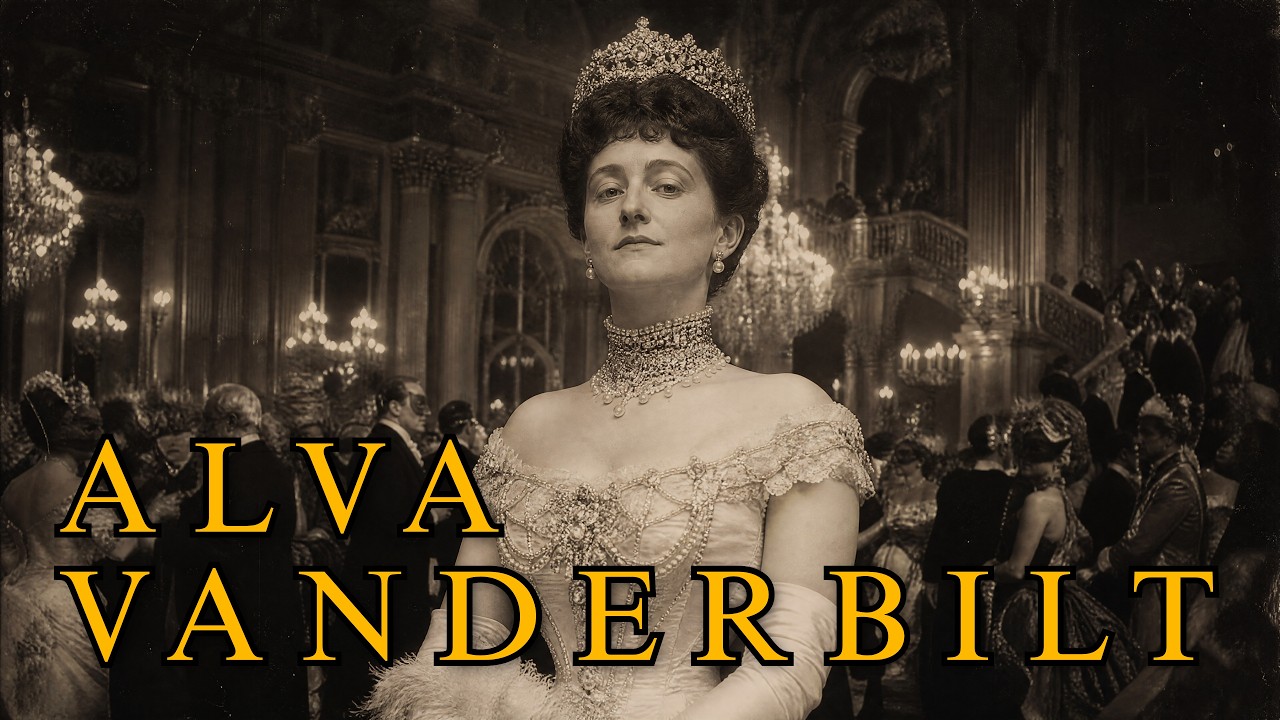
On Easter Monday 1883, a crowd stood in the cold outside a white stone house on Fifth Avenue, waiting to watch strangers arrive dressed as kings. Inside stood the woman who had built the house, costumed as a painting. Twelve hundred invitations had gone out, but barely 700 people came. Alva Vanderbilt had not spent her fortune on the party itself; she had spent it on something far less tangible—a piece of paper that would grant her entry into a society that had refused to acknowledge her existence.
Twelve years later, she would use the same instrument of control against her own daughter, locking her in a house by the sea with a guard posted at the door. And 31 years after that, under oath in a court in Rome, she would admit exactly what she had done. Born in Mobile, Alabama in 1853, Alva Erskin Smith was the seventh of nine children in a Southern family whose standing came from her mother’s side. Her father worked as a cotton commission merchant, building his business on his wife’s family’s capital and connections.
The family owned slaves, and Alva’s earliest documented memory involved bossing an enslaved boy named Monroe Crawford. “I managed the situation,” she later said. “I wanted my own way and with Monroe I got it. It was a case of absolute control on my part.
”
The Civil War destroyed the family’s world. After Lincoln’s assassination, hostility toward Southern families in New York forced them to flee. Her father moved to England to keep the cotton trade alive while Alva and her mother settled in Paris. She spent four years there, obsessively sketching the châteaux of the Loire Valley and Versailles—drawings that would later shape every house she built.
“I was brokenhearted that I must leave France,” she said. “America struck me in contrast to France as crude and raw. ”
The family that returned to New York was not the one that had left. Her father’s business had collapsed, and the family fell through the city one address at a time—three houses in four years, each smaller than the last.
In that world, a family that kept moving to smaller houses stopped being a family that other families called upon. Her mother died in 1871 at 48, triggering a mandatory year of mourning that took Alva off the marriage market at precisely the wrong moment. What she took from those years was a hard rule. “You cannot help your children to advantages through sentimental romance,” she said, “but through money which alone has power.
”
Her rescue came through Consuelo Yznaga, her closest friend, who introduced her to William Kissam Vanderbilt, the second son of William Henry Vanderbilt and grandson of the Commodore. They married in April 1875. Alva was 22. Her father died 14 days later, never knowing whether the gamble had worked.
The Vanderbilts possessed one of the great fortunes in America but could not get a calling card left at their door. New York’s old guard, led by Caroline Webster Schermerhorn Astor, regarded the Vanderbilts “as just the sort of people New York should rally round to exclude. ” The system ran on three mechanisms: a committee of 25 patriarchs who controlled the invitation lists for society’s subscription balls, the calling card that literally determined whether a family existed socially, and 18 opera boxes at the Academy of Music that passed from parent to child. Alva spent a decade working out how to force entry.
Her solution was a house. She hired Richard Morris Hunt, the first American architect trained at the École des Beaux-Arts in Paris, and between 1879 and 1883 they built a French château on the northwest corner of Fifth Avenue and 52nd Street. The house cost around $3 million—roughly $93 million today—and faced in gray Indiana limestone on a street of brownstone. White stone on a brown street, visible from three blocks off.
She set the party for Easter Monday 1883—the first legitimate night of the season after Lent ended. Anyone who stayed away was staying away from her. She borrowed a title, using her friend Consuelo, now Lady Mandeville, as guest of honor. Mrs.
Astor could snub a railroad family; she could not snub a British viscountess. The ball itself became legend. A single dressmaker produced more than 150 gowns. Twenty-five police officers were posted at the entrance, with plainclothes detectives patrolling near the windows—they were watching for dynamite.
The Sun’s front page report opened by noting the ball was “gorgeously accomplished last night with no interruption by dynamite. ”
The costumes were extraordinary. Alva came as a Venetian princess in a costume copied from a Cabanel painting, wearing a Venetian cap covered in jewels set with a peacock worked in many colored gems. Her sister-in-law Alice came as the electric light in a Worth creation that contained a battery.
One guest came as a wasp with antennae made of diamonds. Another came as a cat wearing a taxidermied white cat’s head as a hat. Mrs. Astor came.
She organized one of the quadrilles. The exclusion ended in public. Four days after the ball, a Massachusetts newspaper worked out that every account of it printed in America had been written by the same hand—Alva’s. She had invited newsmen in, allowed the house to be photographed, and described the design elements herself.
The costumes appeared in identical order and language in papers across the continent. The famous cost figure of $250,000 was also misleading: the guests themselves had spent $155,730 of it on their own costumes. Alva’s own outlay was between $35,000 and $50,000. In 1885, William Henry Vanderbilt died, leaving his fortune split between his two eldest sons.
Alva’s husband received $55 million—around $1. 75 billion today. She built again, this time at Newport. Marble House went up between 1888 and 1892, modeled on the Petit Trianon at Versailles, using 500,000 cubic feet of marble.
On her 39th birthday, her husband gave her the house outright in her own name. The marriage was already finished. In 1894, Alva saw something that ended it: driving through the Bois de Boulogne, she passed a carriage more splendid than hers, whose servants wore what she thought at first was her own livery. Her husband had allowed his mistress’s servants to wear the same uniform as his wife’s.
She went back to America and hired the best lawyer in the country. New York law at the time allowed only one ground for absolute divorce: adultery. The same statute barred divorce by consent or collusion. To get out of a marriage, a wife needed her husband to commit real, provable adultery—which is exactly what William Kissam Vanderbilt had spent the summer of 1894 doing in the most conspicuous manner available.
The decree was signed on March 5, 1895. Alva was the plaintiff; her husband was the party judged guilty. Custody of their three children went entirely to Alva. Both parents agreed in open court that the two sons would receive their education in the United States.
About the daughter, who had turned 18 three days earlier, they said nothing at all. Eight months later, she was a duchess. Consuelo Vanderbilt had grown up tall, quiet, and trilingual. Her mother disciplined her with a steel rod strapped down her spine and a whip.
“I do not ask you to think,” Alva told her. “I do the thinking. You do as you are told. ” When Consuelo fell in love with a man named Winthrop Rutherford—a descendant of Peter Stuyvesant and John Winthrop, exactly the old blood Mrs.
Astor had spent decades protecting—Alva launched a campaign against him. She told her daughter he was a fortune hunter, that he had a married mistress, and that there was madness in his family. None of it was ever substantiated. He went on to father seven children.
At Marble House in the summer of 1895, Alva threatened something worse. When Consuelo would not give way, her mother said she would shoot the man her daughter loved. Under oath to a church tribunal in 1926, Consuelo testified the threat was specific: Alva said she would shoot her sweetheart, would then be imprisoned and hanged, and that Consuelo would be responsible. Alva then feigned illness—or at least allowed her daughter to believe she was ill.
Mrs. William Jay, Alva’s intimate friend, came to Consuelo’s room and told her that her mother had suffered a heart attack brought on by her daughter’s callous indifference. “Your mother will never relent,” she said. “And I warn you there will be a catastrophe if you persist.
”
Consuelo surrendered. Charles Spencer Churchill, ninth Duke of Marlborough, arrived at Newport in September and proposed quietly in the Gothic room. “There was no time for thought or for regrets,” she wrote. The settlement was signed the day before the wedding.
An 18-year-old girl signed away her inheritance in 90 minutes. Her income went to her husband. The capital went to a future duke. She controlled none of it.
She spent the morning of her wedding in tears and alone, with a footman posted at the door of her apartment. “Like an automaton, I donned the lovely lingerie,” she wrote. She was 20 minutes late because her eyes, swollen with tears, required copious sponging before she could face the crowd. Outside, 200 police officers held back thousands of spectators.
The route to St. Thomas Church ran down Fifth Avenue, past the great Vanderbilt palaces—gloomy and deserted, boarded up. Her dress carried a piece of Brussels lace that her grandmother had worn at her own wedding in Mobile and that her mother had worn at hers. Winthrop Rutherford sent a pair of antique silver candlesticks.
Two months later, Alva Vanderbilt married the man she actually wanted—Oliver Hazard Perry Belmont—in her own drawing room in front of almost nobody, in a traveling dress of sorrel green cloth, and left town within three hours. He was 12 years her junior. They had 12 years together, the only happy ones in this story. In June 1908, he died of peritonitis after going to the races in the rain.
She was 55. Bertha Honoré Palmer had been right about her all along: Alva had built her life out of paper—cards, lists, decrees, contracts. And she would use every one of them again. After Belmont’s death, she became an ardent suffragist.
She opened Marble House to the public for lectures, sold tickets, and put the money into the campaign. She rented office space for the National Suffrage Association and funded its press bureau—by 1912, it was sending 2,000 copies of its bulletin every week to every major news organization in America. She bailed four striking factory girls out of night court, putting up her own house worth $400,000 as security. She also secretly funded a whites-only suffrage campaign in the South, defending it with the same logic she had applied to her daughter: she was “not at all particular” as to how the vote should be granted.
When the mainstream suffrage organization voted to table her proposal—134 to 169 against—she walked out and financed the rival institution. Alice Paul’s Congressional Union became the National Woman’s Party, a name Alva herself suggested. In 1925, Consuelo petitioned the Catholic Church to declare her marriage to the Duke had never existed. The ground was force and fear.
The strongest evidence against Alva Vanderbilt Belmont was Alva herself. She gave a deposition: “I forced my daughter to marry the Duke. I always had an absolute influence over my daughter… When I gave an order, no one argued.
Therefore, I did not ask her. I commanded her to marry the Duke. ”
The tribunal found that “every sort of constraint, pushed even to physical violence, had been employed to attain her end. ” The decree was signed in August 1926.
The Bishop of Sodus explained it plainly: “The marriage of the Duke of Marlborough and Consuelo Vanderbilt was declared null because through fear she did not give her willing but only her unwilling consent to the contract. ”
A quarter century of a life unwritten by a sentence. Asked to comment, Alva called it “merely one of those adjustments that come into the lives of people. ” Then she asked to be excused.
She was in the middle of packing. She died in Paris on January 26, 1933, at the age of 80. Of her three children, the only one at her bedside was the daughter she had broken. Her funeral was exactly as she had instructed.
The service was at St. Thomas Church, where her daughter had been married 37 years earlier. Everything was done by women. Honorary pallbearers included Jane Addams, Amelia Earhart, and Margaret Sanger.
Women in white and purple carried banners. The hymn had been written by the woman in the coffin. At the head of the casket, held in full view, was the actual banner women had carried at the gates of the White House. It bore three words: “Failure is impossible.
”
Among the mourners filed former strikers from the New York shirtwaist factories. Fifty years after a party where guests spent $155,730 on fancy dress, the factory girls she had bailed out of night court came to honor her. In 1952, Consuelo published her memoirs. She described her mother’s funeral, noting dryly that the hymn “naturally concerned a woman.
” Sometime after the book was already in print, she went back in and added one sentence—the warmest thing she ever said about her mother: “It was only fitting that such tribute should be paid to the courage she had shown in braving popular prejudice and established custom to secure better conditions for women the world over. ”
Alva Vanderbilt spent her whole life deciding what other people were on paper. The final account of her was written by the daughter she sold.