On the morning of February 3, 1997, the United States Ambassador to France entered the pool at the Ritz Hotel in Paris and began her daily swim. She was 76 years old. Two hours later, she was pulled from the water by a hotel employee, unconscious. By the standards of her extraordinary life, it was a quiet end.
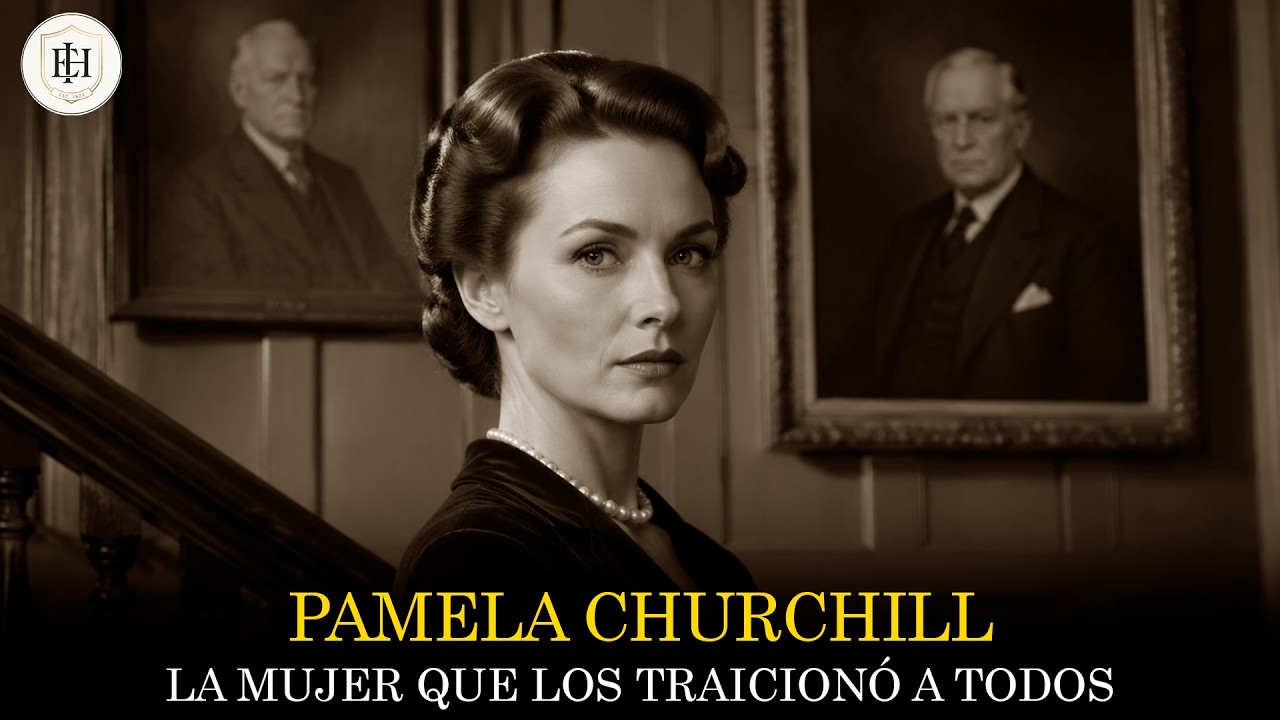
Most people remember her as the girl who married Winston Churchill’s son. But Pamela Beryl Digby was far more deliberate than that. Born on March 20, 1920, in Hampshire, she was the eldest daughter of the 11th Baron Digby, a title dating to 1765. The family owned the Minterne estate in Dorset, which the Digbys had farmed since the 10th century.
Despite the title and the estate, the Digbys were not wealthy by the standards of their own class. The agricultural depression of the 1870s, Lloyd George’s death duties, and the First World War had drained the family capital. Pamela was raised with a clear understanding: the girls had the family name and the obligation to marry well, but no fortune and no London house. She made her debut in London society during the 1938 season at age 18.
Her mother gave her a clothing allowance of 100 pounds, while the rest of the season operated on five times that amount. She borrowed gloves from cousins and wore the same evening dress two nights in a row. She later said the lesson of that summer was simple: a girl without a fortune had only one currency to spend, and that currency was herself. The opportunity arrived in September 1939, in the form of a country house weekend and a blind date with Randolph Churchill.
He was 28, the only son of Winston Churchill, then First Lord of the Admiralty. He was tall, loud, frequently drunk, and almost continuously in debt. He had run for Parliament three times and lost all three. He proposed to her on the first night, in front of the other guests.
She laughed and changed the subject. He proposed again on Saturday morning, Saturday night, and Sunday at lunch. On Sunday afternoon, sitting by the fire in the library, she accepted. She was 19.
She had known him four days. The wedding took place on October 4, 1939, at St. John’s Church in Westminster. Prime Minister Neville Chamberlain sent his apologies, but Winston Churchill was present, greeting the press and kissing the bride.
In photographs from that day, the bride looks directly at the camera. She does not smile like a girl who married for love. She smiles like a girl who has just been seated at the only table in London that matters. The honeymoon lasted three days.
Less than four months later, Randolph was in Cairo with the commandos. By the autumn of 1940, Pamela was settled at 10 Downing Street, eight months pregnant, with her bedroom one floor below the Prime Minister. She was 20 years old. What she had actually married was not Randolph Churchill but his father’s office.
By the spring of 1940, she was sleeping in a bunk in the Downing Street basement, with her infant son Winston in a basket in the top bunk. Each morning, she heard the Prime Minister through the wall, phoning Washington or Cairo or the King. She listened carefully. She listened to the names of American officers, diplomats, and journalists now arriving in London under the new Lend-Lease agreement.
Pamela had a gift. She remembered the names of wives and children, which guest had lost a brother, which guest was about to be promoted, which guest could not tolerate breakfast kidneys. She wrote everything in a small leather diary. Each morning, she and Clementine Churchill mapped out the seating plan for the Prime Minister’s dinner table over early tea.
Winston Churchill noticed. In the winter of 1940, he began asking his daughter-in-law to join him and his American guests for after-dinner coffee. She sat to his left, said very little, and listened. American envoys, after their second brandy, told a 20-year-old English girl things about their president, their wives, and their business affairs.
The next morning, the Prime Minister knew everything. On the night of March 16, 1941, the worst German air raid on London coincided with the most important seduction of the special relationship. In Suite 26 of the Dorchester Hotel, the safest building in central London, Pamela became the lover of William Averell Harriman, President Roosevelt’s personal envoy. He was 49, the heir to the Union Pacific Railroad fortune.
She was 20. Harriman had arrived in London six days earlier. That weekend, the Prime Minister had seated them side by side at every meal at Chequers. The Prime Minister, who saw absolutely everything, said absolutely nothing.
She woke at 5 a. m. in an unknown bed. She lay still for an hour.
She was not in love, she knew that. But she understood exactly what she now possessed: the most useful private channel to the American mind that the British war effort had. At 7 a. m.
, she sat at the Prime Minister’s breakfast table. He looked up at her once over his spectacles. He did not ask where she had been. He passed her the toast.
Winston Churchill knew about the affair within ten days. He did nothing. He did not write to Randolph, he did not summon Pamela, he did not reprimand anyone. He kept inviting Harriman to Chequers.
He kept seating them side by side. He kept asking Pamela at breakfast what Harriman had said. The arrangement continued for nine months. In the spring of 1941, Britain was losing the Battle of the Atlantic and running out of supplies.
Churchill needed every private channel into President Roosevelt’s mind that he could find. His private secretary recorded that Churchill called Pamela his window into the American mind. Randolph returned from Cairo in late 1941 and confronted his father. The Prime Minister told him there were things more important at stake than the dignity of a single marriage.
He told his son to return to Cairo. Randolph returned. The marriage, in any practical sense, ended with that conversation. The divorce was finalized in December 1945.
Pamela then moved to a flat in Grosvenor Square, paid for by Lord Beaverbrook, the press magnate and Minister of Aircraft Production. Her son was placed with a nanny in Surrey. One biographer called this period of her life Operation Seduce the United States. The men she slept with during 1941 and 1942 were not chosen by chance.
When Edward R. Murrow entered her drawing room in late 1941, she began the only love affair of her life she was never able to turn into marriage. Murrow was 33, the chief European correspondent for CBS, whose broadcasts had brought the Battle of Britain into American living rooms. He was married.
She was the only man she ever truly loved, she would say privately for the rest of her life. The affair with Murrow ran in parallel with the affair with Harriman for nearly a year. Both men knew. Neither brought it up.
Murrow treated her as an equal, read her his scripts, asked for her opinion, wrote her long letters now preserved in the Library of Congress. She believed she could turn that affair into marriage. She flew to America in the spring of 1946. The war was over.
Her divorce was final. She phoned Murrow from a small hotel in Manhattan. He told her he could not leave his wife. He had a child on the way.
She held herself together during the meeting, returned to her room, and collapsed. She wrote to her mother that she had never expected the word no. She spent two weeks at Harriman’s country house as a guest. He drove her to the pier, gave her a kiss on the cheek, and told her her ship was sailing at noon.
It sailed at noon. She returned to England. At the end of two weeks, she made a decision that organized the next 13 years of her life: she would go to Paris, and never again would she fall in love with a man she could not also use. In Paris, she met Gianni Agnelli of Fiat, the heir to the largest private industrial fortune in continental Europe.
He fell in love with her. By the autumn of 1947, he had set her up in a Paris apartment with a Bentley, a chauffeur, and a staff of four. For nearly three years, he intended to marry her. His three older sisters told him they would resign from the family business if he did.
He chose family. He called her every morning at 7 a. m. for the rest of his life.
The next lover was Élie de Rothschild, heir to the Château Lafite branch of the great French banking family. He was married. The arrangement worked very well. Neither was in love.
He paid the bills and taught her about wine and paintings. Time magazine, in a 1955 article, mentioned her name in connection with five different married men in a single year. The Paris years gave her a small fortune and a network of contacts no English woman of her generation could match. In the spring of 1959, she bought a ticket on the SS Liberté.
She was 35, beautiful but no longer young, and she needed an American husband. Leland Hayward was the most successful theatrical producer in the United States, with South Pacific, Gypsy, and The Sound of Music behind him. He was 57, married to his fourth wife, Slim Keith. The affair began in less than two weeks.
The marriage took place on May 4, 1960, in Carson City, Nevada. Three of his four children did not accept her. His daughter Brooke had recently lost her mother to suicide; another sister, Bridget, took her own life six months after the wedding. His son Bill was a recovering addict.
The children blamed Pamela, at least in part, for the family’s unraveling. The 11 years of marriage were comfortable for Leland and profitable for Pamela. They hosted the most sought-after dinners in New York. Truman Capote, Babe Paley, and the leading figures of 1960s New York culture attended.
Leland died on March 18, 1971. The estate was modest. Pamela received half; the children received the other half, plus the country house and the residuals to the big musicals. Then there was the matter of the pearls.
Brooke Hayward had inherited a pearl necklace valued at about $90,000 from her mother and had given it to Pamela to keep in the Hayward vault. After the funeral, Brooke asked for it back. Pamela said she knew nothing about them. The pearls had never left the vault, and the vault was Pamela’s.
Brooke wrote a bestselling memoir, Haywire, about the family’s destruction. Six months after Hayward’s death, Averell Harriman, then 79 and recently widowed, telephoned the woman he had not truly held since 1946. He had spent the intervening 25 years as Secretary of Commerce, Governor of New York, undersecretary of state, and chief negotiator of the nuclear test ban treaty. He proposed at dinner at the Pierre Hotel.
She accepted at the table. The wedding was held in September 1971. The Harriman world was vast: the Manhattan mansion on East 81st Street with its 20,000-volume library, the Georgetown house, the Sun Valley ski resort, the 400-acre family estate in Orange County, and an art collection including a Van Gogh, a Renoir, and two Picassos. The morning after the wedding, Averell called his lawyers and made Pamela the primary beneficiary of his living estate and co-trustee of the family trusts.
Harriman’s daughters objected. They had known Pamela in London during the war. They knew what their father had done with her. They assumed the affair had ended in 1946.
They did not understand that the 1971 marriage was, in their father’s eyes, the formal closing of a 30-year interrupted story. Over the 15 years of the marriage, the Harriman world passed, item by item, into Pamela’s hands. Averell died on July 26, 1986, at age 94. The eulogy was delivered by Pamela.
She was 66 years old. She had outlived all three of her husbands. She had the Harriman name, the Harriman money, and the Georgetown house. She had, through 47 years of careful calculation, finally reached the position from which she intended to operate.
In the spring of 1981, Pamela began hosting dinners at her Georgetown house at 3038 N Street. Every Tuesday night at 7:30, 16 Democrats sat at her table. The party had been devastated by Reagan’s landslide. Pamela understood the situation.
She had observed in 1941 what it took to assemble an operative political coalition under impossible conditions. The dinners followed the precise pattern she had used for decades: 16 guests, three courses, two wines, black coffee in the drawing room, a single speaker for 8 to 12 minutes, questions directed by the hostess. In 1982, the political action committee Democrats for the 80s was registered. The Washington press shortened the name to PAM PAC.
Over the 1980s, it raised an estimated $12 million. She made the introductions that mattered. The young governor of Arkansas, William Jefferson Clinton, came to N Street for the first time in the spring of 1987. She sat him next to the evening’s big donor and invited him back ten times over two years.
By 1989, she had introduced him to every major Democratic donor in the country. When he announced his candidacy in October 1991, the Clinton campaign’s first 90 days of donor money came almost entirely from the list she had built. He won the presidency on November 3, 1992. She sat in the second row at the inauguration.
The new president appointed her United States Ambassador to France. She was confirmed in April 1993, at age 73. She moved into the ambassador’s residence with a staff of 17 and hosted dinners three nights a week. The Dayton peace agreement on Bosnia was signed in Paris in November 1995 during her ambassadorship.
She organized the dinner that followed and placed every guest with her own hands. The President of the United States called her twice a week to think out loud about Europe. The pinnacle lasted exactly one year. The lawsuit was already on its way.
In September 1994, the Harriman daughters filed a 200-page suit in New York, alleging that the trustees had breached their duties and that the trust capital had fallen from over $30 million to about $3 million in the eight years since Averell’s death. The most damaging element was a failed Atlantic City casino investment that lost over $20 million. The papers were delivered to Pamela in person at the Paris embassy. She offered to resign.
The Secretary of State told her not to. The President phoned to say she must stay. For the next 18 months, she led the mission by day and sat for depositions in the embassy library by night. The lawsuit was settled in November 1995 for an estimated $15 to $20 million.
Pamela paid her third of the settlement by selling the paintings. The Sotheby’s sale took place in the spring and summer of 1996. The Van Gogh, the Picassos, the Toulouse-Lautrec, the Cézannes all went to auction for a reported $25 million. The Renoir that Winston Churchill had given her as a wedding present in 1940 now hangs in the Smithsonian American Art Museum.
On the morning of February 3, 1997, Pamela walked from the ambassador’s residence to the Ritz Hotel, where the spa manager opened the pool an hour early for her private use. She entered the water and began her first lap. She did not complete it. She stopped mid-stroke and floated face down.
An employee pulled her from the water. She was taken to the American Hospital of Paris with a massive cerebral hemorrhage. It was inoperable. Her son Winston arrived from London that afternoon and stayed with her all night.
She died on February 5, 1997, at age 76. President Chirac personally placed the Grand Cross of the Legion of Honor on her casket. President Clinton sent Air Force One to bring her body home. She was buried on February 14, 1997, in the family cemetery at the Harriman estate in the Lower Hudson Valley, next to Averell.
Her headstone reads: Pamela Beryl, Churchill, Hayward, Harriman, Beloved Wife of W. Averell Harriman. The Harriman daughters did not attend the funeral. She left behind almost nothing in the way of an estate.
The lawsuits had taken the paintings. The trusts had been returned. The Georgetown house was bequeathed to the Democratic Party. What she left was the Pamela Harriman Foreign Service Fellowship, which has placed hundreds of graduate students in American embassies, and 735 feet of personal papers at the Library of Congress, open to researchers.
The question her life poses is whether she was the last of the great English women who lived by the distribution of seats, or the founder of the model that built the modern Democratic Party. The woman who built it did not live to see what it became. She had carried the Churchill name as collateral for half a century, all the way to a marble pool in the Place Vendôme, where the long, silent work of seating distribution finally came to an end.