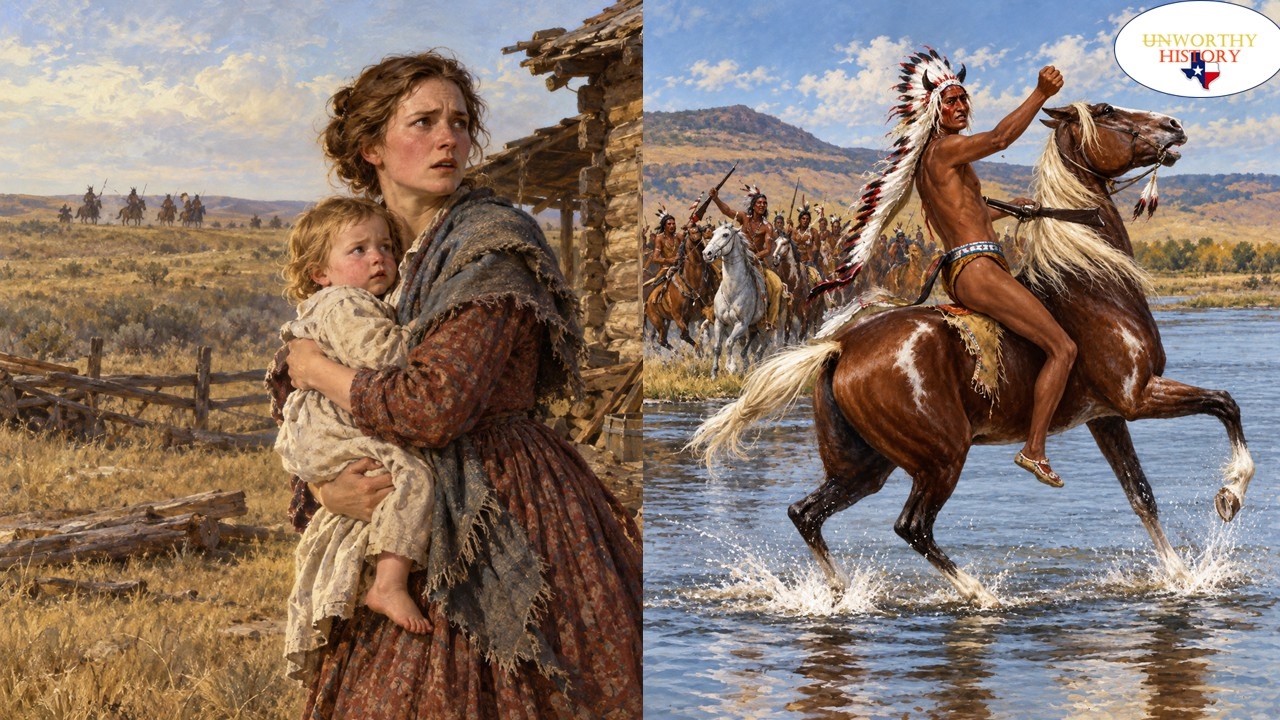
In August 1866, a Cheyenne war party of roughly forty warriors descended on a settler’s cabin in Jewell County, Kansas, dragging Elizabeth Marlin into the woods by a rope around her neck. The entire group then assaulted her in a manner described as savage and brutal, leaving her unconscious before burning her home and stealing everything inside. She survived, but the attack marked one of the first major atrocities in a wave of violence that would drive settlers from White Rock Valley. The Marlin family had arrived in the area in the spring of 1866 with a group of settlers claiming land along White Rock Creek.
This was the second wave of settlement in the region. The first came in the spring of 1862, when William Harshbarger and his wife, John Foroz, and Asbury Clark with his wife and child settled on White Rock Creek after moving from Knox County, Illinois. Those early settlers built cabins, plowed their fields, and prepared to make the valley their home. But two incidents convinced them the land was not yet safe.
In the first, a band of Indians arrived at the Clark cabin while Clark was home alone with his young son. Clark, embarrassed and reportedly unsure how to receive them, left abruptly, leaving his five-year-old son to host the visitors alone. The child offered them everything in the cabin, which amused the Indians greatly, and they left without causing harm. The second incident proved more ominous.
A violent battle between Sioux and Pawnee warriors occurred near the settlement, with the Sioux emerging victorious. One Pawnee, chased by two Sioux warriors, sought refuge in Clark’s cabin and begged him for protection. Clark refused, saying he feared for his life. The Sioux arrived almost immediately and were about to kill their helpless victim inside the cabin when Clark asked them not to kill him there and to take him outside.
They did so, dragging the man a short distance and killing him. During that visit, the Indians told the settlers a major war was coming and suggested White Rock Valley would not be a desirable place to live. The settlers took the advice and left. This first wave retreated, but a stronger wave followed after the Civil War ended.
In the spring of 1866, William Belknap, John Rice with his wife and two children, Nicholas Ward with his wife and adopted son, an old man named Flint, Mrs. Sutzer and her son, the Dart family, Arch Bump, Erastus Bartlett, and John Marlin with his wife and child all claimed land along White Rock Creek. They worked diligently to improve their new homes, without any apparent fear of danger. That changed on an August evening in 1866.
When Marlin saw the Cheyenne warriors approaching, he ran to his horses, mounted one, and rode toward the creek to raise the alarm. Immediately after he left, the attackers entered his cabin, put a rope around his wife’s neck, and dragged her into the woods, where the entire group assaulted her. Marlin fled to a fort just below the town of White Rock for help. The next morning, Thomas Lovelace, an old settler from Republic County, along with Rice and Bump, accompanied Marlin back up the creek.
About four miles west of the county line and six miles east of the attack site, they found Mrs. Marlin wandering in a dazed state. Her ordeal had left her completely unhinged, and when she saw the rescue party, she mistook them for her attackers. To avoid being recaptured, she kept moving from place to place, hampered by the small child with her, until her husband called her name, “Elizabeth,” and she realized they were friends and stopped.
The Indians had stripped the Marlin cabin of all provisions and clothing, emptied the feather beds of their covers, and set the cabin on fire before leaving. Panic spread through the settlements, and everyone retreated to a fort in Republic County. After two days, they all went to Clyde in Cloud County after rumors of a general massacre by Indians, which later proved unfounded. Within days, settlers began drifting back, and by fall, all had returned to their claims.
They remained undisturbed until the following spring, when a second attack by Cheyenne warriors killed four settlers and drove the rest from the county for good. On April 9, 1867, the Cheyenne attacked again. They killed Bartlett, Mrs. Sutzer and her young son, and Nicholas Ward.
They severely wounded Ward’s adopted son, leaving him for dead, and took Mrs. Ward captive. The details of the massacre were reported as follows. The Indians came to Mrs.
Sutzer’s cabin, where Bartlett was staying, and asked for lunch, which she began preparing. She sent her young son across the creek to the Ward home to warn them of the Indians’ presence. Bartlett was in the woods cutting timber. When he returned for lunch, the Indians met him and killed him with a hatchet as he came around the corner of his house.
He was found lying on his back, his iron wedge near his right hand and his own knife driven into his throat. The attackers reportedly avoided using firearms for fear of drawing attention. Mrs. Sutzer apparently tried to run.
She was found dead about thirty yards from the house, her skull crushed by a rock. After completing their work at the Sutzer home, the Indians crossed the creek to the Ward house and again asked for lunch, which Mrs. Ward prepared. They ate, smoked their pipes, and talked in what seemed a friendly manner.
When they finished smoking, one of them calmly loaded his gun and asked Ward whether he thought it could kill a buffalo. Ward said he thought it could. The Indian immediately leveled the gun at Ward’s chest and shot him through the heart, killing him instantly. The two boys, Ward’s adopted son and Mrs.
Sutzer’s son, began to run. The Indians chased them to the creek bank and fired on them in the stream. The Sutzer boy was shot through the heart and killed instantly. Ward’s boy was shot in the neck and left for dead.
Sometime that night, the boy regained consciousness and felt his way back to the cabin in the dark. He found the door broken in and entered. Feeling his way with his hands, he stumbled and fell over the lifeless body of his adopted father. He took some coverings from a bed and returned to the woods, where he remained the rest of the night.
A group of land seekers found him the next morning, and he told them his story. When the Indians had gone out to shoot the boys, Mrs. Ward had closed and barred the door. When the Indians returned, they broke the door down and took her captive.
Her fate was reportedly never known with certainty. Every possible effort was made by Mr. Flint, her grandfather, and her relatives in southern Illinois to find her, through both love and money, but without success. She was never found.
About two months after her capture, an article appeared in the Junction City Union that may have shed light on her fate. It described a white woman seen by some Black soldiers wandering alone on the Saline River. When they approached, she ran out of an old abandoned cabin and headed toward the woods, apparently in great panic, mistaking the soldiers for Indians. The soldiers, fearing she might be a decoy, did not follow her.
Because the description matched that given of Mrs. Ward, and because nothing had been heard of her since, it was believed almost certain that she was the woman and that she had escaped the Indians only to die of hunger and terror alone in the wilderness. Mrs. Ward was described as a tall, attractive young woman no older than twenty-two, with respectable connections, beloved by all who knew her.
As for the Marlin family, records indicate that John Marlin and his wife Nancy, as she is identified in some sources, settled in Jewell County in May 1866. In July, Nancy was assaulted and their property stolen or destroyed in an Indian raid. The couple never returned to the area. By 1881, she had left John, and in January 1884, he obtained a divorce on grounds of desertion and adultery.
Nancy had given birth to three children between 1867 and 1872: Henry Ward, Benjamin, and Mary, who died in infancy. One of the reasons cited in the divorce was that Marlin claimed a case of mumps contracted during his military service had rendered him sterile, meaning the children could not have been his. In September 1884, he married Evelyn Reid near Bonneville, Missouri, and lived there until his death. When Eva died in 1934, she was receiving a widow’s pension of thirty-six dollars per month.
The unknown fate of Mrs. Ward, the lack of any government effort to rescue her, and the fact that frontier settlers were left without protection were noted in the source as a sad commentary on the Indian policy of the time. The assaults on settlers in White Rock Valley in 1866 and 1867 were part of a broader conflict that eventually drew military campaigns into Kansas, including that of General Hancock in 1867, in which General Custer participated.