The night before “Brian’s Song” aired on ABC on November 29, 1971, Joy Piccolo sat alone in her Chicago home with her three daughters, all under eight years old. She knew that the next evening, roughly 55 million Americans would watch a dramatized version of her husband’s death — a film she had never been asked to approve. The movie was made just 18 months after Brian Piccolo died, while the grief was still acute. Joy learned about the production the same way the rest of the country did: by watching it.
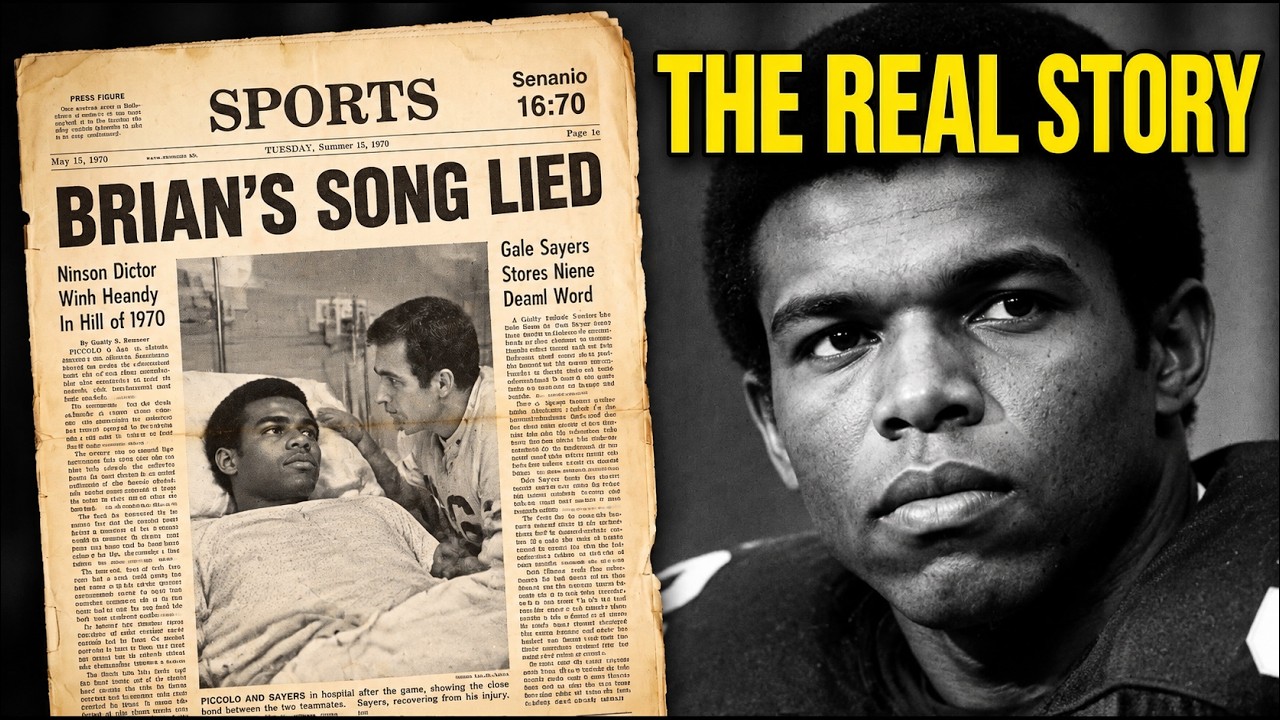
What she saw was a man she recognized, wrapped in a story she did not fully recognize, and the distance between those two things defined the experience. Brian Piccolo was 26 when he died in 1970. He had played four NFL seasons but started for only one. He led the entire nation in rushing in 1964, yet no team drafted him across 20 rounds.
He left behind a wife he married right out of college and three daughters. He was also relentlessly funny — so much so that even his own illness could not fully silence his humor. Scouts passed on Piccolo because they said he was too slow and too small. He arrived at the Chicago Bears training camp in 1965 as a free agent nobody expected to survive the cut.
He spent his first season on the taxi squad, practicing but rarely playing, while watching the man whose job he needed to take become a national phenomenon. He handled that situation the same way he handled everything: by finding humor in it. “I wasn’t only greatly surprised nobody drafted me,” Piccolo said at the time. “It also was a solid blow to my pride.
In my college career, I never was hurt and fumbled once in over 400 carries. I really wanted a pro try. ”
That quote captures Piccolo’s core — pride, humor, and a refusal to let either stop him. The film shows a charming rookie who befriends teammate Gale Sayers through sheer force of personality, but it does not fully capture the texture of that friendship.
Piccolo used humor not just to connect with people, but to reject the narrative being written for him: undrafted, undersized, and perpetually in the shadow of the most electrifying runner the NFL had ever seen. He joked about everything — being undrafted, his own limitations, the gap between what he could do and what Sayers could do. He made Sayers, a man not known for laughing easily, actually laugh. When cancer arrived, he joked about that too.
When a family member broke down at the hospital, he said plainly: “Don’t cry. You got to bounce up. It’s a league rule. ” He asked nurses for things the hospital did not stock.
He made Sayers laugh in rooms where no one else could find anything to laugh at. His college roommate at Wake Forest said Piccolo was the funniest person he had ever been around — not funny like a performer, but funny like a man who had decided somewhere along the way that despair was not an option available to him. Brian Piccolo died on June 16, 1970. He was 26 years old.
That same year, Gale Sayers published “I Am Third,” which included an 18-page chapter on Piccolo — one of the most intimate accounts one professional athlete had ever written about another man’s death. ABC optioned the rights almost immediately. Screenwriter William Blinn was hired. Filming began in the summer of 1971 at the Chicago Bears’ actual training camp, with real players and coaches in the background.
The film aired on November 30, 1971, just 17 months after the funeral. Joy Piccolo later said she had not been told the film was being made. “The pain was still so raw,” she said. She and Brian had married young, right after his senior season at Wake Forest.
She was 30 years old when he died. Nobody called her. Nobody asked. The film went ahead.
Despite that, the woman who had sat in hospital rooms with Brian recognized her husband on screen, even inside a version of his story she had never been asked to approve. The film shows George Halas breaking the news of Piccolo’s cancer to Sayers — a quiet, grave scene. But Halas was not the head coach of the Bears in 1969. He had retired after the 1967 season.
The man who actually coached the Bears when Piccolo removed himself from the game in Atlanta, after an X-ray revealed a tumor, was Jim Dooley. Dooley was the coach who received that news. The film erased him entirely and gave his scenes to Halas because Halas was a legendary name. What the film also erased was a specific truth about Piccolo: he played for a team where the man nominally in charge had already handed authority to someone else, where institutional loyalty was complicated and personal loyalty was everything.
That context is part of why what Sayers did mattered so much. By keeping Halas at the center, the film made the institutional version of the story easier to tell than the human one. The actor who played Brian Piccolo almost turned the role down. James Caan was building a film career in 1971 and had no interest in a made-for-TV movie.
He read Blinn’s script, set it down, and said no. Then he picked it back up. Something in Piccolo’s voice — the humor, the refusal to perform his own tragedy — found something in Caan that he could not walk away from. He said yes.
Four months after “Brian’s Song” aired, Caan appeared as Sonny Corleone in “The Godfather. ”
The actor cast as Gale Sayers had a different story. Lou Gossett Jr. was the original choice, but a few days before filming began, he tore his Achilles tendon during a pre-production workout.
Studio executives hired Billy Dee Williams to replace him on short notice, with almost no preparation. Producer David Wolper made Gossett a promise: the first great role that became available was his. In 1977, Wolper cast Gossett as Fiddler in “Roots” — the role that was supposed to save his career found another way to save it six years later. The two men who made Piccolo and Sayers real for 55 million Americans were, in different ways, accidents of timing.
“Brian’s Song” showed Piccolo dying with dignity — a quiet room, a peaceful ending. That is not what happened. Piccolo underwent three major operations at Memorial Sloan Kettering. The second was a radical mastectomy, the same surgery given to women with breast cancer.
Jeannie Morris, the journalist who spent months documenting his illness for the book “Brian Piccolo: A Short Season,” described the second operation as “extremely mutilating. ” Piccolo told friends afterward that doctors had told him he was cured. He believed it because he needed to believe it, and because the alternative was a conversation nobody in that hospital was ready to have. The cancer came back.
The third operation removed his left lung and left pectoral muscle entirely. Mid-operation, surgeons found more cancer they could not reach. His last weeks were spent being lifted, turned, and punctured in a body that had run out of places left to fight. Joy had grown suspicious of the medical optimism months before the end.
She and Brian had discussed it quietly between themselves, but they never felt they had the standing to push back against the people in the white coats. That detail — a man who joked about everything, who told family members not to cry because it was against league rules, going quiet in the one room where the stakes were too high to joke — is not in the film. George Halas had one reputation, and it was not warmth. Mike Ditka once said Halas threw nickels around like manhole covers.
Players negotiated against him for contracts he did not want to pay. That man paid every one of Brian Piccolo’s medical bills, every hospital charge, every family expense, the full remainder of his contract, and his funeral. He established college funds for Piccolo’s three daughters. When Joy’s bank refused to honor her mortgage because a widow with no steady income was suddenly a credit risk, Halas — who sat on that bank’s board of directors — made a phone call.
The problem disappeared before it reached her. Joy Piccolo said decades later that she never once saw a hospital bill. Someone always handled it before it found her. The film put McLane in the background of hospital scenes without explaining why he was there.
He was there because Halas had told him that was his job from the day of the diagnosis. Every day for eight months, the man who counted nickels spent whatever it took and never told a single reporter. Six months before the Watergate break-in that ended his presidency, Richard Nixon watched “Brian’s Song” in a private screening at the White House and told the press it was one of the great motion pictures he had ever seen. He urged every American to see it.
A sitting president was endorsing a made-for-TV movie about a football player most of the country had never heard of 18 months earlier. The film had done something almost unprecedented for television: it made 55 million people cry on purpose on a Tuesday night, without special effects, movie stars, or a theatrical release. William Blinn’s script won the Emmy for outstanding writing achievement in drama. Jack Warden won for outstanding performance by an actor in a supporting role for his portrayal of George Halas — the coach who was not actually there.
A Los Angeles Times critic wrote the day it aired that the film made race relations look “so simple and uncomplicated and so right that you wonder what the fuss is about. ” A Baltimore Sun critic pushed back: “The film was ostensibly about the death of a football player, but was more precisely about how gracious and charitable that footballer was during his lifetime for deigning to share a room with a black man. ” Both critics were writing about the film. Neither was writing about Brian Piccolo.
Joy Piccolo eventually made peace with “Brian’s Song,” not because it was exactly right, but because the part it got right — the friendship, the humor, the refusal to let the dying overshadow the living — was the part that mattered most to her. The inaccuracies she could live with. The truth underneath them she recognized immediately. Brian Piccolo’s number 41 is retired by the Chicago Bears.
Every year, the team gives an award in his name — not for the most yards or the most touchdowns, but for the teammate who best shows his particular combination of courage, loyalty, and humor. The Brian Piccolo Award is not about speed or statistics. It is about the three things that made him who he was in rooms where none of those measurements helped — the three things the scouts did not measure in 1964 when they decided 20 rounds was not enough time to call his name. The film ran for 73 minutes and made 55 million people cry.
It changed some details, erased some people, and softened some truths. Joy Piccolo watched it knowing all of that. She watched her husband made into a character by people who had never sat in those rooms with him. And she said later that she saw him in it anyway — in the jokes, in the way he talked to Sayers, in the refusal, even inside a film that was being gentle about his death, to seem like someone who had accepted what was happening to him.
She kept the trophy that Sayers brought to the hospital, with his name taped over where Sayers’s name had been. She kept it for the rest of her life. The trophy with the wrong name on the nameplate, handed to the right man by the right friend at exactly the right moment. That part was not changed.
That part could not have been changed. It was too much who he actually was.