A single gunshot ended the life of cereal magnate Charles William Post on the morning of May 9, 1914, in his Santa Barbara mansion. The 60-year-old founder of the Postum Cereal Company, one of America’s wealthiest men, had been suffering from severe abdominal pain for months. An operation at the Mayo Clinic in March had been declared successful, but the agony returned. On that spring morning, he took a rifle from his collection and took his own life.
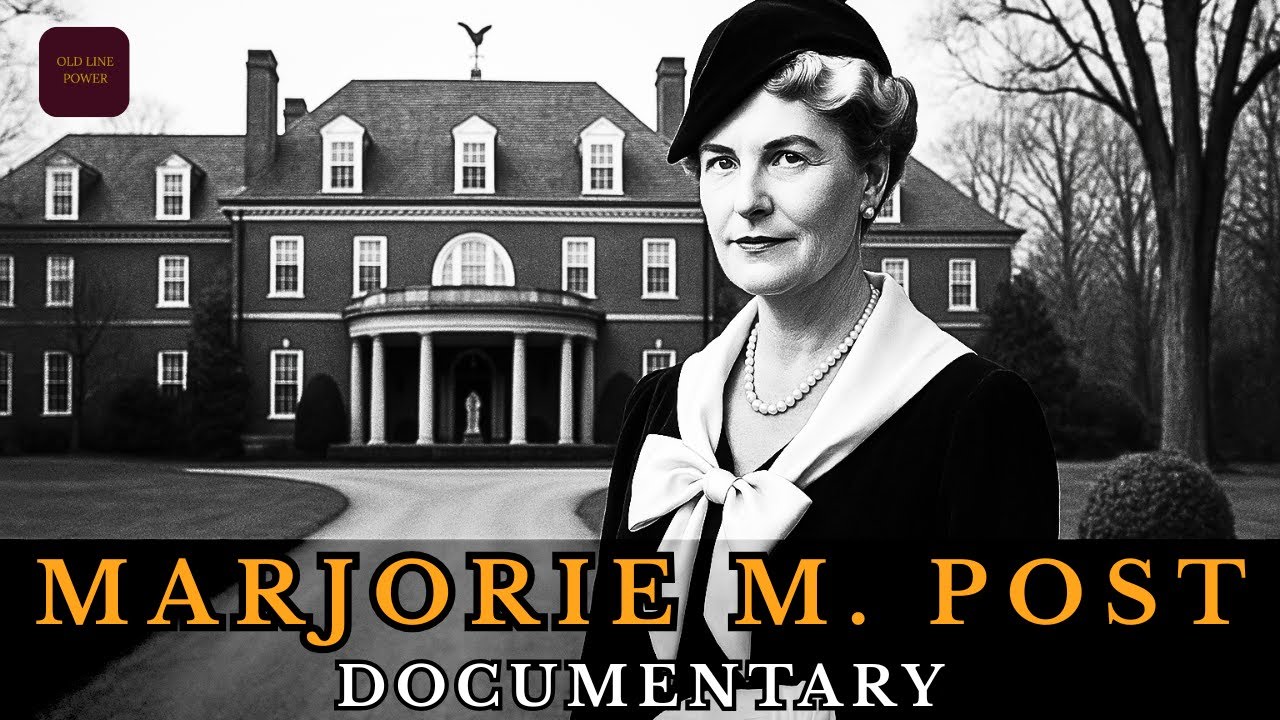
He left a cereal empire worth roughly $20 million. He also left a 27-year-old daughter who would turn that fortune into something far greater. Marjorie Merriweather Post would become the richest woman in America, a business pioneer, a philanthropist, and one of the most famous hostesses of the 20th century. Post had prepared his only child for responsibility in an unusual way.
At age 10, she began attending board meetings with her father in Battle Creek, Michigan. He explained his business decisions during carriage rides home. By her early teens, she toured factories and understood the logistics of packaging, distribution, and shipping. Born on March 15, 1887, in Springfield, Illinois, Marjorie was raised in modest circumstances.
Her father moved the family to Battle Creek in 1891, checking into the famous sanitarium run by Dr. John Harvey Kellogg. There he tasted a grain-based coffee substitute and saw an opportunity. He launched Postum in 1895, working out of a family barn.
His aggressive and often outrageous advertising campaigns convinced Americans that coffee was poison, and the company grew quickly. By 1900, the Postum Cereal Company employed hundreds of workers in a 20-acre factory complex. Marjorie helped in the barn as a child, gluing labels onto boxes. Her father launched Grape Nuts in 1897, despite the fact that it contained neither grapes nor nuts, and Post Toasties followed in 1904.
The rivalry between the Post and Kellogg families became legendary. In 1901, Marjorie was sent to Mount Vernon Seminary in Washington, D. C. , a finishing school for young women of means.
She traveled to Europe with her father during school breaks, where he showed his daughter how commerce worked internationally. Her first marriage at 18, to lawyer Edward Bennett Close of Greenwich, Connecticut, seemed respectable but hollow from the start. The couple had two daughters, Adelaide in 1908 and Eleanor in 1909. Throughout the marriage, Marjorie maintained her connection to the family business.
When her father died, she inherited the company immediately. He was buried in a $100,000 granite mausoleum at Oak Hill Cemetery in Battle Creek. The mausoleum contained 630 tons of Victoria White granite and a burial chamber nine feet below the floor. In 1916, while America still debated entering World War I, Marjorie organized a base hospital with the Red Cross.
She funded construction and equipment personally. The facility opened in France in the summer of 1918, able to accommodate 2,460 patients simultaneously. Her husband reported for military duty as a captain and saw combat in France, earning a battlefield promotion to major. The experience in France changed her.
Her marriage dissolved, and the divorce was finalized in November 1919. She was 32 years old, divorced with two daughters, and the owner of a major corporation. In 1920, she married Edward Francis Hutton, founder of the brokerage firm EF Hutton & Company. The firm had become the second largest brokerage house in the United States by 1920.
Hutton understood business in ways her first husband never had. He took Postum public in 1922 and became chairman of the board the following year. Together, they built a food empire. Postum acquired Jell-O, Baker’s Chocolate, Maxwell House coffee, Hellmann’s mayonnaise, Log Cabin syrup, Calumet baking powder, and Minute Tapioca.
The strategy followed the principles Charles Post had taught his daughter: find successful brands, buy them, apply superior distribution and advertising. The most significant acquisition began with a frozen goose. Aboard the family yacht, Marjorie noticed that a frozen goose tasted remarkably fresh. The trail led to Clarence Birdseye, a local inventor who had developed a revolutionary freezing process.
Marjorie urged Hutton to buy his company. The argument continued for years. In early 1929, Hutton agreed, paying approximately $22 million for Birdseye General Seafood Corporation, more than ten times the price Marjorie had originally proposed. In June 1929, the Postum Cereal Company became General Foods Corporation.
It was the largest food conglomerate in America. The 1920s also saw the construction of their most famous residence. In 1924, Marjorie acquired 17 acres of land in Palm Beach, Florida, on a coral ridge between the Atlantic Ocean and Lake Worth. She reportedly paid around $100 for the parcel.
The name wrote itself: Mar-a-Lago, Spanish for “sea to lake. ”
Construction took roughly four years. Over 600 workers labored on the project, including about 300 European craftsmen. Three boatloads of Doria limestone arrived from Genoa, Italy.
Nearly 36,000 antique Spanish tiles were installed. Twenty thousand roofing tiles came from old Cuban buildings. The completed house featured 58 bedrooms and 33 bathrooms. The final cost reached approximately $7 million.
Marjorie worked with architect Marion Sims Wyeth and Austrian-born designer Joseph Urban, who had created spectacular sets for the Metropolitan Opera. The collaboration was uneasy. Urban transformed the interiors into something theatrical, each room a stage, every vista composed for maximum emotional impact. In 1929, the couple commissioned the largest private sailing yacht ever built.
The 316-foot, four-masted vessel was launched in April 1931 with a crew of 72. Named Husar V, its interiors rivaled any European palace. The couple spent at least six months of each year aboard. The stock market crash of October 1929 did not ruin Marjorie.
General Foods stock declined but did not collapse, since people still needed to eat. She remained one of the wealthiest women in America. The contrast between her life and the lives of millions of unemployed Americans became impossible to ignore. Working with the Salvation Army, she opened the Marjorie Post Hutton Canteen in Hell’s Kitchen, serving 1,000 meals per day to women and children from 1930 to 1935.
She personally supervised the operation. At Christmas, she stood on a Manhattan street corner ringing a Salvation Army bell. No photographers were invited. Her marriage to Hutton deteriorated.
New York divorce law at the time recognized only one ground: adultery. Marjorie set traps with methodical precision, attaching small bells to doors and windows, stretching silk threads across hallways, and sprinkling talcum powder on floors. The evidence pointed to an affair with her own housemaid. She filed for divorce in 1935.
Three months later, she married Joseph Edward Davies, a prominent Washington lawyer with connections to President Franklin Roosevelt. Davies was soon appointed United States ambassador to the Soviet Union. The couple arrived in Moscow on January 19, 1937. Davies attended Joseph Stalin’s show trials and accepted the confessions as genuine, a position that would later be denounced by diplomats and historians.
Marjorie focused on her role as hostess, entertaining Soviet officials with elegance and open capitalism. She discovered microphones hidden throughout the embassy residence. The Soviets were selling off the treasures of the Romanovs. The revolutionary government needed foreign currency and had warehouses full of imperial silver, Fabergé eggs, porcelain, and icons.
Marjorie began to buy. The collection grew over time to include nearly 90 Fabergé pieces, 60 Russian porcelain dining services, 25 silver religious chalices, the nuptial crown Empress Alexandra wore at her wedding, and a diamond diadem that had adorned the last tsarina. During the Great Depression, she had another kind of property. Camp Topridge, in the Adirondack Mountains, grew to 68 buildings across 207 acres.
The main lodge contained a living room with 25-foot ceilings. Guests arrived by airplane and were ferried across the lake, then climbed the ridge by a covered funicular that Marjorie installed for her elderly aunt. Each guest cabin had its own fireplace, bar, butler, and call buttons. The guest list included General George C.
Marshall and Prince Felix of Luxembourg. Her third marriage ended in 1955. Within weeks of Davies’s death in May 1958, she married Herbert Arthur May, a Pittsburgh industrialist and widower. The union was a disaster.
Photographs surfaced showing Herbert at the pool at Mar-a-Lago in the company of younger men. The images were explicit enough to support blackmail. Her own daughter had known about Herbert’s proclivities before the wedding but had not warned her. After the divorce in 1964, Marjorie reclaimed her maiden name and never changed it again.
In 1955, she purchased a 25-acre estate in northwest Washington called Arbramont and renamed it Hillwood. She renovated the 36-room Georgian mansion and filled it with the Russian imperial treasures she had collected over four decades. In 1962, she formalized her intentions. Hillwood would go to the Smithsonian Institution upon her death, along with a $10 million endowment, on condition that it remain exactly as she had arranged it.
Mar-a-Lago would go to the federal government as a retreat for presidents. The Smithsonian accepted Hillwood but soon found the endowment insufficient, returning the property to the Post Foundation. Her daughter Adelaide opened the doors to visitors in 1977. On September 8, 1973, her grandson David died when his twin-engine racing boat capsized in Gardiner’s Bay off Long Island.
Four days later, on September 12, Marjorie Merriweather Post died at Hillwood of cardiac failure. She was 86 years old. She left $17 million divided among her three daughters. Her jewelry joined the Smithsonian’s collection.
The National Symphony Orchestra, the American Red Cross, and Mount Vernon College received substantial bequests. Mar-a-Lago proved problematic. Congress repealed acceptance of the estate in 1980. The Post Foundation sold it in 1985 to Donald Trump for $7 million, a fraction of what Marjorie had spent building it.
Hillwood remains open to visitors today, exactly as Marjorie arranged it. She had written near the end that she collected at first for joy, and only later realized the collection should belong to the country. Marjorie Merriweather Post lies buried at Hillwood in the gardens she designed, surrounded by the objects she loved.