By May 1945, the famous names of Hitler’s navy were already gone. The *Bismarck* had been sunk in the Atlantic in 1941. The *Scharnhorst* was lost in the Arctic dark at the end of 1943. The *Tirpitz* capsized in a Norwegian fjord under British earthquake bombs in November 1944.
What the Allies inherited was a navy of wrecks, cripples, and a few battered survivors. The fate of those vessels ran through atomic fire, the largest salvage operation in Polish history, and a coastal fortress in Norway. The mathematics of sea power were closed out in scrapyards and test lagoons for a full decade after the last salvo.
The paperwork came first. Through the second half of 1945, a tripartite naval commission of American, British, and Soviet officers inventoried every German naval vessel afloat, from destroyers down to harbor tugs. The fleet was divided into three roughly equal shares by drawing lots.
The surviving big ships were few enough to argue over individually. The Soviets pressed hardest and took, among much else, the unfinished aircraft carrier *Graf Zeppelin*. The Americans took the heavy cruiser *Prinz Eugen* for study. The British, with the world’s second largest navy, took ships the way a rich man takes change and marked the unseaworthy remainder for destruction.
The age of the German surface fleet ended in a conference room with dice.
The *Prinz Eugen* crossed the Atlantic under a mixed American and German crew. She was studied down to her welds, and in 1946 was towed to Bikini Atoll and anchored in the target fleet for Operation Crossroads, the first post-war atomic tests. She survived both the air burst and the underwater burst, still afloat when battleships around her were broken.
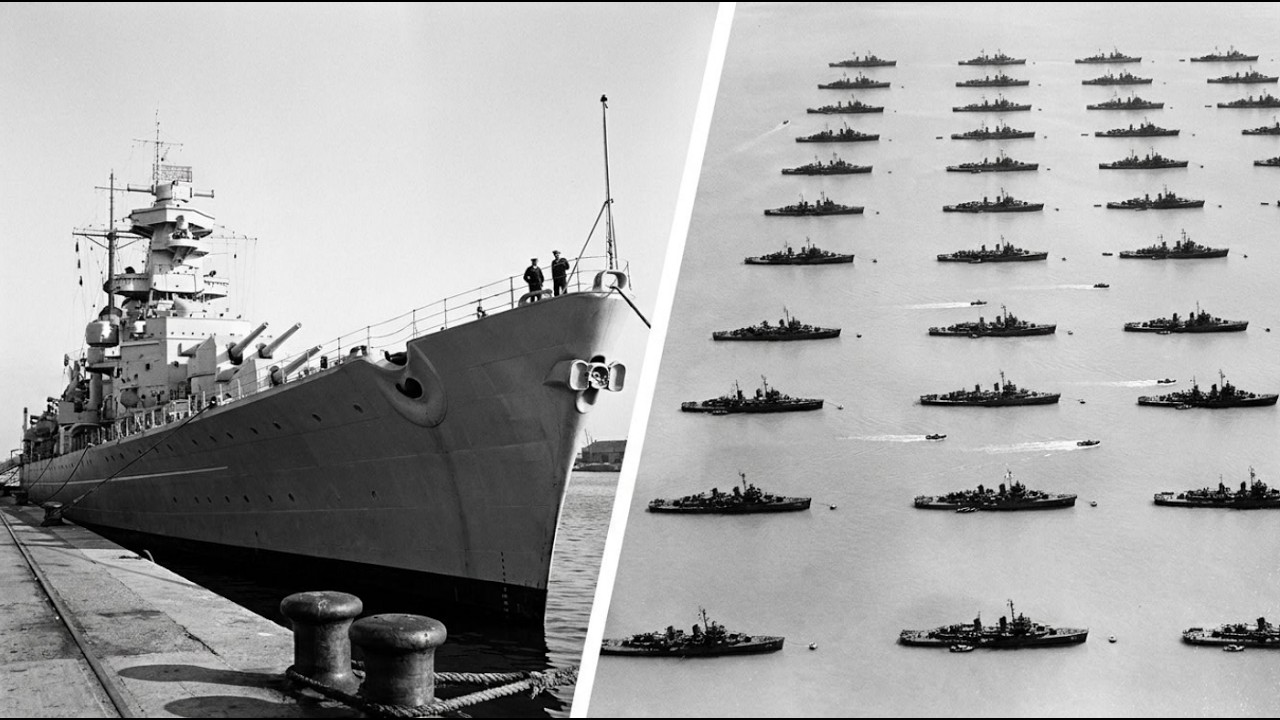
What no inspection could fix was the radiation soaked into her steel. Too contaminated to repair, she was towed to Kwajalein Atoll, where a leak that peacetime dockyards could have mended in a week was left to run. In December of 1946, she rolled over in shallow water and settled with her stern and one propeller above the lagoon.
The hull lies there today, visited by divers. In recent years, survey teams worried by sheening on the lagoon mounted a careful operation to pump the old fuel oil out of her tanks, drawing hundreds of thousands of gallons from a ship that had been dead for 70 years.
The *Prinz Eugen*’s Atlantic crossing was crewed by both navies at once. Several hundred of her German sailors stayed aboard under their own officers to run a ship the Americans did not yet understand. Former enemies stood watches together months after the surrender. The Germans were put ashore before the atomic assignment, and more than one said afterward they were glad not to see it.
The Soviet prizes had shorter stories with stranger endings. The *Graf Zeppelin*, raised from shallow water where retreating Germans had scuttled her, was patched and used exactly once more as a target. In 1947, Soviet aircraft and warships expended ordnance into the carrier off the Polish coast until she went down.
Her position was recorded vaguely and then lost. For six decades, Germany’s only aircraft carrier was simply missing. In 2006, a Polish survey ship mapping the seabed for an oil company found a great flat-topped wreck sitting upright in the Baltic. Navy divers confirmed what the sonar suggested: the carrier had been found by accident.
The light cruiser *Nürnberg*, handed to the Soviets, became the *Admiral Makarov* and served in the Baltic Fleet into the mid-1950s. She was the only major German warship to have a real second career under a victor’s flag. Her sister *Leipzig*, too worn to be worth a share, was loaded and scuttled in the North Sea in 1946.

The heavy cruiser *Admiral Hipper*, wrecked and docked by bombing, was broken up where she sat. Destroyers and torpedo boats were parceled out by the lottery in ones and twos. A traveler in 1950 could have found former German destroyers flying French and Soviet colors.
The old battleship *Schleswig-Holstein* carried the heaviest symbolism to the strangest end. She was the elderly pre-dreadnought whose guns had opened the entire Second World War, firing on the Polish garrison at Westerplatte in the first hour of September 1st, 1939. Bombed and settled in shallow water near the war’s end, she was raised by the Soviets. The ship that fired the war’s first shots finished her existence as a Soviet naval target expended off the Estonian coast.
Poland inherited the *Gneisenau* and turned her into a national project. The battleship, her turrets already removed by the Germans, had been sunk across the harbor mouth at Gdynia as a block ship. Beginning in 1947, Polish salvage crews undertook what remains one of the largest wreck raisings ever attempted in the Baltic. They refloated the giant in 1951, then broke her up over the following years.
The steel of the battleship, named for a Prussian field marshal, went into the rebuilding of the country.
One complete triple turret from the *Gneisenau*, removed during the war and emplaced in occupied Norway, stands to this day at the Austrått fort on Trondheim Fjord. Fully preserved, it is one of the last places on Earth where you can walk through the working spaces of a German capital ship.
The *Tirpitz*, greatest of them all, was dismantled where she lay dying. The capsized giant in the fjord near Tromsø was sold by Norway to a salvage contractor. From 1948 into the late 1950s, Norwegian crews cut the largest warship ever built in Europe apart, piece by piece, working from the upturned hull downward.

Her steel went to Norwegian and European mills. Her generators reportedly powered local industry. The shore nearby carries a memorial to the more than 900 German sailors who died in the capsizing.
A legend grew in Norway that the battleship simply became the country’s cutlery and knitting needles. The truth is more prosaic. The salvage firm sold the steel into the ordinary post-war market. The knives in Norwegian kitchens are almost certainly not *Tirpitz*. The floodlights of a fishing harbor once were.
The deep wrecks kept their secrets longest. The *Bismarck* was located in 1989 by Robert Ballard, the same explorer who had found *Titanic*. She sits upright and largely whole three miles down in the Atlantic, her wooden decks gone, her swastika recognition markings still visible on the bow.
The *Scharnhorst* was found off Norway’s North Cape in 2019 by a Norwegian survey, upside down in 300 meters of Arctic water. Both wrecks are protected as war graves. Nearly 2,000 men went down with the *Bismarck*, and all but 36 of the *Scharnhorst*’s crew of nearly 2,000 died in her final action.
The expeditions established the ethic that now governs all of these hulls: look, film, take nothing. The deep fleet is not property anymore. It is cemetery.
In 1978, the Americans returned one of the *Prinz Eugen*’s salvage propellers. It stands today at the Laboe Naval Memorial near Kiel, a bronze screw the height of a man mounted beside the Baltic. The memorial tower, rededicated after the war to the sailors of all nations, is where the surface fleet story is told to German school children now as a warning.
Germany’s battleships mostly never saw the surrender. The war survivors were divided by lottery among three victors who tested them, expended them, and melted them. One cruiser survived two atomic bombs and lies in a Pacific lagoon. A carrier vanished for 60 years and was found by accident. A battleship became Polish bridges and Norwegian tourist stops. Another became the longest demolition job in Scandinavia.
The sunken legends of the Atlantic and the Arctic were found decades later and left in peace as graves. Steel to scrap, scrap to cities, and the names to memorials.