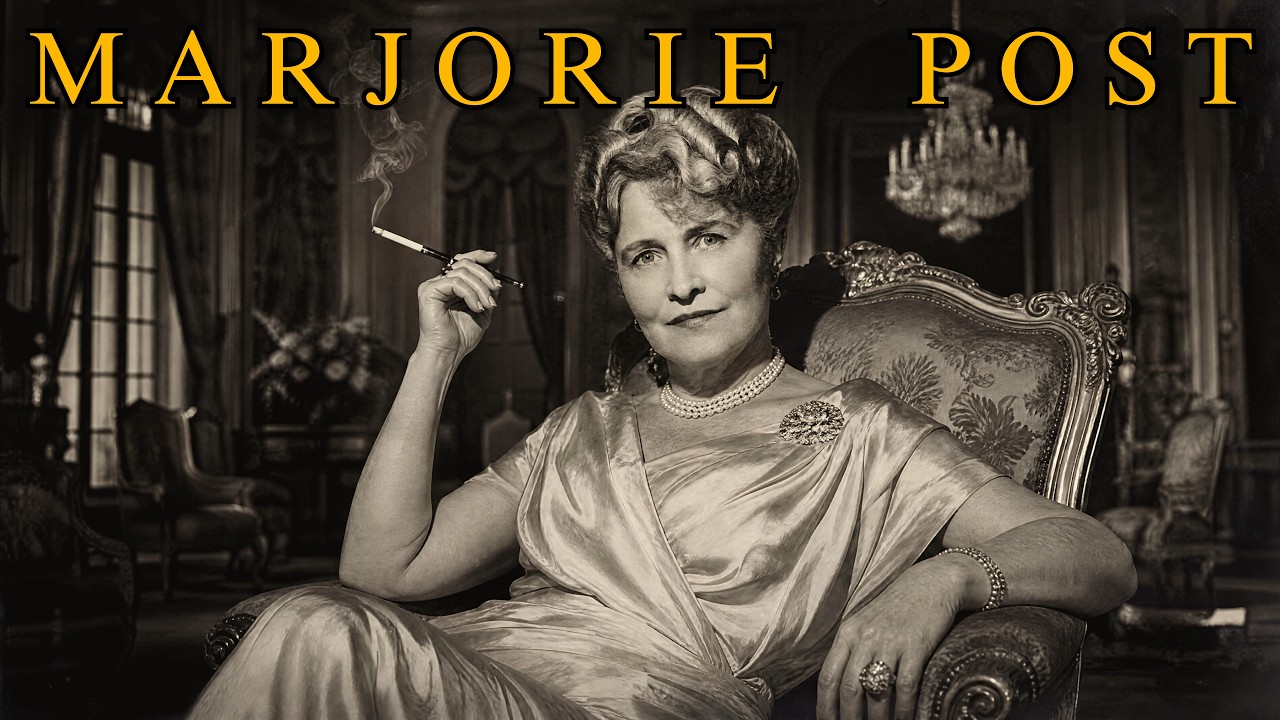
In 1914, a 27-year-old woman inherited a cereal fortune built by her father, who had taken his own life in Santa Barbara after months of unrelenting stomach pain. That woman, Marjorie Merriweather Post, went on to become the wealthiest woman in America, married four times, built the greatest private palace in the country, and died in 1973 alone at the center of it all. Born in Springfield, Illinois in 1887, Marjorie was the only child of Charles Post, a restless, gifted man who had failed at one venture after another before finding his calling in grain. The family moved to Battle Creek, Michigan, where Charles, suffering from chronic nervous collapses, sought treatment at the famous Kellogg sanitarium.
There, he developed a roasted grain drink and later the cereals Grape-Nuts and Post Toasties, building a fortune on aggressive advertising that promised cures for everything from indigestion to appendicitis. Within roughly a decade, the company was worth nearly $10 million. Marjorie was ten years old when she began sitting in on company board meetings. She worked in the plant, pasting labels onto jars and folding boxes in the barn where the first work was done.
Her father gave her stock worth millions by the time she was sixteen and taught her a discipline she kept for life: she would organize the grains of sand on a desert island, he once joked. It was a lesson that shaped her into a formidable businesswoman, but also one that left her unable to tolerate disorder in any form. Marjorie’s parents divorced in 1904 when she was seventeen. Her father remarried his young secretary, and her mother died a few years later.
Then, in the spring of 1914, Charles Post put a gun to his head and died, a man who had built an empire selling cures for stomach ailments and was ultimately broken by one. Marjorie inherited the company, worth around $20 million, making her the wealthiest woman in the United States. She fought her stepmother over control of the company and settled by paying her six million dollars to surrender her shares. Yet, despite owning the company outright, she was not permitted to sit on its board.
She was a woman, and the age’s customs held that a fortune of that size required a man to manage it. For 22 years, her interests inside her own company were represented by her husbands and trusted friends. This gap between what she owned and what she was allowed to control became the defining pressure of her life. Her first marriage, to Edward Close, a conventional lawyer from an old Connecticut family, ended in 1919.
While he served overseas in World War I, Marjorie discovered her own capabilities, equipping an entire military hospital in France, which grew to hold thousands of beds. When the first ship carrying supplies sank in New York Harbor, she simply sent the entire shipment again. She also joined a delegation of women who went to the White House to press the president on women’s suffrage. When her husband returned, she had outgrown him.
They divorced, and she kept their two daughters, Adelaide and Eleanor. Her second marriage, in 1920, was to Edward Hutton, a Wall Street financier who took over the company and helped turn it into a national giant. Together, they acquired brands such as Jell-O, Maxwell House, Baker’s chocolate, and Log Cabin syrup. In 1929, the Postum Company became General Foods, the largest food company in the United States, with Marjorie holding the controlling share.
One of the most important acquisitions was Marjorie’s own doing. Cruising off the coast of New England, she tasted a goose that had been frozen, thawed, and roasted, and was struck by how fresh it tasted. She traced it to an inventor named Clarence Birdseye, who had developed a method of flash-freezing food that preserved its texture and flavor. Her husband resisted the purchase for years, but Marjorie persisted.
In 1929, General Foods bought the Birdseye business for around $22 million, a move that remade the American kitchen and proved her judgment right for the rest of the century. During this marriage, she built Mar-a-Lago in Palm Beach, a house of 118 rooms and 58 bedrooms, completed in 1927. She told her husband she wanted a little cottage by the sea; what rose from the sand was a palace with gold-leafed ceilings, 36,000 antique Spanish tiles, and three boatloads of Italian limestone. It was the grandest private home in America, and it took 600 workers four years to build.
The marriage to Hutton ended in 1935 after she discovered he was having an affair with a maid in the household, which was inside the very palace she had built. To win a divorce under the law of the age, she needed hard proof of adultery. She laid silk threads across doorways, dusted talcum powder on floors, and placed bells to catch her husband in a lie. The betrayal was a blow to her pride from which, her biographer wrote, she never fully recovered.
But the divorce had one consequence: it finally gave her control of her own company. In April 1936, 22 years after inheriting it, Marjorie Post sat down at the board table of General Foods and spoke for the first time in her own voice for her own property. She held that seat for more than two decades, becoming a genuine working director who knew the business from the inside. Weeks after her divorce from Hutton, she married Joseph Davies, a prominent Washington lawyer.
Shortly after, President Roosevelt appointed him ambassador to the Soviet Union, and Marjorie found herself hosting formal dinners in Stalin’s Moscow at Spaso House. She was privately appalled by the police state she was living inside, even as her husband wrote a book defending Stalin and the show trials, a book Hollywood later turned into a film. It was in Moscow that she acquired the treasures that would define her collection. The Soviet regime, desperate for hard currency, was selling confiscated imperial Russian art to foreigners with dollars.
Marjorie bought icons, chalices, porcelain, and nearly 90 pieces by Carl Fabergé, the jeweler to the czars, along with two imperial eggs. She also acquired the diamond nuptial crown of Empress Alexandra, worn at her wedding to the last czar, who was later shot to death in a cellar with her husband and children. Marjorie carried all of it out of Russia, building the largest collection of Russian imperial art outside Russia itself. Her third marriage lasted 20 years, the longest of the four, and ended in 1955.
Davies had grown old, ill, and irritable, and Marjorie could not abide the decline of a failing body, a conviction rooted in her Christian Science faith, which held that the mind governs the body. She settled property on him as she left, a pattern that ran through all her divorces: she was the fortune, so she did the leaving and often gave generously to the men she left behind. At 71, three times divorced, she fell in love one final time. Herbert May, a charming, cultured business executive from Pittsburgh, was the poorest of her husbands.
She set up a trust to provide for him and married him in 1958. She told her granddaughter she was “walking on fluffy pink clouds. ” She took up square dancing at Mar-a-Lago, hosting evenings in the great hall, and became the delight of Palm Beach society. The marriage ended in 1964 after six years, when a set of photographs arrived on her desk.
They showed her husband at the pool at Mar-a-Lago with young men in poses that left nothing to be misunderstood. A blackmailer demanded money to keep them quiet. Marjorie later learned that everyone around her, including her own daughter Dina, had known or suspected the truth before the wedding. When Dina asked, “You mean you did not know?
” Marjorie was stunned, and asked in return, “You mean you did? ” It was the shortest and cruelest of her marriages. When May later suffered a stroke, Marjorie quietly paid his medical bills and gave him a place to live out his days. After the fourth divorce, she never married again.
In her later years, she went deaf. To greet guests properly, a butler would lean in and whisper each name to her as they arrived. She continued to host parties, call square dances, and run her household of nearly 300 staff with precision, but she was increasingly alone. Her butlers measured the distance between each plate with yardsticks.
She dressed for dinner as though a president might arrive at any moment. At the head of the longest private table in Palm Beach, she dined alone. A chairman of her own company once asked her, “Marjorie, you could run General Motors. You could run United States Steel.
You are the smartest woman I know. Why do you have so much trouble with husbands? ” She shrugged and said, “I honestly do not know. Ain’t it hell?
”
She died on September 12, 1973, at Hillwood, her estate in Washington, at age 86. She left Mar-a-Lago to the federal government to serve as a presidential retreat. The government accepted the gift, then returned it a few years later, judging it too expensive to maintain. In 1985, the palace was sold to a private buyer for a fraction of what it had cost to build.
Her estate, worth nearly $200 million, was distributed among her daughters and institutions. Hillwood, the house she had always meant to become a museum, remains open to the public today as the Hillwood Estate Museum and Gardens, holding the largest collection of Russian imperial art outside Russia, including the wedding crown of the murdered empress. Her jewels went to the Smithsonian, including a necklace once made for Napoleon’s wife and earrings said to have belonged to Marie Antoinette. The 70-building Adirondack camp she left to the state of New York, which sold it at auction in 1985 for around $911,000.
Her youngest daughter, Dina Merrill, became an actress in film and television, building a public career of her own. Her two other daughters married many times, more times between them than their mother ever did. Marjorie Merriweather Post is buried in the rose garden at Hillwood, beneath a stone urn. The motto carved beneath her coat of arms reads, in Latin, “All my hope rests in myself.
” She had organized the grains of sand, built an empire, raised a palace, and collected the treasures of a dead dynasty. The one thing she could never keep was a husband, a partner, an equal at the center of it all. The words on her tombstone were the plain truth of a life that taught her, marriage after marriage, that in the end there was no one to lean on but herself.